
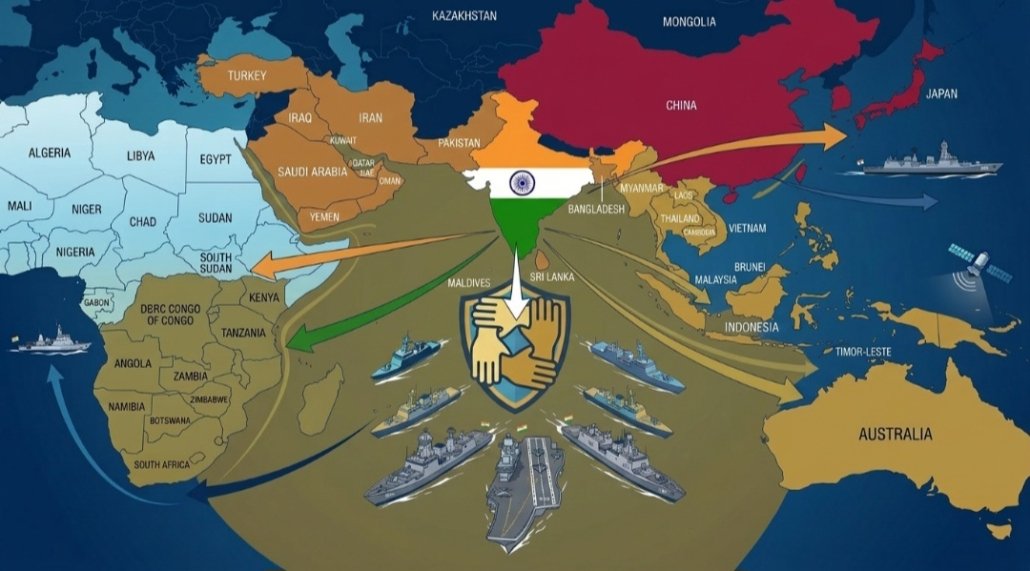
On 04 March 2026, a US submarine torpedoed and sank the Iranian frigate IRIS Dena about 40 nautical miles off Sri Lanka.[1] Sri Lankan authorities recovered the remains of 87 individuals and rescued 32 survivors.[2] US Defence Secretary Pete Hegseth hailed the strike as a “quiet death” for the vessel.[3] The attack — far from Persian Gulf waters — marked a geographic widening of hostilities and quickly revived debates about the strategic balance in the Indian Ocean and the role of India as the region’s largest resident power.
As Dr James Holmes, JC Wylie Chair of Maritime Strategy at the US Naval War College, observes, this “quiet death” off the coast of Sri Lanka marks a radical geographical escalation that challenges the long-dormant “Indian Monroe Doctrine.”[4] The phrase is, of course, a striking one but also reflects a persistent misunderstanding. India has never articulated any Monroe-style claim to exclusive control over the Indian Ocean. New Delhi’s approach is better understood through partnership, collective security, and regional stability rather than exclusionary doctrines. Indian political leadership has repeatedly emphasised that the Indian Ocean is a shared maritime space in which no country, including India, should seek to dominate others through sheer power. The idea that India maintains a Monroe Doctrine in the Indian Ocean is therefore largely an external projection rather than an Indian policy.
India’s maritime policy has long been collaborative and cooperative. In 2015, during his visit to Mauritius, Prime Minister Narendra Modi articulated India’s statement of policy, encapsulating it in the acronym SAGAR (Security and Growth for All in the Region).[5] This acronym became the guiding framework for India’s engagement with its maritime neighbourhood. SAGAR emphasised combined exercises, intelligence sharing, disaster response, maritime situational/domain awareness, capacity-building and capability-enhancement with littoral States. The approach reflected a simple premise that the security of the Indian Ocean cannot be ensured by any single power acting alone.
Over the past decade, this maritime policy has been translated into practical cooperation particularly across the western segment of the Indo-Pacific region, namely, the Indian Ocean. India has supplied offshore patrol vessels (OPVs) to countries such as Sri Lanka, Mauritius, Seychelles and the Maldives.[6] It conducts coordinated patrols with several littoral navies, including those of Indonesia,[7] Thailand,[8] Myanmar,[9] and even France.[10] Indian naval hydrographic teams have surveyed ports and coastlines across the Indian Ocean, helping smaller States improve maritime navigation and safety. The Indian Navy’s Information Fusion Centre for the Indian Ocean Region (IFC-IOR), which is located in Gurugram, now hosts 15 Liaison officers and shares maritime traffic data with more than 65 international working-level linkages with national and multi-national/maritime security centres, strengthening collective awareness.[11]
India’s leadership has consistently framed these activities in cooperative terms. On the tenth anniversary of SAGAR, the Raksha Mantri (Defence Minister) Rajnath Singh remarked that the deployment of what was termed an “Indian Ocean Ship” (IOS) symbolised India’s “commitment to peace, prosperity and collective security” in the region.[12] He emphasised that India’s Navy would ensure that “no nation suppresses another” through overwhelming power and that every country’s interests would be safeguarded “without compromising their sovereignty.[13]” The language was deliberate. India’s policy is not about dominance but about maintaining equilibrium in its strategic geography vis-à-vis Indo-Pacific.
Last year, in 2025, India broadened this framework further. During a visit to Mauritius, Prime Minister Modi announced the evolution of India’s maritime policy from SAGAR to MAHASAGAR (Mutual and Holistic Advancement for Security and Growth Across Regions).[14] This evolution reflects India’s enhanced maritime engagement — beyond the immediate Indian Ocean and the western Pacific — to encompass the wider Indo-Pacific and the Global South. India’s External Affairs Minister S Jaishankar informed Parliament that MAHASAGAR reflected a wider agenda combining security cooperation with economic connectivity, sustainable development, and technology partnership.[15] This evolution from the maritime policy of SAGAR to a broader one encapsulated by the acronym MAHASAGAR is a clear indicator of India’s thinking. Rather than narrowing its strategic outlook, New Delhi is widening its network of partnerships. Maritime security is increasingly tied to economic resilience, climate challenges, and technological cooperation. In this sense, MAHASAGAR reflects the Indian belief that regional maritime stability cannot be separated from broader global dynamics.
Above all, India’s approach rests on consensually-derived international law. New Delhi has consistently emphasised the centrality of the United Nations Convention on the Law of the Sea and the broader principles of a rules-based order. Freedom of Navigation, unimpeded commerce and respect for sovereignty are repeatedly cited in official statements. India’s Defence Minister, Mr Rajnath Singh, has explicitly listed “free navigation, rules-based order, [and] securing peace and stability in the Indian Ocean” as core objectives of the Indian Navy.[16]
These principles are essential for India because the oceans are very significant determinants of India’s economic progress. Some 95 per cent of India’s trade by volume and around 70% by value moves over the ocean.[17] The energy lifelines that sustain the Indian economy also pass through these waters. Before reaching the wider Indian Ocean, ships carrying cargoes of crude oil and liquified natural gas (LNG) from terminals in the Persian Gulf must necessarily traverse the narrow chokepoint of the Strait of Hormuz. Likewise, these types of ships heading for Indian ports from terminals in Europe and the Americas must negotiate the even narrower Strait of Bab-el-Mandeb. Disruptions anywhere along these routes have direct and severely adverse consequences for India’s economy as well as for those of other Indo-Pacific destinations in South Korea, Japan, and China. Maintaining open and secure international shipping lanes (ISLs) is, therefore, a shared interest rather than a unilateral ambition.
India’s maritime policy also draws on a longer diplomatic tradition. During the Cold War, India backed Sri Lanka’s proposal to declare the Indian Ocean as a Zone of Peace. At the 1964 Non-Alignment Summit, Sri Lankan Prime Minister Bandaranaike called for the Indian Ocean to be free of military bases and weapons and India strongly endorsed this initiative.[18] The proposal eventually (in 1971) led to UN General Assembly Resolution 2832, declaring the Indian Ocean a “zone of peace.”[19] The concept envisaged the ocean as an “arc of peace” where littoral States would prevent external rivalries from destabilising the region.
Although the resolution never fully materialised in practice, it remains an important marker of India’s historical position. The objective was not to replace one dominant power with another but to prevent the Indian Ocean from becoming an arena for great-power rivalry. That principle continues to influence India’s diplomatic language today.
The contemporary Indian Ocean is, however, far more complex than the Cold War era vision of a demilitarised zone. Multiple extra-regional powers now maintain a significant presence across the region. The United States operates naval facilities at Diego Garcia and maintains a substantial naval presence. China has established a military logistics facility in Djibouti and has expanded port investments from Gwadar to Hambantota. (These sorts of locations, which enable logistic support and also facilitate significant intelligence, surveillance, and reconnaissance [ISR] capacity, are frequently referred-to as “Strategic Strong Points”). France retains naval forces in Réunion and has multiple exclusive economic zones, including across the southwest Indian Ocean. The United Kingdom also sustains a presence, albeit through joint arrangements with the United States.
Indian officials acknowledge this reality. Speaking at the 2026 Raisina Dialogue, Dr S Jaishankar, India’s Minister for External Affairs (EAM) noted that the Indian Ocean already hosts several major powers and strategic facilities. The task, he argued, is not to deny this pluralistic environment but to manage it in a stable and rules-based manner.[20] India’s objective is therefore not exclusion but balance.
The events surrounding the sinking of IRIS Dena illustrate this approach. India did not treat the incident as a challenge to any imagined sphere of influence. Instead, its response focused on humanitarian and diplomatic considerations. Indian authorities permitted an Iranian vessel to dock in Kochi for repairs and assistance, prioritising safety and de-escalation. Jaishankar later remarked that the decision was taken “from the point of view of humanity.” The emphasis was on preventing further instability rather than asserting control.[21]
This pattern is consistent with India’s broader regional engagement. Through the Indian Ocean Rim Association, India works with twenty-three member States on issues ranging from maritime safety to disaster risk reduction, information-sharing and the blue economy. The organisation itself reflects the cooperative ethos that India prefers to promote. Rather than building exclusive security blocs, New Delhi has generally favoured inclusive platforms where both large and small States participate.
The Indian Navy also spends a significant share of its operational effort on non-traditional security missions. Anti-piracy patrols in the Gulf of Aden have continued for over a decade. The navy has evacuated civilians during crises in Yemen and Sudan, delivered humanitarian assistance after cyclones in Myanmar, Mozambique and Madagascar, and provided relief supplies after natural disasters across the region. These missions rarely draw headlines, but they illustrate the kind of role India seeks to play.
All of this underscores a broader point. The Indian Ocean is simply too interconnected for any single nation to dominate it in the manner suggested by the Monroe Doctrine analogy. The American doctrine emerged in a nineteenth-century context, when geography and naval power allowed the United States to exclude European influence from the Western hemisphere. The Indian Ocean today is an open and extremely busy maritime highway linking Africa, West Asia, South Asia and Southeast Asia. Multiple powers have legitimate interests there, and the region’s stability depends on cooperation rather than exclusion.
India’s own political system reinforces this outlook. As a large democracy with extensive coastlines and a dense network of trade relations, India cannot pursue isolationist or unilateral strategies that might provoke confrontation with its neighbours. Stability in the maritime domain directly affects the prosperity of its coastal states and the functioning of its ports. Consequently, New Delhi has invested more in diplomatic engagement and institutional cooperation than in attempts to enforce a rigid strategic perimeter.
Seen in this light, the phrase “Indian Monroe Doctrine” misrepresents India’s strategic thinking. The sinking of IRIS Dena may have indeed signalled a troubling widening of geopolitical tensions in the Indian Ocean. But India’s reaction so far has followed a familiar pattern: urging restraint, emphasising international law and engaging partners across the region. Rather than claiming exclusive authority over the ocean, India continues to frame the Indian Ocean as a shared space whose stability depends on collective responsibility.
The real challenge for the region is not the emergence of an Indian Monroe Doctrine. It is the growing risk that rivalries among external powers could turn the Indian Ocean into another theatre of great-power competition. India’s strategy, imperfect though it may be, seeks to prevent precisely that outcome.
*******
About the Author:
Mr Suraj Palavalsa is a Junior Research Associate at the National Maritime Foundation. He holds an MA in International Relations (South Asian Studies) from Pondicherry University, Puducherry. He earned his Bachelor’s Degree in Sociology, History, Political Science and Economics (Ancillary) from the Banaras Hindu University (BHU). His current research focuses on matters pertaining to reviving India’s maritime consciousness through an interdisciplinary approach. He can be reached at emc1.nmf@gmail.com.
Endnotes:
[1] Meera Srinivasan, “Torpedo Attack by US Submarine Sinks Iranian Frigate off Sri Lanka,” The Hindu, 05 Mar 2026, https://www.thehindu.com/news/international/strike-on-iranian-warship-off-sri-lanka-us-israel-iran-war/article70703655.ece
[2] Udita Jayasinghe, Idrees Ali, and Phil Stewart, “US Sub Sinks Iranian warship off Sri Lanka, Killing 87 and Expanding War Zone,” Reuters, 04 Mar 2026, https://www.reuters.com/world/asia-pacific/sri-lanka-rescues-30-people-board-distressed-iranian-ship-foreign-minister-says-2026-03-04/
[3] Apoorva Misra, “’Quiet Death’ in the Indian Ocean: How America’s Lethal Mark-48 Torpedo Sank an Iranian Warship,” News 18, 05 Mar 2026, https://www.news18.com/explainers/quiet-death-in-the-indian-ocean-how-americas-lethal-mark-48-torpedo-sank-an-iranian-warship-ws-l-9943357.html
[4] James Holmes, “‘Quiet Death’: A U.S. Navy Nuclear Attack Submarine Sinks Iranian Warship and the World Took Notice,” 19FortyFive, 05 Mar 2026, https://www.19fortyfive.com/2026/03/quiet-death-a-u-s-navy-nuclear-attack-submarine-sinks-iranian-warship-and-the-world-took-notice/
[5] “English translation of Press Statement by Prime Minister during the India-Mauritius Joint Press Statement,” Ministry of External Affairs (MEA), Government of India (GoI), 12 Mar 2015.
[6] “Prime Minister’s Remarks at the Commissioning of Offshore Patrol Vessel (OPV) Barracuda in Mauritius,” MEA, GoI, 21 Mar 2015, https://www.mea.gov.in/Speeches-Statements.htm?dtl/24912/Prime_Ministers_Remarks_at_the_Commissioning_of_Offshore_Patrol_Vessel_OPV_Barracuda_in_Mauritius_March_12_2015.
[7] “38th India-Indonesia Coordinated Patrol Begins in Andaman Sea and Straits of Malacca,” PIB, GoI, 13 Jun 2022, https://www.pib.gov.in/PressReleaseIframePage.aspx?PRID=1833613®=3&lang=2.
[8] “Indo-Thai Coordinated Patrol (CORPAT),” PIB, GoI, 09 Jun 2021, https://www.pib.gov.in/PressReleasePage.aspx?PRID=1725559®=3&lang=2
[9] “8th Indo – Myanmar Coordinated Patrol,” PIB, GoI, 21 May 2019, https://www.pib.gov.in/Pressreleaseshare.aspx?PRID=1572293®=3&lang=2
[10] Dinakar Peri, “In a First, India, France Conduct Joint Patrols from Reunion Island,” The Hindu, 21 Mar 2020, https://www.thehindu.com/news/international/in-a-first-india-france-conduct-joint-patrols-from-reunion-island/article31129323.ece
[11] “About Us”, Information Fusion Centre – Indian Ocean Region (IFC-IOR) website, https://ifcior.indiannavy.gov.in/about_us
[12] “Raksha Mantri Flags-off INS Sunayna as Indian Ocean Ship SAGAR from Karwar with 44 Personnel of Nine Friendly Nations of the Indian Ocean Region,” Press Information Bureau (PIB), GoI, 05 Apr 2025, https://www.pib.gov.in/PressReleseDetailm.aspx?
[13] Ibid
[14] “Press Statement by Prime Minister during the India-Mauritius Joint Press Statement,” Ministry of External Affairs (MEA), GoI, 12 Mar 2025, https://www.mea.gov.in/Speeches-Statements.htm dtl/39157/English_translation_of_Press_Statement_by_Prime_Minister_during_the_India__Mauritius_Joint_Press_Statement_March_12_2025
[15] Rushali Saha, “MAHASAGAR: India’s Global Maritime Vision Explained — and Where Does Australia Fit,” United States Studies Centre, 13 Feb 2026, https://www.ussc.edu.au/mahasagar-indias-global-maritime-vision-explained-and-where-does-australia-fit
[16] Raksha Mantri flags off INS Sunayna as Indian Ocean Ship SAGAR from Karwar with 44 personnel of nine friendly nations of the Indian Ocean Region,” PIB, GoI, 05 Apr 2025
[17] Government of India, Press Information Bureau, “Maritime India, From Vision 2030 to Amrit Kaal 2047”, 26 October 2025. https://www.pib.gov.in/PressReleasePage.aspx?PRID=2182563®=3&lang=2
[18] Ryan A Musto, “India’s Cold War Push for an Indian Ocean Zone of Peace”, Freeman Spogli Institute for International Studies, Stanford University, 03 Dec 2020, https://fsi.stanford.edu/news/india%E2%80%99s-cold-war-push-indian-ocean-zone-peace#:~:text
[19] “Declaration of the Indian Ocean as a Zone of Peace,” Digital Library, United Nations, 1972, https://digitallibrary.un.org/record/192075?v=pdf
[20] “S Jaishankar Says Iran Ship Allowed to Dock in Kochi on ‘Humane’ Grounds,” The Wire, 07 Mar 2026, https://m.thewire.in/article/diplomacy/jaishankar-says-iran-ship-allowed-to-dock-in-kochi-on-humane-grounds/amp?utm=relatedarticles
[21] Samiran Mishra, “After Iranian Ship Sunk By US, S Jaishankar Explains Reality Of Indian Ocean,” NDTV, 07 Mar 2026, https://www.ndtv.com/india-news/iris-dena-iran-israel-war-indian-ocean-caught-on-wrong-side-of-events-s-jaishankar-on-iranian-ship-sunk-by-us-11181112


Leave a Reply
Want to join the discussion?Feel free to contribute!