
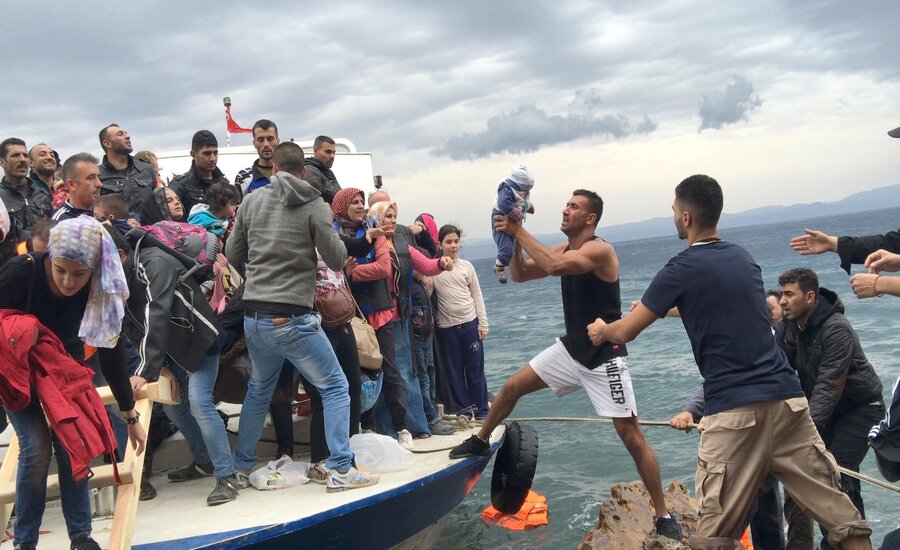
 Image Credit- Human Rights Watch
Globally, the refugee crisis in Europe has drawn international concern. The movement of hundreds of thousands of people from their conflict-torn homelands in Asia and Africa towards a perceivably safer Europe saw the unfolding of the largest refugee crisis experienced by Europe since the Second World War. With prolonged and protracted conflict in Europe‟s neighbouring regions – Syria, Afghanistan, Iran, and dictatorial oppression in Eritrea, thousands of people were compelled to flee their homelands in search of safe and secure environment for living.
These fleeing people were being widely termed „migrants‟ by media and governments, until the United Nations High Commissioner for Refugees (UNHCR) released reports stating that an overwhelming majority of those risking their lives to cross the seas are genuinely fleeing conflict and persecution in their homelands, and have the right to seek international protection under the 1951 Convention Relating to the Status of Refugees, the authoritative international document that determines the status of refugees.1
Due to the lack of legal avenues to seek asylum, these people are compelled to migrate illegally, risking their lives onboard in unseaworthy vessels. Most of the time, the vessels are overloaded, much beyond their capacity. Compared to land and air, the sea is an “anarchic domain,”2 and becomes a gateway for illegal migration. In order to avoid getting caught, smugglers take riskier routes. These conditions have led to the capsizing of many vessels and loss of lives.The sea becomes the key medium to Europe for asylum seekers. According to the International Organization for Migration (IOM), about half a million people have crossed the Mediterranean Sea in 2015, and many more are expected to follow suit.3
Consequently, the number of deaths at sea has also increased – from 3500 in 2014 to more than 2500 deaths in the first half of 2015 itself.4.
The refugee crisis has tested the new maritime strategy of the EU, released in 2014, and also led to a reassessment of EU‟s policies towards refugees. This paper focuses on the maritime dimension of the crisis and analyses EU‟s response.
The Naval Response
Although migrants have long been reaching European shores illegally using sea routes, the issue, however, caught global attention only in 2015, due to the scale of the crisis, and the number of deaths. Two shipwrecks of migrant vessels from Libya that occurred in the Mediterranean Sea near the Italian island of Lempadusa in October 2013 was the first such case, in the recent past that caught public attention. Several hundreds were rescued by the Italian coast guard; nevertheless, many others lost their lives at sea. This incident sensitised the Italian government to migrant deaths at sea, inducing the air and naval rescue operation, Mare Nostrum.5 The operation saved many lives at sea, and ensured the safe arrival of migrants to Europe. However, the operation was expensive, resource-consuming and politically unpopular, and it also lacked support from the European Union and other states.
After a year of its operation, it was replaced by a smaller force by European Agency for the Management of Operational Cooperation at the External Borders of the Member States of the European Union (FRONTEX) from the EU. This was decided on the basis of the belief that rescuing migrant boats encourages more people to attempt crossing the Mediterranean. However, this did not prove to be an effective deterrent for migrants; in fact, a smaller force resulted in a visible increase in the number of deaths at the Mediterranean Sea. For the migrants, taking a life- risking chance on unseaworthy smuggler vessels was no less than the insecurity and instability due to protracted conflicts in their homelands that they were leaving behind.
The biggest, most notable incident occurred in April 2015 off the coast of Libya, when a migrant vessel capsized, causing approximately 800 deaths, which is the largest since the Second World War. This shipwreck jolted EU into realising that a grave humanitarian crisis was unfolding at its own shores. Europe‟s apathy to the crisis till then was highly ironical for a continent priding itself on upholding human rights and human dignity.
The April 2015 accident jolted the EU into action, which culminated into a major decision by the EU to launch the operation- EU NAVFOR Mediterranean in the Southern Central Mediterranean to prevent further loss of life at sea. This operation has been rechristened as Operation Sophia, after the name given to the baby born to a rescued mother on the ship engaged in this operation. This operation is intended to disrupt the network and practices of growing human smuggling and trafficking in the Mediterranean.
There are a number of hazards in sea travel for the refugees. They are transported illegally by human smugglers, who take riskier routes to evade state authorities. The safety and security of the migrants is compromised. Many vessels are not equipped with infrastructure to be prepared for the challenges and threats at sea. Sometimes, passengers, including children, do not even have basic necessities such as life jackets. Recently, the image of the dead body of a three-year-old Syrian boy, Aylan Kurdi, washed ashore went viral in social media, directing attention to human smuggling via sea and evoking global outrage over the lack of effective and urgent action taken by governments.
The work of smugglers is unmistakably illegal, and they do not provide adequate safety measures at sea, but their services are taken as the last possible option by asylum seekers to escape conflict and persecution, even facing human rights violations, and great risk to personal life and property in the process.
By focusing primarily on targeting smuggling networks, the EU is only disrupting a medium, not the root cause. As is evident in the recent past, migrants and refugees were willing to take enormous risks even playing with their families‟ lives to reach safety. They seem to be very resilient in their determination and are willing to cross dangerous and deadly sea and land routes to flee from conflict to safety. This is not an effective long-term approach to end this crisis. Deployment of resources should rather be focused on maritime Search and Rescue (SAR) instead, to minimize loss of life at sea and facilitate legal avenues for entering so that migrants and refugees do not have to resort to the services of smuggler networks. Consequently, this will reduce, if not eliminate the need for refugees to opt for smuggler vessels. As a result, smuggling networks will not survive, with the lack of demand.
Despite a security-oriented approach by the EU in the Mediterranean, various non-governmental agencies are working hard to prevent loss of life at sea. Apart from the most notable work by UNHCR, which has set up registration centres, and facilitates the legal processes and applications for asylum seekers, humanitarian agencies like Médecins Sans Frontières (MSF) have deployed rescue boats to provide medical aid, food and water, etc. to vessels in distress. The Migrant Offshore Aid Station (MOAS), which was established in the aftermath of the Lempadusa accidents in 2013, is working diligently by patrolling frequent migrant routes, and providing aid. These agencies are coordinating with state authorities to minimize duplication of effort and are sharing resources. These organizations, along with notable media agencies such as the BBC also play a crucial role in updating the world via twitter and press releases, as information regarding developments at sea is not as immediately and widely accessible to the public as newsworthy events on land.
The Political Dimension
Although many states such as Lebanon, Turkey and Pakistan have hosted large numbers of refugees that are challenging their national capacities and even altering internal demographics, the EU humanitarian crisis is gaining more global attention as it is occurring in the richest continent of the world, and is widely perceived to be the safest.
At the same time, the surge of refugees has compelled observers to look at sources of the problem. Protracted conflict and the terror of Islamic state in Syria and absolutist dictatorship in Eritrea make strong cases to protect those fleeing these regimes. Furthermore, it re-sensitised the world to relook and resolve the oppression in these states. The EU is pumping in nearly 4 billion Euros for “humanitarian, development, economic and stabilisation assistance to Syrians in their country and to refugees and their host communities in neighbouring Lebanon, Jordan, Iraq, Turkey and Egypt.”6
As conflicts from the neighbouring regions are spilling over to its shores, Europe can no longer relegate conflicts to the background. The refugee crisis disrupts what Basil Germond describes as Europe‟s two-pronged geo-strategy: on the one hand, promoting European values and ideas in zones of influences beyond its borders, and on the other, fortifying Europe from outsiders, creating a zone of immunity from global conflicts.7
As the world looks to Europe for leadership and critical decision making in a crisis which compromises the state and the region‟s security and at the same time, is humanitarian in nature, Europe is walking thin rope between upholding its humanitarian obligations to refugees to preventing loss of life at sea, as also protecting its maritime frontiers.
The refugee crisis has been a crucial test for the solidarity of the EU as a regional and a supra-national organization. Fortunately for the migrants, the EU is accepting incoming refugees, and not closing their doors, despite opposition from some member states. By disrupting this stability, the refugee crisis has also raised the question of borders, and border security. While a majority of states and even more people welcome refugees, some states such as the UK, Denmark, Austria, Hungary, and Slovakia are reluctant to accept refugees. Some governments such as those of Austria and the UK have even built fences across their borders. Even though France had an open door policy for refugees, French President François Hollande ordered closing French borders after the recent terror attacks in Paris. The attack, in fact, reflects the terror and insecurity that the refugees are fleeing from,8 and reiterates the need to provide international protection from the oppression of extremist actors.
According to some analysts, there have also been murmurs of revoking the Schengen area in the face of this crisis.9 While the EU President Juncker has negated this, the possibility of revoking the Schengen agreement would be a potential step back in one of the most monumental achievements of the EU as a regional organization in creating regional trust and mobility.
The crisis also evoked the re-evaluation of European policies on asylum seekers. The Common European Asylum System is not proving to be effective.
Additionally, the Dublin Regulation that presently guides the European asylum system has also come under severe criticism. According to this regulation, asylum seekers have to register and process their applications in the state in which they first landed on European shores. While this was done to avoid replication of asylum applications, it, however, puts the states located in the periphery of Europe at a major disadvantage. Particularly in this crisis, Italy and Greece are currently hosting respectively 115,000 and 213,000 asylum seekers at present.10 By restricting their mobility and ability to apply for applications in other states, the time taken to process applications will be at least months, if not years. That can potentially strain the respective state‟s resources as well as inhibit the asylum seekers‟ ability to work, be independent, and mobile. A central database system that enables information sharing on asylum seeker applications across member states can overcome this limitation.
The problem of illegal migration by the sea route is neither a new phenomenon, nor is it endemic to Europe; but the scale of the crisis and the geo- political area within which it is unfolding is critical. Conflict remains a critical push factor, and lack of legal avenues further the risks taken by migrants. Further, states like Malaysia and Australia, which are attractive destinations for illegal immigrants via sea, can draw from Europe‟s experience to formulate more informed policies and responses. It must be noted that illegal migration via sea is a transnational phenomenon, and therefore, response at the regional level is more balanced than a national strategy, which may predictably look primarily at the state‟s core national interests, with international humanitarian obligations on the side-lines. Secondly, as the area of surveillance and SAR increases at the regional level, understanding patterns and analyses can be more comprehensive in reaching at an effective solution.
At the same time, it may be unrealistic to expect a Europe-like level of regional integration and cohesiveness anywhere else in the world. But as EU President Jean Claude Juncker, in his State of the Union speech in September, gave the example of Europe‟s past of “war and political persecution” during the two World Wars, and the incredible number of refugees that resulted in, and looking at Europe‟s cohesiveness as a region now, regional cooperation foregoing narrow national identities, is not a wild stretch of imagination. He also took pride in Europe being a beacon of hope for those torn by conflict, when historically Europe has had the most intense military conflict within. Therefore, a move from regional conflict to co-operation, particularly for common challenges such as illegal migration at sea, can potentially be a feasible option. Also, bilateral, multilateral, regional co-operation can even eradicate illegal migration by the sea route for states where the asylum seekers originate from within the region.
At the same time, Europe should not be the yardstick for success and there are good examples even beyond Europe. For instance, the 1969 African Refugee Convention11 has an even more liberal approach to protection than the 1951 UN Refugee Convention, where the scope of the definition of a refugee is widened, and there is a tilt towards greater collective responsibility to provide shelter. Moreover, the various imperfections in the European response should be kept in mind while learning lessons from it. Internal disagreements within the EU states has not only proven to affect the efficacy of decisions taken by the EU, but also brought into question the success of the EU as a supra-national regional organization. The migrant crisis has been a tough test for the implementation, direction and the effectiveness of the EU Maritime Security Strategy (MSS). The subsequent EU naval operation EU NAVFOR Med Sophia has an increasingly militaristic tilt, rather than providing the very essential SAR in the Mediterranean, which is the need of the hour.
The migrant crisis brings out the vulnerability at sea that both migrants as well as states face. This reiterates the indispensability of maritime preparedness and the vitality of maritime domain awareness for better national and human safety.
About the Author
Abhiruchi Chatterjee is a Research Associate at National Maritime Foundation (NMF), New Delhi. The views expressed are her own and do not reflect the official policy or position of the NMF. She can bereached at chatterjee.abhiruchi@gmail.com
1 Statement by UN High Commissioner for Refugees, António Guterres on refugee crisis in Europe, 2015. UNHCR [Online] See link: http://www.unhcr.org/55e9459f6.html [Last accessed: 20 Oct 2015]
2 Anne Korin, and Gal Luft, 2004. Terrorism Goes to Sea. Council on Foreign Relations. Originally published on Foreign
Affairs [Online] See link: http://www.cfr.org/world/terrorism-goes-sea/p7545 [Last accessed: 20 Oct 2015]
3 International Organization for Migration, 2015. [Online] See link: http://www.iom.int/news/half-million-migrants-cross- mediterranean-while-almost-3000-die-so-far-2015 [Last accessed: 20 Oct 2015]
4 UNHCR, 2015. [Online] See link: http://www.unhcr.org/55e9459f6.html [Last accessed: 20 Oct 2015]
5 Mare Nostrum Operation, For further information, see link:
http://www.marina.difesa.it/EN/operations/Pagine/MareNostrum.aspx [Last accessed: 20 Oct 2015]
6 Jean-Claude Juncker, 2015. State of the Union 2015: Time for Honesty, Unity and Solidarity. European Commission. [Online] See link: http://europa.eu/rapid/press-release_SPEECH-15-5614_en.htm [Last accessed: 20 Oct 2015]
7 Basil Germond, 2015. The Maritime Dimension of European Security: Seapower and the European Union. London: Palgrave Macmillan.
8 The analysis draws from various social media, particularly Twitter posts in the aftermath of the attacks. For further information, see links: https://twitter.com/RFCdan/status/665302723592519680,
https://twitter.com/KenRoth/status/666177796679536640 [Last accessed: 15 Nov 2015]
9 The Economist, 2015. Why the Schengen agreement might be under threat. [Online] See link:
10 Jean-Claude Juncker, 2015. State of the Union 2015: Time for Honesty, Unity and Solidarity., n.6
11 Convention Governing the Specific Aspects of Refugee Problems in Africa, 1969. [Online] See link: http://www.au.int/en/sites/default/files/Convention_En_Refugee_Problems_in_Africa_AddisAbaba_10September1969_0.pd f [Last accessed: 20 Oct 2015]

 Image Credit- Politics Now
  Image Credit - The National Interest
 Image Credit- The New Indian Express
 Image credits - The South china Sea
Leave a Reply
Want to join the discussion?Feel free to contribute!