

Damage to ‘critical’ underwater infrastructure (CUI) especially submarine communication cables continues to make headlines in 2026. With six ‘outages’ of cable systems again in the Baltic Sea within the span of a week from December 2025 to January 2026, the narrative of ‘sabotage’ of underwater infrastructure has neither lost focus nor steam.[1] Significant efforts are being made globally — both at national and international levels — to develop measures to create deterrence and enhance resilience of CUI. The three ‘hotspots’ for cable damage incidents over the past five years have been the Baltic Sea, the Red Sea, and the Taiwan Strait. Of these three locations, the Baltic Sea and the Taiwan Strait have aroused the strongest suspicions of sabotage given the geopolitical context within which these incidents have occurred (the Russia-Ukraine conflict and Chinese ambitions over Taiwan respectively) and the frequency with which such infrastructure has been disrupted. Between 2019 and 2023, Taiwanese authorities have reported thirty-six (36) cases of undersea cables being damaged “by external forces”.[2] Taiwanese scholars have classified such actions as one of China’s “illegal, coercive, aggressive, and deceptive” (ICAD) activities — an acronym more commonly used within Southeast Asian nations in lieu of “grey-zone” tactics — to exert low-intensity yet persistent “hostilities” to test Taiwan’s resilience.[3] That is not to say instances of damage in the Red Sea or the frequent disruption of submarine cables connecting Vietnam have not created cause for concern.[4] Measures taken at the national, regional, and global level to better safeguard such infrastructure span military, technological, cooperative, economic and legal initiatives.
This article focuses on the legal measures being undertaken with the aim of tracking the development of recent trends in national and international law to safeguard underwater infrastructure. It seeks to inform the Government of India (the Ministry of Communications, the Ministry of External Affairs, and the National Security Council Secretariat) of emerging positions on the adaptation or application of existing international law to instances of critical infrastructure damage. This may assist the Government of India in developing internal positions on the approach it deems fit and seeks to advocate at international forums such as the International Advisory Body for Submarine Cable Resilience. The article also seeks to compare and contrast two recent cases involving suspected cable sabotage in Finland and Taiwan, namely the Eagle S case and the Hong Tai 58 case, respectively, with the former leading to an acquittal and the latter to conviction and sentencing. Particular focus will be on the application of law and the factors that were considered while determining guilt. The aim is to distil those factors that lead to a successful conviction and incorporate such changes within India’s own domestic law. This article also seeks to inform officers of the Indian Coast Guard and the Indian Navy of the particular elements of the offence that are taken into consideration during prosecution for determination of guilt. Since they are the agencies that will conduct operations at sea and may be responsible for collecting crucial evidence to aid prosecution, identifying factors that prove elements of the offence becomes necessary.
The Importance of a ‘Legal Start and Finish’
We see a concerted effort, especially in Europe, to deploy coordinated military presence and to bolster technological measures that would enhance maritime situational awareness and response mechanisms. NATO, for instance, has established the NATO Maritime Centre for the Security of Critical Undersea Infrastructure (NMCSCUI) as an ‘information-sharing’, ‘coordination’, and ‘decision-making’ tool to support military response.[5] Positioned as an operational hub involving NATO Allies, partner-countries, and even the private sector operators of critical infrastructure, the aim of this centre is to “deny any aggressor the cover of “plausible deniability”.[6] As has often been discussed, attribution remains the biggest challenge in holding actors liable for damage and consequently deterring future instances. As per Professor James Bergeron, “they will be spotted, the cameras will be snapping, the underwater sensors will be monitoring and there will be a signals trail of liability, so that they’re not going to be able to deny their actions and will ultimately be held liable”.[7] This process is being optimised by implementing artificial intelligence and machine learning algorithms for swifter information processing and pattern recognition. Given the sheer amount of maritime traffic traversing the seas daily, “sense-making” of the data points being collected to translate them into actionable information is mammoth challenge that technological tools are trying to overcome. The “Mainsail” platform co-developed by the NMCSCUI, which provides “Seabed-to-Space Situational Awareness for NATO and NATO Allies” processes a vast amount of data from distinct sources such as satellite imagery, sonar systems, and underwater sensors.[8] This data is then fused to provide a near real-time picture that can improve threat assessments and coordination in response. The NMCSCUI is further integrated with Op BALTIC SENTRY — launched in January 2025 and executed by the Allied Command Operations as a multi-domain deployment involving frigates, underwater autonomous vessels and maritime patrol aircrafts to deter future attacks on critical underwater infrastructure — to translate information into action at sea.[9] While these interventions exist at the operational level, strategic coordination is undertaken by NATO’s “Critical Undersea Infrastructure Coordination Cell”, involving the military and civilian actors across the public and private.[10] In addition, there is a “EU-NATO Task Force on Resilience of Critical Infrastructure”.[11] The European Investment Bank has also recently granted a €25 million venture debt facility to a Dutch company for advanced fibre-optic sensing technology as an additional source of data to identify threats underwater.[12] Given the frequency and severity of impact of underwater infrastructure damage incidents, it is only natural that Europe, through the EU and NATO, is investing heavily in the protection of underwater infrastructure.
Yet, in October 2025, prosecution against the Cook Island-flagged tanker Eagle S for damaging the EstLink 2 electricity cable and three telecom cables failed in the Helsinki District Court.[13] Not only were the Captain, and the First and Second Officers of the vessel acquitted, but the State had to bear the legal costs of the defence to the tune of EUR 180,000. While the reasoning of the Court shall be subsequently discussed, this highlights that investing in technological and military solutions alone cannot achieve deterrence. In this case, the ‘intention’ of the defendants while raised and discussed, was not a deciding factor in the judgment, which was determined on the basis of the lack of applicability of Finnish criminal jurisdiction. The Court had identified the possibility of applying Finnish criminal jurisdiction to acts committed outside the territorial sea but was precluded from doing so because of the structure of Finnish law, as will be discussed. Therefore, the stated objectives of Op BALTIC SENTRY and NMCSCUI to deny plausible deniability may have political and/or diplomatic consequences, as opposed to legal ones.
Successful prosecutions are critical to deterring future conduct, as only then does the ‘risk-reward’ equation tilt against the actors.[14] The mere law-enforcement disruption of criminal activities without seizure of vessels or crew responsible can allow for the same vessel and crew to engage in similar conduct again this time more experienced and aware of movement patterns of law enforcement agencies. Even if vessels are flagged and tracked, the ease with which vessels can change registration and spoof the name of their vessel demands a disproportionate effort from law enforcement agencies. Therefore, the legal process plays a central role in the law enforcement process.
As depicted in Figure 1,[15] maritime law enforcement is a circular process that not only ends with the law but also begins with it. Steps of monitoring and surveillance, information processing and sharing, and operational planning and execution are just a part, albeit a crucial one, of the entire process. This cycle is case in point in the Eagle S prosecution. 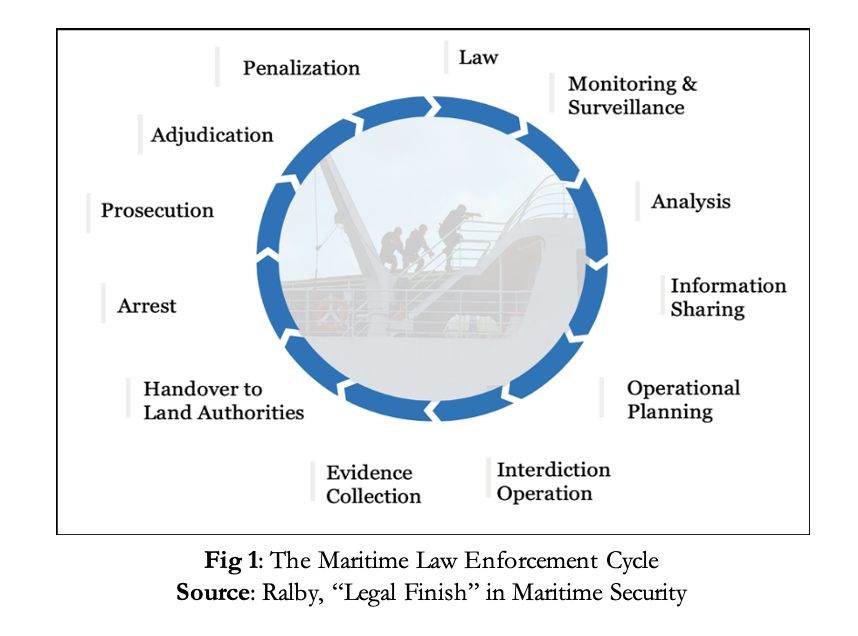
It must also be pointed out that the plugging of legal infirmities is crucial not only in the case of suspected sabotage but also if the damage is indeed accidental. Analysts have pointed out that the increase in cable damage incidents in the Baltic Sea may not be due to an intentional targeting of such underwater infrastructure but due to an increase in “shadow fleet” tanker traffic to the port of Ust-Luga and St Petersburg in Russia via the Baltic Sea.[16] As per the Norwegian Coastal Administration, there has been a significant increase in average tanker voyages per month (662 [March 2020 and 2022] to 955 [April 2022 to September 2023]), an increase in the size of the tankers (60,354,000 metric tons to 92,043,000 metric tons between 2020 and 2022), and an increase in the average age of tankers from 8.3 years in 2020 to 14.6 years in 2023.[17] Since most western insurers and shipping companies have stopped insuring or carrying Russian oil since the outbreak of the conflict in Ukraine, smaller traders and shipping companies — often with no prior record of involvement in the business — have become some of the world’s largest oil traders.[18] Dubious insurance records, poor seaworthiness of tankers/vessels, and poor seamanship are often characteristics of the ‘shadow fleet’. This was experienced in the case of Eagle S and as per the District Court judgment, “some of the numerous faults on the ship were so serious that the Finnish Transport and Communications Agency, which conducted a port state control inspection on the ship, subsequently detained the ship in Finland in order to have the faults repaired on 8 January 2025. The port-side anchor windlass that was regularly used to anchor the ship as well as other associated devices that ensure that the anchor is properly secured in its stowed position were also found to be in poor repair and partially broken or deficient due to wear and long-term neglect of maintenance”.[19] Further, the cables that are frequently being damaged in the Baltic Sea are laid in such a way that they are perpendicular to the direction of travel of these vessels. The combination of all these factors makes it possible to argue that the damage is, indeed, due to poor seamanship as opposed to being caused by intentional sabotage. This distinction is important as significant investment in law enforcement capabilities and networks, while useful for effective interdiction, may not change behaviour and safety practices. This is where effective prosecution, which invariably requires a robust legal framework, becomes important as even if the cause is accidental, commercial vessels and operators are more likely to be more careful if economic costs are imposed upon them.
Comparing the Eagle S and Hong Tai 38 Cases
The Eagle S and the Hong Tai 38 cases, which were prosecuted in Finland and Taiwan, respectively, offer good case studies to demonstrate the effectiveness of legislation in prosecution, given that the latter case led to the conviction and sentencing of the ship’s master — a Chinese national, for a period of three years. This followed a spate of legislative amendments made by Taiwan to its Telecommunications Management Act, the Electricity Act, the Natural Gas Enterprise Act, the Water Supply Act, the Meteorological Act, the Commercial Port Act, and the Law of Ships, often referred-to as the “seven undersea cables laws”. These amendments require the mandatory display of AIS information in the territorial sea and “prohibited waters”; display of the vessel’s name, IMO ship identification number, and Maritime Mobile Service Identity (MMSI) codes; the requirement for vessels (including non-Taiwanese ones) to maintain logbooks that accurately record navigation activities and accidents;[20] the imposition of serious fines and penalties (including imprisonment) on the vessel owner and/or the ship’s master for damaging submarine infrastructure; and even confiscation and disposal of tools, ships, or other machinery and equipment used in the crime, regardless of ownership (including foreign vessels).[21] However, two other measures have had the greatest impact with respect to prosecution of these cases. The first is the designation of ten domestic undersea cables as “critical infrastructure”.[22] The second is the passage of a resolution that requires the Ministry of the Interior to publicly release maps of the undersea cables and pipelines to put prospective defendants on notice.[23]
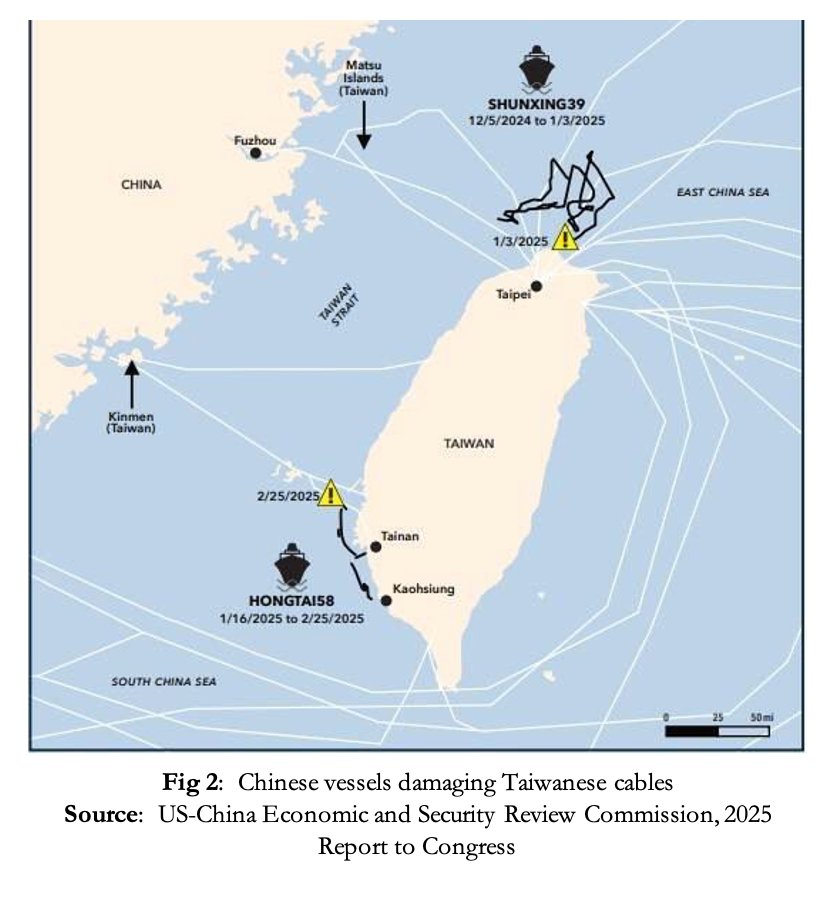
As depicted in Figure 2,[24] in the Hongtai 58 case, a Togolese-flagged cargo vessel, the Hongtai 58, disrupted the Taiwan-Penghu cable located 5 NM from Tainan. The key facts relied-upon by the judgment of the Tainan District Court while convicting the master to three years imprisonment were: (1) the electronic chart of the vessel displayed the location of the submarine cable line; (2) the cable was located in the “Shangkai” Warning Zone which is a public “no-anchoring zone”, i.e., ships are not allowed to anchor in that zone; (3) the Taiwan Penghu cable had been declared as “critical infrastructure”.[25] The reasoning of the Tainan District Court was that the master of the vessel “should have been fully aware of the navigational environment as the nautical charts of the vessel itself marked the location of the cable, and knew that arbitrarily dropping anchor in this area could very likely result in the anchor snagging the submarine cable beneath the seabed and damaging it”.[26] Furthermore, the defendant wilfully instructed the crew to lower anchor and allowed the vessel to drift, despite being aware that the vessel was in an unsecured anchoring state. The judgement went on to reason that given how critical the cable was to broadband connectivity and communications for the Penghu islands, and the significant disruptive impact on governmental and societal operations across livelihood, economic, and public information, the defendant’s actions warranted severe condemnation. All these factors played a role in the conviction and the quantum of sentencing.
In the Eagle S case, however, the issues were slightly more complicated. The cables were disrupted within Finland’s Exclusive Economic Zone and therefore, Finnish criminal jurisdiction did not automatically apply. As per the Criminal Code of Finland, “[a]n offence is deemed to have been committed both where the criminal act was committed and where the consequence specified in the statutory definition of the offence occurred”[27] This application is restricted if any international treaty binding on Finland restricts the scope of application of the criminal law of Finland. In the Court’s findings, because the consequences of the act extended to Finland, and the material elements of the offence as designed in national law were fulfilled, the offence in principle could be considered to have been committed in Finland. The decision however turned on if and how international law applied so as to restrict application of criminal jurisdiction. The court relied upon the interpretations of Article 97 and Article 113 UNCLOS. Article 97(1) states that ‘[i]n the event of a collision or any other incident of navigation concerning a ship on the high seas, involving the penal or disciplinary responsibility of the master or of any other person in the service of the ship, no penal or disciplinary proceedings may be instituted against such person except before the judicial or administrative authorities either of the flag State or of the State of which such person is a national’. Incidences of navigation, as per the Enrica Lexie case, inovolves damage caused related to the ‘manoeuvring or movement’ of a ship. An International Law Association (ILA) report argues that intentional damage should not be treated as an ‘incident of navigation’ and therefore, the exclusive jurisdiction clause should not apply.[28] The Court rejected this argument with a broad brush statement that the interpretation of this article did not support the conclusion that it did not apply to intentional crimes while deciding that Article 97 applied, as the “ship’s anchor fell into the sea due to a failure of the anchor securing mechanism, and the defendant’s alleged negligence related to their duties on board the ship”. Therefore, there was no intentional damage and hence it was an incident of navigation. Evidently, the decision of the Court was influenced by its determination that the incident was not intentional. Very surprisingly, the Court did not take into account the fifty-six-mile drag mark on the seabed and the missing anchor (which was later recovered by Swedish authorities).[29] This was because it made a determination as to the cause of damage at the stage of application of law — on the basis of which it decided the applicability of law — without a material and detailed analysis into the facts of cause of damage. Additionally, the idea of ‘incident’ itself would be opposed to an ‘intentional’ act,[30] and there was a lack of clarity as to the rationale behind the inclusion of intentional crimes within Article 97.
On Article 113 of UNCLOS, the decision of the Court turned on the fact that Finland had enacted an “Act on the Protection of Certain Underwater Cables”. The legislator’s intention, thereby, was that only [emphasis added] cable damage caused by Finnish citizens and Finnish vessels outside Finland’s territory could be dealt with in accordance with Finnish law. This too is unfortunate as the Court did not elaborate on why exclusive flag State jurisdiction was applicable, especially when the construction of Art 113 — which is framed as a positive obligation — is explicitly different to Art 97 which confers exclusive jurisdiction. Additionally the applicability of Article 97 to the ‘high seas’ read with the application of Art 59 allowing for attribution of rights or jurisdiction to the coastal State “on the basis of equity and in the light of all the relevant circumstances, taking into account the respective importance of the interests involved to the parties as well as to the international community as a whole” was not discussed and consequently not applied.
The Finnish court thus missed an opportunity to adopt a broad interpretation of UNCLOS provisions to confer jurisdiction to coastal States to prosecute for damage to underwater infrastructure within their EEZ and establish State practice in this regard. This might have allowed for the progressive development of international law to accommodate the increased criticality of underwater infrastructure to national economies and societies. The other camps of development of international law include negotiating and concluding a new agreement within UNCLOS[31] or even utilising creative interpretations such as the doctrine of ‘constructive presence’ to justify boarding and prosecution.[32]
The implications of these cases for India are as follows:
- The construction of national law plays a critical role in the way evidence is collected, elements of the offence are made out, and whether conviction can be secured. This is important for both accidental causes of damage and supposedly intentional damage done by merchant vessels at the behest of a national actor.
- The declaration of such infrastructure as ‘critical’ can play a crucial role in the reasoning of courts while interpreting national and international law. Courts are more likely to accept broader interpretations of provisions of national and international law while dealing with “critical infrastructure”. Naturally, better framed national law can make reconciliation with international law possible. Moreover, there seems to be strong advocacy from scholars and even States to accept and acquiesce to broader applications of jurisdiction, the Eagle S case notwithstanding. While India has, through the “Telecommunications Act, 2023” extended extra-territorial criminal jurisdiction for damage to telecommunications infrastructure, it should develop arguments to justify the exercise of such jurisdiction to prevent the imposition of legal costs due to inaccurate exercise of jurisdiction. Such arguments should be presented internationally to develop consensus on such approaches as a measure of “legal diplomacy”.
- India should declare at least her national cables connecting her island chains as “critical infrastructure” to support such interpretation.
- The publication of cable routes and protection/no-anchoring zones can have a demonstrable impact on prosecution. This, however, needs to be supported by monitoring and effective information-sharing mechanisms to ensure that the vessel can be apprehended before it ‘gets away’. The reason why Hongtai 38 was successfully prosecuted as opposed to Shunxing 39 was that the latter was able to leave Taiwan before being apprehended. Additionally given its multiple names and flags, tracking a vessel’s location subsequently has been challenging.[33] Therefore, operational measures and legal measures need to simultaneously be pursued for effective protection.
*******
Endnotes:
[1] “A Rash of Baltic Cable-Cutting Raises Fears of Sabotage,” The Economist, 06 January 2026. https://www.economist.com/europe/2026/01/06/a-rash-of-baltic-cable-cutting-raises-fears-of-sabotagehttps://www.economist.com/europe/2026
[2] Koh Ewe and I-ting Chiang, “Taiwan Jails China Captain for Undersea Cable Sabotage in Landmark Case,” BBC News, 12 June 2025 https://www.bbc.com/news/articles/cwy3zy9jvd4o
[3] Gahon Chia-Hung Chiang, “Countering China’s Subsea Cable Sabotage” Global Taiwan Brief Vol. 10, Issue 6 (Washington, D.C.: Global Taiwan Institute, 2025) https://globaltaiwan.org/wp-content/uploads/2025/03/GTB-10.6-PDF.pdf
[4] David Hutt, “EU, Southeast Asia Aim to Boost Security for Undersea Cables”, DW, 06 September 2025
[5] “How NATO Protects Seabed Infrastructure,” SeaWaves, 21 January 2026, https://seawaves.com/how-nato-protects-seabed-infrastructure/
[6] “NATO Officially Launches New NMC-SCUI,” NATO, 28 May 2024, https://mc.nato.int/media-centre/news/2024/nato-officially-launches-new-nmcscui
[7] Ibid
[8] “NATO’s Mainsail,” NATO Allied Command Transformation, https://www.act.nato.int/article/natos-mainsail
[9] “Baltic Sentry to Enhance NATO’s Presence in the Baltic Sea,” NATO’s Supreme Headquarters Allied Powers Europe (SHAPE), 14 January 2025, https://shape.nato.int/news-releases/baltic-sentry-to-enhance-natos-presence-in-the-baltic-sea
[10] “NATO Expands Its Engagement on Critical Undersea Infrastructure in the Mediterranean,” NATO, 21 November 2025, https://www.nato.int/en/news-and-events/articles/news/2025/11/21/nato-expands-its-engagement-on-critical-undersea-infrastructure-in-the-mediterranean
[11] European Commission, “Proposal for a Council Decision on Strengthening the EU’s Resilience of Undersea Critical Infrastructure,” European Commission Press Corner, 29 June 2023 https://ec.europa.eu/commission/presscorner/detail/en/ip_23_3564
[12] “Optics11 to Revolutionize Protection of Undersea Cables with EU Loan €25 Million from EIB,” Optics11, 15 January, 2026, https://optics11.com/pressrelease/optics11-to-revolutionize-protection-of-undersea-cables-with-eu-loan-e25-million-from-eib/
[13] Helsinki District Court, Case No R 706/2025/12270, The Tanker Eagle S, judgment dated 03 October 2025 https://www.ejiltalk.org/wp-content/uploads/2025/11/Tuomio-asiassa-706-2025-12270-EN.pdf
[14] Dr Ian Ralby, “Legal Finish in Maritime Security Is Too Often Lacking a Legal Start,” CIMSEC, 08 October 2024 https://cimsec.org/legal-finish-in-maritime-security-is-too-often-lacking-a-legal-start/
[15] Ralby, “Legal Finish in Maritime Security,” CIMSEC.
[16] Roderick Beck, LinkedIn post, “Estonia subsea cables outages …”, LinkedIn, 07 January 2026 https://www.linkedin.com/posts/roderick-beck-94868948_estonia-subseacables-outages-activity-7416783294928863233-Z_A_/?utm_source=share&utm_medium=member_ios&rcm=ACoAACT-zeEBqZPTcJlcHMgihHnPIrCV8HodgyM
[17] Elisabeth Braw, “Russia’s growing dark fleet: Risks for the global maritime order”, Issue Brief, Atlantic Council, 11 January 2024 https://www.atlanticcouncil.org/in-depth-research-reports/issue-brief/russias-growing-dark-fleet-risks-for-the-global-maritime-order/#changes-in-tanker-traffic-from-russia
[18] Dmitry Zhdannikov and Nidhi Verma, “Insight: Obscure traders ship half Russia’s oil exports to India, China after sanctions”, Reuters¸ July 27, 2023 https://www.reuters.com/business/energy/obscure-traders-ship-half-russias-oil-exports-india-china-after-sanctions-2023-07-27/
[19] Case No R 706/2025/12270, The Tanker Eagle S, p2
[20] “Legislature passes amendments strenthening undersea cable protections”, News, The Overseas Community Affairs Council, R.O.C (Taiwan), 17 December 2025 https://www.ocac.gov.tw/OCAC/Eng/Pages/Detail.aspx?nodeid=329&pid=82223900
[21] Tsai Yun-jung and William Hetherington, “Amendments to Protect Undersea Cables Take Effect,” Taipei Times, 12 January 2026. https://www.taipeitimes.com/News/taiwan/archives/2026/01/12/2003850453?s=09
[22] TVBS News Staff, “Taiwan-Matsu Cable Damage Prompts Emergency Response,” TVBS News, 22 January 2025 https://news.tvbs.com.tw/english/2758571?from=english_extend
[23] Liao Chia-ning and Fion Khan, “Committee Passes Review of Changes to Laws for Cables,” Taipei Times, 21 October 2025. https://www.taipeitimes.com/News/front/archives/2025/10/31/2003846398
[24] U.S.–China Economic and Security Review Commission, 2025 Report to Congress (One Hundred Nineteenth Congress, First Session, November 2025). https://www.uscc.gov/sites/default/files/2025-11/2025_Annual_Report_to_Congress.pdf
[25] Taiwan High Court, Tainan Branch, Criminal Judgment, Case No. 235 of 2025 (12 June 2025) https://tnd.judicial.gov.tw/tw/cp-4360-2681666-d1d4a-261.html
[26] Tainan District Court, “Press Release on Case No 235 of 2015 Concerning Violations of the Telecommunications Management Act,” Tainan District Court, Taiwan, https://tnd.judicial.gov.tw/tw/cp-4360-2681666-d1d4a-261.html
[27] Case No R 706/2025/12270, The Tanker Eagle S
[28] International Law Association, Submarine Cables and Pipelines under International Law: [Third] Interim Report 2024, Rapporteur: Dr Tara Maria Davenport https://www.ila-hq.org/en/documents/ilathi-1
[29] James Kraska and Elizabeth Hutton, “The Doctrine of Constructive Presence and Damage to Submarine Cables and Other Critical Underwater Infrastructure,” International Law Studies 106 (2025): 779–802 https://digital-commons.usnwc.edu/cgi/viewcontent.cgi?article=3138&context=ils
[30] Tom Ruys and Yiannis Bamnios, “Anchoring Criminal Jurisdiction at Sea: The Helsinki District Court’s Eagle S Judgement and Its Impact for the Protection of Submarine Cables and Pipelines,” EJIL: Talk!, 07 November 2025 https://www.ejiltalk.org/anchoring-criminal-jurisdiction-at-sea-the-helsinki-district-courts-eagle-s-judgement-and-its-impact-for-the-protection-of-submarine-cables-and-pipelines/
[31] Raul (Pete) Pedrozo, “Implementing Agreement to Enhance Protection of Critical Undersea Infrastructure,” International Law Studies 106 (2025): 146–168 https://digital-commons.usnwc.edu/cgi/viewcontent.cgi?article=3104&context=ils
[32] James Kraska and Elizabeth Hutton, “The Doctrine of Constructive Presence and Damage to Submarine Cables and Other Critical Underwater Infrastructure,”
[33] “Taiwan Is Hunting One Cable Cutting Vessel Disguised with Three Separate Digital Identities,” Lloyd’s List Intelligence, 13 January 2025. https://www.lloydslistintelligence.com/thought-leadership/blogs/taiwan-is-hunting-one-cable-cutting-vessel-disguised-with-three-separate-digital-identities
 https://www.reuters.com/
Leave a Reply
Want to join the discussion?Feel free to contribute!