
 CIMSEC
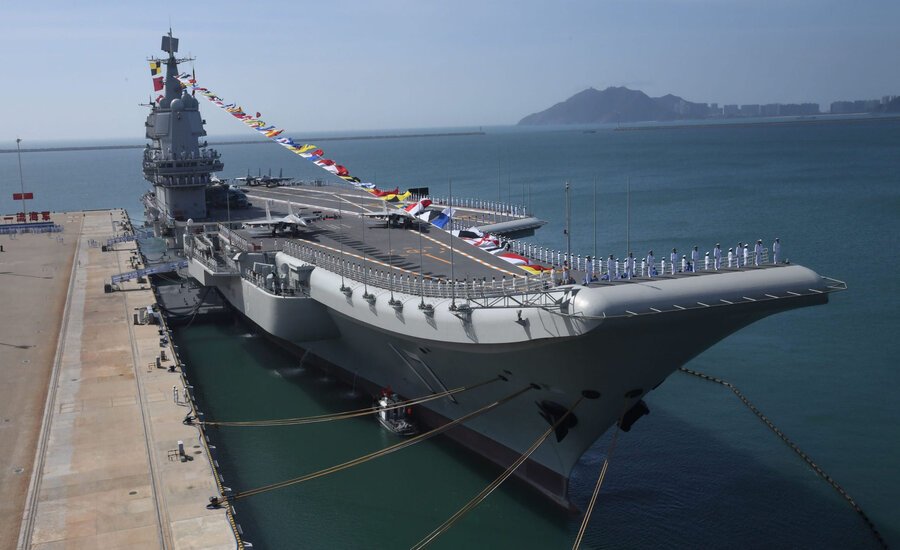
Within five years after the China commissioned its first Soviet-origin aircraft carrier Liaoning in September 2012, it launched its first-ever domestic carrier – the Type 001A – on 26 April 2017. The new carrier is likely to be commissioned in 2020 as Shadong. Even though the Liaoning and the Type 001A are medium-sized conventionally powered (non-nuclear) vessels equipped with aircraft ski-jumps (not catapults), and thus far less capable than the super-carriers operated by the United States, the occasion was celebrated in China as a major achievement symbolic of China’s ‘great power’ status. A report indicates that China’s larger next generation Type 002 carrier equipped with a steam catapult is already under construction since March 2015, and its follow-on carriers may be nuclear powered.
The launch of the Type 001A is indeed a milestone in the development of China as a major naval power. It reminds us of the famous battleship HMS Dreadnought commissioned into the Royal Navy in 1906. The Dreadnought was a highly successful warship induction marking the dawn of the 20th century warfare at sea. It became iconic of a transformative naval capability in a manner that the older existing warships of the world began to fade into obsolescence as pre-Dreadnoughts. The celebration in Beijing similarly justified, given the achievement of China’s defence-technological endeavour within a relatively short period of time. It stands out rather conspicuously in comparison to India, which has been operating aircraft carriers since 1961, but is yet to commission its first indigenous carrier named Vikrant.
Moving from ‘symbolism’ to ‘substance’, such ‘flat-tops’ are indeed valuable platforms for maritime force-projection, which, for centuries, has been an important naval mission of all major power navies. However, given China’s maritime geography and the kind of insecurities it encounters today from vastly superior adversarial navies of the United States and Japan operating in the western Pacific rim, the PLA Navy’s growing doctrinal reliance on carriers seems to be an aberration. It may have been more prudent for China to focus on bolstering its existing Anti-Access/ Area-Denial (A2AD) operational doctrine with the naval doctrine of ‘sea-denial’ – particularly given the PLA Navy’s traditional strengths in submarine, sea-mine and missile warfare – rather than diluting its naval doctrine by adding the carrier-based ‘sea-control’ doctrine.
Chinese carriers will also be highly vulnerable in the western Pacific rim, not only to the advanced navies, but also to the many unfriendly airbases and submarine bases of the littoral countries dotting the periphery of the East and South China Seas. It is well known that even the smaller countries in the region are building potent sea-denial capabilities against China. The recent induction of the six advanced Russian Kilo-class submarines into the Vietnamese Navy is case in point. If a maritime conflict breaks out in the area, the PLA Navy carrier would surely be a primal target, and any such successful targeting would be a major symbolic blow to China’s morale, and thus its war effort.
The Chinese believe that ‘sea-control’ is necessary to assert its maritime-territorial claims in the China Seas. This could have been achieved effectively – and at reduced risk – by optimally using the air-bases in the Chinese mainland and the occupied islands, which China is expanding through reclamation. Ironically, China’s island-building activity in the South China Sea has caused a major ‘damage’ to China’s claim to its ‘peaceful rise’ theory, which is now being aggravated by its own carrier-building programme. Furthermore, the programme lacks operational credibility, much into the foreseeable future. It would take the PLA Navy many years to operationalize a full-fledged Carrier Task Force, and possibly decades to make it effective enough to achieve sea-control against advanced navies. Meanwhile, the process could cause an indelible dent on China’s objective to propagate a ‘benign’ and ‘constructive’ image in the Indo-Pacific region, including through its ‘One-Belt-One-Road’ (OBOR) initiative.
Chinese strategists also believe that carrier-based sea-control is necessary to protect their Sea Lines of Communication (SLOCs) in the Indian Ocean, as indicated by China’s recently articulated strategy of “open-seas protection” in its 2014 Defence White Paper. However, this could have been achieved – again effectively, and at reduced risk – by deploying its warships in its naval bases at strategic locations such as Djibouti and Gwadar.
China is likely to have at least three aircraft carriers in commission at any given time in the future. The Chinese have clearly gone too far ahead for any reappraisal of its aircraft-carrier programme, possibly lured into the ‘command of the seas’ gambit of the major western naval powers, without factoring their own geo-strategic conditions and circumstances. One may, therefore, expect that the PLA Navy’s ‘doctrinal duality’ in terms of primacy to both ‘sea control’ and ‘sea denial’ may become its dilemma in the coming years.
**********************************
*Captain Gurpreet S Khurana, PhD, is Executive Director at the National Maritime Foundation(NMF), New Delhi. The views expressed are his own and do not reflect the official policy or position of the NMF, the Indian Navy, or the Government of India. He can be reached at gurpreet.bulbul@gmail.com
china’s aircraft carrier dreadnought or doctrinal dilemma
 Image Credits: Council on Foreign Relations
Leave a Reply
Want to join the discussion?Feel free to contribute!