
 Image Credits: The Times of India
China and Russia conduct regular combined exercises under the military cooperation mechanism signed in 2005. A bilateral naval exercise in the South China Sea (SCS) was held in mid-September 2016. Since 2012, the two neighbours have held annual exercises, with this being the fifth in the series. The earlier exercises were held in the Yellow Sea (2012), the Sea of Japan (2013), the East China Sea (2014) and in two phases in the Mediterranean and the Black Sea (2015).
The September 2016 naval drills, code-named ‘Joint Sea-2016’, comprised defensive operations, search and rescue missions, anti-submarine operations, amphibious missions as well as ‘island-seizing’ activities, featuring Chinese and Russian marines storming ‘enemy’ beaches with landing crafts and amphibious tanks, while helicopters carried air mobile Marines to encircle the ‘enemy’s’ rear.
The eight-day exercise was significant for several reasons. First, this is the first time that the Chinese and Russian naval contingents held exercises in the SCS. The PLA Navy’s South Sea Fleet (SSF) formed the bulk of the forces along with some elements participating from the North Sea and East Sea Fleets. The drills were held in the waters off Zhanjiang, the southernmost city of Guangdong province, where the SSF is headquartered. The SSF is responsible for safeguarding of Chinese interests in the SCS.
Second, the announcement in late July of the planned bilateral exercise generated unease among the many stakeholders in the South China Sea dispute as it followed closely on the heels of the judgement by the Permanent Court of Arbitration (PCA) in The Hague. The International Tribunal, in its 12thJuly judgement, rejected Beijing’s expansive claim in the SCS and provided further grounds for the US to conduct its so-called ‘freedom of navigation’ operations in the disputed waters. This has increased the possibility of the SCS becoming a flashpoint in Sino-American relations. Beijing claims nearly the whole of SCS, but Brunei, Malaysia, the Philippines, Taiwan and Vietnam have rival claims.
Third, Russia is the only major country to support Beijing over the South China Sea disputes, and China has been successful in engaging Russia given that it is deprived of any steadfast allies. A favourable Russian position on the PCA’s verdict – opposing any third-party interference in the matter has helped China score a geopolitical win with regard to the SCS issue. The ‘Joint Sea-2016’ seems to be a coincidental Sino-Russian response to the geopolitical fallout of The Hague verdict. The alarm over the location of the exercises appears misplaced as these were conducted in the waters off the Guangdong province – far from any disputed islands. Similarly, the exercises of this magnitude are planned well in advance, and the announcement in July 2016 is merely a coincidence. The timing also follows a regular pattern of previous exercises being held in the spring and summer months.
However, a noteworthy feature of the exercise is the growing military cooperation between China and the Russia on various fronts. The naval facet of this collaboration is showcasing increasing signs of maturity with the growing complexity of naval drills in terms of size, equipment, complexity of exercises and the ‘islandseizing’ components. The ‘Joint Sea-2016’ exercise was held over eight days – an unusually long duration for bilateral naval exercises clearly signifying the seriousness of growing naval cooperation. It is likely the duration of these exercises may have been extended due to the PCA verdict.
The maturing collaboration between the two navies is causing concern among the region’s major stakeholders. These drills are also the first that China conducted with a foreign navy after initiating new military reforms in December 2015 and January 2016. Xi Jinping ordered reorganisation of the previous People’s Liberation Army (PLA) structure built around seven military regions into five integrated ‘theatre commands’ with an aim to make PLA a more efficient and capable war-fighting machine. It is likely that the naval drills were attempted to assess the newly integrated organisation and the preparedness of the PLA Navy for operating under the reformed structure. This is also a first for the PLA Navy in terms of exercises conducted in the South China Sea with a major power; by inviting Russia to conduct bilateral naval exercises in the SCS, even if far from the disputed islands, China has set a precedent – allowing other major naval powers to conduct similar bilateral or multilateral naval exercises with the littorals of the South China Sea.
*************************
About the Author:
Manpreet Singh Chawla is a Research Associate at the National Maritime Foundation (NMF). The views expressed here are his own and do not reflect the official policy or position of the NMF, the Indian Navy or the Government of India. He can be reached at manpreetschawla@hotmail.com
 Image Credits: Sino Defence Forum
 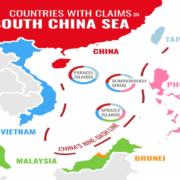 Image Credits: Forbes
  Image Credits: Dhaka Tribune
 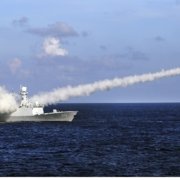 Image Credits: Suptnik News
  Image Credits: Australian Security Magazine
  Image Credits: US Naval Institute
  Image Credits: IIPLA
 Image Credits: Sino Defence Forum
Leave a Reply
Want to join the discussion?Feel free to contribute!