
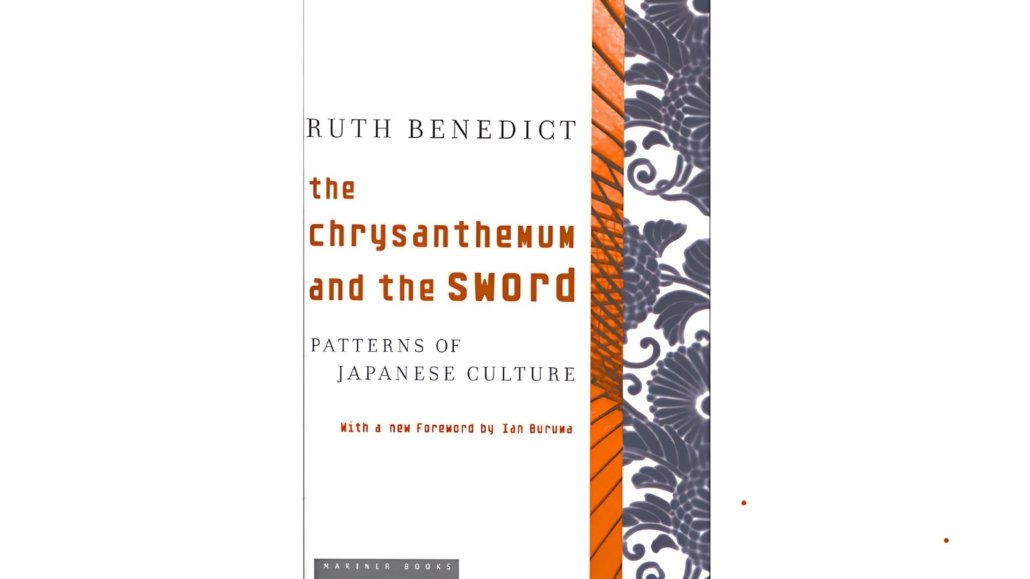
Ruth Benedict, Mariner Books, reprinted edition 2005.324 pages, ISBN-10: 0-618-61959-3, Rs 1662 (paperback)
“They cultivate the pleasures of the flesh like fine arts, and then, when they are fully savoured, they sacrifice them to duty.”
– Ruth Benedict
The very title of Ruth Benedict’s The Chrysanthemum and the Sword is rich with symbolism, capturing in a single phrase the paradoxes and harmonies at the heart of Japanese culture. The chrysanthemum (or kiku (菊) in Japanese), is a flower that represents refinement, beauty, and resilience. It is no ordinary flower in Japanese culture. The 16-petaled chrysanthemum crest, known as the kiku mon (菊紋), has been associated with the emperor and the imperial family since the Kamakura period (1185–1333 AD), first adopted by Emperor Go-Toba. He was not only a ruler but also a poet, calligrapher, and swordsmith, who saw the chrysanthemum as a symbol of artistic refinement and imperial strength. In contrast, the ‘sword’ evokes the steel of samurai discipline, the code of loyalty, the martial virtues of obedience and the readiness to defend one’s honour with violence if required.
Benedict’s choice of title is masterful, for it fuses these opposing yet coexisting elements: aesthetic delicacy alongside uncompromising discipline. In many ways, this duality still frames how observers perceive Japan — a society capable of extraordinary artistic sensitivity while maintaining a powerful social and military order tradition. Benedict uses this symbolism as the gateway into her anthropological study of Japan, attempting to explain its worldview to a wartime American audience.

The 16-petaled chrysanthemum crest of Emperor of Japan
Source: Freepik
Commissioned during World War II by the US Office of War Information, the Chrysanthemum and the Sword was intended to help American policymakers understand their then-enemy, “Imperial Japan.” Since travelling to Japan was impossible, Benedict relied on what was known as “culture at a distance,” gathering data through Japanese immigrants, prisoners of war, academic sources, newspapers, films, and other published works. Published in 1946, the book quickly became one of the most influential texts in the field of cultural anthropology and had a lasting impact on how the West perceived Japanese society. The book is remarkable for what it is ‘not’: it is not a study of Japanese religion in isolation, nor a monograph on Japanese political systems or its economic models. Benedict herself clarifies on page 13 of the volume that it examines “Japanese assumptions about the conduct of life.” In other words, she tries to understand what makes the Japanese behave as they do across multiple spheres of life — in war, family life, work, art, and moral conduct. Her central argument is that to understand a nation, one must understand its moral and emotional grammar, the deep cultural codes that shape day-to-day choices. Japan, to Benedict, is not just a collection of political institutions, but a civilisation with a powerful sense of order, shame, obligation, and beauty that frames everything from the tea ceremony to the ethos of the warrior.
The book delves deeply into the mortal substratum of Japanese society, offering enduring insights into the cultural forces that shape national behaviour. Among her more nuanced observations is the role of women – portrayed not merely as passive bearers of obedience, but as embodiments of quiet strength and resilience, particularly in times of national duress. This duality mirrors the broader Japanese ethic: outer deference, inner fortitude.
At heart of Benedict’s framework lie two critical constructs – on (恩) and giri (義理). On, signifies a lifelong social debt, a binding gratitude owed to parents, benefactors, and superiors. It is something that must be repaid with lifelong loyalty. Giri, is its moral counterpoint – it is the ethical imperative to act rightly and honourably in response to on. Together, they form a self-regulating ecosystem of duty and reciprocity. These concepts explain much about Japanese behaviour in personal and professional relationships, anchoring social cohesion in Japan.
While Benedict did not explicitly articulate the concept of mentsu (メンツ), or ‘face,’ it is an essential corollary to her analysis.[1] It is rooted in the samurai tradition of honour unto death (Seppuku or Hara-Kiri). Mentsu evolved from the warrior’s ‘big honour’ to a more refined, civilian preoccupation with reputation and role-fulfilment. Unlike the relational emphasis in Chinese mien-tzu, the Japanese mentsu is structured around hierarchical obligation and shame-avoidance. One’s public persona is meticulously curated through the fulfilment of duties – the visible enactment of on and giri – and the avoidance of haji (恥), or disgrace. Shame is a powerful force in Japan. Unlike cultures where guilt — a violation of internalised conscience — is the primary moral regulator, Japan, Benedict argues, is a “shame culture,” where social reputation and the avoidance of public disgrace are the critical forces guiding behaviour. This explains many aspects of Japanese social cohesion: from the reluctance to challenge authority to the subtle etiquette of daily life, where harmonious interaction is prized above blunt honesty.
This layered conception of honour – where aesthetic restraint and moral discipline converge – continues to influence Japanese diplomacy, business etiquette, and military partnerships. For Indian interlocutors, especially in maritime and strategic domains, understanding this subtle grammar of dignity, obligation, and face is not merely cultural awareness, it is operational necessity. Missteps in this regard do not just offend; they erode trust.
Benedict also highlights the role of ritual, etiquette, and aesthetic disciplines — from chanoyu (茶の湯 – tea ceremony) to ikebana (生け花 – flower arrangment) and haiku (俳句 – Poetry) — in reproducing moral order. These are not mere artistic expressions, but structured practices reinforcing social hierarchy, emotional restraint, and moral continuity. Through such codes, Japan sustains not only beauty but cohesion.
Her work, while constrained by the limitations of wartime anthropology, remains a foundational attempt to “read” Japan on its own terms. Despite overgeneralisations and a tendency to contrast Japanese culture with an idealised American self-image, Benedict’s framework introduced a vital idea: that conduct in Japan is never solely individual or pragmatic — it is cultural, ethical, and performative. This has direct relevance for maritime analysts and policymakers. Japan’s merchant marine practice of kaiso bunri (階層分離) — separating ship ownership from operation — illustrates a culturally grounded ethic of trust and responsibility. The shipowner’s on to the crew, and the crew’s reciprocal giri, create a system where even commercial shipping is imbued with a near-military ethos of duty and honour.
Consequently, Japan’s maritime strategy is never devoid of cultural logic. Whether in coalition navies, MDA initiatives, or freedom-of-navigation operations, Japan brings with it not just tactical interest, but moral seamanship. For Indian maritime engagement, recognising this is essential. Japan’s approach is steeped in loyalty, precision, and mutual respect — all filtered through the cultural grammar of mentsu, on, and giri. Strategic alignment, therefore, must be matched by cultural intelligence. Misreading the cultural cues — especially public embarrassment or perceived breaches of obligation — can cause disproportionate strain in bilateral relations. For Indian maritime strategists and diplomats, Benedict’s insights serve as both caution and compass: in Japan, strategy is not just calculated — it is cultivated.
For India, The Chrysanthemum and the Sword is more than a window into Japanese culture; it is a tool to better understand how to cooperate with one of Asia’s most influential powers. India and Japan share a growing strategic, economic, and technological partnership, from joint maritime security frameworks to critical mineral supply chains and digital innovation. However, policy alone cannot build trust. Deep, respectful cultural understanding is necessary to avoid misinterpretations that could otherwise arise in areas such as business negotiations, joint military exercises, or even tourism and people-to-people exchanges. For example, India’s approach to maritime security dialogues with Japan could benefit from appreciating the Japanese emphasis on hierarchy, collective duty, and harmonious decision-making — aspects rooted in on and giri. These cultural logics influence how Japanese policymakers frame their responses to regional threats and alliances. Similarly, for Indian businesses, awareness of the subtleties of Japanese etiquette, aesthetics, and shame-based social regulation can prevent misunderstandings, encourage smoother transactions, and build the trust needed for durable commercial relationships. India’s policymakers and business leaders must recognise, as Benedict shows, that in Japan’s worldview, social relationships are seldom transactional in a purely economic sense. They are moral frameworks built on a foundation of long-term obligation and honour. Understanding these frameworks will be invaluable as India looks to expand its maritime and commercial presence across the Indo-Pacific with Japanese support.
There is also a broader lesson here for India, which applies well beyond Japan. In a world where international partnerships increasingly hinge on cultural intelligence, reading works like The Chrysanthemum and the Sword helps us appreciate that all nations carry deep-seated historical memories and moral assumptions that shape how they view security, prosperity, and social order. Just as the United States tried to understand Japan through Benedict’s work during World War II, India should constantly seek to read and interpret other societies with similar empathy and rigour. Whether in Southeast Asia, Africa, the Gulf, or Europe, India’s rising role demands a nuanced comprehension of how partners think and act, going well beyond economic data and military capability.
History is not a static ledger of events; it is a living, breathing tapestry of ideas, symbols, and relationships. By studying how the chrysanthemum and the sword continue to define Japan, India can better appreciate the importance of cultural memory in shaping strategic policy. As we strengthen maritime partnerships, invest in transnational connectivity, and uphold rules-based order in the Indo-Pacific, this kind of cultural literacy will be indispensable.
For India, maritime cooperation with Japan will continue to deepen — from shipbuilding to joint MDA (maritime domain awareness) to potential connectivity projects. Each of these domains involves not only technology but trust, loyalty, and reciprocal respect. Benedict’s book, despite its age, warns us that failing to understand the moral codes of partners leads to misalignment and frustration. For instance, Japan’s defence industry historically tends to favour long-term, stable relationships, with strict codes of conduct, rather than opportunistic quick deals. When India pursues co-development of ship-based systems or advanced platforms, this pattern means that Japanese partners may expect consistent commitment and a culture of honour in negotiations, rather than shifting positions. Further, Japan’s emphasis on shame avoidance means public diplomatic spats or sudden reversals could have outsized effects on bilateral confidence. Understanding how ‘the sword’ — the code of honour and discipline — still shapes modern maritime strategy in Japan will help India safeguard trust in a complex Indo-Pacific.
For Indian maritime strategists, Benedict’s work offers a mirror to think about our own values, too. Are there equivalents of on and giri in Indian seafaring tradition, or in the Indian Navy’s ethos of duty and respect? Can we map our own cultural codes more consciously as we design alliances? Reading this book is not simply about Japan. It is about the art of cultural literacy as a pillar of maritime strategy. Benedict shows that no matter how modern a navy becomes, its spirit will still be shaped by symbols — the chrysanthemum’s grace and the sword’s discipline — which, in turn, shape how it fights, cooperates, and lives.
As India navigates the Indo-Pacific’s swirling currents, let us remember this: cultural understanding is as important as ships, satellites, and treaties. Benedict’s remarkable work still lights that path, reminding us that culture is the sea in which all strategies must sail.
******
About the Reviewer
Ms Aashima Kapoor is a Research Associate at the National Maritime Foundation, where she works with the Indian and Regional Maritime Security (IRMS) Cluster. Her research primarily focuses on East Asia, with a particular emphasis on the maritime geostrategies of Japan and their impact on India’s own maritime strategic thinking. In addition to her academic expertise, she is proficient in the Japanese language (N4). She can be reached at ea2.nmf@gmail.com
Endnotes:
[1] Kriti Ganesh, “Sino-Japanese Nuances of “FACE” and Lessons for India,” National Maritime Foundation, 09 March 2024. https://maritimeindia.org/sino-japanese-nuances-of-face-and-lessons-for-india/.
 https://www.ogc.org/
Leave a Reply
Want to join the discussion?Feel free to contribute!