
 wikipedia
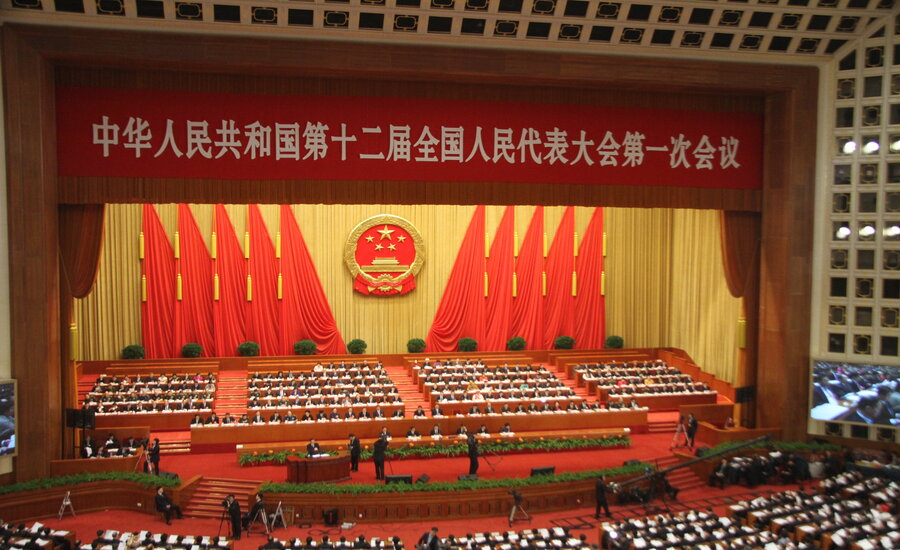
The fifth session of 12th NPC and China People’s Political Consultative Conference (CPPCC) was held from 3rd to 15th March in Beijing. It commenced with the opening session that saw Premier Li Keqiang place his Work Report.Popularly called the Liang Hui (Two Sessions), the biggest but rather ‘rubber stamp’ national legislative and advisory body NPC and the CPPCC of the government discussed various issues including maritime and One Belt and One Road initiative (OBOR). The Work Report consisting of 42 pages predominantly focused on economic development of China. The last three pages covered issues related to ethnic minority, Hong Kong, Macau and Taiwan as well and commented on promoting national defence capability. For China, maintaining a stable economic growth rate of 6.5 percent is a major concern, given its implications for both the domestic stability and international affairs.
Notably, this year’s Work Report has been more articulate in discussing issues such as national sovereignty, territorial integrity, maritime interests and rights. While highlighting the achievements of 2016 and what is to be done in 2017, the Chinese Premier explicitly stated that: “We are resolute in upholding China’s sovereignty, territorial integrity and maritime rights and interests”. Although there is no mention of any particular issue of concern, much emphasis has beenlaidon “strengthening maritime and air defence, as well as border control and necessary operations related to international peacekeeping, stability, countering terrorism and providing escort in high seas.”
The above two statements are highly relevant to the disputes in the South China Sea and the East China Sea, and the entities involved in the disputes. It is well known that maritime interests constitute the focal point of China’s current relations with the Asia Pacific countries amidst the increasing tensions in the Western Pacific rim. Therefore, the Premier’s statement on maritime and sovereignty issues implies that China’s maritime interests are gaining prominence in its diplomacy and preservation of its national interests.
Recently, the Chinese government announced that the People’s Liberation Army (PLA) would be downsized to accommodate the increase in the strength of Marine Corps from 20, 000 to 1, 00,000. This indicates a tectonic shift in its focus from protecting China’s periphery to maritime force protection. This development was driven by the growing Chinese interest overseas. Some of these corps would be stationed at facilities that China operates in Djibouti and Gwadar.
The last year’s Work Report has failed to mention maritime issues. In comparison, this year’s Work Report addressed China’s maritimeinterest in same spirit as protecting sovereignty and territorial integrity. ‘Sovereignty’ and ‘territorial integrity’ is designated as China’s ‘core interest’, where limited flexibility exists for peaceful resolution of disputes, and the use (or the threat of use) of force is a more preponderant theme.
One Belt and One Road (OBOR) was another widely debated issue at this year’s annual sessions. This initiative is considered necessary to further China’s economic development and growth, as it would expand the country’s economic footprint towards globalization. In comparison to the previous Work Report, the current edition is focused on specific programs. Besides strengthening the compatibility of customs clearance procedure, China aims to deepen the international industrial capacity, foster cooperation among OBOR countries and promote exports of Chinese equipment, technologies, standards and services.
Through international industrial capacity and cooperation, China is trying to bring in investment from its trading partner like Japan, which has been declining in the last few years. The Premier argues that such an approach is an initiative to rebalance the world economy, and promote inclusive globalization; which would help in curtailing growing protectionism in Europe and America market.
As a part of OBOR initiative, the government also aims to enhance the exchanges and cooperation in field of education, culture and tourism. After China’s bid to expand Confucian studies in the universities across the globe, the Chinese government is likely to facilitate more studies or student exchange programs through the OBOR. The City University of Hong Kong had already opened a research program on OBOR. The Chinese University of Hong Kong offers scholarships to the student from OBOR region to pursue a career with the University. Education is a novel element of the OBOR initiative.
As announced in the Work Report, China is holding OBOR International Forum in May 2017. This initiative is described as “opening the page on a great new chapter of mutually beneficial cooperation.” The Chinese Foreign Minister, Wang Yi stated that the forum would have more than 20 Heads of States and Government, over 50 leaders of international organizations, 100 ministerial-level officials as well as over 1, 200 delegates from across the globe. The OBOR is pitched as part of China’s effort to challenge the prevailing protectionism and unilateralism. The Chinese government is expecting to finalise certain projects at this upcoming Forum. By May 2017, OBOR forum could give China a rough idea on international interest and participation in this initiative to enable Beijing to review its OBOR strategy.
**********************
* Dolma Tsering is a Research Associate at the National Maritime Foundation (NMF). The views expressed here are her own and do not reflect the official policy or position of the NMF. She can be reached at dolma19@gmail.com

 Image Credit- Business standard
  Image Credit- The Economic Times
  Image Credits: Dhaka Tribune
  The White House

 ORF online
Leave a Reply
Want to join the discussion?Feel free to contribute!