
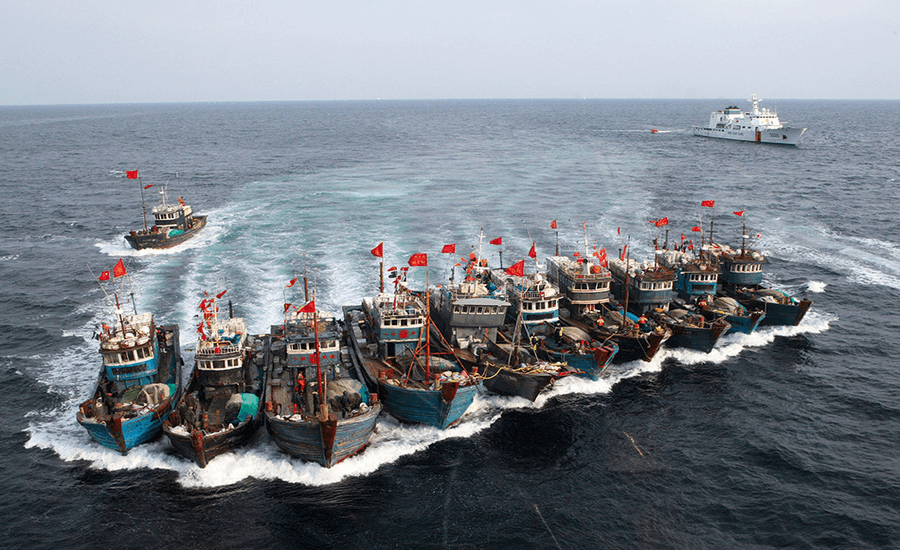
 Image Credits: World Ocean Review
China has invited sharp reactions from African countries over excessive and indiscriminate exploitation of sea-based resources. In December 2014, officials from 24 African countries expressed concerns over the poor state of the African fisheries industry (estimated to be US $24 billion) due to over-exploitation, poor supervision of fishery operations and ineffective law enforcement in the Exclusive Economic Zones. Perhaps the bigger concern for these countries was the unsustainable destructive fishing practices adopted by the Chinese distant water fishing companies operating off the west coast of Africa. These operations had deep economic, environmental and social impact on the people of Africa – the local fishers were losing livelihoods and there were visible signs of destruction of the ecologically fragile ocean environment. Further, some of the Chinese fishing vessels were operating without valid licenses, falsifying their catch as also suspected of catching fish in prohibited areas. These activities broadly fall into the category of illegal, unreported and unregulated (IUU) fishing.
The Greenpeace in its 2013 report noted that Chinese fishing operations in African waters had been growing steadily from 13 licenses in 1985 to 462 in 2013. There were 114 reported cases of illegal fishing by the Chinese fishing companies in waters off Gambia, Guinea, Guinea-Bissau, Mauritania, Senegal and Sierra Leone. More important, four fishing companies were labelled as ‘rogue’ and China National Fisheries Corporation (CNFC), the largest among these, was accused of IUU operations. It had under-declared the gross tonnage for 44 of the 59 vessels, avoiding licensing fees and illegally operating in prohibited areas. Similarly, another study noted that the Chinese distant water fleet annual fish catch between 2000-2011 was about 4.6 million tons and nearly 3.1 million tons was extracted from African waters. Further, China’s overseas fish catch was pegged at 4.6 million tons which is 12 times of what is reported to the UN.
The reputation of Chinese fishing companies hasinvited similar criticism from South Korea which accused the Chinese vessels of IUU operations. Reportedly, 341 Chinese fishing vessels broke rules and South Korea warned of stringent action against defaulters including fines and confiscation of catch instead of handing the matter over to Chinese authorities. Similarly, Indonesia took bold steps to curb IUU fishing and since 2014, after President Joko Widodo assumed office, 151 vessels engaged in IUU operations in Indonesian waters have been scuttled. Last year, notwithstanding fears of diplomatic fallout for Sino-Indonesian relations, Indonesia sank a Chinese vessel that was caught fishing in its waters in 2009. Earlier this year, Indonesia scuttled 30 foreign and local boats, which included 11 from Vietnam, 8 from Malaysia, 7 from the Philippines and the balance from Indonesia. Indonesia loses nearly US $2-5 billion annually due to IUU fishing and Indonesia’s Maritime Affairs and Fisheries Minister Susi Pudjiastuti has argued that IUU fishing be treated as transnational organized crime.
Besides, China’s fish trade (including products imported into China and processed for export) has invited scrutiny over ‘transparency and traceability’ of supply chains which involve clarity on origins, certification for no-illegal transshipments at sea, details of landing and ‘transit between countries for various stages of processing’. For instance, illegal and unreported Pollock and wild-caught Salmon from China was estimated to be more than 30,000 tons and 28,000 tons respectively and these were exported to the US. Further, according to another study, Chinese vessels have been reported in 93 countries and Antarctica and that ‘China’s distant water catch may be under-reported’.
There are also instances of Chinese fishermen using explosives for catching fish and causing irreparable damage to marine ecology and food chain. This practice, called as ‘blast fishing’, is thriving in Dayawan Bay in the South China Sea coast of Guangdong province.
It is quite clear that there are concerns about the Chinese IUU fishing activity and it will have to rein-in its distant water fishing companies, support the international regime to stop IUU fishing on the high seas, ensure transparency of catch, adhere to legal and environmental friendly fishing activity, and avoid illegal ‘at-sea transshipment’. Also, it needs to sign the FAO Agreement on Port State Measures to Prevent, Deter and Eliminate IUU Fishing (PSMA) and provide data on Chinese high- seas fishing vessels and their activities.
China will have to recognize that States look to the sea as a major source of food and are working towards exploitation of these resources in a sustainable manner. They also see the sea as a key to social development and job creation in the form of Blue Economy. Given these trends, IUU fishing by Chinese companies requires greater attention by the State authorities.
********************************
About the Author:
Dr Vijay Sakhuja is Director National Maritime Foundation, New Delhi. He can be reached at sakhuja.v@gmail.com


 Image Credits: The Better India
 Image Credit - U.S. NAVAL INSTITUE
  Image Credits: Allianz Global Corporate & Specialty
 Image Credits: DNA India
Leave a Reply
Want to join the discussion?Feel free to contribute!