
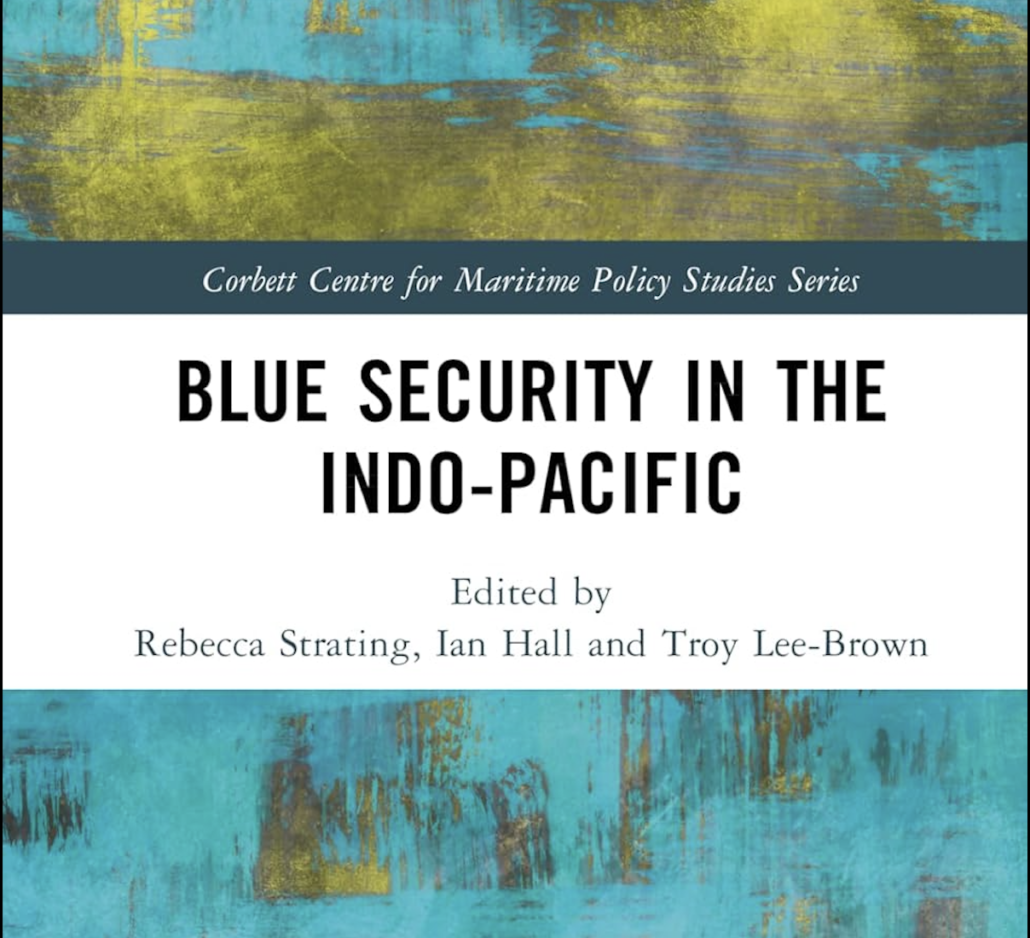
Editors: Ian Hall, Troy Lee-Brown, and Rebecca Strating. Routledge, Abingdon and New York, 2025. 248 pages, Rs 10,221, ISBN: 978-1-032-69289-0 (Hardback)
Against the backdrop of intensifying geopolitical competition, worsening climate change, increasing maritime crime, and mounting pressure upon marine resources, the maritime domain has emerged as one of the most contested and strategically consequential spaces of the twenty-first century. Blue Security in the Indo-Pacific, edited by Ian Hall, Troy Lee-Brown, and Rebecca Strating, engages with this evolving strategic environment by proposing a broader and more integrated understanding of maritime security. Published as part of the Corbett Centre for Maritime Policy Studies Series by Routledge, the volume brings together contributions from leading scholars and practitioners to examine how States across the Indo-Pacific conceptualise and pursue “Blue Security” in response to both traditional and non-traditional maritime challenges.
The volume is edited by three prominent scholars of Indo-Pacific strategic affairs and maritime security. Ian Hall is Professor of International Relations at Griffith University, Troy Lee-Brown is a Research Fellow at the University of Western Australia’s Defence and Security Institute, and Rebecca Strating is Director of La Trobe Asia and Professor of International Relations at La Trobe University. Their combined expertise is reflected in the interdisciplinary and comparative nature of the book, which draws upon international relations theory, maritime law, and security studies to construct a framework suited to the complexity of the subject.
At its core, the book challenges narrow understandings of maritime security centred exclusively upon naval power and interstate rivalry. Instead, the editors propose “Blue Security” as a multidimensional framework encompassing strategic, legal, civil, economic, and environmental dimensions of maritime affairs. Inspired by the existing concepts of the “blue economy” and “good order at sea”, “blue security” is defined as a maritime order that is peaceful, stable, and equitable across these five dimensions. Critically, the editors emphasise that such an order is not given but created, requiring sustained effort and commitment from States and other actors to build, maintain, and improve. Drawing upon the “English School” of international relations, with its focus on how order is purposefully made and unmade through material power, legal argument, and diplomatic action, and accepting the insistence of the “Copenhagen School” upon a broad and holistic understanding of security, the editors construct a framework capable of accommodating the full range of challenges States face in the maritime domain.
The “Introduction” establishes that States across the Indo-Pacific view maritime security through very different lenses depending upon their geography, strategic culture, capabilities, and developmental priorities. Three broad categories of priority emerge from the comparative analysis. Some States — particularly those bordering the South- and the East China Sea — are primarily concerned with territorial disputes and naval competition. Others, such as the United States, Japan, Australia, New Zealand, and India, focus upon maintaining regional order and protecting the rules-based maritime system. A third group — most prominently the Pacific Island States — prioritise climate change, marine resources, and environmental security, in ways that differ fundamentally from the security outlooks of larger powers. For these States, climate change is not a background condition but an existential threat, with rising sea levels endangering not only inhabited land but the very maritime entitlements upon which their economies depend.
One of the most valuable aspects of the volume lies in its broad geographical coverage, spanning South Asia, Southeast Asia, Northeast Asia, and Oceania, with eighteen country case studies written by specialists with deep knowledge of their respective States. This regional diversity allows the editors to demonstrate convincingly that the Indo-Pacific is far from strategically uniform, and that a one-size-fits-all approach to maritime security is neither analytically adequate nor practically useful.
Several individual chapters merit particular attention. Justin Burke’s chapter on Australia is among the most candid in the volume, documenting the considerable gap between Australia’s rhetorical commitment to maritime security and the reality of fragmented governance and declining naval capability. Burke notes that Australia’s Royal Australian Navy possessed 368 missile cells on its major surface combatants in 1995 but only 208 by 2020, a reduction of 43 per cent, while simultaneously holding responsibility for the world’s third largest exclusive economic zone. His central recommendation — the creation of an “Office of Oceans and Maritime Affairs” within the “Department of Prime Minister and Cabinet” to drive an integrated blue security strategy — is carefully argued and practically grounded.
Dita Liliansa’s chapter on Indonesia raises concerns that extend well beyond Indonesia’s borders. Her analysis of how rising sea levels could legally threaten Indonesia’s archipelagic state status, with projections suggesting that 92 of Indonesia’s outermost islands face submersion, points to a fundamental vulnerability in the international legal architecture governing maritime entitlements. Indonesia spent decades of diplomatic effort establishing its archipelagic status under UNCLOS, and the prospect of that status being physically eroded by climate change represents a challenge for which neither international law nor Indonesian domestic policy has yet found an adequate response.
Charmaine Misalucha-Willoughby’s chapter on the Philippines offers a compelling analysis of what the author terms “blue insecurity”, presenting the Philippines as an instructive example of the consequences of chronic strategic incoherence. Without an overarching maritime security framework, the Philippines has relied upon a proliferation of maritime law enforcement agencies with overlapping mandates and competing jurisdictions. The chapter traces how successive administrations have oscillated between alliance with the United States, bandwagoning with China, and resort to international arbitration, arguing that these inconsistencies reflect deeper structural failures in domestic maritime governance rather than simply shifting external pressures.
Edward Sing Yue Chan’s chapter on China provides essential context for understanding the strategic environment within which all other Indo-Pacific States must operate. Chan traces China’s maritime ambitions from coastal defence to far-sea protection, documents the growing role of the Chinese Coast Guard and maritime militia as instruments of grey zone coercion, and offers a clear-eyed assessment of the tensions between China’s stated commitment to a peaceful maritime order and its actions in the South and East China Seas. His observation that China’s approach to issues such as IUU fishing and environmental sustainability is selective, addressed only where consistent with broader national security priorities, is an important qualification to China’s self-presentation as a responsible maritime power.
Bernard Yegiora’s chapter on Papua New Guinea offers a perspective too rarely heard in the maritime security literature. PNG’s vast exclusive economic zone of 3.12 million square kilometres is governed by a state whose nearest police base to some of its most remote maritime territories is hundreds of kilometres away. The account of the Budi Budi Island cocaine discovery, in which bags of cocaine were found by a lone fisherman with no awareness on the part of any law enforcement agency, illustrates with stark clarity the gap between formal maritime jurisdiction and actual governance capacity.
Beyond these individual cases, across the country chapters, several common findings emerge that lend the volume considerable analytical coherence. Almost universally, States are found to lack integrated maritime security strategies capable of bridging traditional and non-traditional security concerns. Governance is fragmented across multiple agencies with insufficient coordination mechanisms. The gap between the size of States’ maritime jurisdictions and their capacity to govern them is striking and widespread. And the tension between economic development imperatives and environmental sustainability is present in virtually every case examined.
The volume is not without limitations. The “blue security” concept, while intellectually productive, is so broad that it risks encompassing almost every dimension of maritime affairs, potentially diffusing analytical focus rather than sharpening it. In some cases, the country chapter format, while enabling valuable comparison, leaves limited space for deeper contextual analysis. The treatment of non-State actors, explicitly included within the “blue security” framework, is also thinner than the framework’s ambitions would suggest, with fishing communities, maritime industry actors, and civil society organisations appearing intermittently rather than systematically across the case studies. Additionally, while the volume’s geographical coverage is impressive, the question of whether the Indo-Pacific constitutes a coherent strategic region or primarily a geopolitical framing promoted by certain powers is raised but not fully resolved, and a more sustained engagement with this tension would have strengthened the volume’s theoretical foundations.
These limitations notwithstanding, “Blue Security in the Indo-Pacific” represents a substantial and timely contribution to the field. Its core argument that maritime security must be understood holistically if it is to be addressed effectively, is both well-supported and practically consequential. The volume demonstrates through its eighteen case studies that the most pressing maritime security challenges facing Indo-Pacific States are as much problems of governance and institutional coordination as they are problems of naval capability and strategic competition. For scholars of maritime security, international relations, and Indo-Pacific affairs, and for practitioners working in defence, foreign policy, and ocean governance, this volume will be essential reading.
********
About the Author
Ms Kripa Anand is a Research Associate at the National Maritime Foundation (NMF). Her research encompasses maritime security issues, with special focus upon the manner in which India’s own maritime geostrategies are impacted by the maritime geostrategies of the island-States of Oceania in general and Australia and New Zealand in particular. She may be reached at ocn1.nmf@gmail.com.


Leave a Reply
Want to join the discussion?Feel free to contribute!