
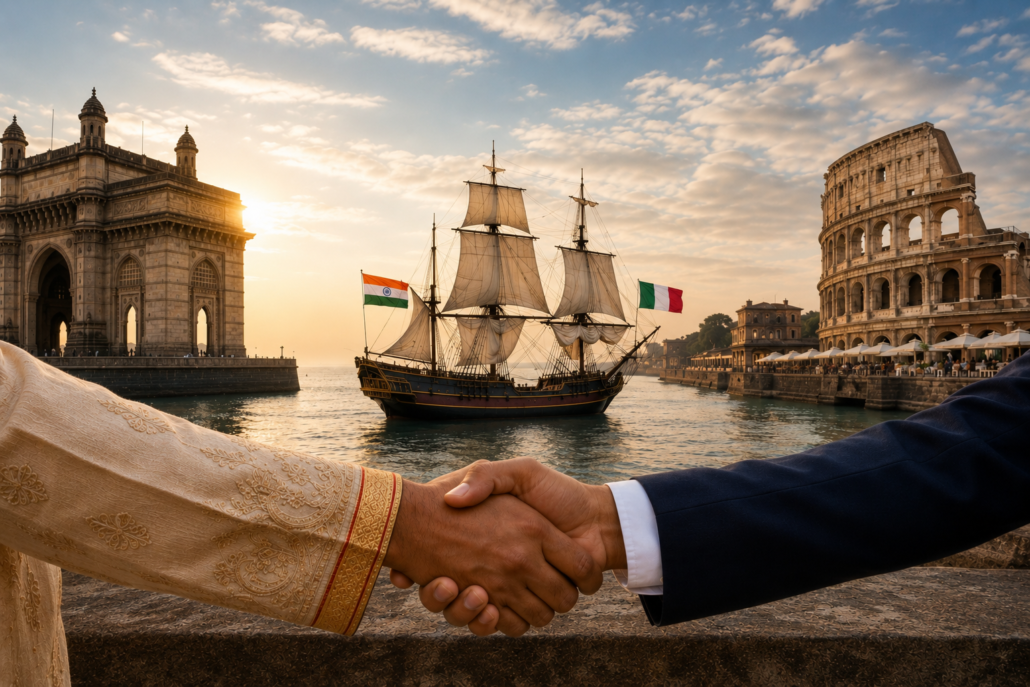
The recent elevation of India-Italy relations to those of a “Special Strategic Partnership”[1] reflects a widening convergence that now extends beyond trade, defence, and technology, into the realm of maritime heritage and cultural diplomacy.[2] The decision by both countries to deepen cooperation in culture, archaeology, tourism, and heritage preservation, demonstrates a recognition that historical connections can strengthen contemporary diplomacy. Within this context, maritime heritage provides an important intellectual and diplomatic bridge linking the Indian Ocean and the Mediterranean worlds.
Both leaders welcomed the signing of a Memorandum of Understanding (MoU) regarding Italy’s participation in the development of the National Maritime Heritage Complex at Lothal in Gujarat.[3] The significance of this development extends beyond mere museum cooperation. Lothal occupies an important position within India’s maritime imagination because it represents the world’s earliest port-based urban settlement associated with the Indus-Saraswati Civilisation.[4] The decision also reflects a wider geopolitical context. Across regions, maritime heritage is increasingly becoming linked with questions of identity, connectivity, tourism, and strategic influence. Nations are investing in museums, underwater archaeology, cultural routes, and heritage diplomacy as instruments of soft power projection. In this context, the collaboration between India and Italy acquires significance because it connects two maritime civilisations through a shared interest in preserving and interpreting maritime history.
The leaders also acknowledged the participation of the Indian national pavilion at the Venice Art Biennale in 2026.[5] Venice itself historically functioned as one of the most important maritime gateways linking Europe with Africa-Asia trade networks.[6] The symbolic importance of India’s presence in Venice, therefore, intersects with deeper historical memories of Indo-Mediterranean commercial and cultural exchange. Such initiatives contribute to the construction of a long-term narrative in which India and Italy are viewed, not merely as contemporary partners, but as civilisational actors connected through centuries of maritime interactions.
Equally significant was the announcement declaring 2027 as the “Year of Culture and Tourism between Italy and India”.[7] The aim is to promote a broad calendar of cultural activities and pave the way for a major exhibition on ancient cultural relations between India and Italy to be jointly organised by the respective Ministries of Culture.[8] This announcement reflects an emerging recognition that diplomacy increasingly operates not only through State institutions (although they are the enablers), but also through informal thrust lines.[9]
The proposal to organise an India-Italy Cultural Forum involving institutions, think-thanks, scholars, and representatives of the creative industries further expands the scope of engagement. Unlike traditional State-centric diplomacy, such forums create sustained intellectual and cultural ecosystems capable of generating long-term collaboration. They facilitate interaction between museums, universities, think tanks, conservation experts, filmmakers, maritime archaeologists, tourism planners, and cultural entrepreneurs. More importantly, they help transform cultural diplomacy from a ceremonial exercise into an institutional process.
Another important initiative announced during the discussions was the twinning programme between UNESCO World Heritage sites in India and Italy.[10] The objective of the initiative is to strengthen cooperation in the protection, enhancement, and management of cultural heritage. Although framed within heritage conservation, the programmes carry wider implications. UNESCO sites are not simply monuments; they are embedded within local economies, tourism circuits, urban planning systems, and national identity narratives.[11] Collaborative management therefore creates opportunities for exchanging expertise in conservation technologies, climate adaptation strategies for heritage sites, sustainable tourism practices, and digital documentation methods.
Tourism today is closely connected with heritage branding, maritime routes, urban revitalisation, and cultural economies. Italy possesses one of the world’s most sophisticated heritage tourism infrastructure, while India has increasingly sought to expand its own heritage-based tourism sector. Cooperation in this field creates possibilities for knowledge exchange in museum management, conservation science, maritime tourism development, and heritage interpretation.
The growing emphasis on maritime cooperation also aligns with India’s broader cultural diplomacy initiatives, particularly Project MAUSAM. Launched by India in 2014, Project MAUSAM seeks to reconnect countries linked historically through the Indian Ocean by highlighting shared maritime histories, trade networks, and cultural exchanges.[12] Although the initiative initially focused primarily on countries across Asia and Africa, the contemporary expansion of Indo-Mediterranean engagement creates an opportunity to incorporate Mediterranean partners such as Italy and Greece into the broader framework of maritime cultural cooperation.[13]
The broader significance of these developments also lies in the changing geopolitical landscape connecting the Indo-Pacific and the Mediterranean regions. Maritime routes linking Asia, Africa, and Europe have once again acquired centrality due to shifts in global trade, energy transportation, and connectivity projects such as the India-Middle East-Europe Economic Corridor (IMEC).[14] Within this emerging geography, India and Italy occupy important maritime positions at opposite ends of interconnected oceanic spaces. Consequently, maritime heritage and cultural diplomacy become tools through which larger narratives can be constructed.
However, the true importance of these initiatives will depend upon whether they move beyond symbolism. Cultural declarations often generate visibility without producing institutional continuity. The challenge before both countries is therefore to convert commemorative initiatives into long-term frameworks of cooperation capable of integrating research, tourism, maritime studies, heritage conservation, education, and public diplomacy. Unless supported through sustained assurance and insurance mechanisms, cultural agreements risk remaining episodic and ceremonial.[15]
The recent developments nevertheless indicate that India and Italy are beginning to recognise an important reality: maritime history is not simply about the past. It is increasingly becoming part of how nations imagine connectivity, identity, and partnerships in the present. The attempt to reconnect the India Ocean and Mediterranean ‘worlds’ through culture and heritage may therefore represent the beginning of a broader Indo-Mediterranean maritime discourse with long-term geopolitical and civilisational implications.
Reconnecting the Indian Ocean and the Mediterranean
The contemporary effort to strengthen maritime and cultural cooperation between India and Italy is not occurring in a historical vacuum. Long before the emergence of modern nation-States, the Indian Ocean and the Mediterranean constituted interconnected maritime spaces linked through commerce, migration, religion, diplomacy, and cultural exchange.[16] Although India and Italy did not exist in their present political forms during much of this history, the regions that now constitute these countries participated in wider oceanic networks that connected Indian subcontinent with the Mediterranean across several centuries.[17]
The foundations of these interaction can be traced back to ancient maritime trade routes linking the Roman Empire with the western and southern coasts of India. Following the discovery and systematic use of monsoon wind patterns in the Indian Ocean, maritime trade between these regions expanded considerably between the first century BCE and the third century CE.[18] Roman merchant began travelling through the Red Sea into the Arabian Sea, establishing commercial connections with ports along the Malabar and Coromandel coasts.
Historical texts such as the Periplus of the Erythraean Sea[19] and archaeological findings from sites in southern India demonstrate the scale of this interaction.[20] This historical entanglement is underscored by material evidence: the largest volume of Roman coins found outside their home regions has been discovered in India, highlighting the intensity and longevity of trade and cultural exchanges between the subcontinent and the Mediterranean world.[21] Roman coins, amphorae, ceramics, and Mediterranean artefacts discovered in India coastal settlements indicate active maritime exchange. Indian spices, textiles, ivory, gemstones, and luxury goods moved westward, while gold, wine, glassware, and metal products arrived into India. Ports in present-day Kerala and Tamil Nadu (such as Muziris and Arikamedu) became important nodes within this Indo-Mediterranean commercial system.
The collapse of direct Roman political authority did not entirely end these connections. During the medieval period, maritime interactions between the Mediterranean and Indian Ocean worlds continued through Arab, Persian, Venetian, and other intermediary trading networks. Italian thalassocracies, particularly Venice and Genoa, emerged as important commercial powers deeply integrated into eastern trade systems.[22] Although direct navigation from Italy to India remained limited during much of this period, Indian goods continued reaching Mediterranean markets through layered commercial routes crossing the Red Sea and West Asia.
The importance of Indian Ocean trade to Mediterranean economies was so substantial that the disruption of these routes contributed to European efforts to discover alternative sea passages to Asia.[23] In many ways, the maritime expansion of European powers during the fifteenth and sixteenth centuries was directly linked to the strategic and commercial importance of Indian Ocean trade networks. The Portuguese arrival in India under Vasco da Gama in 1498 marked a major turning point in this process, transforming patterns of maritime power and commercial competition across Eurasia. Although Portuguese expansion dominated early European maritime engagement with India, Italian individuals and intellectual traditions also remained connected to these developments. Several Italian travellers, missionaries, merchants, and scholars journeyed to India during the early modern period, contributing to the exchange of geographical knowledge, artistic traditions, and cultural perceptions between Europe and South Asia.
Maritime relations between India and Italy also evolved through broader transformations in global politics during the colonial and industrial eras. The opening of the Suez Canal in 1869 dramatically altered maritime geography by reconnecting the Mediterranean more directly with the Indian Ocean.[24] This development significantly reduced travel time between Europe and Asia, strengthening the strategic and economic importance of maritime routes linking the two regions.
For Italy, which achieved political unification in the nineteenth century, maritime access and Mediterranean influence became central strategic concerns. Simultaneously, colonial India became increasingly integrated into imperial maritime trade systems connecting Europe, West Asia, and Asia-Pacific markets. Ports such as Bombay emerged as major nodes within global shipping networks, facilitating intensified interaction between Mediterranean and Indian Ocean commercial systems.
In recent decades, however, significant geopolitical changes have renewed interest in reconnecting the Indian Ocean and Mediterranean worlds. The rise of the Indo-Pacific as a strategic geography, growing concerns regarding maritime security, global supply chain disruptions, energy transportation routes, and infrastructure connectivity projects have all increased the importance of oceanic geopolitics. Within this evolving environment, India and Italy are rediscovering the historical depth of their maritime linkages.
This renewed interest is not simply about recovering historical memory. Rather, it reflects a broader recognition that maritime history continues to shape contemporary geopolitics. Oceans are no longer viewed merely as spaces of transportation; they are increasingly understood as arenas of strategic competition, economic integration, technological cooperation, and cultural diplomacy. Consequently, historical maritime relationships are acquiring renewed relevance within contemporary foreign policy thinking.
The idea of an Indo-Mediterranean space has therefore become increasingly important. Traditionally, policy discussions treated the Indian Ocean and the Mediterranean as separate geopolitical regions. Yet historically, they formed part of interconnected commercial and cultural systems extending across Eurasia and Africa. Reimagining these regions as interconnected maritime spaces allows countries such as India and Italy to develop broader frameworks of cooperation rooted in both historical experience and contemporary interests.
Maritime history also offers an important corrective to overly narrow understandings of bilateral relations.[25] Too often, international partnerships are evaluated only through trade volumes, defence agreements, or short-term diplomatic outcomes. While these dimensions remain important, they do not fully capture the deeper civilisational and historical contexts that shape long-term relationships between societies. Maritime exchange historically created forms of interaction that were gradual, layered, and socially transformative.[26] Ports became spaces where languages, religions, technologies, cuisines, and artistic traditions intersected.[27]
In this context, the growing emphasis on maritime heritage within India–Italy relations acquire greater significance. Heritage is not simply about preserving monuments or artefacts. It is about interpreting historical experiences in ways that shape contemporary identity and strategic imagination. The collaboration at Lothal, the cultural initiatives linked with Venice, and the broader focus on Indo-Mediterranean connectivity collectively indicate an attempt to reconnect historical memory with present geopolitical realities.
Yet there remains a critical challenge. Much of the public understanding of maritime history in both India and Europe continues to remain fragmented and land-centric. Maritime consciousness often receives limited attention within educational systems, public discourse, and national historical narratives. As a result, societies frequently underestimate the extent to which oceans shaped patterns of economic development, cultural interaction, and political transformation.
Strengthening India–Italy maritime cooperation, therefore, requires more than commemorating historical ties. It requires the development of a sustained intellectual and institutional framework capable of integrating maritime history into contemporary strategic thinking. Without such a framework, historical references risk becoming symbolic gestures disconnected from policy relevance.
Building a Long-Term Indo-Mediterranean Maritime Partnership
The historical relationship between India and Italy demonstrates that maritime interactions have never been confined solely to commerce. They have historically shaped cultural exchange, political imagination, technological diffusion, and civilisational connectivity across regions. Recognising this historical depth is essential because it provides the foundation upon which a more meaningful and future-oriented Indo-Mediterranean partnership can be constructed.
However, if India and Italy intend to transform recent cultural and maritime initiatives into a durable strategic framework, both countries will need to move beyond symbolic engagement and develop structured, policy-oriented mechanisms of cooperation. Maritime collaboration must therefore be approached not as a ceremonial exercise, but as a long-term institutional and strategic partnership connecting heritage, research, tourism, sustainability, education, and geopolitical connectivity.
The following recommendations identify key areas in which India and Italy can deepen cooperation and build a comprehensive Indo-Mediterranean maritime partnership:
- Strengthening Maritime Archaeology and Underwater Heritage Cooperation.
One of the most promising areas for India-Italy collaboration lies in maritime archaeology and underwater heritage research. Both countries possess historically significant coastlines containing ancient ports, submerged settlements, shipwrecks, and maritime trade remains. Italy has developed substantial expertise in underwater archaeology, conservation methods, and maritime museum practices, while India has gradually expanded research activities in locations such as Dwarka, Poompuhar, and the Gujarat coastline.
Collaborative archaeological expeditions, technological exchanges, and training programmes could significantly strengthen India’s maritime heritage capacities and capabilities. Joint research on ancient Indo-Mediterranean trade networks would not only contribute to academic scholarship, but also help create broader international awareness regarding historical maritime connectivity between the Indian Ocean and Mediterranean regions. Cooperation in this field should also include conservation science, digital documentation, and marine heritage protection policies.
- Transforming Lothal into an International Maritime Research Hub
The National Maritime Heritage Complex at Lothal must evolve beyond its identity as a domestic museum project and emerge as an international centre for maritime research, heritage interpretation, and Indo-Mediterranean studies. Italy’s participation creates an opportunity to integrate advanced curatorial methods, interactive exhibition technologies, conservation expertise, and global museum practices into the development of the complex.
Lothal can become a platform connecting archaeology, public history, tourism, education, and maritime diplomacy. Joint exhibitions focusing on Roman–Indian trade, Mediterranean shipping networks, ancient navigation systems, and historical port cities could position the complex as a globally recognised maritime institution. Establishing collaborative research laboratories and visiting scholar programmes at Lothal would further institutionalise India–Italy maritime engagement.
- Expanding Research Collaboration
India and Italy should establish sustained research partnerships focused on maritime history, oceanic geopolitics, heritage conservation, and Indo-Mediterranean connectivity. At present, scholarly cooperation in these areas remains limited and fragmented despite the historical depth of interaction between the two regions.
Universities, museums, think tanks, and maritime research institutes should therefore develop structured exchange programmes involving researchers, historians, archaeologists, geographers, and policy experts. Joint conferences, archival projects, fellowship programmes, and collaborative publications would help build an intellectual ecosystem capable of supporting long-term policy engagement.
An “India–Italy Centre for Indo-Mediterranean Studies” could also be established as a permanent institutional platform dedicated to research on maritime connectivity, cultural diplomacy, blue economy initiatives, and strategic maritime affairs. Such a centre would help bridge the gap between scholarship and policymaking.
- Developing Digital Maritime Heritage Platforms
Digital technologies offer important opportunities for expanding access to maritime history and heritage. India and Italy should collaborate on digital archiving, virtual exhibitions, 3D mapping of archaeological sites, and immersive museum technologies focused on Indo-Mediterranean maritime exchange.
Jointly developed virtual heritage corridors linking museums, ports, historical trade routes, and archaeological sites could make maritime history more accessible to global audiences. Such initiatives would also strengthen educational outreach and public engagement, especially among younger generations increasingly dependent on digital platforms for historical learning and cultural interaction.
- Promoting Sustainable Maritime and Heritage Tourism
Tourism cooperation between India and Italy should focus on developing integrated maritime-cultural tourism frameworks rather than relying solely on conventional promotional campaigns. Italy’s experience in heritage tourism management and coastal urban conservation offers important lessons for India’s expanding tourism sector.
Both countries can collaborate in designing maritime tourism circuits connecting ancient ports, museums, UNESCO heritage sites, coastal cultural landscapes, and historical trade centres. Such initiatives would support local economies while simultaneously promoting public awareness regarding maritime history.
Special attention should also be given to sustainable tourism models. Coastal regions across both countries face challenges related to environmental degradation, infrastructure stress, and over-tourism. Policy exchanges regarding visitor management, coastal conservation, heritage-sensitive urban planning, and sustainable tourism practices could therefore generate long-term benefits.
- Building Climate and Coastal Resilience Partnerships
Climate change presents growing risks to coastal heritage sites, maritime ecosystems, and port cities across both the Indian Ocean and Mediterranean regions. Rising sea levels, coastal erosion, flooding, and marine pollution increasingly threaten historically important maritime landscapes.
India and Italy should therefore develop joint initiatives focused on coastal resilience, climate adaptation, and heritage conservation technologies. Collaboration between environmental agencies, conservation scientists, maritime planners, and heritage institutions would help integrate sustainability concerns into maritime policy frameworks. Such cooperation is especially important because heritage preservation can no longer be separated from ecological and climate-related challenges.
- Orange Economy for Maritime Cultural Diplomacy
Film, literature, digital media, and other creative industries offer important but underutilised opportunities for India–Italy maritime cooperation. Maritime histories possess strong narrative potential capable of reaching audiences beyond academic and diplomatic circles.
Joint documentary productions, historical film collaborations, museum storytelling projects, podcasts, and multimedia heritage initiatives could help popularise Indo-Mediterranean maritime history in accessible formats. Such initiatives would not only strengthen cultural diplomacy, but also support broader people-to-people engagement and creative sector collaboration. The orange economy can, therefore, become an important instrument for connecting historical narratives with contemporary cultural industries. By integrating heritage with creative expression, both countries can expand the public visibility of maritime cooperation while strengthening long-term cultural engagement.
Conclusion
The recommendations outlined above collectively demonstrate that the future of India–Italy maritime cooperation cannot remain confined to symbolic diplomacy or isolated cultural initiatives. Maritime heritage, historical memory, research collaboration, tourism, climate resilience, and strategic connectivity are increasingly intersecting within a broader Indo-Mediterranean geopolitical space. Consequently, the real significance of the emerging India–Italy partnership lies not merely in commemorating historical linkages, but in institutionalising them through long-term frameworks of cooperation capable of generating intellectual, cultural, economic, and strategic outcomes.
If approached seriously, these initiatives can help both countries move toward a more integrated understanding of maritime policy in which heritage is linked with contemporary geopolitical realities and future-oriented development. The challenge therefore is not the absence of opportunities, but the ability to sustain institutional commitment, public engagement, and policy continuity beyond short-term diplomatic momentum.
In an era increasingly defined by maritime competition, infrastructural connectivity, and geopolitical realignment, the ability to combine cultural diplomacy with strategic vision may become an important source of international influence. India and Italy, as two historically maritime civilisations positioned within interconnected oceanic regions, possess both the historical depth and the contemporary opportunity to shape such an Indo-Mediterranean framework for the future.
********
About the Author:
Mr Suraj Palavalsa is a Research Associate at the National Maritime Foundation. He has a Bachelor’s degree in Sociology, History, Political Science, and Economics (Ancillary) from Banaras Hindu University (BHU), and earned his MA degree in International Relations (South Asian Studies) from Pondicherry University, Puducherry. His current research focuses on reviving India’s maritime consciousness, as also on ports and maritime connectivity, adopting an interdisciplinary approach to both areas. He can be reached at emc1.nmf@gmail.com.
Endnotes:
[1] Shubhajit Roy, “India, Italy upgrade ties | Special strategic partnership announced: Trade to corridor, defence to ports”, The Indian Express, 21 May 2026, https://indianexpress.com/article/india/strategic-partnership-india-italy-narendra-modi-giorgia-meloni-trade-defence-10699996/.
[2] Government of India, Ministry of External Affairs, Media Centre, “India-Italy Joint Declaration”, Ministry of External Affairs, Government of India, 20 May 2026, https://www.mea.gov.in/bilateral-documents.htm?dtl/41198/IndiaItaly_Joint_Declaration_May_20_2026.
[3] Government of India, Ministry of External Affairs, Embassy of India to Italy and San Marino, Press Releases, “Transcript of Special Briefing by MEA on the visit of the Prime Minister to Italy”, Embassy of India to Italy and San Marino, MEA, GoI, 26 May 2026, https://www.indianembassyrome.gov.in/news_letter_detail.php?id=128.
[4] UNESCO, World Heritage Convention, Tentative List, “Archaeological remains of a Harappa Port-Town, Lothal”, World Heritage Convention, UNESCO, https://whc.unesco.org/en/tentativelists/5918/.
[5] Government of India, Prime Minister’s Office, Press Information Bureau, “India-Italy Joint Declaration”, Press Information Bureau (PIB), GoI, 20 May 2026, https://www.pib.gov.in/PressReleasePage.aspx?PRID=2263405®=3&lang=1.
[6] UNESCO, World Heritage Convention, “Venice and its Lagoon”, World Heritage Convention, UNESCO, https://whc.unesco.org/en/list/394/.
[7] Government of India, Prime Minister’s Office, Press Information Bureau, “India-Italy Joint Declaration”, Press Information Bureau (PIB), GoI, 20 May 2026.
[8] Government of India, Prime Minister’s Office, Press Information Bureau, “India-Italy Joint Declaration”, Press Information Bureau (PIB), GoI, 20 May 2026.
[9] Priyasha Dixit, “Approaches to Developing Maritimity: Integrating Formal Institutions and Informal Narratives”, in Maritime Perspectives: Enhancing India’s Maritime Consiousness, eds., VAdm Pradeep Chauhan and Sruthylacshmi B Bhat (New Delhi: National Maritime Foundation, Oct 2025).
[10] “India, Italy to celebrate 2027 as Year of Culture: MEA”, ANI News, 21 May 2026, https://www.aninews.in/news/world/europe/india-italy-to-celebrate-2027-as-year-of-culture-mea20260521055111/.
[11] UNESCO, World Heritage Convention, “Home: World Heritage”, World Heritage Convention, UNESCO, https://www.unesco.org/en/world-heritage.
[12] Government of India, Ministry of Culture, “Project Mausam”, Ministry of Culture, Government of India. https://www.indiaculture.gov.in/project-mausam.
[13] Priyasha Dixit and Suraj Palavalsa, “Expanding the western Horizon of Project MAUSAM Integrating the Mediterranean and European countries”, in Operationalising Project MAUSAM: Building India’s Maritime Consciousness & Regional Leadership, eds., Suraj Palavalsa and VAdm Pradeep Chauhan (New Delhi: National Maritime Foundation, Oct 2025).
[14] Press Trust of India, “IMEC, Indo-Pacific routes key to reducing Hormuz dependence: EY”, Economic Times, 28 May 2026, https://economictimes.indiatimes.com/industry/transportation/shipping-/-transport/imec-indo-pacific-routes-key-to-reducing-hormuz-dependence-ey/articleshow/131370386.cms.
[15] Suraj Palavalsa, “Legal and Institutional Framework for Project MAUSAM”, in Operationalising Project MAUSAM: Building India’s Maritime Consciousness & Regional Leadership, eds., Suraj Palavalsa and VAdm Pradeep Chauhan (New Delhi: National Maritime Foundation, Oct 2025): 261-275.
[16] Dr Arvind Virmani & Shruti Sabharwal, “Gondwana: Economic Integration of Indian Ocean Region”, NITI Aayog Working Paper, NITI Aayog, December 2025, 2-5, https://niti.gov.in/sites/default/files/2026-02/Gondwana-Economic-Integration-of-Indian-Ocean-Region.pdf.
[17] Frederic C Lane, “The Mediterranean Spice Trade Further Evidence of Its Revival in the Sixteenth Century”, The American Historical Review 45, no. 3 (1940): 581–90.
[18] Mathew Cobb, “The Chronology of Roman Trade in the Indian Ocean from Augustus to Early Third Century AD”, University of Wales Trinity Saint David, https://repository.uwtsd.ac.uk/id/eprint/853/1/Cobb%2C%20Matthew%20%282015%29-%20The%20Chronology%20of%20Roman%20Trade%20with%20India%20in%20the%20Principate.pdf.
[19] Periplus Maris Erythraei (Periplus of the Erythraean Sea), translated by Wilfred H. Schoff (London: Longmans, Green and Co., 1912).
[20] Eivind Heldaas Seland, “The Periplus of the Erythraean Sea: A Network Approach”, The Asian Review of World Histories, August 2016, DOI: 10.12773/arwh.2016.4.2.191.
Also Read:
Elizabeth Ann Pollard, “The Mediterranean and the Indian Ocean”, in A Companion to Mediterranean History, eds., Peregrine Horden & Sharon Kinoshita (New Jersey: John Wiley & Sons, Ltd, 457-474.
[21] Robert Sewell, “Roman Coins Found in India,” Journal of the Royal Asiatic Society (October 1904): 591-6377, http://penelope.uchicago.edu/Thayer/E/Journals/RAsiaSoc/1904/October/Roman_Coins_Found_in_India*.html.
[22] Peter L Viscusi, “Venetian Merchants Dominate Trade with the East”, EBSCO Information Services, 2022, https://www.ebsco.com/research-starters/history/venetian-merchants-dominate-trade-east.
[23] KN Chaudhuri, Trade and Civilisation in the Indian Ocean: An Economic History from the Rise of Islam to 1750 (Cambridge: Cambridge University Press, 1985).
[24] Daniel R Headrick, The Tools of Empire: Technology and European Imperialism in the Nineteenth Century (New York: Oxford University Press, 1981), 156–165.
[25] Michael N Pearson, The Indian Ocean (London: Routledge, 2003), 3–11.
[26] KN Chaudhuri, Trade and Civilisation in the Indian Ocean: An Economic History from the Rise of Islam to 1750 (Cambridge: Cambridge University Press, 1985), 64–78.
[27] Michael N Pearson, Port Cities and Intruders: The Swahili Coast, India, and Portugal in the Early Modern Era (Baltimore: Johns Hopkins University Press, 1998), 15–32.


Leave a Reply
Want to join the discussion?Feel free to contribute!