
Rear Admiral Monty Khanna (Retd) – Issue No 14 dated 01 Jan 2026
China’s third aircraft carrier, Fujian was commissioned on 05 Nov 2025. She is a substantial departure from her earlier siblings. Gone is the ramp at the bows which has been replaced by three Electro Magnetic Launching Systems (EMALS), thus making the switch from a Short Take Off but Arrestor Landing (STOBAR) configuration to a full-fledged Catapult Take Off But Arrestor Landing (CATOBAR) one. Apart from that, she is much larger (estimated displacement of approximately 80,000 tons), a little longer (315 m), and far more capable. Simultaneously, China developed three aircraft that can be operated from the Fujian. These are the J-15T (a catapult compatible version of the J-15), the J-35 (a twin engined 5th generation stealth fighter) and the KJ-600 (a carrier operable AWACS platform). Given the scale of the changes and the immense design work involved for doing so, it may have been assumed that the next one or two aircraft carriers would have been built to the same design. However, this is unlikely to be so. The vessel currently undergoing construction in Dalian Shipyard is starting to appear more and more like a nuclear-powered aircraft carrier for reasons spelt out in detail below.
Reason No 1. China has not shied away from its ambition to build nuclear powered aircraft carriers. The PLAN sees itself as a peer rival of the U.S. Navy and, in the past, has drawn a lot of its inspiration from the platforms that the USN has acquired over the years. Principle amongst these are aircraft carriers. Being constrained in this pursuit by technology denial regimes in place, it had little option but to turn to the Russians during the formative years of this effort. Hence the purchase and extensive redesign of the Liaoning and its modified clone, the Shandong. However, realization has always run deep that with over a century worth of intense experience in operating aircraft carriers, the ultimate repository of information and technology in this field lies with the USN. The early departure from a STOBAR configuration and the leapfrogging to an EMALS based CATOBAR carrier in the Fujian, mimicking developments in the USN, underscores this hypothesis. The adoption of nuclear power remains the holy grail insofar as carrier construction is concerned. China’s ambition to have such a platform has been on display at the Beijing maritime museum for close to two decades (Fig 1).
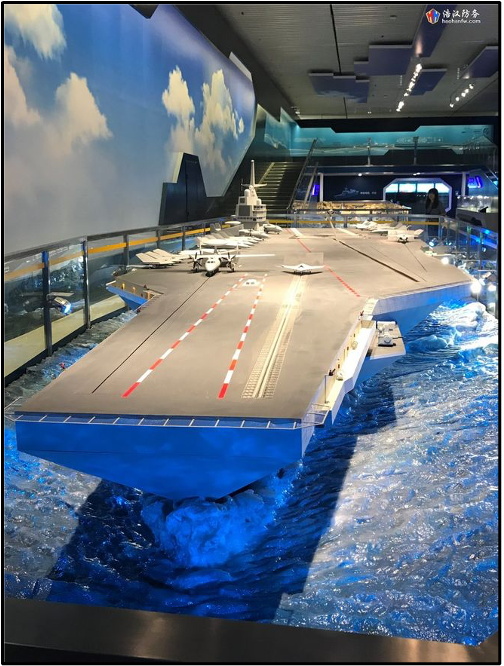
Fig 1: Model of CVN at the Beijing Maritime Museum
Reason No 2. China goes through an elaborate process of derisking the induction of aircraft carriers by testing the broad parameters of evolving configurations at a 1:1 scale model at the Ship Integration Facility of the China Ship Design and Research Center located at Wuhan. Developments at this facility are a harbinger of what is likely to come! After the construction of the Fujian was well underway, redesign activity resumed at this facility. The entire island structure was dismantled and a new one fabricated at the rear of the model (Fig 2).
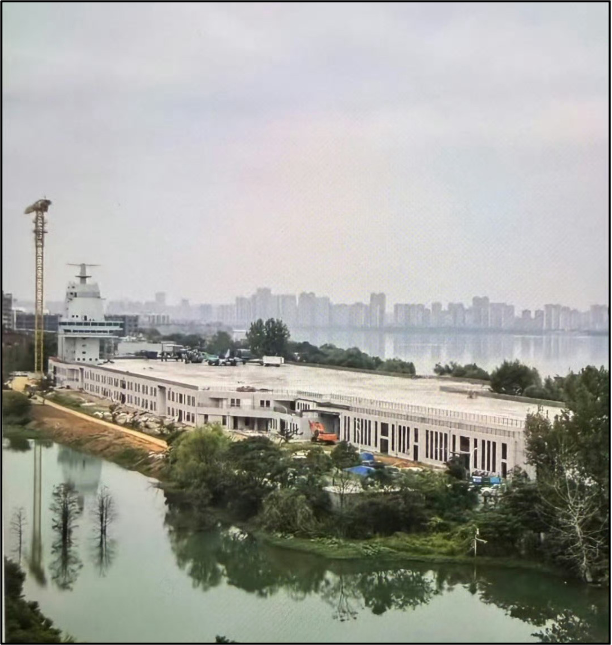
Fig 2: Island Reconstructed Right Aft of the 1:1 Scale Model at Wuhan
As mentioned in Issue No 3 of Dabolim Diaries dated 15 Jan 2025, one of the major considerations of sighting the island of an aircraft carrier is the facilitation of unimpeded aircraft operations. On the USS Ford for instance, the island has been shifted further aft of the location it had on the Nimitz class. The new location allows far greater parking space for aircraft ahead of the island while minimising the space astern. This is an advantage as if an aircraft had to be moved from aft of the island to ahead of it or vice versa, landing operations on the angled flight deck have to stop. The concomitant disadvantage of bridge watchkeepers having a large blind zone ahead of the ship has been addressed by placement of lookouts near the bows as well as by using modern day EO/IR pods.
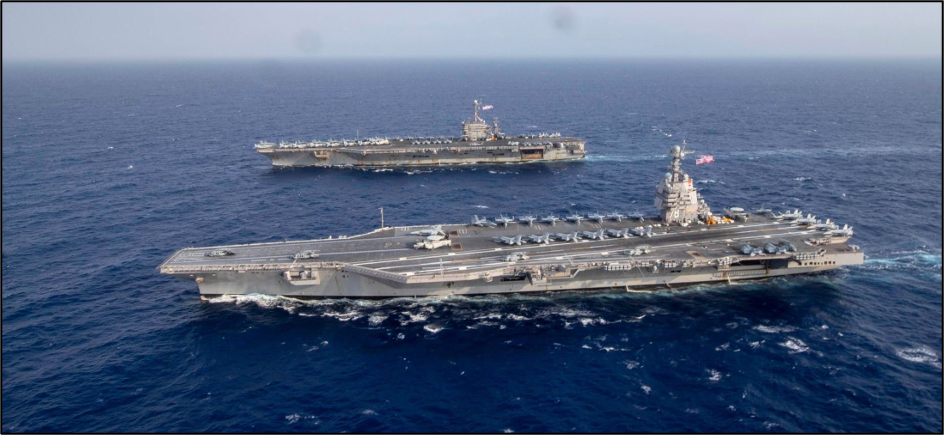
Fig 3: USS Ford (Foreground) with a Nimitz Class Aircraft Carrier (Background)
Such flexibility in the placement of the island is not available to conventionally powered aircraft carriers as the island also houses the funnel for locating up-takes and down-takes that cater for the voluminous amount of air required to power hydrocarbon-based fuel burning engines; be they boilers or gas turbines. These passages are required to be short to cater for efficiency and minimise the use of internal volume. Further, machinery spaces at the bowels of the ship are typically spread over two or more sections in a central position of the hull so as to ensure flooding or damage of any one section does not result in a catastrophic failure of the entire propulsion system. As a consequence, the island perforce has to be located close to the midships position or may even be split into a twin-island configuration as done in the Royal Navy’s Queen Elizabeth Class aircraft carriers.
Reason No 3. The drydock in Dalian Shipyard where the vessel is currently undergoing construction was vacant for several months before the keel of the presumed Type 004 was laid. In the past, the dock has been regularly used for the construction of large commercial vessels in addition to aircraft carriers (Liaoning and Shandong). Keeping an expensive asset like this idling at a time when commercial shipbuilding is booming and there is immense pressure on shipyards to deliver vessels in the shortest feasible time-frame, would be justifiable only if it were needed for a project of immense strategic value. The vacant dock could be linked to either slippage in the commencement date of this vessel or to undertake some modifications which were probably necessary for handling the complexities associated with a Nuclear Power Plant (NPP), an activity that this yard is undertaking for the first time.
Reason No 4. Recent pictures of the shipyard dated December 2025 show rapid progress of fabrication with over 150 m of the keel and associated compartments having already been laid.
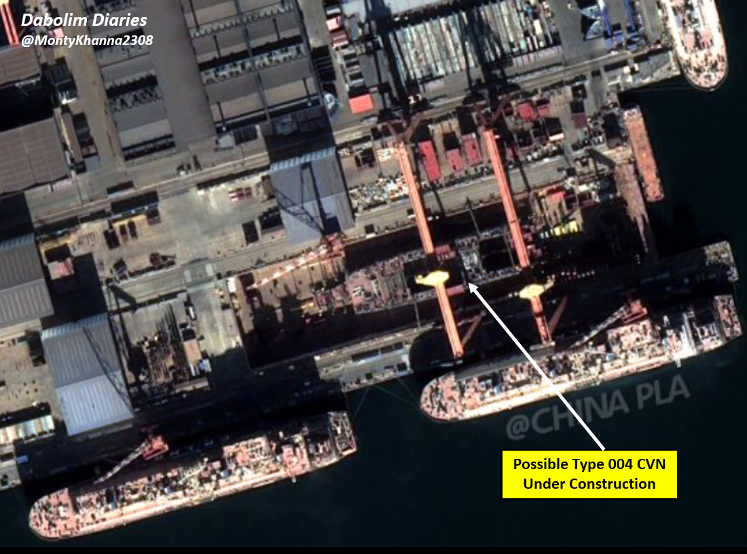
Fig 4: Picture of Dry Dock in Dalian Shipyard with Assessed Type 004
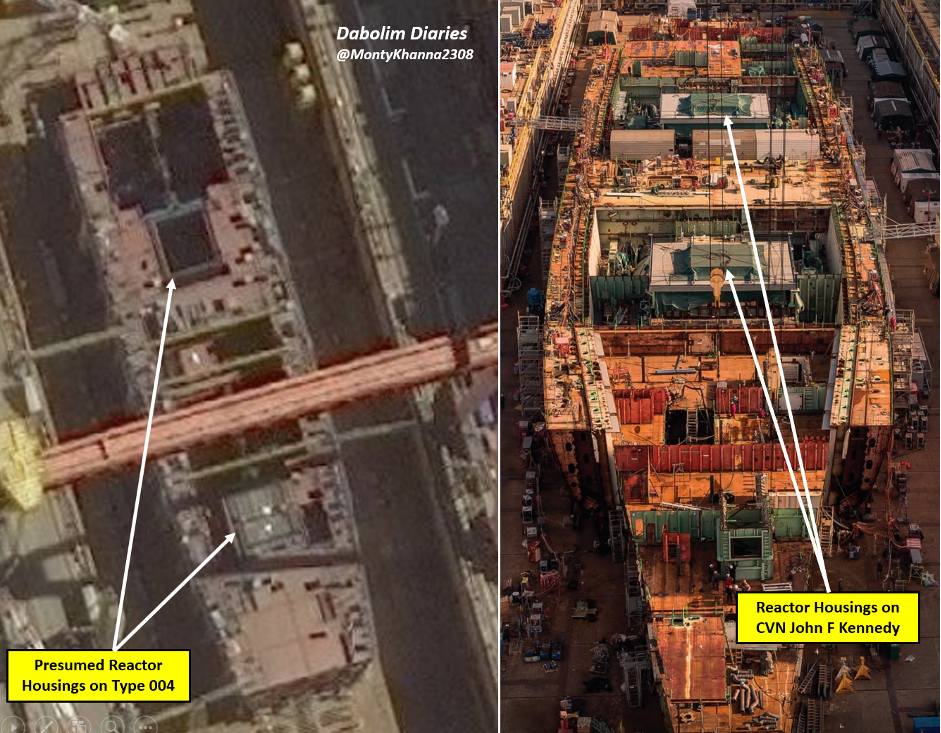
More importantly, the structure contains two, what appears to be double walled containers of approximate dimensions 15 x 15 m, which are commensurate to the design and dimensions of shipborne nuclear reactors. These containers are well spaced out to ensure that they lie in different sections of the vessel; to cater for survivability should one section of the vessel sustain damage. Large openings aft of each of these containers would be for the fitment of boilers, turbines, reduction gearing and other auxiliary equipment to convert the thermal energy of the reactor into propulsive power. This layout is similar to that of the under construction CVN John F Kennedy, as seen in Fig 5 below.
Fig 5: Comparative Pictures of Type 004 (Left) and CVN John F Kennedy (Right) Under Construction
Assessment
Size. While it is difficult to make a precise judgement on the overall size of the Type 004 aircraft carrier, going by its estimated beam at the waterline, this vessel will be substantially larger than the Fujian. It is therefore possible that it would trump the USS Ford in both length (337 m) and displacement (approx. 100,000 tons) to emerge as the largest combat vessel in the world. Apart from operational requirements, the prestige associated with possessing the largest sized warship could play a significant role in deciding the overall dimensions.
Numbers and Configuration. The United States Department of Defence annual Report to Congress on ‘Military and Security Developments Involving the People’s Republic of China 2025’ states that the PLAN aims to build another six aircraft carriers by 2035 thereby resulting in a total fleet of nine, if one were to add the three carriers already in commission. While this may seem far-fetched, there is no doubt that the number of carriers with the PLAN is poised to grow. The point to ponder is the configuration of the new carriers that the PLAN builds. Will all of these be nuclear powered, built along the lines of the Type 004 currently under construction or will the new builds be a mix of Type 003 and Type 004 follow-ons, incorporating iterative improvements in each subsequent vessel? Going by the past, China has been observed to initially build vessels of a Type in small numbers, and use the experience gained to rapidly incorporate design changes in the next iteration of the class. The small number of Type 52 and Type 52B (two of each) gave way to the Type 52C of which six were built. Still not satisfied, the design continued to evolve and finally gave rise to the Type 52D Kunming Class of which close to 40 are in commission/building. If the Type 004 meets also its planned requirements, it is quite likely that having attained design maturity, all subsequent iterations of carriers would be clones of her, albeit with minor modifications.
Rationale for Carriers. China has been a strong proponent of adopting asymmetric means to combat maritime threats. The entire A2AD philosophy is anchored in the concept of Distributed Maritime Operations (DMO) where, a large number of seaborne, airborne and land-based weapons distributed over a large number of platforms/locations on land, would make it hazardous for any force to operate within a finite distance of the Chinese mainland (initially up to the first island chain, then to the second island chain and now, possibly a little beyond). As distance from the coast increases, maritime power, which if primarily resident in relatively smaller seagoing vessels as well as shore-based assets, tends to dissipate. For distant operations (Central Pacific, Indian Ocean and Arctic), larger assets (with self-contained airpower) complemented by bases has hitherto been the way to proceed. China which aspires to be a global Navy capable of challenging the USN at distant locations, for now appears to be hedging its bets. It does so by investing in large seagoing assets like aircraft carriers, LPDs and Type 55 destroyers while simultaneously retaining its focus on smaller and distributed asymmetric capabilities complemented by shore-based vectors. This could, however, change if moving ahead, China makes a judgement call that distributed capabilities will far outweigh the capabilities that large and possibly vulnerable assets bring to the table. If that were to happen, the overall number of aircraft carriers that China builds will be significantly lower than the nine spelt out in the U.S. DoD Annual Report.


Leave a Reply
Want to join the discussion?Feel free to contribute!