
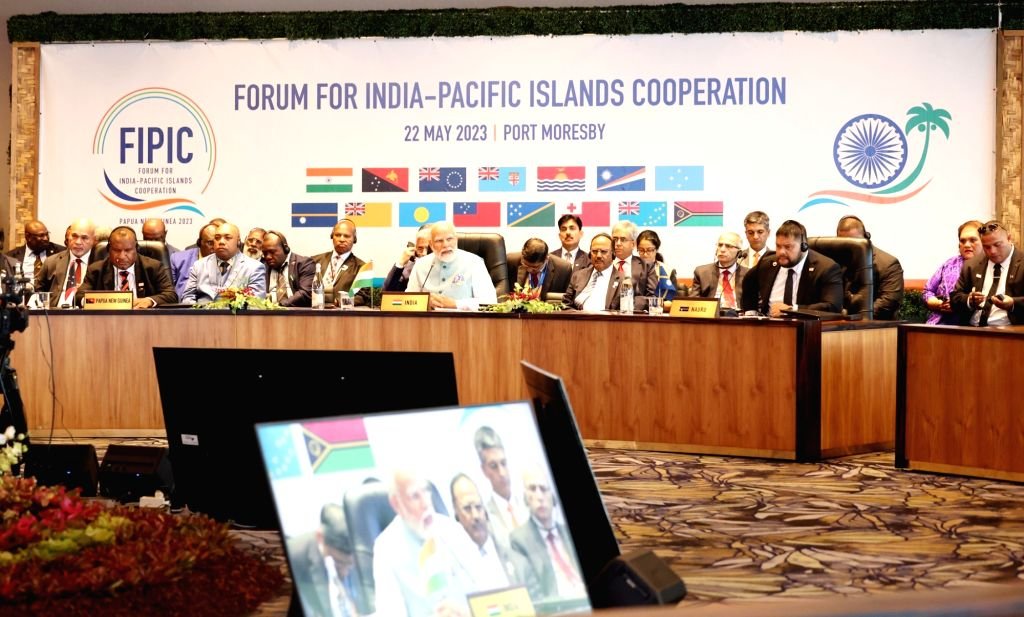
The “Forum for India-Pacific Islands Cooperation” (FIPIC) was established in 2014 as a strategic initiative by India to strengthen its diplomatic, economic, and cultural engagement with the Pacific Island Countries (PICs). FIPIC comprises 14 Pacific Island nations — Cook Islands, Fiji, Kiribati, Marshall Islands, Micronesia, Nauru, Niue, Palau, Papua New Guinea, Samoa, Solomon Islands, Tonga, Tuvalu, and Vanuatu.[1] These countries hold geostrategic significance due to their location, maritime resources, and votes in international forums such as the United Nations. For India, engagement with PICs serves as a means to counterbalance growing Chinese influence, deepen development partnerships in areas such as energy and sustainable growth, and promote cultural and diplomatic ties. However, despite its potential significance, FIPIC remains relatively unknown outside diplomatic and academic circles. This paper explores the reasons behind the lack of global awareness surrounding FIPIC and proposes ways to effectively leverage the platform as a strategic instrument to advance India’s presence across the southern Pacific subregion of the Indo-Pacific.
The Establishment of FIPIC
Established during Prime Minister Narendra Modi’s visit to Fiji in November 2014, FIPIC marked a significant shift in India’s outreach to the Pacific.[2] By bringing together India and 14 PICs under a formal multilateral framework, FIPIC signalled a renewed and sustained commitment to building closer political, economic, and development ties with the region. Over time, it has evolved into a key mechanism for deepening India’s engagement with Pacific island nations, aligning with India’s broader maritime and Indo-Pacific strategy.
The inaugural FIPIC Summit, held at the level of heads-of-government, took place in Suva, Fiji, on 19 November 2014, with the goal of fostering stronger partnerships with the PICs.[3]
The second FIPIC Summit followed in Jaipur, Rajasthan, in August 2015.[4] Building upon the outcomes of the initial meeting, leaders discussed important shared concerns, including climate change, sustainable energy, food security, and the need for reform in the United Nations.
In September 2019, on the sidelines of the 74th United Nations General Assembly (UNGA) in New York, Prime Minister Modi engaged with the leaders of the Pacific Island Developing States in a plurilateral setting.[5] During the meeting, he emphasised the common values and shared future between India and the PICs, reaffirming India’s dedication to supporting the development goals of the region.[6]
The third FIPIC Summit took place in Port Moresby, Papua New Guinea, on 22 May 2023, and was co-hosted by Prime Minister Modi and Papua New Guinea’s Prime Minister, James Marape. On the sidelines of the third FIPIC summit, Prime Minister Modi was conferred the Republic of Fiji’s highest civilian honour— the Companion of the Order of Fiji (CF)— by Prime Minister Rabuka, on behalf of Fijian President HE Mr Ratu Wiliame Maivalili Katonivere.[7] This gesture not only reflected the strengthening bilateral relationship between India and Fiji but also signalled a broader strategic shift, as India positioned itself as a reliable and long-term partner for the Pacific Island nations amid intensifying geopolitical competition in the region. It marked a significant evolution in India’s Act East Policy, signalling its growing intent to extend its strategic footprint beyond Southeast Asia and into the wider Indo-Pacific.
India’s “Look East” and “Act East” Policies
India’s “Look East” policy became a cornerstone of its foreign policy in the post-Cold War era. Initiated in 1991 under the leadership of Prime Minister Narasimha Rao, the policy aimed to strengthen political ties, boost economic integration, and enhance security collaboration with Southeast Asian nations.[8] It signified a major shift in India’s global outlook, acknowledging the strategic and economic significance of Southeast Asia for India’s national interests.[9] Prime Minister Modi formally initiated the “Act East” policy in 2014, furthering the vision of the “Look East” policy with a stronger emphasis on implementation and engagement.[10]
India’s “Act East” policy (AEP) has increasingly emphasised engagement with the PICs, notably through multilateral frameworks such as FIPIC. However, despite its potential, FIPIC has not garnered significant international recognition or become a major subject of discourse. A key reason for this has been the absence of a robust strategic communication and outreach strategy, limiting India’s ability to effectively project its soft power and strategic interests across the Pacific.
This gap is particularly notable considering that the AEP completed a decade in 2024. While there has been substantial scholarly and policy focus on India’s engagement with ASEAN under the AEP, literature and policy discourse around FIPIC and India’s Pacific outreach remain sparse. The dominant narrative continues to prioritise Southeast Asia, overlooking the critical opportunities and challenges emerging in the wider Indo-Pacific, especially among the Pacific Island nations.
In recent years, however, India has begun cultivating a more pronounced maritime consciousness, aligning its strategic posture with its oceanic geography. Central to India’s evolving maritime foreign policy is a recognition of the Indo-Pacific as a continuum, wherein the Pacific Islands form an increasingly important component. Strengthening platforms like FIPIC is therefore essential, not only to advance development cooperation but also to reinforce India’s credibility and strategic influence across the broader Indo-Pacific region.
FIPIC and the Future of India’s Strategic Outreach
In his book, The India Way: Strategies for an Uncertain World, India’s External Affairs Minister, Dr S Jaishankar, emphasises the need for India to adopt a more proactive, multi-aligned, and interest-driven foreign policy, especially in an era of shifting global power dynamics.[11] He argues that India must be a decider or a shaper, not just an abstainer or a bystander in global affairs.[12] This ethos directly supports the idea that India must step-up its engagement with underrepresented but strategically significant regions such as the Pacific Islands, where the geopolitical vacuum is increasingly being filled by other powers, particularly China.
EAM Jaishankar repeatedly argues for India to craft and project its own narrative, rather than rely on global institutions or Western powers to define its role. He warns against passivity in foreign policy and insists upon strategic clarity, institutional activism, and visibility in international affairs. He also stresses the importance of building coalitions beyond familiar platforms (not limiting diplomacy to just the G20, Quad, or ASEAN), and engaging across the “Global South” to build diplomatic equity and moral authority. FIPIC exemplifies this shift: it is a uniquely Indian initiative that amplifies the voices of Small Island Developing States (SIDS), provides tangible development support, and fosters South-South cooperation. In this context, strengthening FIPIC through sustained institutional support, strategic outreach, and proactive diplomacy would align closely with EAM Jaishankar’s vision of a more self-assured India shaping its own global narrative and strategic direction.
The Pacific Islands have evolved into a theatre of great power competition with China’s growing influence in the region— highlighted by its security pact with the Solomon Islands— and the US working to dissuade Pacific Island nations from forging similar security ties with Beijing.[13] The US maintains no fewer than eight defence and security arrangements with nations across the Pacific region.[14] In 2023, the United States signed an agreement with Papua New Guinea (PNG), granting the US military “unimpeded” access to key military bases and facilities across the country, significantly strengthening its strategic foothold in the region.[15] Earlier, in 2020, Washington had also entered into a defence and security pact with Fiji, further consolidating its security partnerships across the Pacific Islands in response to growing geopolitical competition.[16]
Amid this intensifying geopolitical contestation, India’s own engagement— through FIPIC— offers a distinct, non-militarised alternative. While FIPIC holds strategic importance in India’s foreign policy and is well recognised within diplomatic, policy, and regional circles involving India and the 14 Pacific Island countries, the grouping is relatively unknown in a global context, especially when compared to major multilateral groupings such as ASEAN, the Quad, or APEC. In Indian strategic circles, of course, FIPIC is seen as a key initiative to deepen ties with Pacific Island nations. Among the elites of the PICs, it is appreciated as a unique platform where India engages directly with leaders of these nations, outside of larger power frameworks. India is seen as a development and climate partner rather than a military competitor. Possible reasons for a lack of global awareness about FIPIC include:
- Niche Regional Focus:
FIPIC involves India and 14 Pacific Island nations within which grouping, even the more important, PICs have fairly limited global political heft, military capacity, or economic weight, when compared individually to larger powers, such as Japan, Australia, or the US. - Recent Creation and Limited Summits:
After the inaugural summit in 2014, only two additional FIPIC Summits have been held, that too, with an eight-year gap between them (2015 in Jaipur and 2023 in Port Moresby)! In contrast, major groupings meet annually or have more structured institutions. - Developmental, Not Security-Focused:
Many global groupings such as the Quad or APEC gain visibility because of security or economic cooperation, whereas FIPIC focuses mainly on development partnerships focused upon more amorphous non-traditional facets of holistic security such as climate change, renewable energy, and capability-enhancement (very often but nevertheless incorrectly labelled ‘capacity-building’)— sectors that often remain underreported. - Lack of Strong Institutional Backbone:
FIPIC does not have a permanent secretariat, formal treaty structure, or regular coordination mechanisms like the ASEAN Secretariat. Without institutional visibility, momentum fades between successive Summits. This is in particularly stark contrast with other far more robust structures such as the Pacific Islands Forum (PIF). - Limited Public Diplomacy:
Neither India nor the PICs comprising FIPIC have promoted FIPIC aggressively or even vigorously in global forums, multilateral meetings, or media spaces. Consequently, awareness— outside specialised elite diplomatic circles— remains low. Once again, this lackadaisical approach by New Delhi offers a stark contrast with other far more robust and dynamic structures such as the Pacific Islands Forum (PIF), the “Pacific Community” (SPC) collective, “Council of Regional Organisations of the Pacific” (CROP), and even relatively specialised ones such as the “Pacific Regional Environment Programme” (PREP), the “Pacific Islands Forum Fisheries Agency” (FFA). - Since the South Pacific is seen by Australia and the US (as also by New Zealand and France) as their strategic ‘backyard’, India is unable to leverage extant trilaterals (such as the India-Australia-France trilateral, for example) or even the Quad to its advantage, in its endeavours to position India as a significant player.
Achievements Under FIPIC
New Delhi’s ineptitude in its ability to sustain strategic messaging is all the more ironic— if not tragic— given the several laudable achievements of FIPIC. For one thing, under FIPIC, India has moved beyond generic aid to implement targeted projects in sectors critical to the Pacific region, such as healthcare, digital connectivity, climate resilience, and skill development. Through a blend of grant-based assistance and training programs, India has positioned itself, at least amongst a narrow stratum of PIC elites, as a trusted development partner. India provides an annual grant-in-aid of US$ 200,000 to each of the 14 PICs to support localised development projects such as solar electrification, community infrastructure, and livelihood initiatives.[17] Through the Indian Council for Cultural Relations (ICCR), India offers scholarships for students from PICs to pursue higher education in Indian institutions, strengthening people-to-people connections and human capital.[18] Under the “Indian Technical and Economic Cooperation” (ITEC) programme, professionals from PICs receive fully funded technical training at premier Indian institutions, in fields such as IT, agriculture, public policy, and entrepreneurship.[19]
Climate cooperation has been central, with initiatives such as the solarisation of government buildings— announced at FIPIC-III in 2023, and broader alignment with the “International Solar Alliance”.[20] While not officially a FIPIC initiative, the “Barefoot College”, based in Tilonia, Rajasthan, has worked with the Ministry of External Affairs to train women from the Pacific and other regions to install and maintain solar lighting systems, often in areas without access to electricity.[21] This program promotes both sustainable energy access and women’s empowerment and has been highlighted in Indian diplomatic efforts as a flagship example of South-South cooperation.
Under PM Modi’s 12-point action plan announced at FIPIC-III in Port Moresby, India significantly scaled-up its commitments. These include setting up dialysis centres, a regional IT and cybersecurity hub, solar infrastructure, fisheries support, traditional medicine collaboration, and enhanced digital and maritime partnerships.[22] The visit of Indian Naval Ships to Papua New Guinea, and Indian naval hydrographic support further signal India’s strategic intent in the Pacific. These initiatives aim to position FIPIC as a key component of India’s Global South diplomacy, as being distinct from other security-intensive initiatives, through its strong focus upon empowerment, sustainability, and mutual respect.
It is reiterated that while FIPIC has yielded tangible benefits and goodwill, it nevertheless remains under-recognised internationally. Greater institutionalisation, a clever and sustained publicity programme that provides heightened visibility, and greater diplomatic investment— aligned with India’s Indo-Pacific Oceans Initiative (IPOI) that gives first-order specificity to India’s current maritime policy of MAHASAGAR (Mutual And Holistic Advancement of Security And Growth across Regions) and EAM Jaishankar’s call for India to act as a “decider” and narrative-shaper— will be key to strengthening India’s role as a credible, long-term partner in the Pacific.
Recommendations
Against the foregoing backdrop, the following policy recommendations are offered for consideration by the MEA and other concerned ministries:
- Craft a Strategic Narrative and Institutional Framework
- To elevate FIPIC’s profile and long-term impact, the Government of India needs to articulate and consistently disseminate a clear, consistent narrative that frames FIPIC as a values-driven, inclusive platform focused on sustainable development and mutual respect, rather than as a tool of geopolitical balancing. This would align with India’s broader foreign policy vision of being a responsible and responsive global leader.
- Institutionalising FIPIC as a regular biennial Summit with sectoral working groups (on climate resilience, renewable energy, maritime cooperation, and health security) would lend structure and continuity to the partnership. Additionally, launching an “India–Pacific Islands Strategic Dialogue”, a permanent forum for high-level exchange on Indo-Pacific security, regional connectivity, and blue economy priorities would deepen strategic alignment.
- Simultaneously, public diplomacy must be amplified through targeted outreach that showcases concrete deliverables, such as solar electrification projects, disaster resilience efforts, student scholarships, and health collaborations. Communicating these successes widely can help turn FIPIC into a recognised symbol of meaningful South-South cooperation.
- Formalise an Annual India-Pacific Dialogue. Sponsor a Track 1.5 or 2.0 Dialogue Series, bringing together policymakers, scholars, business leaders, and civil society from India and the PICs to exchange ideas on climate change, governance, connectivity, and cultural ties. This would embed FIPIC more deeply within India’s Indo-Pacific strategic framework (especially the IPOI) and reinforce its image as a credible development partner and an emerging global leader with strong roots in South-South cooperation.
- FIPIC Website. Establishing a government-led digital presence for FIPIC would significantly reinforce India’s leadership and credibility in the Indo-Pacific region. It would offer Pacific Island stakeholders a transparent, accessible platform for information exchange and collaboration, enabling more direct engagement with Indian initiatives. While there is, indeed, a FIPIC website hosted by the Federation of Indian Chambers of Commerce & Industry (FICCI), which focuses primarily on trade and investment promotion, there is a clear need for an official government-managed portal dedicated to the FIPIC. Unlike a business-oriented platform such as the FICCI-managed site, a government-driven portal would provide a more comprehensive and strategic overview, encompassing trade, development assistance, cultural exchange, and diplomatic engagement, thereby ensuring a holistic representation of India’s multifaceted partnership with the Pacific Island nations. Such website, directly administered by the Government of India (by the Ministry of External Affairs or a dedicated secretariat), would serve as a comprehensive and authoritative platform, consolidating all dimensions of India’s engagement with the Pacific Island nations. Obviously, offering the site in English, Hindi, and selected Pacific Island languages would enhance its accessibility and outreach. This website should include:
- Official summit declarations, joint statements, and policy documents.
- Updates on development partnerships, grants, technical cooperation programs, and scholarship initiatives.
- Information on cultural exchanges, people-to-people ties, and capacity-building projects.
- Multimedia content (videos, interviews, webinars) showcasing collaborative efforts.
- Interactive features such as event calendars, virtual forums, and feedback channels.
- Leveraging of FIPIC by the Indian Navy.
- The Government of India needs to leverage FIPIC to demonstrate regional leadership by exploiting the Indian Navy’s established competence in maritime capacity-building and capability-enhancement, especially in terms of humanitarian assistance and disaster relief (HADR). Given the vulnerability of PICs to natural disasters, India can position its naval assets as vital instruments of goodwill through pre-positioned relief supplies, rapid response operations, and disaster management exercises. Simultaneously, FIPIC offers a strategic avenue to expand India’s role as a net provider of security in the region. This includes enhancing maritime situational awareness (MSA), information-sharing leading to more comprehensive maritime domain awareness (MDA), conducting combined patrols and naval exercises, offering technical training to Pacific Island naval personnel, and hosting regular port visits. Taken in aggregate, these initiatives would solidify India’s image as a reliable and benevolent maritime partner in the Indo-Pacific.
Conclusion
Over a decade since its launch in 2014, FIPIC has emerged as a pivotal— yet largely neglected (even within the MEA itself)— pillar of India’s diplomatic engagement with the PICs. Through summits, grants, and capacity-building programmes such as scholarships and training, FIPIC reflects India’s commitment to South-South cooperation and inclusive multilateralism. Yet, despite its relevance in the current geopolitical landscape, the forum remains relatively obscure outside policy and diplomatic circles.
This limited visibility stems from the absence of a sustained strategic narrative to drive FIPIC’s evolution. Meanwhile, China, Australia, and the United States continue to deepen their presence in the Pacific through expansive economic and military engagement, consistently outpacing India’s efforts in scale and particularly in terms of visibility. As EAM S Jaishankar advocates in The India Way, India must craft and project its own foreign policy narrative, particularly in regions like the Pacific where PICs can amplify India’s global standing and strategic reach.
Going forward, institutionalising FIPIC through a dedicated digital platform, expanding its thematic scope to include climate finance, digital infrastructure, and blue economy partnerships, and embedding it more deliberately into India’s broader Indo-Pacific vision especially through the first-order specificity provided by the IPOI to India’s maritime policy of MAHASAGAR— will be critical. Moreover, positioning and then leveraging FIPIC as a flagship initiative of India’s Global South diplomacy not only aligns with India’s evolving maritime and multilateral strategy but also offers a meaningful pathway to reaffirm India’s role as a responsible, responsive, and trusted development partner in an increasingly contested region.
******
About the Author
Ms Kripa Anand is a Research Associate at the National Maritime Foundation (NMF). Her research encompasses maritime security issues, with special focus upon the manner in which India’s own maritime geostrategies are impacted by the maritime geostrategies of the island-States of Oceania in general and Australia and New Zealand in particular. She may be reached at ocn1.nmf@gmail.com.
Endnotes:
[1] Business Accelerator for Forum for India – Pacific Islands Cooperation (FIPIC), “About FIPIC”, Ministry of External Affairs, Government of India. https://fipic.ficci.in/about.html.
[2] Business Accelerator for Forum for India – Pacific Islands Cooperation (FIPIC), “About FIPIC”
[3] “India – Fiji Bilateral Relations”, High Commission of India, Suva, Fiji, April 2024. https://www.indiainfiji.gov.in/docs/1714023254india_fiji_brief%20%20Apr_24.pdf.
[4] Business Accelerator for Forum for India – Pacific Islands Cooperation (FIPIC), “About FIPIC”, Ministry of External Affairs, Government of India. https://fipic.ficci.in/about.html.
[5] “Prime Minister meets Pacific Island Leaders,” Ministry of External Affairs, Government of India, September 2019. https://www.mea.gov.in/press-releases.htm?dtl/31854/Prime_Minister_meets_Pacific_Island_Leaders.
[6] “India – Fiji Bilateral Relations”, High Commission of India, Suva, Fiji, April 2024. https://www.indiainfiji.gov.in/docs/1714023254india_fiji_brief%20%20Apr_24.pdf.
[7] Prime Minister’s Office, ‘Prime Minister’s meeting with the Prime Minister of the Republic of Fiji’, Press Information Bureau, May 2023. https://pib.gov.in/PressReleasePage.aspx?PRID=1926258.
[8] Amb (Retd) Dilip Sinha, ‘India’s Look East Policy and the Northeast’, Distinguished Lectures, Ministry of External Affairs, Government of India, April 2016. https://www.mea.gov.in/distinguished-lectures-detail.htm?505.
[9] Haokip, T. (2014). India’s Look East Policy: Its Evolution and Approach. South Asian Survey, 18(2), 239-257. https://doi.org/10.1177/0971523113513368 (Original work published 2011).
[10] Dipanjan Roy Chaudhary, ‘PM Modi’s Act East Policy places India as an active stakeholder in regional affairs’, The Economic Times, April 2025. https://economictimes.indiatimes.com/news/india/pm-modis-act-east-policy-places-india-as-an-active-stakeholder-in-regional-affairs/articleshow/119999800.cms?from=mdr.
[11] S Jaishankar, The India Way: Strategies for an Uncertain World (Gurugram: HarperCollins Publishers, 2022)
[12] S Jaishankar, The India Way, 211
[13] Joseph Hammond, “China’s Security Agreement with the Solomon Islands: Wider Implications for Geopolitics in the South Pacific,” Journal of Indo-Pacific Affairs (Maxwell Air Force Base, AL: US Department of Defense, December 2023), https://media.defense.gov/2023/Nov/14/2003340194/-1/-1/1/VIEW%20HAMMOND%20-%20JIPA.PDF.
[14] Prianka Srinivasan and Virginia Harrison, “Mapped: the vast network of security deals spanning the Pacific, and what it means”, The Guardian, July 2024. https://www.theguardian.com/world/article/2024/jul/09/pacific-islands-security-deals-australia-usa-china.
[15] “Agreement Between the United States of America and Papua New Guinea”, Department of State, The United States of America, August 2023. https://www.state.gov/wp-content/uploads/2023/10/63374-Papua-New-Guinea-Defense-08.16.2023.pdf.
[16] , “Agreement Between the United States of America and Papua New Guinea,” Department of State, The United States of America.
[17] Business Accelerator for Forum for India – Pacific Islands Cooperation (FIPIC), “About FIPIC”, Ministry of External Affairs, Government of India. https://fipic.ficci.in/about.html.
[18] Indian Council for Cultural Relations, ICCR Scholarship Portal, https://a2ascholarships.iccr.gov.in.
[19] Indian Technical and Economic Cooperation Programme, “Sagar Amrut Scholarships”, Ministry of External Affairs, Government of India. https://www.itecgoi.in/Sagaramrut.
[20] “India – Fiji Bilateral Relations”, High Commission of India, Suva, Fiji, April 2024. https://www.indiainfiji.gov.in/docs/1714023254india_fiji_brief%20%20Apr_24.pdf.
[21] Media Centre, “Media Briefing on Barefoot Solar Grandmothers from Least Developed Countries Undergoing Training in India under ITEC Programme,” Ministry of External Affairs, Government of India, March 2018. https://www.mea.gov.in/media-briefings.htm?dtl/21325.
[22] Anita Joshua, “12-step action plan to strengthen India’s partnership with Pacific Island nations,” The Telegraph, May 2023. https://www.telegraphindia.com/india/12-step-action-plan-to-strengthen-indias-partnership-with-pacific-island-nations/cid/1938944.


Leave a Reply
Want to join the discussion?Feel free to contribute!