
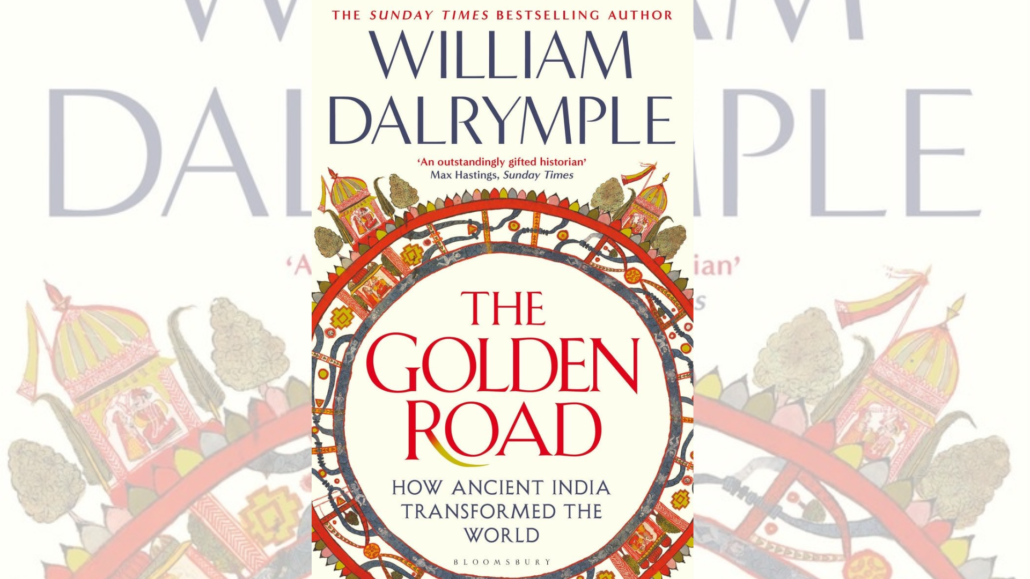
William Dalrymple. Bloomsbury Publishing (London), 2024. 479 pages, ISBN: HB: 978-1-4088-6441-8, Rs 999 (Hardback)
“The Golden Road—” has been authored by the esteemed British historian, William Dalrymple, who is widely recognised for his contribution to scholarship on South Asian history. In this book, Dalrymple essentially focuses upon a certain phenomenon that spanned roughly a millennium and a half — c. 250 BCE to 1200 CE as he emphasises — during which India prospered as a leading power in the region stretching from the Red Sea, across the Indian Ocean, right to the edges of the Pacific. He captures the essence of this phenomenon, and more importantly, the actual bounds of the region affected in this era through the commonly known term, “Indosphere”. Dalrymple opines that India’s knowledge systems, its elaborate culture, and its rich traditions, were once, in fact, quite dominant across the region he describes as the ‘Indosphere’. His examination of the geographically rooted subject called the “golden road” in this book, is at its core a fundamental attempt to re-introduce a forgotten perspective — and concentrates upon a period of Indian history during which the subcontinent was collectively at its zenith, as a maritime power.
For the sake of this book’s narrative, Dalrymple has positioned India as a central territorial entity within the region that he has labelled the Indosphere. The inquisitive element in his approach and analysis is primarily aimed at underscoring the fact that India’s geographical advantage facilitated trade, migration, and the diffusion of knowledge. Therefore, the author’s initial step is to re-frame the inherent role and character of the Indian subcontinent during the specified millennium for the purpose of his enquiry into the affairs of ancient human history. He justifies this characterisation of the Indian subcontinent by stressing upon the uniqueness of its geographical location, its civilisational antiquity, and its highly structured socio-economic set-up, as the main factors contributing to this remarkable historical influence. By presenting this hypothesis, he highlights India’s pivotal role as a dominant power responsible for shaping the region’s cultural, economic, and intellectual landscape. Dalrymple’s perspective reinforces the notion that India was not a mere participant in ancient history but an active centre of global interactions.
Given the extensive time period that Dalrymple has chosen to deal with — a challenging endeavour to undertake in a single volume due to the sheer degree of detail and magnitude of activity at hand — he has remained faithful to a narrative that is concerned with capturing the broader essence of the time. Rather than attempting to exhaustively document historical events in a linear fashion, he has stitched together a cohesive argument in favour of ancient Indian maritime history. Additionally, the author continuously strives to reflect upon the enduring nature of the age-old traditions, practical knowledge, and belief systems across the Indosphere that find their origin in India. The author also highlights that beyond the popularly known religious and cultural influence, India’s contribution to this region has been quite diverse, ranging from practical disciplines such as science and mathematics to astronomy, and even the fine arts.
The book explores the length and breadth of the Indosphere through ten chapters, each of which concentrates upon a unique set of themes, relaying evidence belonging to varying periods in history, often attempting to create a simultaneous image — a panoramic scene — of the said regional expanse. The nature of the author’s enquiry is pragmatic yet reminiscent of innocent wonder as it draws upon the many tangible records that have survived from the era. Dalrymple frequently sets the scene for each chapter by relaying an anecdote that encapsulates the moment of rediscovery of the historical evidence. The first chapter, for instance, deliberates on the moment a British hunting party stumbled upon the caves of Ajanta while tracking their wild game during the summer of 1819. The second chapter begins with a scene set in contemporary Egypt, elaborating on the finds of a team of archaeologists excavating an ancient temple of the Egyptian goddess Isis at Berenike. The third chapter, yet again, begins with the author’s personal account of his time in Afghanistan, accompanied by a team of French archaeologists. The fourth chapter takes a giant leap back in time — to 629 CE — detailing Xuanzang’s journey to India. Similarly, subsequent chapters introduce several historical moments including tales of Wu Zetian, the glory of a renowned Pallava king, a shipwreck salvaged from the Java Sea, the royal court of Sindh during the 8th century, and a recollection of the first landslide victory of the Reconquista, to name just a few. The author’s narrative is held together by a series of such anecdotes sprinkled throughout the text.
Dalrymple’s approach of layering anecdotes across time upon one another and intertwining them with legitimate and well-documented historical evidence while formatting the text in a relatively informal fashion, quite akin to storytelling, is aimed at recreating a vivid snapshot of the past. However, Dalrymple’s also seemingly relies on his intention to inspire a recurring realisation accompanied by a sense of rediscovery within the reader. This methodology makes the text more accessible to the reader as it relies upon a relatively more fluid historical narrative without the pressure of retaining complex historical processes and developments in tow throughout their reading experience.
Dalrymple’s approach is also commendable, particularly within a discipline as potentially complex and theoretically dense as history, as it allows for an immersive and revelatory experience which sustains the reader’s engagement with the text. Moreover, this approach underscores an often-overlooked aspect of India’s past, particularly in a maritime context. The outlook that Dalrymple abides by synthesises historically accurate documentation with relevant ethnographic insights, thereby reconstructing a reliable image of the past while also shedding light on the resilience of Indic influences in social, cultural, economic, and intellectual realms.
In sum, “The Golden Road” is a remarkable contribution that challenges, and as a consequence, enriches the currently prevalent land-centric narrative of human history by incorporating a much-needed maritime element in the discourse. It is a book that is suitable for a wide audience, ranging from students to practitioners. It is also beneficial to the field of Indian maritime history in particular, as it touches upon the distinct manner in which Indian, or Indic, influence percolated beyond the subcontinent where these traditions and values originated. There are two observations of particular mention that must be credited as a fair outcome of the author’s unique approach in this book. Firstly, Dalrymple has managed to widen and reframe the scope of ancient Indian history by proposing the “golden road” — essentially an east-west maritime corridor stretching across the geographical bounds confined within the Indosphere he repeatedly refers to — as a precursor to the far better known Silk Road”. Secondly, he has refrained from ossifying Indic influences, confining them to an inaccessible era. Rather, he leaves the door open by posing a simple yet tantalising proposition: Could India do so again?
******
About the Reviewer
Ms Priyasha Dixit is a Research Associate at the National Maritime Foundation. Her area of focus is the enhancement of maritime consciousness in India — a theme that incorporates issues of seminal importance including, inter alia, India’s maritime (seafaring) history (incorporating ancient Indian knowledge systems), the maritime history of the Indian Ocean, India’s maritime heritage and its underwater cultural heritage, as also the MAUSAM initiative of the Government of India. She may be contacted at indopac8nmf@gmail.com.


Leave a Reply
Want to join the discussion?Feel free to contribute!