
CHINA’S ZUBR CLASS HOVERCRAFTS – AN ASSESSMENT
Rear Admiral Monty Khanna (Retd) – Issue No 4 dated 22 Jan 2025
The Zubr Class (Type 958) is by far the largest hovercraft in the world. It was designed by the Almaz Central Naval Design Bureau, St. Petersburg, USSR. Construction was subsequently undertaken by the Almaz Shipyard in St. Petersburg and the Feodosiya Shipbuilding Company in Crimea.
The basic specifications of the craft are as mentioned below
- Standard displacement: 480 tons
- Full-load displacement: 555 tons,
- Length: 57.3 meters
- Beam: 25.6 meters
- Height: 21.9 meters
- Draught: 1.6 meters
- Max Speed: 60 knots
- Cruising Speed: 55 knots
- Range: 300 nautical miles
- Crew: 27-31 (including 4 officers)
- Effective Operations: Wave height 2 meters, Wind Speed 12 meters/second
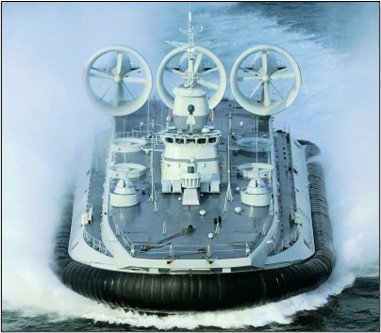
Zubr Class Hovercraft Seen from the Bows
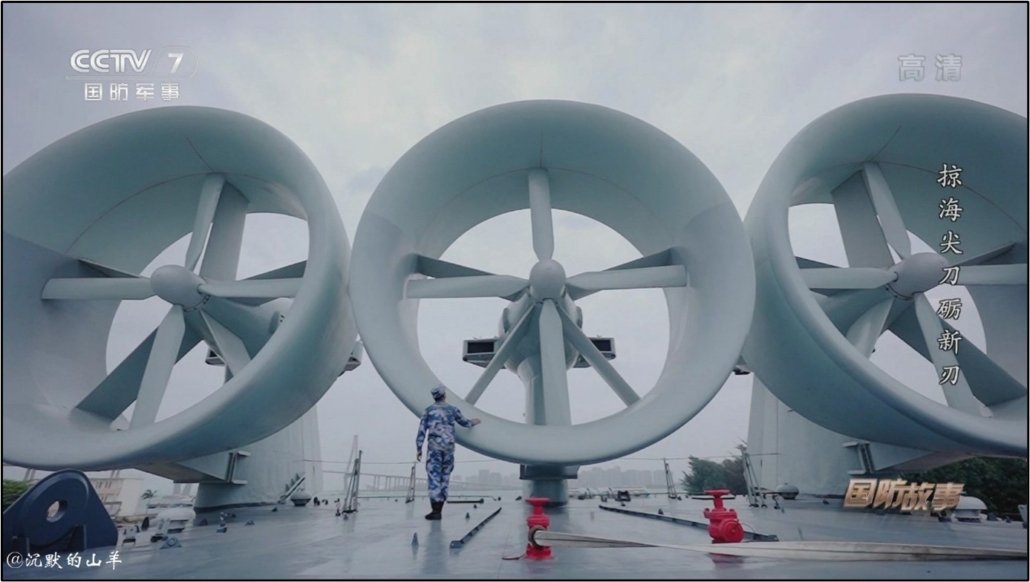
The hovercraft is powered by five gas turbines which are a derivative of the Kuznetsov NK-12MV. Three of these are used for propulsion and two for generating lift. The enormous size of the controllable pitch propulsion fans is evident from the photograph below.

Propulsion Fans of the Zubr
On July 2, 2009, the Chinese Ministry of Defense signed a contract with the Ukrainian Special Equipment Export Corporation for four such hovercraft. According to the terms of the contract, the PO More Shipyard in Feodosiya, Ukraine was to deliver two fully built craft along with a complete set of technical documentation to China. Subsequently, the remaining two would be built in a Chinese yard with technical and material support being provided by Ukraine. The reported value of the contract was $315 million.
As per a report by the People’s Daily online (https://www.chinanews.com.cn/mil/2013/04-27/4770557.shtml), at the time, the Russian side had raised doubts about the deal as it was felt that the Type 958 was a complete copy of the Russian Zubr class hovercraft with all patents being held by the Almaz Central Naval Design Bureau in St. Petersburg, Russia. It was also feared that given China’s track record of copying foreign military equipment, they would rapidly do so and may even sell the product in the international market. Nonetheless, the deal went through and construction commenced soon thereafter.
In preparation for berthing the craft, China began the construction of a facility on the western side of the Guangzhou Shipyard International (GSI) in 2013. The choice of the premises of a shipyard for this facility possibly stems from their desire to ensure the smooth transfer of technical knowhow to the shipbuilders for construction of subsequent craft.
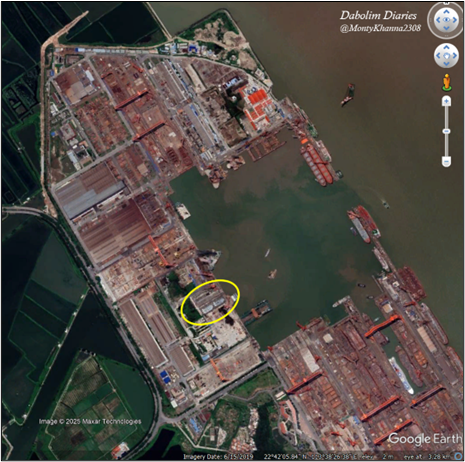
Zubr Class Facility on the Western Side of GSI (Circled in Yellow)
The first vessel (3325) was finally handed over at Guangzhou in May 2013 and the second (3326) in February 2014.
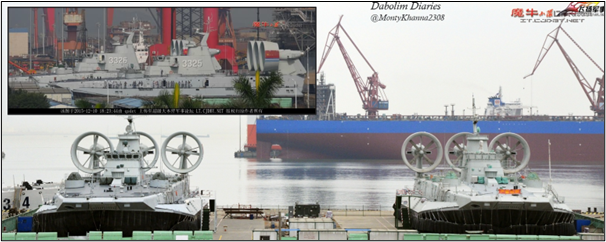
3325 and 3326 Soon After Their Commissioning at GSI
The construction of the remaining two contracted craft in China faced complications due to the Russian takeover of Crimea in 2014. Early photographs of their construction at the Huangpu Shipyard in Shanghai, however, emerged in 2015.
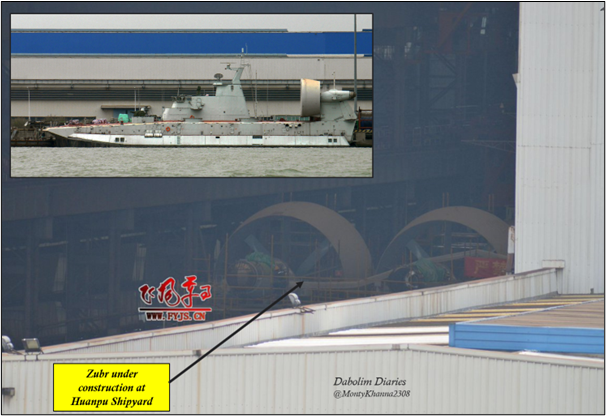
3327/3328 Under Construction at Huangpu Shipyard, Guangzhou
This was subsequently confirmed by imagery on Google Earth dated 19 Dec 2015.
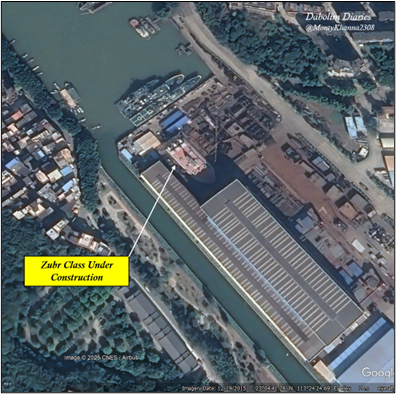
Google Imagery Dated 19 December 2015
It is estimated that both the craft were delivered by 2017 and were given pennant numbers 3327 and 3328.
A second berthing facility for the Zubr was created at the western bank of the Zhanjiang waterway, adjacent to the PLA Navy dockyard, by augmenting an existing Type 726 LCAC facility (210 14’.5 N, 1100 24’.9 E). The first image of a Zubr at this location appeared on Google Earth on 24 Oct 2017.
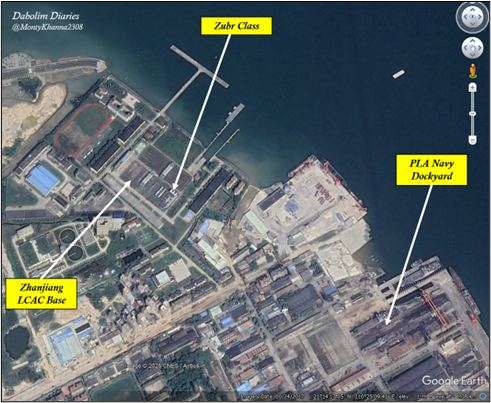
Google Earth Image of Zhanjiang LCAC Base dated 24 Oct 2017
More or less simultaneously, an operational hovercraft base was constructed at Lunxing on Nansen Island, at the mouth of the Zhanjiang waterway (210 05’.8 N, 1100 31’.8 E). Work on this facility commenced in 2014 and is estimated to have been completed by 2016.
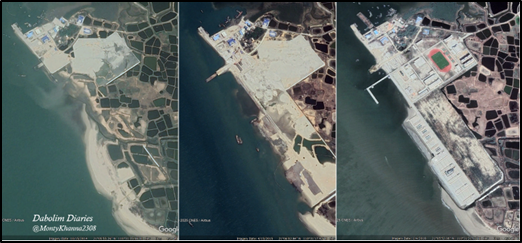
Time Sequence Images of Lunxing Base dated 15 Oct 2014, 15 Apr 2015 and 04 Jan 2018
A picture of two Zubrs (3325 and 3326) berthed at this facility dated August 2017 gives credence to this estimate.
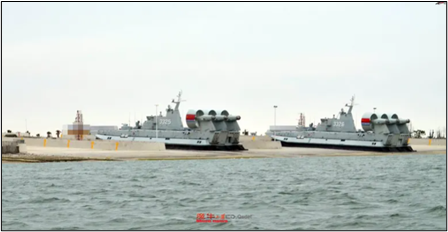
3325 and 3326 Berthed at Lunxing, Nansen Island
With three berthing facilities having been created, it appears that the PLAN has purposed each of them. The base at Lunxing is an operational base used for embarkation/disembarkation of vehicles and troops as well as short term berthing. It has four bays for the Zubr and six for the Type 726/A LCACs, each of which could berth two LCACs.
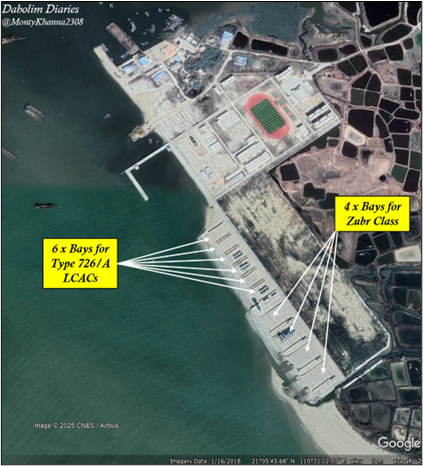
Google Earth Image of Hovercraft Base at Lunxing, Nansen Island dated 16 Jan 2018
The base in Zhanjiang is probably being used for berthing when the craft are not partaking in exercises/ operations.
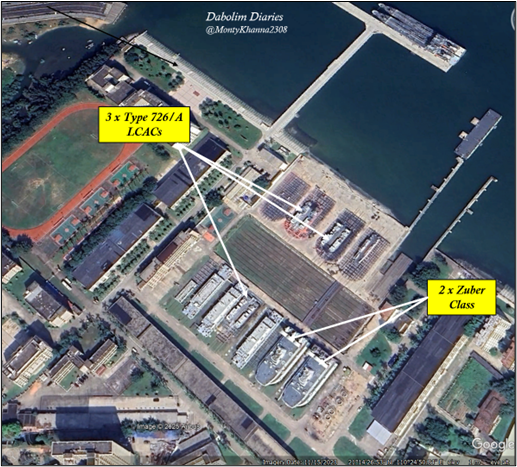
Google Earth Image of Hovercraft Base in Zhanjiang dated 15 Nov 2023
The facility at GSI is possibly for long term storage/ preservation. Imagery of hoses leading from shore-based equipment to the craft lends credence to this assumption. Russians have been known to undertake preservation in this manner of vessels which do not have a regular requirement in peace and are needed only for major exercises or combat.
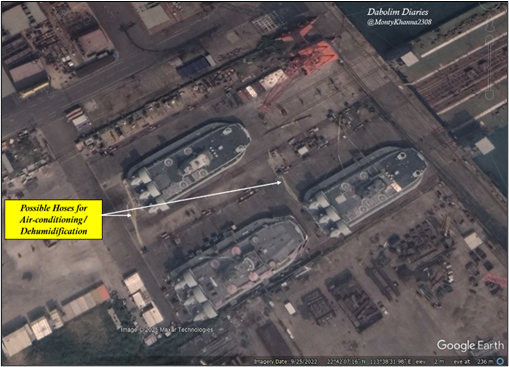
Google Earth Image of Zubr Facility at GSI dated 25 Sep 2022
In 2022, China added two more locally built Zubr class hovercraft to their fleet (3260 and 3261) thereby reaching a total holding of six craft. In external appearance, these are identical to the first four with the exception of the placement of the AK 630 mountings which have been moved substantially forward.
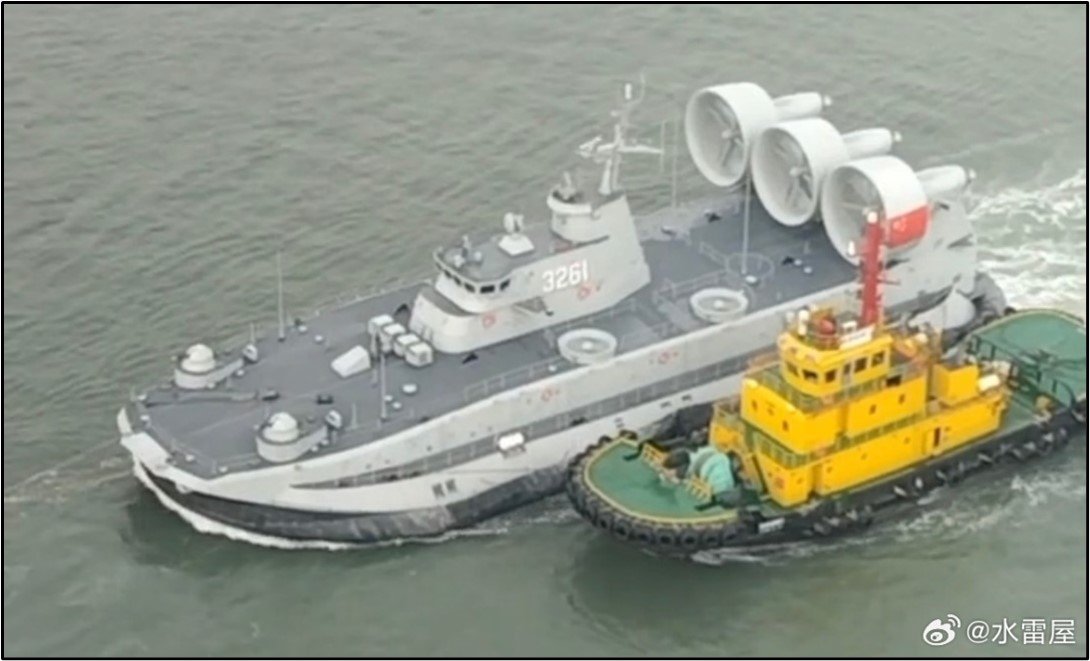
Newer Version of Zubr Class with AK 630 Mounts Shifted Forward
The Zubr has a phenomenal combat capability. It is capable of carrying three T-80 main battle tanks or eight BMP-2 infantry fighting vehicles or ten BTR-70 armed personnel carriers. When used as a troop carrier, it can carry 140 combat personnel and equipment, as well as 130 tons of material. Equipped with two AK 630 gatling guns, apart from landing troops and equipment ashore, it can also provide fire support to beachhead troops.
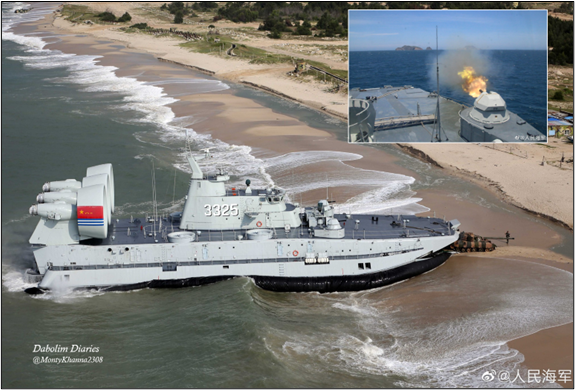
Zubr Discharging Tanks on a Beach (Inset: AK 630 in Action)
Given the Zubr’s limited endurance, the PLA Navy has developed upon the option of ferrying it closer to the combat zone on a Mobile Landing Platform (MLP). The commissioning of the Donghaidao (Pennant No 868) in 2015 provides them a platform to do so, a capability that was demonstrated in a film released on CCTV a few months after her commissioning. A more recent photograph released in May 2023 suggests that such an evolution remains relevant even today and is rehearsed from time to time.
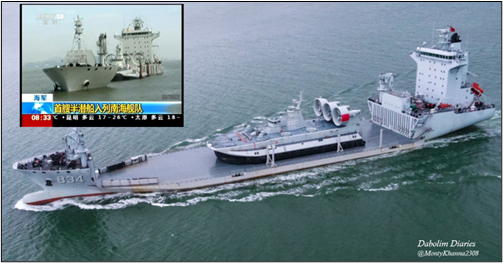
Donghaidao with Zubr Embarked in 2023 (Inset: Similar evolution in 2015)
Assessment. The Zubr Class is a very capable hovercraft with an enormous lift capability. It is, however, prone to defects and expensive to operate and maintain. Greece, which procured four such craft in 2000 has also faced tremendous difficulty in sustaining even a low state of operational readiness. Insofar as China is concerned, the limited numbers constructed, in spite of possessing complete design data, reinforces this assessment. The tendency to conserve the fleet through preservation and restricting usage tells us that these craft have a niche role in combat for which limited numbers would suffice.


Leave a Reply
Want to join the discussion?Feel free to contribute!