
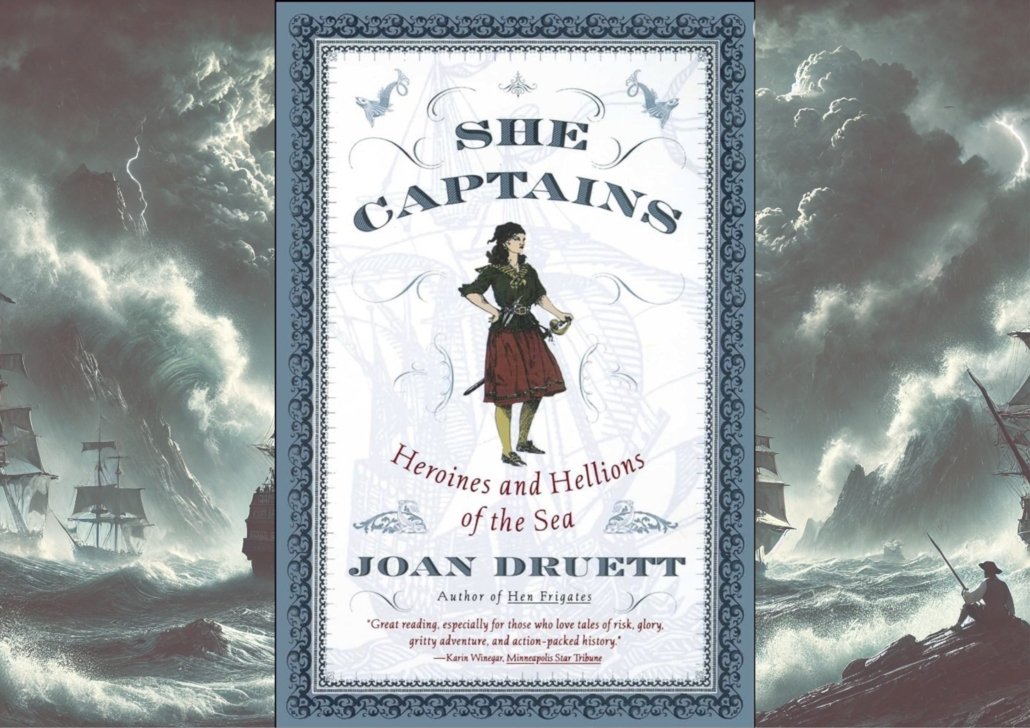
Joan Druett New York: Simon & Schuster, 2000. 304 pages ISBN 978-0-7432-1437-7.
Joan Druett’s “She Captains: Heroines and Hellions of the Sea” is a compelling exploration of the often overlooked women in maritime history who defied societal norms to lead, fight, and navigate the seas. As an acclaimed maritime historian, Druett has made it her mission to bring to light the stories of these extraordinary women, challenging the male-dominated narrative that has long defined seafaring history. Through meticulous research and an engaging narrative style, Druett has carved a niche for herself in a field traditionally focused on male sailors and explorers. Her previous works, such as “Hen Frigates: Wives of Merchant Captains Under Sail” and “Petticoat Whalers: Whaling Wives at Sea, 1820-1920”, similarly highlight her significant contribution in bringing forth the oft-overlooked salience of the women folk in various aspects of maritime life. In “She Captains”, Druett continues this theme, offering a vivid and detailed account of women who not only participated in maritime adventures but played pivotal roles in shaping the maritime world. This book stands out as a unique contribution to both, maritime history and gender studies; bringing to the forefront the stories of women who, despite the challenges and societal expectations of their time, persevered and made a significant mark.
Druett draws upon a wide array of sources- including historical records, legends, and folklores- to reconstruct the lives of these women and place them within the broader context of maritime history. Druett’s narrative is organised thematically, with each chapter focusing on a different type of ‘she captain’, ranging from pirate queens and naval leaders to merchant sailors and adventurers. This thematic organisation allows Druett to explore the various roles women played at sea, providing a comprehensive overview of maritime activities that the gutsy ladies have undertaken across different cultures and time periods.
Druett strives to highlight the contributions of the ‘femme’ in maritime expeditions globally. The book is particularly strong in its detailed portrayal of individual women, such as Queen Artemisia I of Caria, who fought at the Battle of Salamis, and the infamous pirate Anne Bonny. Druett brings these figures to life with vivid descriptions and a keen sense of the regional and social contexts in which they operated. The author’s ability to blend historical analysis with engaging narrative is a key strength of the book. Her writing is lucid, lively, and easy to understand making the book appealing to a broad audience, including those who may not have a background in maritime history.
The book seeks to challenge the traditional narratives that exclude or minimise the contributions of the fairer sex in this domain. The book’s theme aligns with other works that highlight the role of women in history, such as Margaret Creighton’s Iron Men, Wooden Women: Gender and Seafaring in the Atlantic World, 1700-1920. Moreover, She Captains is particularly relevant today, as it contributes to the ongoing effort to diversify historical narratives by including the voices of those whose vital roles have been historically downplayed.
Druett’s ability to humanise these historical figures goes beyond simply recounting their exploits. She delves into their motivations, challenges, and the societal constraints they faced. This approach allows readers to connect with these women on a deeper level, appreciating the complexities in their lives. By highlighting the stories of the women who defied societal expectations and took on varying roles, the author provides a compelling argument against the notion that maritime history is solely a male dominated domain, further bolstering the perspective that seafaring is a gender agnostic occupation. This feminist perspective is one of the book’s most significant contributions.
The book’s occasional reliance on secondary sources and legends without sufficient critical examination is a minor drawback. While Druett does acknowledge the mythical elements in some of the stories, there are moments when the line between history and legend becomes blurred. For instance, the narrative of Alfhild—a Scandinavian princess who supposedly became a pirate—is based more on legends than historical facts. Druett’s use of legends and folklore, while engaging, may at times compromise the book’s historical rigour. Additionally, while the thematic organisation is effective in showcasing the diversity of female maritime roles, it can also result in a somewhat fragmented reading experience. The lack of a clear chronological sequence or geographical cohesion often requires the reader to shift between different time periods and regions, which can be disorienting. A more structured approach could have provided a clearer narrative, enhancing the overall flow of the book.
“She Captains: Heroines and Hellions of the Sea” is a significant work that brings much-needed attention to the women who played crucial roles in maritime history, particularly in the west, and therefore is recommended as a must read for anyone interested in maritime history, gender studies, and the history of maritime expeditions.
While Druett primarily focuses on Western maritime heroines, her work resonates with the legacy of Indian women warriors as well. Figures such as Kittur Chennamma, Rani Jindan, Rani Abbakka Chowta, Akkadevi, and Rani Durgavati, who led valiant struggles against colonial powers, have left an indelible mark on India’s anti-colonial history, though their contributions were not all within the maritime domain.
Rani Abbakka Chowta, in particular, has been immortalised with an Indian Coast Guard ship, ICGS Rani Abbakka, named in her honour, recognising her role in defending coastal Karnataka from Portuguese invaders. As the queen of the coastal town of Ullal in the 16th century, Abbakka fiercely resisted repeated Portuguese attacks on her kingdom, refusing to submit to colonial domination. She organised her forces, forming alliances with local rulers and Muslim traders, and successfully repelled several assaults on her territory. Her courage and strategic acumen made her a formidable force against one of the most powerful naval empires of the time. This tribute stands as a testament to her enduring legacy of leadership and resistance.
Relating Druett’s work to Indian history, it becomes evident that the role of women in the maritime domain is not limited to the Western world. Indian readers can easily identify with the stories of these pioneering women, as their own history is filled with examples of women who navigated complex political and national security landscapes. Druett’s narrative provides a broader context for understanding how women across different cultures have contributed to shaping maritime history, making it relevant to a global audience, including those interested in India’s maritime heritage.
In conclusion, She Captains is an interesting amalgam of fact and fiction, blending historical accounts with mythical elements to create an engaging narrative. Despite its occasional reliance on legends, the book remains a valuable contribution to maritime history and serves as an inspiring tribute to the women—both real and legendary—who defied societal expectations to make their mark in the traditionally male-dominated world of the sea. In today’s context, with women having joined the armed forces in many countries, including maritime forces, books like these offer vital motivation. They highlight that, with dedication and due diligence, the sky is the limit. This is exemplified by the recent appointment of Admiral Lisa Franchetti as the Chief of Naval Operations (CNO) of the United States Navy, making her the first woman to hold the highest naval position in that country. Such achievements reinforce the idea that women have always been, and will continue to be, warriors and leaders—whether in legend, history, or in our contemporary times.
******
About the Reviewer:
Ms Muskan Rai is a Junior Research Associate at the National Maritime Foundation (NMF). She graduated in History from Ramjas College, University of Delhi, and completed her post graduation in “International Relations, Security and Strategy” from the OP Jindal Global University. Her research interests include maritime history, multi-disciplinary maritime studies and India’s maritime relations with East Asia. She can be reached at rsf3.nmf@gmail.com.


Leave a Reply
Want to join the discussion?Feel free to contribute!