
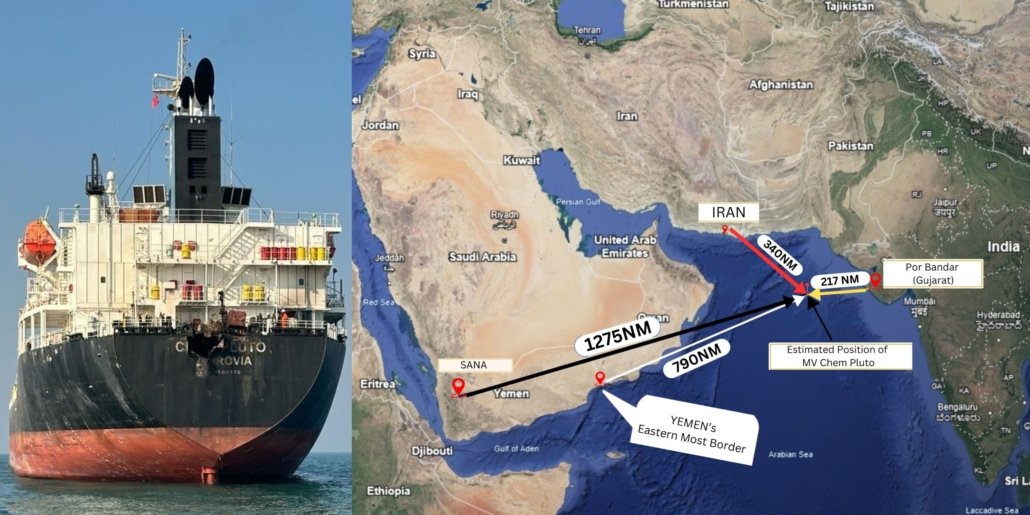
 Credit: Google Earth
Abstract
The economic wellbeing of a country is contingent upon free, open, and secure seas consistent with the prevalent ‘rules-based order’, through which global trade and energy can flow unhindered. The spillover of the Israel-Hamas conflict into the Red Sea and the adjoining Arabian Sea is threatening these very global trade lifelines. This article explores the intricacies of maritime geopolitics, by specifically focusing upon the targeting of the merchantmarine as a newfound tool for strategic messaging by some States, either directly or through their proxies. While a US-led coalition that seeks to keep the critical sea lane in the Red Sea open is trying to dissuade offenders by the limited use of force, the escalatory potential of this localised conflict spiralling out of control is quite real. In this precariously poised geopolitical environment, India must make such strategic choices vis-à-vis the deployment of the Indian Navy as would best serve its national- and maritime-security interests. In the process, the concerned parties that seek to convey strategic messages to India must receive nuanced responses from New Delhi.
Keywords: Indian Navy, Merchantmarine, Maritime Security, Israel-Hamas Conflict, Russian Navy, Strategic Communication, Strategic Messaging, Prosperity Guardian, Sankalp, Persian Gulf, Red Sea, Strait of Hormuz, Bab-al-Mandab
On 25 December 2023, the Novocherkassk, a large Russian naval landing ship, became the latest victim of a series of attacks on naval vessels in the Black Sea during the ongoing Russia-Ukraine conflict, which has been raging since February 2022. The ship was apparently hit by anti-ship cruise missiles at its base in Crimea.[1] The list of Russian naval ships that have faced attacks from Ukrainian missiles, UAVs and surface/sub-surface drones — starting with the debilitating attack on the Russian Cruiser and flag ship of Russia’s Black Sea Fleet, the Moskva, in April 2022 — is fairly large, and includes all types of vessels, including a submarine. An open-source collation of such ships is placed at Table 1:[2]
| Ship Name/Type | Outcome of Attack | No. of Ships |
| Moskva (Slava Class guided missile cruiser) | Damaged, and eventually sank | 1 |
| Rostov-on-Don (Kilo Class submarine | Damaged beyond economical repair | 1 |
| 5 x Raptor Class patrol boats | 3 destroyed; 2 damaged | 5 |
| 1 x Project 02510 BK-16E High-speed assault boat | Destroyed | 1 |
| 1 x Project 640 small patrol boat | Destroyed | 1 |
| Saratov Tapir Class landing ship | Destroyed | 1 |
| 3 Ropucha Class landing ships | Minsk damaged beyond economical repair; Olenegorsky Gornyak and another damaged; | 3 |
| 1 x Serna Class landing craft | Destroyed | 1 |
| Vasily Bekh: Project 22870 rescue tug | Destroyed | 1 |
| 1 x Project 266M Natya Class minesweeper | Damaged | 1 |
| Askold: cruise missile corvette | Damaged | 1 |
| Total | 17 |
Table 1: Russian Navy Ship Casualties during the ongoing Russia-Ukraine Conflict
Source: Newsweek 90
While the numerous Russian naval ship casualties, when seen in isolation, appear quite terrible in scale, they can still be explained away as the anticipated outcomes of a conventional State-on-State warfare, wherein military hardware bears the maximum brunt. However, the wanton and wilful attacks on the merchant ships of third-party countries that are not at war with anyone — as seen recently in the Red Sea and as far down as the mid-Arabian Sea — has quite another connotation. Therefore, the question that begs urgent attention of the global community — and indeed of all stakeholders interested in secure oceans conducive to risk-free trade and energy flow — is whether certain States are using this lesser belligerent means for strategic messaging in a relatively peaceful environment, albeit amidst the prevailing tension in the West Asian region.
This article undertakes a brief survey of a few major ship-targeting incidents — by live ordnance firing or other less volatile measures — in and across the Red Sea, and then assesses the impact of such attacks on sovereignty, economic security, and maritime interests of the affected States. It also seeks to provide a circumstantially viable validation of the hypothesis that some States may be resorting to such ‘below the conflict threshold’ means to fulfil their desired geopolitical ends, and finally examines the response strategies of affected stakeholders including India to address the emerging challenges to their maritime security and economic wellbeing.
Targeting of Merchant Shipping in the Red Sea and adjoining Arabian Sea
The latest edition of the Israel-Hamas conflict, which flared up after the horrific attacks perpetrated by Hamas from across Gaza on hapless Israeli citizens on 07 October 2023, threatens to assume larger proportions in scale, scope, and spatial dimension with every passing day. On one hand, the Lebanon-based Hezbollah elements and the Gaza-based Hamas fighters have been firing rockets on Israel, and Israel has been responding in equal measure. On the other, Yemen-based Houthi rebels have taken an altogether different approach to demonstrate their support to the Hamas and the greater Palestine cause. Their unilateral decision to attack merchant ships that have any linkages with Israel, in the Red Sea — and the subsequent expansion in scope to target all ships therein regardless of ownership and nationality — as long as Israel continues its military operation in Gaza, has caused the fallout of the Israel-Hamas conflict to spill over into the maritime domain.
MV Galaxy Leader became the first ship to be attacked, on 19 November 2023, wherein the Yemen-based Houthi rebels spectacularly boarded the India-bound vessel using a helicopter in a commando-style raid and hijacked it.[3] The cargo vessel, part-owned by a British company and an Israeli shipping magnate, was subsequently commandeered to the Houthi-controlled port of Hodeida in a brazen display of the Houthi’s ill-conceived intent and commensurate capabilities. Subsequently, the Gabon-owned and Indian-crewed oil tanker, the MV Saibaba, transporting crude oil from Port Said to India, was attacked in the Red Sea on 23 December 2023, and became the 14th vessel to be targeted since the Galaxy Leader incident.[4]
That date (23 December 2023) turned out to have ominous connotation for Indian maritime interests, given that another tanker, the MT Chem Pluto, heading towards the Indian port of Mangalore from the Saudi Arabian Port of Al Jubail in the Red Sea, was attacked by an explosive-laden aerial drone in the Arabian sea, about 217 nautical miles (NM) west of Porbandar in Gujarat. Figure 1 below depicts the approximate location of this attack. The ensuing fire on board was successfully extinguished by the ship’s crew, comprising 21 Indians and a sole Vietnamese. The vessel, flying the Liberian flag and owned jointly by entities from Japan and Netherlands, was subsequently escorted by Indian naval and coast guard ships to Mumbai for assessment of damage, inspection, and further repairs.
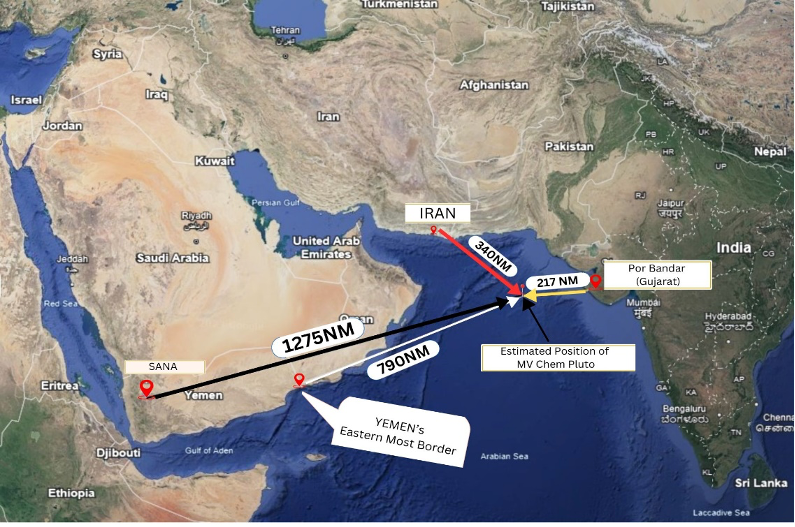 Figure 1: Approximate Location of Drone Attack on MTChem Pluto
Source: Base map from Google Earth. Markings by the Authors
A Reuters report cited a Pentagon official as saying that the unmanned assault drone was launched from Iran. [5] However, Iran’s foreign office was quick to deny the accusation, calling it “worthless” and “… an attempt by the US to distract public attention…”[6]
While conclusive attribution for the attack may not be feasible, a logical analysis, comprising the measurement of distances from some probable points of launch to the site of drone attack at Table 2 (and depicted in Figure 1), vis-à-vis the capabilities of probable originators in the context of the ongoing Israel-Hamas conflict, is quite instructive.
| Possible Originating Point | Probable point of Attack | Estimated distance |
| Sana’a (Yemen) | 217 NM west of Porbandar | 1275 NM (2320 km) |
| Eastern Border of Yemen | 217 NM west of Porbandar | 790 NM (1435 km) |
| Eastern Border of Iran | 217 NM west of Porbandar | 340 NM (612 km) |
Table 2: Distance from some probable points of launch to the site of drone attack
Source: Authors
First of all, the distance of 1,275 NM from Sana’a, the centre of the Houthi controlled part of Yemen, to the location of attack appears to be well beyond the reach of the drones in their possession. In fact, even a distance of 790 NM measured from the eastern border of Yemen — even though this is not an area under Houthi control — may still be beyond the attack range of the drones generally held by non-State actors. Secondly, the maritime domain awareness (MDA) picture and technologies for tracking of a vessel at high seas — so far away from the coast — to enable accurate targeting, would certainly not be available to the rebels. Thirdly, the Houthi rebels already have an adequate number of vessels within their attack range in the Red Sea and the proximate waters across the Bab-al-Mandab in the Gulf of Aden, to progress their heinous agenda. Thus, it would not be operationally prudent for the rebels to reach so far out in the Arabian Sea to press home their position — however illegal, unethical, and rather rooted in criminality — with minimal expected gains for all their efforts.
That raises the question of who, if not the Houthis, could be behind this attack? A critical relook at the issues raised above does point to the fact that only the ‘littoral States’ would have the MDA wherewithal — including access to the automatic identification signals (AIS) — to track the movement of merchant ships and carry out subsequent targeting. Further, the datalink capabilities required — whether by terrestrial or aerial/satellite means — to precisely direct unmanned combat aerial vehicles (UCAV) capable of self-destruct missions, would also be within the preserve of States. If that be the hypothesis, there are only two States between the Strait of Hormuz and India — an indisputable fact rooted in geographic reality.
Tool for Strategic Messaging?
While the objective of this exercise is not to investigate a ‘whodunnit’, the possible motives behind States getting involved in unprovoked, though deniable, attack on merchant ships and non-combatants on the high seas, that too in peacetime, certainly merits greater examination. The most obvious reason, proffered by Houthis themselves, is that they will continue to disrupt the commodity and energy flow across the international sea lanes (ISLs), till the world at large, duly alarmed with the threat to global maritime trade, collectively pressurises Israel to declare a ceasefire in Gaza. However, in the case of an attack that empirically appears to be beyond the reach and capabilities of the Houthis, the intent of States — whosoever they may be — comes into question.
In the instant case, it is widely believed that the Houthi rebels, engaged in a civil war in Yemen for the past decade or so, have the tacit support of Iran, by way of ideological indoctrination, financial support, and the provision of military hardware. In fact, the debilitating drone attacks on Saudi Arabia’s oil installations in September 2019, though claimed by Houthi rebels, had a clear signature of Iran’s involvement; and the subsequent US investigations tried to prove as much with circumstantial evidence.[7] Since the definitive role of Iran in past and present disruptive actions by Houthi rebels — as indeed its suspected intent towards greater destabilisation of the West Asia/Middle-East region — has not been conclusively established, the article will refer to this abstract country as a ‘Said State Player’ (SSP) hereinafter.
In order to prevent wanton and random attacks by Houthi militants on commercial ships transiting the Red Sea, the US, announced the commencement of Operation PROSPERITY GUARDIAN, as part of Task Force (TF) -153, under the broad umbrella of the Combined Maritime Forces (CMF). The initiative, comprising naval forces from multiple countries,[8] has been proactively destroying incoming drones and boats, using ship-based firepower.[9] While only a few nations operating with TF-153 have publicly acknowledged their participation, some other countries engaged in same effort, have chosen to remain unidentified.
India formally joined the CMF as an associate partner in April 2022; which enabled the Indian Navy to work closely with the US Navy and naval forces of other collaborating countries in strengthening maritime security in the western part of the Indian Ocean.[10] Media reports indicate that since the advent of the recent Houthi-ascribed drone and missile attacks on merchant ships in the Red Sea, the Indian Navy has ‘mission-deployed’ five of its six most potent and heavily armed Kolkata Class destroyers, as also Indian Coast Guard patrol vessels in a supporting role in the seas around the Arabian Peninsula.[11] While the Indian Navy has neither confirmed nor denied these reports,[12] the fact that either INS Kolkata or INS Chennai have been seen to swiftly respond to a variety of maritime incidents in the region in full public view, is not lost on observers and analysts.
Thus, the SSP, by carrying out a surprise drone attack on a merchant ship just beyond the Indian exclusive economic zone (EEZ) and having a clear Indian connect — in that it was headed to an Indian port — has surely sought to convey an unequivocal strategic message to India. One can logically surmise that the message seeks to dissuade India — traditionally seen as a long-standing friend of the SSP — from joining the US-led Operation PROSPERITY GUARDIAN against the Houthi activities in the Red Sea and adjoining waters off Yemen.
There are, supposedly, other broader motives for the SSP, in addition to the above India-specific signalling; and they all have inherent elements of strategic communication to varying extent and for different recipients. Some plausible ones are mentioned below:
- Warn those oil-exporting countries within the Persian Gulf region that have sectarian difference with the SSP, that their energy-export system will be deliberately disrupted if they do not overtly support the Palestinian cause. Further, if they continue to align with the US to contain or contest unilateral influence-building endeavours of the SSP in the region, this could prove to be detrimental to their national interests.
- Expand the scope and scale of Israel-Hamas conflict to the whole of the West Asian littoral and the adjoining maritime areas of the Arabian Sea, by involving those countries that are aligned to the SSP’s ideology — whether religious or cultural — and may have similar agendas.
- Inflame anti-West sentiments in the region by projecting the US and the collaborating forces as highly partisan and unreasonable in their actions when they respond by use of force — however limited in scale — to keep the critical sea lanes open and maintain the freedom of navigation therein.
- Propel this largely localised conflict onto the international arena, with the objective of somehow embroiling the US and other associated western allies into a warlike situation to an extent where the other major adversarial powers such as China and Russia are forced to consider some kind of counteractive response. If the precariously poised situation somehow attains kinetic dimension, the SSP would certainly be satisfied with the outcome.
- Signal to the world-at-large that its economic and social well-being — on account of the interruption of trade and energy flows — will be significantly and adversely impacted if the global community does not act in unison to exert overbearing pressure upon Israel — through the US, of course, — to cease hostilities in Gaza.
Beyond Strategic Messaging?
The attacks by Houthi forces on merchant vessels in the Red Sea, as also on other ships in the Arabian Sea, did present a modicum of doubt over the involvement of the SSP — even though this has been pretty common knowledge for long. However, all pretences at being the tacit ‘behind-the-scenes’ actor were dropped, when the Iranian Navy seized MT St. Nikolas, a Greek-owned tanker, about 50 NM off the Omani coastal town of Sohar, on 11 January 2024. The vessel, which was transporting about 1,45,000 tonnes of crude oil from the port of Basra (Iraq) in the Persian Gulf to a refinery in Turkey, was subsequently commandeered toward the Iranian port of Bandar-e-Jask across the Strait of Hormuz.[13] Figure 2 presents a spatial perspective of the incident and its location.
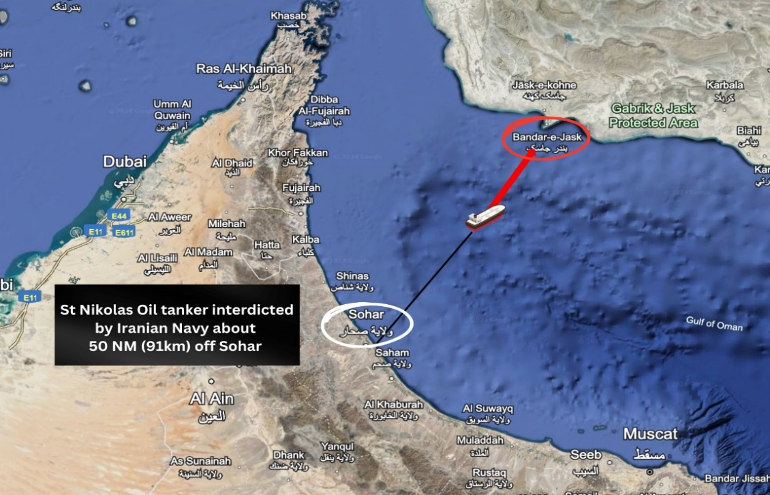 Figure 2: Approximate Location of MT St Nikolas Seizure Incident
Source: Base map from Google Earth. Markings by the Authors
Iran stated that this action was in response to an earlier incident of April 2023, wherein the US Navy had interdicted the same ship — then named the MT Suez Rajan — in the South China Sea as part of its ‘sanctions-enforcement’ regime. The entire cargo of ‘contraband’ Iranian oil, supposedly destined for China, was confiscated; and later transhipped to a port in Texas.[14] This action has the potential to place Iran in direct confrontation with the US. Iran however, appears to have taken care to keep this action just about in the ‘grey zone’ in that the ship — owned by a Greek company, flying the flag of the Marshall Islands, carrying Iraqi oil, and destined for Turkey — has no direct connection with the US or its national interests. However, its strategic signal — articulated as a response to the US having “stolen”[15] the Iranian oil earlier —could not have been more explicit. The US, for the time being, has restricted itself to a diplomatic statement: “We condemn this apparent seizure. The Iranian government should immediately release the ship and its crew. These provocative and unacceptable actions need to stop.”[16]
Indian Response strategy
India publicly denounced the attack on the MT Chem Pluto and underscored the resoluteness of its intent to address the emerging challenge. Shri Rajnath Singh, India’s Defence Minister, asserted that “… the Government of India has taken the attacks very seriously and … that the perpetrators of these attacks will soon be brought to justice …”[17] The media, in fact, attributed the collective sense of Indian anger to these ‘very strong’ words of the Indian Defence Minister: “Those who have carried out these attacks, we will find them from the bottom of the sea …”[18] [sic]
And the Indian Navy — becoming increasingly combat-ready, credible and a future-ready Force— is more than capable and committed to ‘walking the talk’. In this context, it is worth recalling that India was one of the first countries to deploy its warships, in November 2008, for the countering of piracy in the waters off Somalia and the Gulf of Aden. Soon thereafter, INS Tabar became the first ever warship to take decisive kinetic action against an ill-intentioned pirate mother-ship, and destroyed it.[19] India has, since then, maintained continuous deployment of its warships on anti-piracy duty over the past decade-and-a-half. Cutting to the contemporary timeframe, India, additionally began to deploy Indian Navy ships under Operation SANKALP — which translates to ‘Resolve’ — since June 2019, to convey its intent to protect the security of its energy flows, after random attacks were reported on ships transporting oil from the Persian Gulf. [20]
Subsequent to the Chem Pluto attack, an increased contingent of Indian naval and coast guard ships and other associated assets have been deployed in a wide swath of the Arabian Sea. This response-strategy has started yielding the desired results, as seen in the successful Indian Navy’s mission to recover the hijacked cargo vessel, the bulk carrier MV Lila Norfolk, from the clutches of pirates in the north Arabian Sea, on 04 January 2024. The Indian Navy’s marine commandoes (MARCOS), duly supported by Indian P-8(I) maritime reconnaissance aircraft, UAVs, ships, and helicopters, rescued all 21 crew members including 15 Indians.[21] This operation, although not directly related to the ongoing Houthi actions, signalled the firmness of the Indian Navy’s own resolve to be a credible first-responder in multifarious contingencies within the Indian Ocean Region.
Conclusion
The contemporary scope of maritime warfare extends beyond traditional paradigms, and increasingly encompasses advancements in various high-technology applications such as the extensive use of drones, as seen in the ongoing turmoil in and around the Arabian Peninsula. The integration of MDA tools into the kill chain further enhances the capabilities of States — and those of non-state actors, too — oft-times endowing them with asymmetric operational advantage. Consequently, there is a tendency on part of some actors to indiscriminately leverage such asymmetric advantages for strategic messaging. However, in recognition of the protracted and intricate nature of conflict that may subsequently erupt if merchant vessels are considered to be easy prey for predatory attacks; it becomes imperative for States to be mindful of the escalatory potential of such strategic signalling endeavours. Therefore, due prudence must be exercised while using this instrument.
As far as the currently prevailing maritime instability in the Red Sea (and extending well beyond it into the Arabian Sea) is concerned, the attacks on merchant vessels — whether carried out by the Houthis, pirates, or even by State parties under a cloak of deniability — are likely to continue for some time in future, especially as Israel has indicated that its offensive in Gaza will not end any time soon. The coalition of State-parties under Operation PROSPERITY GUARDIAN are presently trying to address the evolving threat by the judicious use of limited force as a defensive measure, so as not to further expand the scope and expanse of conflict. However, with the Houthi resolve of exacting revenge against the warships of TF-153 which targeted their bases ashore — duly aided and abetted by ordnance support from the SSP — and given the fact that these ships are operating in constricted waters in the Red Sea, it appears to be only a matter of time before they get lucky, and a warship is hit. In this dynamic situation, where more and varied kinds of attacks are occurring with ominous regularity, a successful incident against a warship — howsoever minor — will leave no option to the defending coalition of countries, than to escalate the conflict.
In this tenuous and potentially explosive situation, the Indian Navy’s choice of deploying its warships and associated support systems in good strength around the affected region appears to be quite prudent. This approach will ensure the ready availability of its assets and their operational preparedness to intervene quickly to address the emerging threats to India’s maritime and economic security. Such an operationally poised combat-ready force will also be able to mitigate the impact of the so called ‘strategic communication’ that the SSP or any other party seeks to convey to India. The proactive posturing of such a potent force, if and when absolutely necessary, will enable the country to pose some ‘strategic questions’ of its own to the originators of such strategic signals. In the process, if an opportunity presents itself to collaborate with other stakeholders who identify themselves with the free, open, and secure seas consistent with the prevalent ‘rules-based order’, the Indian Navy must contribute positively — though not necessarily with grand fanfare and undue publicity.
******
About the Authors:
Captain Kamlesh K Agnihotri, IN (Retd.) is a Senior Fellow at the National Maritime Foundation (NMF), New Delhi. His research concentrates upon maritime facets of hard security vis-à-vis China, Pakistan, Russia, and Turkey. He also delves into maritime security-challenges in the Indo-Pacific Region and their associated geopolitical dynamics. Views expressed in this article are personal. He can be reached at kkumaragni@gmail.com
Mr Chemi Rigzin is a Research Associate at the National Maritime Foundation. He holds an MPhil degree in Geography from Delhi University. His research currently focuses upon critical areas of hard security such as PLA naval modernisation, Chinese port construction and facilities. He also delves into more generalised threats to shipping and maritime connectivity within the Indo-Pacific. He may be contacted at pcrt4.nmf@gmail.com
Endnotes
[1] Andrew Osborn, Max Hunder, “Ukraine strikes Russian naval landing warship, Moscow admits damage”, Reuters, 26 December 2023. https://www.reuters.com/world/europe/ukraine-carries-out-air-assault-crimeas-port-feodosia-2023-12-6/#:~:text=MOSCOW%2FLONDON%2C%20Dec%2026%20(,along%20the%20Black%20Sea%20coast
[2] David Brennan, “Russian Black Sea Fleet’s Losses Since Ukraine War Began: Full List”, Newsweek 90, 08 November 2023. https://www.newsweek.com/russian-black-sea-fleet-losses-ukraine-war-full-list-warships-sunk-damaged-1841828
[3] Chris Jewers, “Hijacked cargo ship Galaxy Leader is spotted off Yemen in satellite images days after Iran-back Houthi rebels stormed the vessel in the Red Sea”, Mail Online, 21 November 2023, https://www.dailymail.co.uk/news/article-12775407/Hijacked-cargo-ship-Galaxy-Leader-spotted-Yemen-satellite-images-Houthi-rebels.html
[4] Sam Lagrone, “Houthis Fired Ballistic Missiles into Red Sea, Iranian Drone Strikes Merchant Ship Off India, Says Pentagon”, USNI Weekly, 23 December 2023, https://news.usni.org/2023/12/23/houthis-fired-ballistic-missiles-more-drones-at-merchant-ships-in-red-sea-says-centcom
[5] Reuters, “Pentagon says Iranian drone ‘attack’ hit chemical tanker near India”, 24 December 2023, https://www.reuters.com/world/pentagon-says-iranian-drone-attack-hit-chemical-tanker-near-india-2023-12-24/
[6] The Times of Israel, “Iran denies responsibility for drone attack against tanker near India”, 25 December 2023, https://www.timesofisrael.com/iran-denies-responsibility-for-drone-attack-against-tanker-near-india/
[7] Humeyra Pamuk, “Exclusive: US probe of Saudi oil attack shows it came from north – report”, Reuters, 20 December 2019, https://www.reuters.com/article/idUSKBN1YN29E/
[8] Operation PROSPERITY GUARDIAN includes the warships and other assets from the United Kingdom, Bahrain, Canada, France, Italy, Netherlands, Norway, Seychelles, and Spain, in addition to the US Navy. See US Department of Defense, “Statement from Secretary of Defense Lloyd J. Austin III on Ensuring Freedom of Navigation in the Red Sea”, 18 December 2023, https://www.defense.gov/News/Releases/Release/Article/3621110/statement-from-secretary-of-defense-lloyd-j-austin-iii-on-ensuring-freedom-of-n/
[9] For instance, see US Central Command, X (Formerly Twitter) Post, 31 December 2023, 2:23 PM, https://twitter.com/CENTCOM/status/1741381969936834951
[10] Press Information Bureau, “Press Statement by Raksha Mantri Shri Rajnath Singh after India-US 2+2 Ministerial Dialogue”, 12 April 2022, https://pib.gov.in/PressReleaseIframePage.aspx?PRID=1815838
[11] Aaron-Matthew Lariosa, “Indian Navy Retakes Merchant Ship From Armed Hijackers in the Arabian Sea”, USNI News, 07 January 2024, https://news.usni.org/2024/01/07/indian-navy-retakes-merchant-ship-from-armed-hijackers-in-the-arabian-sea?mc_cid=168a95156e&mc_eid=52bfb7c103
[12] Sam Lagrone, “Houthis Fired Ballistic Missiles into Red Sea, Iranian Drone Strikes Merchant Ship Off India, Says Pentagon”, ibid.
[13] Jana Choukeir, Ahmed Elimam, Robert Harvey, “Iran seizes oil tanker involved in US-Iran dispute in Gulf of Oman – state media”, Reuters, 12 January 2024, https://www.reuters.com/business/autos-transportation/uk-shipping-authority-receives-report-vessel-boarded-by-armed-persons-off-oman-2024-01-11/
[14] Iran Daily, “Iran’s Navy seizes oil tanker in court-mandated retaliation: Seizure lifts crude prices”, 13 January 2024, https://newspaper.irandaily.ir/7483/2/7011.
[15] Iran Daily, “Iran’s Navy seizes oil tanker in court-mandated retaliation: Seizure lifts crude prices”, ibid.
[16] The White House Pess Briefing, “Karine Jean-Pierre, NSC Coordinator For Strategic Communications John Kirby, and National Economic Council Director Lael Brainard”, 11 January 2024, https://www.whitehouse.gov/ briefing-room/press-briefings/2024/01/11/press-briefing-by-press-secretary-karine-jean-pierre-nsc-coordinator-for-strategic-communications-john-kirby-and-national-economic-council-director-lael-brainard/
[17] Press Information Bureau, “Raksha Mantri commissions stealth guided missile destroyer INS Imphal in Mumbai; Terms it as a symbol of ‘Aatmanirbharta’ in defence”, 26 December 2023, https://pib.gov.in/PressReleasePage.aspx?PRID=1990408
[18] Aaron-Matthew Lariosa, “India Vows Vengeance After Merchant Vessel Attacks”, 26 December 2023, https://news.usni.org/2023/12/26/india-vows-vengeance-after-merchant-vessel-attacks
[19] Isabel Reynolds, “Asians step up defence against Somali pirates”, Reuters, 19 November 2008, https://www.reuters.com/article/idUST333573/
[20] Press Information Bureau, “Op SANKALP : 3rd Year of Indian Navy’s Maritime Security Operations,” 19 June 2022, https://pib.gov.in/PressReleaseIframePage.aspx?PRID=1835382#:~:text= In%20the%20milieu%20of%20the,Indian%20Flag%20Vessels%20transiting%20through.
[21] Spokesperson Navy, X (Formerly Twitter) Post, 05 January 2024, 8:31 PM, https://twitter.com/indiannavy/status/1743286659880280527?ref_src=twsrc%5Etfw%7Ctwcamp%5Etweetembed%7Ctwterm%5E1743286659880280527%7Ctwgr%5E731a2991eb46be27ba1c2ade6d0d5e74b06234d5%7Ctwcon%5Es1_&ref_url=https%3A%2F%2Fnews.usni.org%2F2024%2F01%2F07%2Findian-navy-retakes-merchant-ship-from-armed-hijackers-in-the-arabian-sea
 A View of Hindustan Shipyard Limited (Image Credit: www.reddit.com)
Leave a Reply
Want to join the discussion?Feel free to contribute!