
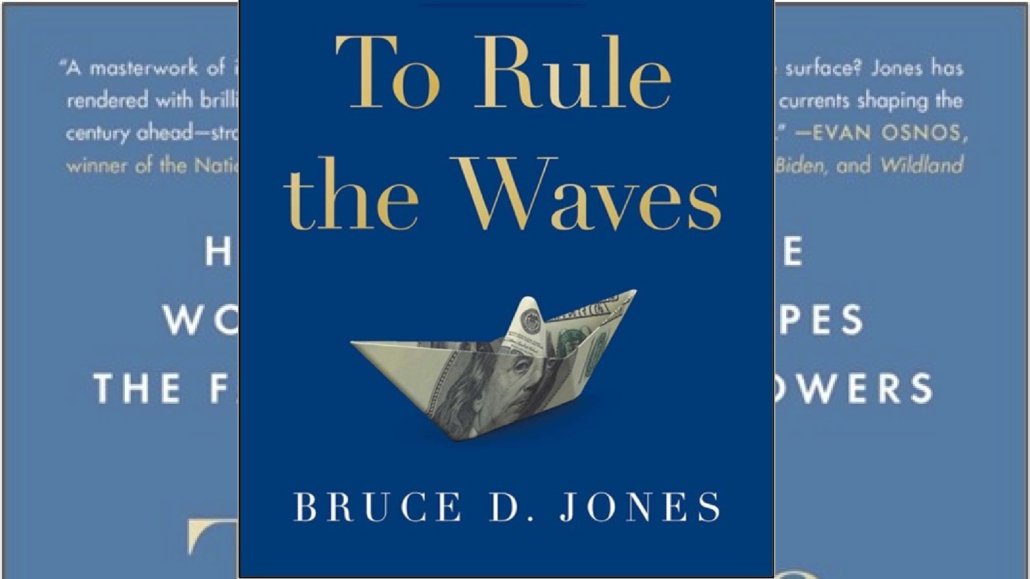
Bruce D Jones. (2022 Edition). Scribner. 14 September 2021. 402 pages
In this book, the author, Bruce D Jones, delves into the geopolitical, economic, and strategic importance of the world’s oceans, emphasising their role as the cornerstone of global power dynamics. The book is organised into four parts, beginning with a historical overview of maritime governance (Part I), progressing to the revolution in container shipping initiated in 1956 (Part II), addressing the complexities of flag state jurisdiction (Part III), and concluding with an examination of the strategic importance of maritime power (Part IV).
Jones asserts that control over the seas has historically been, and continues to be, a crucial determinant of a nation’s dominance within the international order. He deftly weaves historical narratives, contemporary geopolitical analyses, and discussions on technological advancements, to present a comprehensive exploration of maritime supremacy and its implications for global powers.
Throughout history, the oceans have been vital for trade, exploration, and military strategy, serving as essential economic and political power conduits. It is, therefore, fitting that the book opens with a historical overview of maritime dominance, tracing its roots back to ancient empires and the early modern powers, notably the British Empire. The British mastery of the seas during the 18th and 19th centuries, fuelled by the Industrial Revolution and colonial expansion, established a precedent for how nations could leverage naval superiority to secure global hegemony. Jones effectively argues that the transition of maritime power from Britain to the United States in the 20th century underscores the enduring importance of control over the seas. The dominance of the US Navy, particularly during World War II and the Cold War, ensured American pre-eminence in the global order. However, the section is somewhat limited and repetitive, offering largely familiar data points with few new insights beyond specific trade details.
Jones underscores the fact that maritime power extends beyond mere military strength, encompassing the securing of trade routes and the projection of influence. Jones underscores the central role of the oceans in the global economy, noting that over 90% of world trade by volume is transported by sea, positioning maritime shipping as the backbone of globalisation. The author explores the complexities of supply chains, illustrating how goods, from electronics to food, depend upon the seamless operation of maritime logistics. Critical nodes such as ports, shipping lanes, and chokepoints such as the Strait of Hormuz and the South China Sea emerge as pivotal components of this system. He discusses the transformative impact of container shipping, which revolutionised global trade by reducing costs and expanding markets, thereby driving worldwide economic growth.
Jones goes on to examine the oceans as geopolitical battlegrounds where major powers such as the United States, China, and Russia compete for influence. He dwells upon the strategic importance of the South China Sea for global trade and underscores its potential as a flashpoint for US-China tensions. Highlighting China’s construction of artificial islands and militarisation of the region, Jones portrays these actions as part of China’s broader challenge to US dominance of the Indo-Pacific. He also discusses Russia’s Arctic strategy, where climate change is opening new shipping routes and access to untapped resources. Russia’s significant investments in its Northern Fleet and related infrastructure signify the Arctic’s emerging role as a new frontier for geopolitical competition.
The book addresses the strategic significance of chokepoints, such as the Strait of Malacca and the Suez Canal, which are crucial for global trade and energy flows. Jones argues that control over these chokepoints is a vital measure of a nation’s maritime power. However, he falls short in exploring the practicalities of securing these critical waterways. He delves into technological advancements that have revolutionized naval warfare and commerce, including nuclear-powered submarines, aircraft carriers, precision-guided missiles, satellites, and unmanned systems, collectively enhancing situational awareness and operational capabilities.
In the commercial sphere, Jones discusses how technology is reshaping shipping and logistics through innovations such as autonomous ships, digital tracking systems, and green technologies. These advancements increase efficiency, reduce environmental impact, and introduce new vulnerabilities, such as cyber threats to maritime infrastructure. He also addresses the environmental consequences of human activity on the oceans, including overfishing, pollution, and anthropogenic contributions to climate change. He highlights the paradox of the seas as both a source of wealth and a repository for waste, with the exploitation of marine resources and pollution posing significant threats to ocean ecosystems and biodiversity. Climate change, associated with rising sea levels, ocean acidification, and melting ice caps, poses an existential threat to several coastal communities and small island nations. Jones calls for international cooperation to address these challenges, though he acknowledges that geopolitical rivalries often hinder collective action.
The book concludes with a forward-looking analysis of maritime power in the 21st century, identifying three key trends: the rise of China, technological disruptions, and climate change. Jones emphasises the need for multilateralism and innovation to ensure the oceans remain a source of prosperity and stability. However, the discussion on climate change and pollution is somewhat limited, and the absence of maps detracts from the reader’s comprehension. Depth of analysis appears to have been sacrificed for breadth, making the book less insightful for readers already well-versed in maritime issues. Nevertheless, for the uninitiated, it serves as a well-researched, concise treatise on the primacy of the seas in an interconnected world, highlighting the importance of thoughtful stewardship in an increasingly contested global arena.
In summation, Jones provides a reasonably compelling narrative on the enduring significance of maritime power in shaping global dynamics. His wide-ranging analysis underscores the complex role of the oceans in economic, geopolitical, and environmental contexts. While the book offers limited new insights for people reasonably well-read in the field of maritime affairs, it remains an valuable resource for those seeking to understand the fundamentals of the complex interplay between maritime power and global stability.
About the Reviewer
Commodore Himadri Bose is a serving officer of the Indian Navy. He is an avid writer on military history, naval warfare, and military strategy and regularly reviews books for various publications. He may be contacted at bosehimadri@gmail.com


Leave a Reply
Want to join the discussion?Feel free to contribute!