
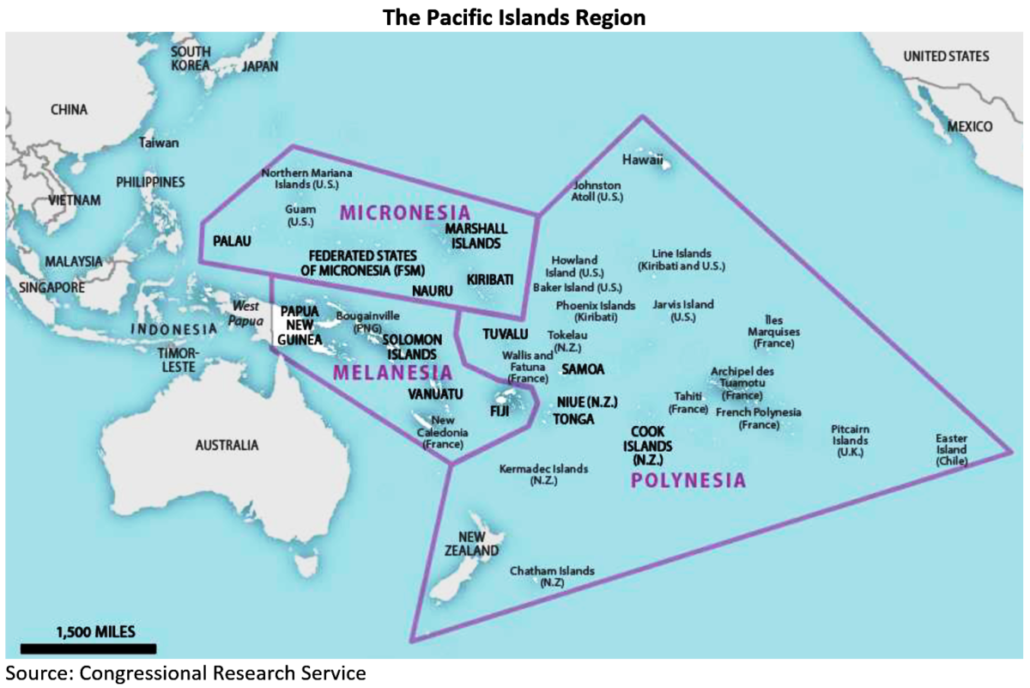
This article by Mr Richard Clark, former special Assistant and Press Secretary to the President of the Government of the Federated States of Micronesia (FSM) and founder of both the Cybersecurity & Intelligence Bureau (CSIB), and the FSM Information & Intelligence Service (IIS), was first published in The Diplomat on 19 April 2024 and is republished here with the permission of the author. In far too many cases, Indian strategists do not seriously consider Oceania at all, dismissing it as a distant place of minimal importance to New Delhi. Such dismissiveness is likely prove to be a very costly error. Oceania has very considerable relevance not only to countries such as the US, Australia, New Zealand, but to China, Japan, and India as well. If India is to be a power of any consequence in the Indo-Pacific and not merely its western segment (the Indian Ocean) alone, Oceania needs to be taken seriously. This is especially important in the light of India’s decade-long (since 2014) geopolitical investment in the “Forum for India-Pacific Islands cooperation” (FIPIC), juxtaposed against that of the People’s Republic of China, as evidenced by the recent visit (26 May to 04 June 2023) of Mr Wang Yi, the then-Foreign Minister of the, to eight FIPIC countries, namely, the Solomon Islands, Kiribati, Samoa, Fiji, Tonga, Vanuatu, Papua New Guinea, and Timor-Leste. The geopolitical game of Wei Qi that is afoot in Oceania has India and China on the one hand, and the US, Australia, and China, on the other, all jockeying for favourable positions upon this gameboard of “Go”. The views expressed in this article are those of Mr Clark as an individual and are not to be construed as reflecting official views of either the Indian establishment or the National Maritime Foundation.
***
Wesley Simina, the President of the Federated States of Micronesia (FSM), travelled to China between 05 and 12 April 2024 for a State visit, on the heels of his visit to the United States, where he had exchanged notes on a 20-year renewal of key elements of the Compact of Free Association, an agreement that is the foundation of FSM-US relations. While many in Washington might think that the renewal sorts out FSM-US relations for the next two decades, a closer look at Simina’s China visit should give them pause.
Immediately prior to his China Visit, Simina gave an interview to Mar-Vic Cagurangan at the Pacific Island Times,[1] where he described his appreciation at the chance to play “peacemaker” between Washington and Beijing.
Simina’s trip to China overlapped with visits by Russia’s Foreign Minister Sergey Lavrov,[2] Thailand’s Princess Maha Chakri Sirindhorn, Suriname’s President Chandrikapersad Santokhi, and Taiwan’s former President Ma Ying-jeou,[3] representing the opposition Kuomintang party. Despite the busy diplomatic schedule in Beijing, Simina was given the red-carpet treatment.
Simina did not bring along his Chief of Staff, Jane Chigiyal, nor his acting attorney general, Leonito Bacalando Jr.; yet Simina was accompanied by Chris Christian, the son of former President Peter Christian and husband to the executive director of the Western & Central Pacific Fisheries Commission, Rhea Moss-Christian, as well as Eugene Pangelinan, previously the executive director of the FSM’s National Oceanic Resource Management Authority. Pangelinan was alleged by former President David Panuelo to have unilaterally provided permits to dual-purpose research vessels from China.
In the meeting between China’s Xi Jinping and Simina, Xi inaccurately suggested that Austronesian languages originated in Fujian Province. Simina apparently did not push back on this. Nor did Simina raise the issue of China’s diplomats following former President Panuelo and his family this past September 2023.
Notably, Simina said that the FSM is “firmly committed to the One China principle.” Historically the FSM has used the term “One China policy” instead, the idea being that the word “principle” means something specific to Beijing that it doesn’t mean to the FSM.
However, we have seen Simina misuse crucial words in the past. During the FSM president’s meeting with the US Secretary of Defence this March, Simina said that the FSM and the United States share the values of “peace, unity, and freedom.” FSM presidents, including Panuelo (2019-2023), Christian (2015-2019), and Emanuel Mori (2007-2015) tend to always the words “peace, unity, and liberty” because those are the words on the FSM’s seal.
The fact that Simina knew to repeat the themes of the words he’s heard before, but failed on the execution, is consistent with his personality and previous public addresses. In isolation, a reference to the “One China principle” does not represent a policy shift from the FSM; it is most likely that Simina simply does not see the difference between the One China policy and the One China principle.
What does represent a policy shift, however, is the FSM’s uncritical support for China’s favoured language. Simina describes wanting to deepen the “comprehensive strategic partnership” with China. Former President Panuelo, by contrast, spoke of the FSM-China Great Friendship, named after the Great Wall of China. The implication was that, yes, the FSM and PRC were friends, but there was also a definable border—i.e. economic and technical cooperation were on one side of the wall, and agreements in opposition to the rules-based order were on the other side, to remain unknowable.
While in office, President Peter Christian may have allowed Xi Jinping to call the FSM-China relationship a comprehensive strategic partnership but he took the effort to ensure the FSM didn’t join the Asian Infrastructure and Investment Bank, an operating arm of the Belt and Road Initiative.
But what ought to attract the most attention is the China-FSM Joint Statement.[4]
In the seventh item of the statement, the FSM says it will explore cooperation with China under the Global Security Initiative (GSI) to “address the impacts of traditional and non-traditional security challenges.” The GSI has similarities to the Common Development Vision, which was the proposed security agreement for the Pacific Islands that former FSM President Panuelo rejected in May 2022 after discussing what it would actually do.
More concerning is item number ten in the joint statement, where the FSM endorses this text:
“The two sides reiterated their commitment to firmly upholding the international nuclear non-proliferation regime with the Treaty on the Non-Proliferation of Nuclear Weapons as the cornerstone, and call on relevant countries to fulfill international obligations and prudently handle issues such as the discharge of nuclear-contaminated water and cooperation on nuclear-powered submarines.”
Under this text, the FSM fails to call out China for having nuclear-powered and nuclear-weapons-equipped submarines patrolling the Pacific, but does unsubtly (albeit not by name) criticise the United States and Australia for AUKUS—a security alliance that aims to provide Australia with nuclear-powered submarines, and for the express purpose of deterring the nuclear-powered submarines China is already using.
The FSM also signed on to criticisms of Japan for its discharge of ALPS-treated wastewater. China has long been focusing on this issue to smear Japan through fora such as the Pacific Islands Forum, preying on Pacific Islanders’ sensitivity to nuclear issues with the aim of making the West appear as the transgressor of international norms.
Perhaps Simina doesn’t know that China outputs orders of magnitudes more radioactive tritium than Japan, and that Japan’s discharge of ALPS-treated wastewater isn’t the same as nuclear-contaminated water.
Perhaps Simina is similarly unaware that China patrols the Pacific with nuclear-weapons-equipped and nuclear-powered submarines. After all, in his first week as president, he shut down the FSM Information and Intelligence Service, which was mandated to provide him that sort of information.
And perhaps Simina supports China’s claims over Taiwan because he is unaware that the Chinese Communist Party, in fact, has never once controlled the island.
What’s most plausible, however, is that such nuance and context do not matter when donor money is on the table. Now that the Compact of Free Association has been funded by the U.S. Congress, the FSM might as well seek the benefits of China and other partners, and test the limits of its rhetoric.
There is nothing wrong with such an approach, if undertaken openly; even Henry Puna, the secretary-general of the Pacific Islands Forum, recently recommended that Pacific Islands ought to play large powers against each other for maximum benefits. The trouble lies in the FSM’s apparent unwillingness to own up to what Simina apparently promised Xi. As of this writing on the evening of April 18, the FSM had yet to publicise this state visit to China in any format, leaving Chinese media and official readouts as the only public sources of information.
In short: it is profoundly difficult for the FSM to maintain its own security if, with one side of its mouth, it supports the international rules-based order it benefits form and, with the other side of its mouth, it supports China’s efforts to violently overtake it and reshape it in its image.
Update: on the morning of April 19, approximately three hours after the publication of this article and the author’s direct dissemination to FSM officials in the Office of the President, the FSM government published a press release on their Facebook Page, found here.[5] The release avoids discussing the China-FSM joint statement, makes no mention of nuclear issues, and reintroduces the One China policy language.
The release also lists 10 memoranda of understanding reached during Simina’s visit to China, including a relationship between China Media Group and the Office of the President’s Division of Public Information. This marks the first time that the press secretary of the FSM would engage in a relationship with China’s state media, or any foreign government’s public information apparatus for that matter. This is further noteworthy as it was Simina and former President Christian who, in September 2021, shut down then-President Panuelo’s proposed Freedom of Information Act, which would have provided FSM citizens the explicit legal right to information about and from their government. It was the legal opinion of the FSM Department of Justice at that time that FSM citizens categorically do not possess a right to information from their government.
Endnotes:
[1] The Pacific Island Times, “FSM’s Hedging Strategy Aims at Keeping Peace in Pacific Region, Simina Says,” pactimes, April 5, 2024, https://www.pacificislandtimes.com/post/fsm-s-hedging-strategy-aims-at-keeping-peace-in-pacific-region
[2] “China’s Xi Jinping Meets with Russian Foreign Minister in Show of Support,” The Diplomat, thediplomat.com, 09 April 2024, https://thediplomat.com/2024/04/chinas-xi-jinping-meets-with-russian-foreign-minister-in-show-of-support/
[3] Brian Hioe, “Taiwan’s Former President Meets Xi Jinping during China Trip,” The Diplomat, 10 April 2024, https://thediplomat.com/2024/04/taiwans-former-president-meets-xi-jinping-during-china-trip/
[4] Xinhua News Agency, “Full Text: Joint Statement between the People’s Republic of China and the Federated States of Micronesia – Belt and Road Portal”, 10 April 2024, https://eng.yidaiyilu.gov.cn/p/0G7NVTKD.html.
[5] Office of the President, Federated States of Micronesia, Facebook Post, 19 April 2024, https://www.facebook.com/piofsm/posts/pfbid0fJ8Xr28pLn1EeebWpyFq8UCg4xmrjEUKanAfKLTKrYpdT6CRkxpBejoQE8AcK5yDl


Leave a Reply
Want to join the discussion?Feel free to contribute!