
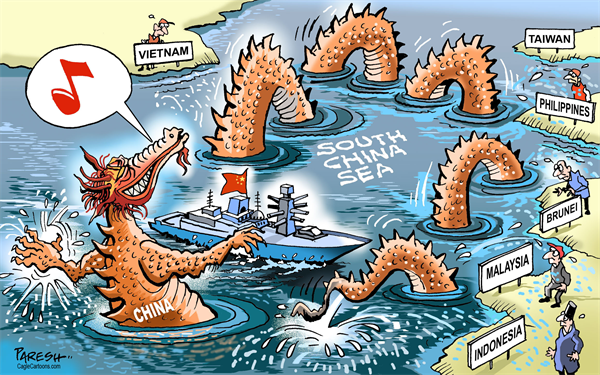
Japan released its latest edition of Defense White Paper titled ‘Defense of Japan 2013’ on July 9, 2013. While describing the Defense Policies of Countries which possibly affect the Security Environment Surrounding Japan, the paper contended that “… in regard to the issues of conflicting interests with its surrounding countries, including Japan, China has attempted to change the status quo by force based on its own assertion which is incompatible with the existing order of international law.”[1] As expected, there was near instant criticism of this Japanese articulation from the Chinese foreign policy establishment, and was given wide coverage by the Chinese media with ample rhetoric thrown in. While the Chinese Foreign Office called the Japanese report as ‘worrisome, one media comment went on to say that “Japan runs the risk of playing with fire”[2] by playing up the ‘China threat’ theory.
The above Japanese Defense White Paper was preceded by an American Senate Resolution[3] tabled on June 10, 2013, “reaffirming strong support for peaceful resolution of territorial, sovereignty and jurisdictional disputes in the Asia-Pacific maritime domains”. After presenting a detailed narrative of events involving various opposing parties, particularly over last three years, the operative part of the Resolution states that “the Senate condemns the use of coercion, threats, or force by naval, maritime security, or fishing vessels and military or civilian aircraft in the South China Sea and the East China Sea to assert disputed maritime or territorial claims or alter the status quo” The similarity in language of the key assertion–with respect to the disputants’ endeavours to ‘change the status quo of disputed waters and territories by force’–between the two documents is clearly discernible.
Means of Seeking Peace and Stability: Use of ‘Force’ or otherwise?
There is no denying the contentious nature of maritime claims, both in the East and South China Seas. However, there appears to be a general acknowledgement by various disputants–within if not publicly articulated–that ‘threat or use of force’ may not be a viable option for any party for decisive resolution in the prevalent regional environment. On the contrary, it may prove to be detrimental to the interests of the State that contemplates so. Assuming that an underlying consensus exists against this course of action, the only instruments left in the foreign policy basket are those which are predicated on peaceful means of redressal. Notwithstanding the fact that such instruments are inherently slow-moving and often limited in effectiveness, they are still considered to be a better option. The ‘use of force’ as the last resort for coercive diplomacy, of course, remains available and implicit while peace is being given a long rope.
Thus, if the ‘use of force’ is not a viable option, then the appreciation of the adversary’s intentions and own possible response strategies by States in question may be conveyed, both domestically as well as externally by way of official documents. These may take the shape of White Papers, parliamentary resolutions, strategic policy formulations, unilateral statements of purpose, bilateral/multilateral agreements and Memoranda of Understanding (MOUs), protest notes, demarches, pleas for arbitration and the like. The list of such documents put out in recent past, in the context of precariously balanced situation in the western-Pacific region, and particularly focusing on the South China Sea, is pretty large. While each may mostly be meant to safeguard the concerned State’s own national interests, different parties try to read between the lines, examine for implied signals and interpret them through their perceptions. The rebuttal that invariably follows does little to inspire confidence. A look at some such documents does validate this argument.
South China Sea Case: Documentary onslaught from one side
While the draft American resolution, duly cleared by Senate Foreign Relations Committee on June 25, 2013 awaits formal passage, this is not the first time that the US Senate has indulged in such an exercise. A similar Resolution was passed by unanimous consent after an extended China-Vietnam stand-off in May-June 2011 wherein the US Senate “deplore[d] the use of force by naval and maritime security vessels from China in the South China Sea”; and also “reaffirm[ed] strong support for… continued efforts to facilitate a multilateral… process to resolve these disputes.”[4]
The American pitch for ‘multilateral’ approach to resolve the South China Sea conundrum stems from the fact that there are multiple parties from ASEAN grouping involved, in addition to China and Taiwan. There is also a general belief amongst the concerned ASEAN States as well as the US, that China as a large country with strong Comprehensive National Power (CNP) will have disproportionate advantage while negotiating bilaterally with individual disputants. This may result in the interests of such disputants being overshadowed through coercive diplomacy. Thus, the willingness of the US to remain a stakeholder in South China Sea matters, citing ‘national interest’, notwithstanding the fact that US agenda is different from that of the ASEAN disputants, is still more than welcome. Further the American support for ASEAN’s multilateral endeavours to draft the Code of Conduct (COC) for parties in the South China Sea, has provided much needed leverage to smaller disputants like Philippines and Vietnam in projecting their rightful claims vis-à-vis China.
Vietnam passed and promulgated its domestic ‘Law on Vietnamese Sea’[5] on June 21, 2012 in order to define, manage and administer its maritime areas and zones. This Law effective January 1, 2013, brings the South China Sea archipelagos of Paracel (Hoang Sa) and Spratly (Truong Sa) under its sovreignty and national jurisdiction. It also mandates the Vietnamese maritime law enforcement authorities to ensure Protection of such sovereignty and national jurisdiction. This law in accordance with the provisions of 1982 Law of the Sea Convention (UNCLOS) , combined with various submissions to the UN Commission on the limits of Continental Shelf (CLCS) starting May 2009, formalises its claims at the international forum.
The Philippines went a step further in seeking international intervention for resolution of its dispute with China. It decided to file for arbitration under article 287 and Annexure VII of UNCLOS on January 22, 2013,[6] wherein it sought the following injunctions, among others:-
- Declaration that China’s maritime claims in the South China Sea based on its so-called nine-dash line are contrary to UNCLOS and invalid
- China brings its domestic legislation into conformity with its obligations under UNCLOS
- China desists from activities that violate the rights of Philippines in its West Philippine Sea maritime domain
It contended that having exhausted all political and diplomatic means to resolve the disputes bilaterally with China and, particularly after a three-month long stand-off over Scarborough Shoal commencing mid April 2012, it was left with no option other than resort to the arbitration plea at the international forum.
South China Sea Case: The Chinese Response
China has steadfastly maintained its position of ‘indisputable’ territorial sovereignty over various land features in the South China Sea and associated maritime zones. China has issued its own set of documents, in support of this position in the past few years, especially since May 7, 2009 communication to the Secretary-General of the United Nations.[7] This official letter, in response to the Vietnamese submission of its claims to the UN CLCS, had a map showing the famous ‘nine dash lines’ attached– possibly the first time that China formally did so. Thereafter, it followed up for the next two years with letters in response to either Vietnamese or Philippines’ communications, refuting their stances all along, while reiterating that it ‘enjoyed sovereign rights and jurisdiction over the islands in the South China Sea and the adjacent waters.’ Further, China’s White Paper of April 2013 on ‘Diversified Employment of Chinese Armed Forces’ also lists the ‘safeguarding of China’s maritime rights and interests’ as an important duty for the PLA Navy.
In an oblique response of sorts to the promulgation of the ‘Law on Vietnamese Sea’, China conferred the status of prefecture to ‘Sansha’ County the very next day, on June 21, 2012, and tasked it with the administration of the Paracel and Spratly island chains, in addition to that of Zhongsha Island (Macclesfield Bank). Yet another ‘Regulation for Management of Public Order for Coastal and Border Defense’ promulgated by the provincial Government of Hainan took effect on January 1, 2013, coincidentally (and perhaps orchestrated), on the very same day that the ‘Vietnamese Sea law’ came into force. The new regulation authorised Hainan’s ‘Public Security Border Defense’ units to board or seize foreign vessels in case they were found to be ‘landing illegally on islands under the administration of Hainan’ and violating national sovereignty, among five other misdemeanours.
As regards arbitration plea of Philippines, China, quite predictably, rejected it out-of-hand by citing the provisions of Article 298(1)[8] of 1982 UNCLOS; whereby it made a declaration to the effect that “… [it] does not accept any of the procedures provided for in Section 2 of Part XV of the Convention with respect to all the categories of disputes referred to in paragraph 1 (a) (b) and (c) of Article 298 of the Convention.”[9]
With respect to the US Senate resolutions, China vehemently crticised the 2011resolution, and has also expressed strong opposition against the current draft, warning that it may further complicate the regional situation. China has taken every opportunity to convey – whether at ARF Meetings or Shangri La Dialogues – that it does not see a role for US in the region. For instance, a Chinese Foreign Ministry spokesperson pre-empting a joint US-ASEAN Statement once stated that “We firmly oppose any country having nothing to do with the South China Sea issue, getting involved in the dispute.”
Paper Wars?
It can be seen from the above paper trail that China on one hand, and the South China Sea disputants on the other, have escalated the claim, counter-claim and counter-counter claim machinations; and none of the parties are better placed while the ‘charade’ continues. Each assertion is met with an equally unrelenting riposte, and there does not appear to be any chance of a vital breakthrough in near future. The situation on the ground remains tenuous, with contentious issues raising the pitch with predictable regularity, the current one involving the China and the Philippines over the Ren’ai Reef (Second Thomas shoal). Similar issues of sovereignty and associated maritime claims have been festering for close to a year in the East China Sea; and the current US Senate Resolution has taken cognisance of the situation in both the seas.
While the ‘threat or use of Force’ is not a desirable option at all, and the situation in South China Sea has thankfully not come to such a pass, the potential for the documentary releases to defuse the crises as the above narrative indicates, also appears to be limited. On the contrary, it can be argued that strident statements sometimes tend to complicate the situation further instead of bringing about a calming influence, prompting the author to use the sobriquet of ‘Paper Wars’.
The only silver lining appears to be the positive progress on COC discussions, which seek to evolve a code for ‘conscientious’ implementation of the ‘Declaration on Code of Conduct’ (DOC) agreement signed between China and the 10 ASEAN countries, more than a decade back. But as a Chinese proverb: “a thousand-mile journey begins with but the first step” goes, the regional players may be in for a long haul in search for a lasting solution.
Endnotes:
[1] See ‘Defense of Japan 2013’ White paper, p. 38, http://www.mod.go.jp/e/publ/w_paper/pdf/2013/11_Part1 _Chapter1_Sec3.pdf
[2] Wu Liming, ‘Commentary: Japan runs risk of playing with fire’, People’s Daily Online, July 10, 2013, http:// english.peopledaily.com.cn/90883/8318985.html
[3] See US Senate Resolution 167, http://beta.congress.gov/congressional-record/2013/06/10/senate-section/article/s4062-2/?q=S.+RES.+167+2013
[4] US Senate Resolution 217 dated June 27, 2013, Calling for a peaceful and multilateral resolution to maritime Territorial disputes in Southeast Asia, http://legiscan.com/US/bill/SR217/2011.
[5] Law No. 18/2012/QH13 dated June 21, 2012 of the National Assembly on Vietnamese sea, http://luatkhaiphong.com/Van-ban-Tieng-Anh/Law-No.-18/2012/QH13-dated-June-21-2012-6856.html.
[6] Republic of Philippines notification 13-0211 dated January 22, 2013, http://www.pia.gov.ph/news/piafiles/ DFA-13-0211.pdf?iframe=true&width=
[7] The Chinese communication, CML/18/2009 dated May 7, 2009, to the United Nations, http://www.un.org/ Depts/los/clcs_new/submissions_files/vnm37_09/chn_2009re_vnm.pdf.
[8] Article 298(1) allows States to declare that they exclude the application of the compulsory binding procedures for the settlement of disputes in respect of certain specified categories of disputes. (Optional exceptions to applicability of section 2 of Part XV).
[9] United Nations Division for Ocean Affairs, ‘Law of the Sea, Bulletin No. 62 of 2006, P. 14, http://www.un. org/Depts/los/doalos_publications/LOSBulletins/bulletinpdf/bulletin62e.pdf.
******
About the Author:
Kamlesh K Agnihotri is a Research Fellow with the China Cell of National Maritime Foundation, New Delhi. The views expressed are solely those of the author and do not reflect the official policy or position of the Indian Navy or the Foundation. The author can be reached at kkagnihotri@maritimeindia.org

 Image Credit- The Economic Times
Leave a Reply
Want to join the discussion?Feel free to contribute!