
 Source: Earth.Org
Back in 2020, two migratory birds flying over the Pointe d’Esny, south of Mauritius, in the Indian Ocean, were conversing:
Bird one: Hey, can you see the oil, all over the ocean? There’s a ship too.
Bird two: Yes, Buddy. The MV Wakashio traveling from China to Brazil ran aground here in Mauritius’s environmentally sensitive area, off the shore of Pointe d’Esny. I wonder how much damage has been caused because of the spill!
Bird one: I am also wondering about our marine friends, the corals, the sea grass meadows, the whales. Its’s woeful that they had a cataclysmic and early death!
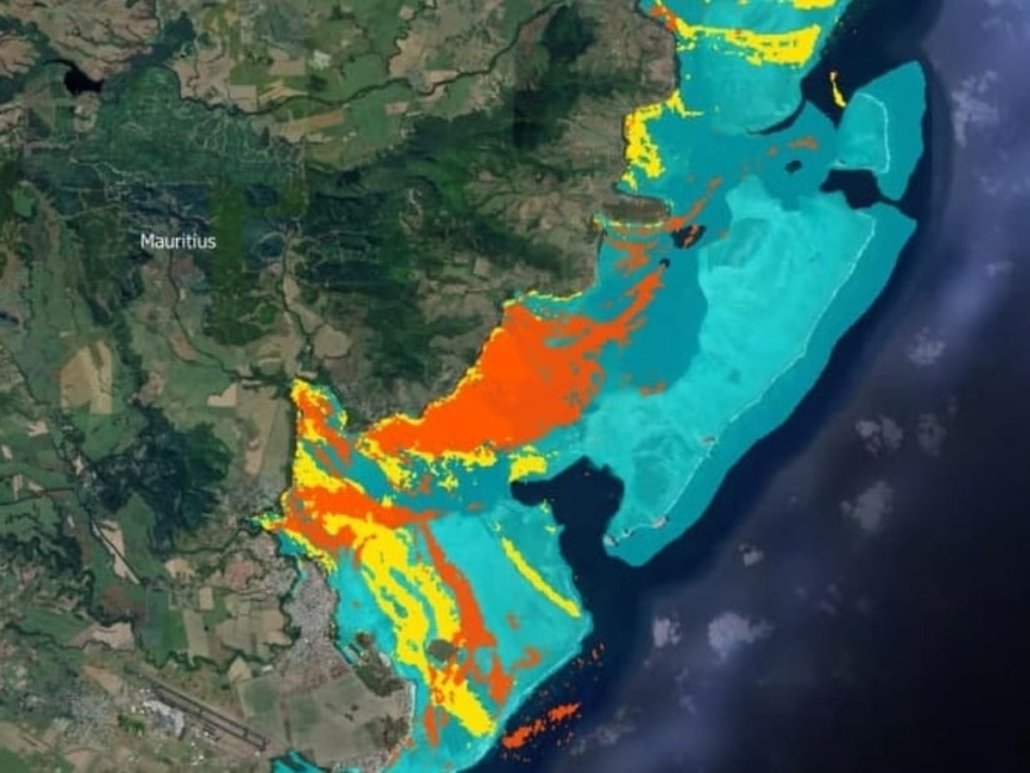
From the conversation of the two birds, it’s apparent that they are talking about the catastrophic event of bulk carrier MV Wakashio running aground off the coast of Mauritius. On 25 July 2020, the carrier ran aground on a reef at Pointe d’Esny, on the south-eastern coast of Mauritius. It was not carrying any cargo, but an estimated 3,894 tonnes of low-sulphur fuel oil, 207 tonnes of diesel and 90 tonnes of lubricant oil were on board.[1] More than 3,000 tonnes of oil from the ship’s fuel reservoirs had been pumped out before the ship carrying 1,000 tonnes of fuel oil broke into two. The ship was registered in Panama but is under Japanese ownership. The area of event is environmentally sensitive and falls under the Ramsar Convention.
Recently, in July 2023, the Panama Maritime Authority published the investigation report and concluded that the incident was “most probably a result of human factor.” The investigation report mentioned that even though the accident caused no human injury, but it engendered a great damage to the vessel and defiled the environment, as a result, it was tagged as a “very serious marine casualty.” Even after proper functioning of equipment and having sufficient personnel for manning the operations, there were certain factors which could have contributed to the grounding of the bulk carrier. The Chief Officer was instructed by the captain to pass 5 miles south of Mauritius before attending a crew member’s birthday celebration. Confusion over the course, led the ship to end up cruising closer to land. The Chief Officer then lost sight of the fact that the ship was approaching shallow waters, this could have been a result of his cell phone messing with the signals, as was reported, he used satellite signals to communicate with family members. Even though the captain had returned to the bridge prior to the grounding, he also overlooked the ship’s deviation from its intended route. Thus, perfunctory and lackadaisical attitude of crew members had share in the event of occurrence.[2]
The Aftermath
Any event affecting the health of the environment is unpalatable and deplorable. For this particular case, Greenpeace Africa warned that thousands of marine species were “at risk of drowning in a sea of pollution, with dire consequences for Mauritius’s economy, food security and health”. Environmentalists were of the opinion that, “local residents were breathing heavy vapours of oil.”[3] Fuel oil carried in the carrier are highly viscous and non-volatile. Bunker oil can be difficult to contain, evaporate, and disperse by the natural removal process in the marine environment.[4] Consequently, bunker oil can persist and contaminate the oceanic ecosystem for long periods of time. Toxicity of oil can hamper species’ life and can suffocate animals if they touch or ingest oil. Filter feeders, corals, crustaceans, and molluscs are often the first species to be affected. This particular incident also affected larger species quite drastically, as almost fifty whales were seen washed up on the beach in one week alone.[5]
Once oil comes into contact with corals, it can kill them or impede their reproduction, growth, behaviour, and development. Oil destroys the insulating ability of fur-bearing mammals, such as sea otters, and the water repellence of a bird’s feathers, thus exposing these creatures to the harsh elements. Without the ability to repel water and insulate from the cold water, birds and mammals will die from hypothermia.[6] Dolphins and whales can inhale oil which exposes them to immune and reproductive issues. The entire reef ecosystem can suffer from an oil spill, affecting the many species of fish, crabs, and other marine invertebrates that live in and around coral reefs.[7] The Blue Bay region of Mauritius is a reef area and hence can be gauged that it got affected in a similar fashion. The hull of the ships has anti fouling paints which are also toxic in nature. Disintegrated flakes of the paint can also affect the flora and fauna of the region.
Impact of an oil spill is not just ecological but also economical. Since the fish in the area become unfit for consumption, fishing activities get halted for several weeks and months. This affects the livelihood of the fishermen whose sole income depends on the number of fish he catches.
There will be oil spills as long as there is oil and there is trading of oil. Probably that is why nature also has its own methods of coping up with such adverse situations. Over time, oil gets weathered by physical and biological processes, like volatile oil gets evaporated quickly, certain species of marine bacteria like Marinobacter, Alkanivorax can eat petroleum compounds thus removing oil from the ocean naturally. But like any other natural process, it is prolonged. By the time oil gets removed innately, much of the desecration would have been done.
In the case of oil spills, prevention is always better than cure. International Maritime Organisation (IMO) has adopted a comprehensive set of regulations designed to enhance safety of shipping, to prevent accidents occurring in the first place, and to mitigate the impacts of an accident should one occur. These regulations address everything from ship building to safety management, to training of seafarers.[8]
To conclude, a little diligence on part of the seafarers, operators, crew members and flag States can arrest a lot of marine incidents that impede the ecosystem and, in the way, save the habitat of lot of species which directly or indirectly play a role in maintaining the balance of the ecosystem.
In the Indian Ocean near Pointe d’Esny where whales and fishes were discussing their fate, Whale one said, “I can’t breathe, I think I have inhaled the oil. I dreamt of swimming across the Indian Ocean, but my dream has been killed, I can’t make it”. Hearing this, Whale two sighed, “Neither can I. These humans didn’t just claim our habitat but are using and exploiting them irresponsibly, I wonder what will happen when the ocean can’t bear it anymore! I hope, they pay their price.”
*****
About the Author
Ms Titli Dinda is currently interning at the NMF, within the Foundation’s “AUTEX 2023” internship programme. Having completed M.Sc in Economics from University of Kalyani, West Bengal, she aspires to continue her research in Blue Economy and Climate Change, with specific focus on marine ecological issues and its impact on marine environment and the economy. She may be contacted at titlidinda@gmail.com.
[1] International Maritime Organisation, “Responding to MV Wakashio oil spill”, https://www.imo.org/en/MediaCentre/HotTopics/Pages/Wakashio-FAQ.aspx.
[2] Panama Maritime Authority, Directorate General of Merchant Marine, Maritime Affairs Investigation Department, “Report MV Wakashio R-029-2021-DIAM”
[3] “Mauritius oil spill: Wrecked MV Wakashio breaks up”, BBC News, 16 August 2020. https://www.bbc.com/news/world-africa-53797009.
[4] Ling Zhu, “Compulsory Insurance and Compensation for Bunker Oil Pollution Damage”, 2007, Springer, p.7, 18.
[5] Sydney Cohen, “The Mauritius Oil Spill: A disaster with ecological and human impacts”, 03 December 2021, Interfaith Centre for Sustainable Development, https://interfaithsustain.com/mauritius-oil-spill/.
[6] National Ocean and Atmospheric Administration (NOAA), “How does oil spill impact marine life?”, https://oceanservice.noaa.gov/facts/oilimpacts.html.
[7] NOAA Office of Response and Restoration, “How do oil spills affect coral reefs?”, https://response.restoration.noaa.gov/about/media/how-do-oil-spills-affect-coral-reefs.html#:~:text=Once%20oil%20comes%20into%20contact,in%20and%20around%20coral%20reefs.
[8] International Maritime Organisation (IMO), “Responding to MV Wakashio Oil spill” https://www.imo.org/en/MediaCentre/HotTopics/Pages/Wakashio-FAQ.aspx.
 Source:IMO
Leave a Reply
Want to join the discussion?Feel free to contribute!