
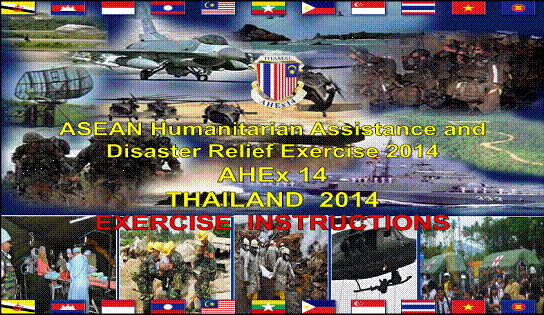
The first-ever joint Humanitarian Assistance and Disaster Relief and Military Medicine (HADR & MM) Exercise under the auspices of the ‘ASEAN Defense Ministers Meeting Plus’ (ADMM+), was conducted with great professionalism from June 17-20, 2013 in Brunei. The military participants in this exercise were from the ASEAN countries and also included eight dialogue partners viz. Australia, China, India, Japan, New Zealand, Russia, South Korea and the United States. Seven ships, 20 helicopters and more than 2000 troops including the specialized engineering contingents and medical personnel took part. In accordance with the ‘Securing our people, our future together’ theme for this year’s ADMM, these exercises conducted over four days showcased multinational military response to a simulated post-typhoon scenario.
HADR & MM Exercise
These exercises were structured with the aim to evolve a common set of Standard Operating Procedures (SOPs), test them out in near real time environment, enhance practical cooperation at the intra-ASEAN and ASEAN Plus levels, and learn from the best practices followed by more capable and experienced forces. Two separate but closely linked aspects were exercised at diverse locations. The first aspect focused on the immediate post-disaster response of SAR, and delivery and distribution of aid and relief material by land, air and maritime transportation. This part of the exercise was conducted in the port area of Brunei district encompassing the Muara Naval and Rimba Air Base. The second dealt with the related post-disaster medical and engineering contin-gencies that the management and rehabilitation teams would be faced with during a real disaster scenario. This effort focused on setting up of field hospitals to treat injured and the sick; casualty evacuation; epidemic prevention, vaccination and water treatment; and disposal of fatal casualties. The engineering tasks on the other hand, involved restoration of transportation links by building bridges, clearing debris and constructing helipads; erecting emergency electric supply, sanitation, drainage and drinking water infrastructure; establishing preliminary communication links between the disaster site and the disaster response teams; among other urgent requirements. These activities were conducted in the Temburong district and were coordinated by a Multi-National Coordination Centre (MNCC) established at the Muara Naval Base, as also a subsidiary Incident Coordination Centre (ICC) at Bangar in Temburong District. (See Map)
Participating Nations’ Forces
This inaugural edition of the exercise saw comprehensive participation from military forces of virtually all the ADMM Plus nations. The multinational exercise steering committee comprised five nations including Japan, China, Singapore, Vietnam and Brunei. Singapore sent its ‘Endurance’ class landing ship along with its complement of vehicles, fast utility craft and four Puma helicopters. Malaysia was represented by its Logistics Support ship ‘Mahawangsa’, ‘Nuri’ helicopters and a large convoy of engineering and medical support vehicles which transited via the land border. A Philippines Air Force C-130 brought in HADR equipment including rigid inflatable boats (RIBs). Vietnam sent its engineering and medical contingent for the exercise. Thailand, Russia, Myanmar and Cambodia sent their delegations and troops by air. Japan contributed with a JMSDF destroyer ‘Shirane’ and ‘Huey’ helicopters. In addition, two C-130 aircraft brought vehicles, medical equipment and engineering stores. The United States was represented by one dry cargo and fuel replenishment ship, ‘USNS Mathew Perry’ from its Sealift command.
The Indian Navy dispatched its large amphibious ship ‘Gharial’ from the Eastern Naval Command. The landing ship displacing about 5000 tons with ‘Seaking’ helicopters on board, brought along vehicles, ambulances, medical teams and specialised personnel from other services too. Such ships have been found to be immensely valuable during previous HADR contingencies in the Bay of Bengal, including post-2004 Tsunami. In fact, the amphibious fleet of various-sized landing ships forms the mainstay of Indian preparedness for dealing with maritime natural disasters in the region in recent times.
The scale of participation by the Chinese PLA was particularly noteworthy when compared with contribution made by rest of the participating nations. The PLA Navy dispatched its largest and latest Type 71 Landing Platform Dock (LPD) ship named ‘Kunlunshan’. The Ship docked in Brunei’s Muara port about two weeks in advance of the Exercise’s commencement. The 18000 Ton amphibious ship capable of carrying two Z8 (Super Frelon) helicopters, two LCVPs (Landing Craft Vehicles/Personnel) and high speed heavy lift hovercraft is a very potent asset during combat as well as HADR situations. Additionally, the IL-76 transport aircraft of the PLA Air Force flew in specialist doctors, paramedics and engineering personnel along with medical equipment, medicines and emergency treatment kits. These specialised personnel totalling 110 and were deployed in addition to the ship’s crew. The PLA Navy hospital ship ‘Peace Ark’ which runs a 300 bed ‘specialty’ hospital onboard also joined the exercise on June 16, 2013. It carried out twin roles of participating in the exercise as well as providing free medical services to the general public which included diagnostics, treatment of minor ailments, specialists’ consultation and minor surgeries.
ADMM Plus Mechanism: Role and Relevance
This inaugural exercise was the most visible activity of the ADMM Plus mechanism, which was set into motion in 2010 at Hanoi with the declared objective of seeking practical cooperation in five key areas of maritime security, counter-terrorism, disaster management, peacekeeping operations and military medicine. The twin undeclared objectives of this mechanism perhaps revolve around expanding the umbrella of security challenges facing the ASEAN Forum to a much wider domain of the Asia-Pacific region; as also include the ASEAN dialogue partners into supporting, supplementing and building capacities within South-East Asia for tackling such challenges.
The security issues concerning ASEAN are in themselves, vexed enough to warrant a suitable tool to address them. However, in the era of increasing inter-dependencies of the South-East Asian states with the Asia-Pacific neighbourhood and other stakeholders either resident or present in that region, their security concerns do transcend intra-ASEAN domain. The South China Sea conundrum, SLOC security imperatives, mitigation of emergencies related to climate change, prevention of illegal activities impinging on national and regional security, and expeditious management post natural disasters are some pressing challenges, which call for priority redressal by invoking joint synergistic initiatives. Therein lies the vital relevance of a suitable mechanism like the ADMM Plus, that aims to identify if not find ab-initio measures to ensure a modus Vivendi for all concerned.
The global community has been quite appreciative of certain endeavours of this regional structure. Its efforts to draft a ‘Code of Conduct’ (COC) for parties involved in the South China Sea disputes for ‘conscientious’ implementation of the 2002 ‘Declaration on Code of Conduct’ (DOC) agreement is particularly noteworthy. The draft COC also reiterates that cooperation in less contentious activities such as joint exploration of oceanic resources, HADR and Search and Rescue (SAR) be progressed, while the more contentious issues are kept aside pending resolution over longer timeframe. In this context, it is posited that the conduct of this inaugural HADR & MM Exercise at Brunei is a major milestone achieved by the ADMM Plus mechanism.
Conclusion
The fact that 18 nations’ armed forces spanning the entire capability and capacity spectrum participated on a common platform for a large scale HADR exercise, is no mean feat for ASEAN in general and a small State like Brunei in particular. Considering this as an inaugural event, all credit must be given to the perseverance of the ADMM Plus interlocutors and to the willingness of the associated States to remain engaged on multiple issues of security concern in the wider Indo-Pacific region.
However, as is often the case with any large grouping involving members having differing motivations and national strengths, a real risk of ‘Group Dynamics’ overshadowing immediate ‘group objectives and agenda’ does exist. Such dynamics, if permitted to develop unchecked, may at times, put paid to any lofty intentions that nascent instruments like the ADMM Plus may harbour, with regard to big-ticket breakthroughs of wider acceptability.
Hence, all stakeholders and the wider strategic community must assiduously guard against such a pitfall. Only then will the well meaning multilateral mechanisms like ADMM Plus be able to graduate to larger security issues of greater import for ‘furthering regional defense cooperation’.
******
About the Author:
Commander Kamlesh Kumar Agnihotri is a Research Fellow with the China Cell of the National Maritime Foundation, New Delhi. The views expressed are solely his own and do not reflect the official policy or position of the Indian Navy or the National Maritime Foundation. The author can be reached at kkagnihotri@maritimeindia.org


Leave a Reply
Want to join the discussion?Feel free to contribute!