
 Vivekananda international foundation
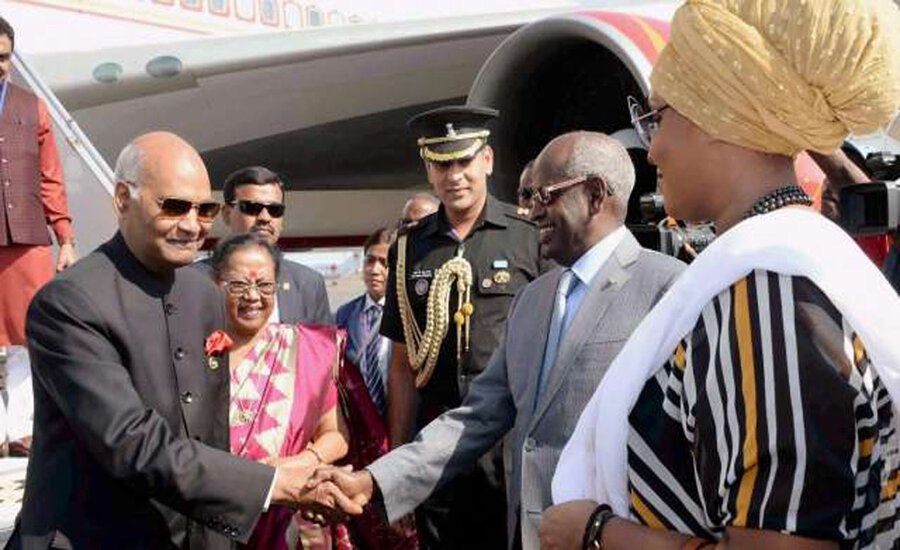
On the third and fourth of October 2017, the 14th President of India, H.E Ram Nath Kovind undertook his first official visit abroad. It was significant that this was to Djibouti, an Indian Ocean littoral country of immense geo-strategic importance.[1] Incidentally, President Kovind is the very first Indian President to officially visit Djibouti.
This issue brief examines the significance of the Indian President choosing Djibouti as the destination for his maiden outgoing State visit. It outlines the geo-strategic importance of Djibouti, and discusses the State visit, with particular focus upon policies that can be adopted to strengthen India-Djibouti relations.
Geo-Strategic Importance of Djibouti
Though a small country, with an area of around 23,200 sq. km, Djibouti’s geographical location on the Horn of Africa bordering a critical choke point of Bab-el-Mandeb makes it geo-strategically significant. It has a population of 957,271[2] with most people following a moderate form of Sunni Islam. The countries that constitute the Horn of Africa are Djibouti, Somalia, Ethiopia and Eritrea. Djibouti is located at the confluence of the Red Sea with the Gulf of Aden and the Indian Ocean. It connects Africa, West Asia and the rest of Asia. The Strait of Bab-el-Mandeb, a 17 nm wide stretch of water that connects the Gulf of Aden with Red Sea and thereby the Suez Canal, is located between Yemen in the Arabian Peninsula, and Djibouti and Eritrea in the Horn of Africa. It is through the Bab-el-Mandeb that Persian Gulf oil, natural gas and petroleum products are shipped to Europe and North America. The European Union’s and North Africa’s oil exports and merchandise trade with China, Japan, India and the rest of Asia, also pass through this strait. Likewise, some 50 per cent of China’s oil imports must also cross Bab-el-Mandeb. Thus, the closure of this strait, for any reason, would not only cut off the flow of oil and trade, but also impact the economic and political stability of a number of countries.[3]
Djibouti lies close to the restive areas of Africa and West Asia, wherein domestic, regional and global politics already threaten the stability in the region, and thereby, the conduct of safe and secure maritime trade. Major insecurities emanate from piracy and militancy off Somalia, while concerns arising from the deteriorating security situation in war-torn Yemen are rising steadily. Thus, given Djibouti’s geo-strategic importance and its proximity to unstable geographical areas, several countries have established military bases in this small country. France, which ruled Djibouti during the colonial period, has a base here, and this base also hosts soldiers from other European countries. After the terror attacks of 11 September 2001, the USA established a military base in Djibouti as part of its war on terror. Named Camp Lemonnier, it is America’s largest military base in Africa, with as many as 4,000 personnel stationed in it. Japan, too has acquired a facility since 2011 to enable it to support its anti-piracy operations in the Gulf of Aden.[4] Likewise, Saudi Arabia and Qatar are also reported to have bases.[5]
In July 2017, China set up its first foreign military base, once again in Djibouti.[6] China has acquired land for its base on a ten-year lease till 2026. The reasons given by China for establishing the base are that it will facilitate rest and rehabilitation for Chinese troops involved in various activities such as its shipping-escort missions in the Gulf of Aden and waters off Somalia; UN peacekeeping operations; and, humanitarian rescue missions, as was seen when China evacuated its citizens from Libya and Yemen. The military base, Beijing argues, will also help protect Chinese investments in Africa, and Chinese nationals working on infrastructure projects in the region.[7] It is important to note that China has already invested in the infrastructure sector in Djibouti, including a port and a 750 km-long rail line, which links landlocked Ethiopia to Djibouti and facilitates economic activity between the two countries. Significantly, China and Djibouti also concluded a Defence and Security Agreement in 2014.
Djibouti is able to manoeuvre successfully among countries of diverse strategic interests and geopolitical leanings. The earnings that it receives from the bases set up on its land are critical to its economy. Some of the countries that have established bases are also investing in other infrastructure projects within Djibouti[8]. There appears to be little concern within the Government of Djibouti about the geographical implications of offering extra-regional powers quite so firm a footing within the Indian Ocean.
The visit
Though President Kovind’s visit is the first high-level visit from India to Djibouti, it needs to be seen as part of the continuum of India’s broader engagement with Africa. The Third India-Africa Forum Summit (IAFS III), held in India between 26 and 29 October 2015, provided a decisive thrust to India-Africa relations. Representatives of all 54 African countries participated in the Summit; among whom were 41 Heads of State or Government. Later, India’s apex leadership, including its Prime Minister, the then Vice-President, and, the then President, all paid official visits to various countries in Africa. Interestingly, most of these visits were to coastal States, whose shores are washed by the waters of the Indian Ocean, or the Atlantic Ocean or the Mediterranean Sea. Yet, Djibouti was not amongst these. However, President Guelleh of Djibouti did visit India in October 2015, to participate in IAFS III. On that occasion, he had a bilateral meeting with the Indian Prime Minister Modi. In fact, the first major visit from Djibouti to India was undertaken by Djibouti’s President Ismail Omar Guelleh in May 2003. President Kovind was reciprocating the gesture to highlight the importance to India of Djibouti and the Horn of Africa in particular; and Africa in general.
The visit also enabled the Indian President to express India’s gratitude to Djibouti for its logistical support to the civilian evacuation from Yemen, in April 2015, undertaken by the Indian Navy (Operation RAHAT). The growing instability in Yemen and the military intervention by Saudi Arabia in that country had put the lives of nearly 5,000 Indian nationals in Yemen in danger. Indian warships evacuated not only these stranded Indians but also 2,000 nationals of over forty countries, and disembarked them in Djibouti from where they were transported to their respective countries.[9] At present, Djibouti also hosts the Embassy of India to Yemen.
Obviously, India-Djibouti economic relations too were discussed during the Presidential visit. In 2016-17, India’s bilateral trade with Djibouti was a mere US$ 284 million.[10] The visit sought to up this in significant fashion and spelt out the investment opportunities for Indian companies in infrastructure projects such as road construction, port development, power transmission and transport in Djibouti. This is because Djibouti is an important entry port and transshipment point for the region’s landlocked countries. The visit also enabled to highlight the opportunities offered by the Blue Economy to build new partnerships.
Given the geo-strategic importance of Djibouti as an important Indian Ocean littoral, one would have expected that issues of maritime security would be given primacy in discussions held by the President. However, the India-Djibouti Joint Statement does not specifically refer to maritime issues. It, however, does mention that both the countries acknowledged India’s role for the maintenance of peace and stability in the Horn of Africa. It is important to note in this context that the Indian Navy warships have been making regular calls at Djibouti for Operational Turns Around while conducting anti-piracy operations in the Gulf of Aden since November 2008; during combined exercises with the US and French navies; and, for overseas deployment. Following the Indian President’s visit, the interaction between the navies of the two countries may be institutionalized.
During the visit, India and Djibouti held discussions on eradicating the menace of terrorism; the reform of UN Security Council; the importance of the International Solar Alliance; and ways and means to deepen economic relations. An MoU was also signed on Foreign Office Consultations between the two countries.[11] The visit could also result in the up-gradation of bilateral diplomatic relations. Presently, the Honorary Consul of India has been functioning in Djibouti since 1969, while Djibouti opened its embassy in India in 2004.
The dominant narrative among many analysts was that the Chinese inroads in Djibouti including the establishment of its first foreign military base had influenced the choice of the Indian President’s maiden visit to Horn of Africa. While this may be one of the influencing factors, the visit was indeed motivated by a larger purpose. It sought to establish political relations at the highest level so that they will help to safeguard India’s interests in this region. These interests are vital to India’s economic and social well-being, and are independent of the ‘China factor’. These include, among others, the safety of the thousands of Indian nationals working in West Asia, and the safe shipping of critical energy imports sourced from this sub-region. While the two countries have cooperated at multilateral fora including the India-Africa Forum Summits, effective bilateral cooperation has remained a relative void. The visit filled this strategic vacuum. One can expect that high level interactions would now continue and that subsequent visits would focus on specific agreements and issues related to maritime security, challenges and cooperation.
Symbolism has an important place in diplomacy. Although ‘matters maritime’ were not discussed specifically, the very fact that Djibouti was chosen for President Kovind’s first outgoing visit conveys the growing centrality of maritime issues in India’s foreign policy. Unlike extra-regional stakeholders such as the USA, China and Japan, India occupies a central position in the Indian Ocean Region astride the main International Shipping Lanes (ISLs). India does not seek a military base in Djibouti. However, President Kovind’s visit spells out loud and clear, without saying so, that the Indian Ocean is India’s ‘primary area of maritime interest’[12], and that India intends to be a ‘net security provider’[13] in the Indian Ocean Region.
Looking ahead
Djibouti has shown that like in many other parts of the world, it too can manoeuvre adroitly with multiple powers – be they the USA, China, Japan, France or India. In such a scenario, India needs to conduct its diplomacy in a very competitive atmosphere. India has been late in undertaking a high level bilateral visit to Djibouti. However, having made a beginning, it is important that a serious follow up is made and a vibrant, broad-based bilateral relation is established. Cooperation on maritime issues will have to be a byproduct of this solid foundation.
The SAGAR[14] template of focus on both bilateral and multilateral security and economic relations, capacity building and capability-enhancement of the Indian Ocean littorals, and, a regional response to maritime challenges through regional institutions, has to be implemented in Djibouti. Given Djibouti’s geo-strategic importance and the nature of its relations with global powers, it has to be actively made part of discussions on the emerging security architecture in the Indian Ocean Region. Its inputs have to be incorporated to work out customised solutions to maritime challenges, especially as the Horn of Africa is a region beset with maritime insecurities.[15]
One of the more important issues highlighted during the IAFS III held in India in October 2015 was cooperation in the Blue Economy. The Framework for Strategic Cooperation spelt out that India and Africa would place special emphasis on closer collaboration through training, capacity building and joint projects in developing sustainable fisheries, maritime connectivity, managing marine resources, promoting eco-tourism and developing renewable energy. It was also agreed that they would pursue cooperation in hydrography, port operations and marine transport; address illegal and unregulated fishing; develop infrastructure in coastal areas; develop eco-friendly marine industries and technologies; and, build new networks of activity in coastal areas and associated hinterlands.[16] India needs to identify and implement specific projects in Djibouti in all these areas, as the latter is seeking investments to enable it to make big developmental strides.
India also needs to spell out, in much more detail, the cultural, civilizational and nautical linkages between India and Djibouti. This will help in deepening its maritime diplomacy with Djibouti. It will bring out that India, as a maritime nation, has always had a pervasive global maritime influence and this was achieved without any domination or force. India should convey that whatever policies other countries may make, its actions will be anchored on this spirit of cooperation, co-existence, and an absence of coercion. It is here that the relevance of India’s Project Mausam[17] is most evident, and this needs to be implemented in Djibouti as well.
Conclusion
Djibouti is a country of great geo-strategic significance in the Horn of Africa, playing host to the military bases of several major countries of the world. Quite clearly, extra-regional stakeholders are strengthening their respective footholds in the Indian Ocean Region. While India does not need a military base in Djibouti, it needs to spell out that it is a major stakeholder in ensuring the stability and security of the region. The historic visit by H.E. President Ram Nath Kovind to Djibouti has sent this message loud and clear. It has laid the foundation for a vibrant, broad based bilateral relationship with an important Indian Ocean littoral. India needs to now sincerely build upon this foundation and implement specific projects in the economic, cultural, social and security areas.
******************************
*G. Padmaja is Regional Director of the Visakhapatnam Chapter of the National Maritime Foundation (NMF), New Delhi. The views expressed are her own and do not reflect the official policy or position of the NMF. She can be reached at sri2003ja@yahoo.com
Notes and References
[1] From Djibouti, H.E. President Kovind left for a State visit to Ethiopia from 4-6 October 2017.
[2] Djibouti Population. (2017-11-10). Retrieved 2017-11-20, from http://worldpopulationreview.com/countries/djibouti-population/
[3] Thomas C. Mountain, “Choke point Bab el-Mandeb; Understanding the Strategically Critical Horn of Africa”, Nov 19, 2011, Foreign Policy Journal, https://www.foreignpolicyjournal.com/2011/11/19/choke-point-bab-el-mandeb-understanding-the-strategically-critical-horn-of-africa/ (last accessed 17 November 2017)
[4] Andrew Jacobs And Jane Perlez, “U.S. Wary of Its New Neighbor in Djibouti: A Chinese Naval Base” The New York Times, February 25, 2017, https://www.nytimes.com/2017/02/25/world/africa/us-djibouti-chinese-naval-base.html (last accessed 17 November 2017)
[5] C. Raja Mohan, “Raja Mandala: India and Djibouti’s Geopolitical Scrum”, October 3, 2017, The Indian Express, http://indianexpress.com/article/opinion/columns/raja-mandala-india-and-djiboutis-geopolitical-scrum-ram-nath-kovind-abroad-visit-4871697/ (last accessed 17 November 2017)
[6] Abhijit Singh, “China’s Military Base In Djibouti: Strategic Implications For India”, August 21, 2017, Texas National Security Network, https://warontherocks.com/2017/08/chinas-military-base-in-djibouti-strategic-implications-for-india/ (last accessed 17 November 2017)
[7] Tomi Oladipo, “ Why are there so many military bases in Djibouti?”, BBC Monitoring, June 16,2015, http://www.bbc.com/news/world-africa-33115502 (last accessed 1 November 2017)
[8] Jane Perlez and Chris Buckley, “China Retools Its Military With a First Overseas Outpost in Djibouti”, The New York Times Nov. 26, 2015 https://www.nytimes.com/2015/11/27/world/asia/china-military-presence-djibouti-africa.html?action=click&contentCollection=Africa&module=RelatedCoverage®ion=Marginalia&pgtype=article (last accessed 1 November 2017)
[9] The President of India, Speeches, Address of the President of India, Shri Ram Nath Kovind at the Community Reception Djibouti, October 3, 2017, http://www.presidentofindia.nic.in/speeches-detail.htm?343 (last accessed 17 November 2017)
[10] Ministry of External Affairs, Government of India, Transcript (uncorrected) of Media Briefing on State visit of President to Djibouti and Ethiopia (September 29, 2017) September 29, 2017
http://mea.gov.in/media-briefings.htm?dtl/28991/Transcript_uncorrected_of_Media_Briefing_on_State_visit_of_President_to_Djibouti_and_Ethiopia_September_29_2017 (last accessed 1 November 2017)
[11] Ministry of External Affairs, Government of India, Transcript of Media Briefing by Secretary (OIA) and Press Secretary to the President, onboard Special Flight enroute Addis Ababa to Delhi (October 06, 2017) October 06, 2017; http://mea.gov.in/media-briefings.htm?dtl/29017/Transcript_of_Media_Briefing_by_Secretary_OIA_and_Press_Secretary_to_the_President_onboard_Special_Flight_enroute_Addid_Ababa_to_Delhi_October_06_2017 (last accessed 14 November 2017)
[12] Ministry of Defence (Navy), Government of India, Ensuring Secure Seas: Indian Maritime Security Strategy, October 2015, Chapter 2, Maritime Security-Imperatives and Influences, pp. 31-32
[13] Ministry of Defence (Navy), Government of India, Ensuring Secure Seas: Indian Maritime Security Strategy, October 2015, Chapter 5, Strategy for shaping a favourable and positive maritime environment, pp.78-101; Also refer, Press Information Bureau, Government of India, Indian Navy-Net Security Provider to Island Nations in IOR: Antony, 12 October 2011,
http://www.pib.nic.in/newsite/erelease.aspx?relid=76590(last accessed 26 July 2016)
[14] Ministry of External Affairs, Government of India, Prime Minister’s Remarks at the Commissioning of Offshore Patrol Vessel (OPV) Barracuda in Mauritius (March 12, 2015), http://www.mea.gov.in/Speeches-Statements.htm?dtl/24912/Prime_Ministers_Remarks_at_the_Commissioning_of_Offshore_Patrol_Vessel_OPV_Barracuda_in_Mauritius_March_12_2015, (last accessed 27 February 2017)
[15]Press Information Bureau, Government of India, Ministry of Defence, 1 November 2017 , “For our collective aspirations to bear fruition and their impact to be sustainable, having a peaceful, stable and secure maritime environment in the region is a pre-requisite”
– Smt Nirmala Sitharaman, Raksha Mantri; http://pib.nic.in/newsite/pmreleases.aspx?mincode=33 (last accessed 17 November 2017)
[16] Ministry of External Affairs, Government of India, India-Africa Framework for Strategic Cooperation, 29 October 2015, http://www.mea.gov.in/Uploads/PublicationDocs/25981_framework.pdf (last accessed 17 November 2017)
[17] Press Information Bureau, Government of India, Ministry of Culture, 25 April 2016, http://pib.nic.in/newsite/PrintRelease.aspx?relid=141133 (last accessed 27 February 2017); Press Information Bureau, Government of India, Ministry of Culture, Project ‘Mausam’ Launched by Secretary, Ministry of Culture, 21 June 2014, http://pib.nic.in/newsite/PrintRelease.aspx?relid=105777
(last accessed 27 February 2017); Ministry of Culture, Government of India, Mausam: Maritime Routes and Cultural Landscapes, http://www.indiaculture.nic.in/project-mausam (last accessed 27 February 2017)
INDIAN PRESIDENT’S VISIT TO DJIBOUTI FULFILLING A STRATEGIC NECESSITY
 The economic times
 CFR org
Leave a Reply
Want to join the discussion?Feel free to contribute!