
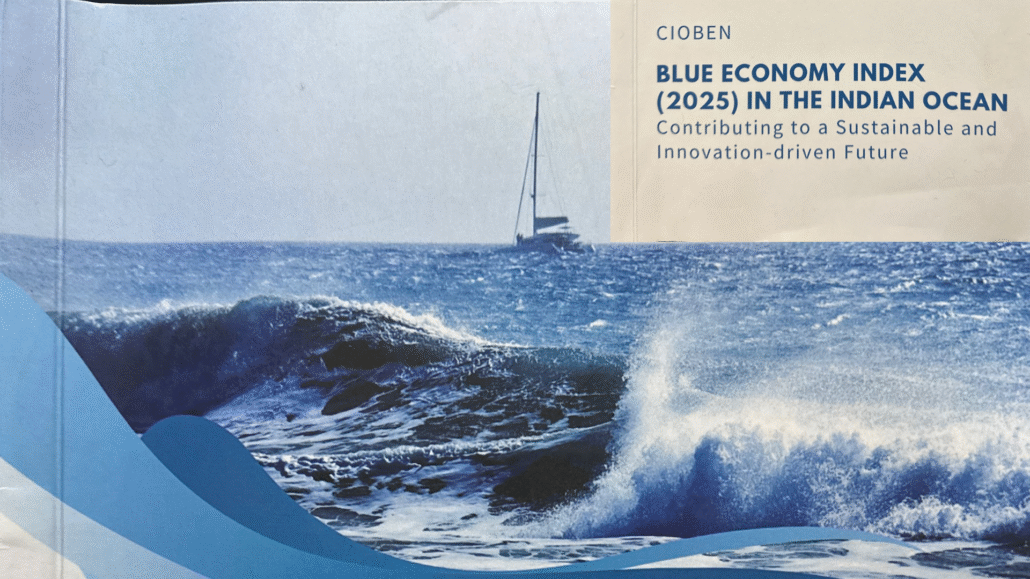
Yangfang Li and Yishuang Yang. Blue Economy Index (2025) in the Indian Ocean: Contributing to a Sustainable and Innovative-driven Future. China–Indian Ocean Blue Economy Think Tank Network (CIOBEN), April 2025.
Introduction
The Blue Economy Index 2025 in the Indian Ocean Region, published under the auspices of the China–Indian Ocean Blue Economy Think Tank Network (CIOBEN), is an ambitious attempt to provide a systematic, quantitative framework for assessing Blue Economy development across 36 littoral States. Structured around three pillars—Economic Development, Social Equity, and Environmental Sustainability—nine dimensions, and twenty-four indicators, the volume positions itself as a “scientific, inclusive, and operational” assessment system.
The Index, however, is best understood not only as a technical tool but also as a normative intervention in the politics of the IOR. By offering a comparative framework that is both accessible and replicable, CIOBEN seeks to position itself as the region’s intellectual hub. This raises concerns of narrative capture—where one institution’s framing becomes the dominant reference point, especially for smaller States. For India, the stakes are particularly high: its leadership within IORA and BIMSTEC depends on advancing credible, regionally owned alternatives.
This review situates the Index within its intellectual and geopolitical context, outlines its contributions, and highlights key limitations before reflecting on its implications for both scholarship and governance in the IOR.
Context and Rationale
The Indian Ocean Region is increasingly central to global trade, energy flows, and connectivity. However, it is also a theatre of pressing sustainability challenges. States in the region face overlapping pressures from illegal, unreported, and unregulated (IUU) fishing, marine pollution, and climate change. While the Blue Economy is often promoted as a growth driver, realities vary: many small island developing States (SIDS) and coastal economies remain heavily dependent on fisheries and tourism, with limited capacity to diversify into emerging maritime industries. Weak regional cooperation further compounds these vulnerabilities, leaving States exposed to external framings of the Blue Economy agenda.
CIOBEN justifies the Index on two grounds. First, it critiques existing global frameworks—such as those of the World Bank, UNDP, and the European Union—for privileging developed-country contexts, using indicators that fail to capture the realities of developing States. Second, it highlights the absence of comprehensive, cross-country quantitative research in the IOR, where most studies remain descriptive or nationally bounded. Against this backdrop, the Blue Economy Index 2025 presents itself as filling a critical gap by providing a region-specific benchmark to guide both national policy and regional cooperation.
Conceptual Framework and Structure
The Index builds upon the World Bank and the UN’s broad definition of the Blue Economy as the sustainable use of ocean and marine resources to achieve economic growth, social well-being, and environmental protection. However, CIOBEN emphasises that there is no unified or authoritative global definition, and that the concept remains contested. Its own framing—rooted in “blue growth”—presents the scope of the Blue Economy as including traditional marine sectors (fisheries, tourism, shipping) as well as emerging activities such as marine renewable energy, mineral extraction, and biotechnology.
The Index is structured across three overarching pillars, nine dimensions, and twenty-four indicators:
- Economic Development (four dimensions, ten indicators) — including marine economic capacity, food provision, maritime trade, and renewable energy.
- Social Equity (three dimensions, nine indicators) — covering livelihoods, governance effectiveness, and marine culture.
- Environmental Sustainability (two dimensions, five indicators) — focused on ocean health and species diversity.
Indicators range from tangible measures such as the share fisheries in the GDP, aquaculture capacity, and renewable energy installations, to more qualitative dimensions such as cultural heritage and governance effectiveness. Each country is graded on a scale of 1–10, with 1–4 rated “poor,” 4–7 “good,” and 7–10 “excellent.”
The methodological ambition is evident: the Index attempts to operationalise a balance between economic value creation, social equity, and ecological protection. At the same time, CIOBEN acknowledges its limitations, noting challenges in data quality, comparability, and inclusiveness of indicators.
Key Findings
The overall results present a sobering picture of Blue Economy development in the IOR. Of the 36 countries assessed, none scored above 6 points. Fifteen countries fell within the “good” range, while 21 were rated “poor.”
- Top performers included Djibouti (5.08), Seychelles (4.93), Australia (4.81), Comoros (4.79), the UAE (4.75). These cases demonstrate relative strength in combining economic activity with governance and environmental safeguards.
- Middle performers included Kenya, Bangladesh, Thailand, Qatar, Tanzania, the Maldives, and India, scoring between 4.1 and 4.6.
- Low performers included Indonesia, South Africa, Iran, Somalia, Myanmar, Sri Lanka, Malaysia, and Pakistan, many of which scored between 2.5 and 3.9, highlighting structural underdevelopment and dependence on traditional marine industries.
India scored 4.01 overall, placing it at the lower end of the “good” category but within the overall grade of “middle performers”. It ranked relatively high in economic development (4.46), particularly due to its strong maritime trade and the impressive share of renewable energy but fared poorly in social equity (3.6) and environmental sustainability (3.9). Within these, India’s governance effectiveness score was strikingly low (1), far behind Australia (9), Djibouti (8), and even Yemen (6). India also scored poorly on marine culture (1), lagging behind Bangladesh (5) and Pakistan (4). Its performance on environmental protection placed it fifth-lowest in the region, underscoring systemic gaps in marine conservation and coastal risk management.
The results collectively suggest that while the Blue Economy discourse is vibrant in the region, actual performance remains modest, with most countries struggling to balance economic, social, and ecological priorities.
Contributions of the Report
As a first attempt at a region-wide quantitative assessment, the Blue Economy Index 2025 makes a notable contribution. It provides a structured framework that allows for cross-country comparison and draws attention to developmental disparities, particularly the vulnerabilities of SIDS. By extending the scope beyond purely economic indicators to include governance, social equity, and sustainability, the Index broadens the conceptual field of what constitutes the Blue Economy.
The book makes several significant contributions:
- First Systematic Assessment: It provides the first region-wide, quantitative attempt to measure Blue Economy development across the IOR, filling an evident gap in the literature.
- Comprehensive coverage: With 36 countries and two regional groupings, its scope surpasses existing efforts such as the AOSIS Blue Economy Development Index, which is limited to 22 SIDS.
- Balanced framework: By including economic, social, and environmental pillars, the Index avoids a narrow focus on industrial performance and attempts to capture multidimensional sustainability.
- Policy relevance: CIOBEN positions the Index as a tool not just for analysis but for decision-making, offering governments benchmarks against which to evaluate their performance and identify gaps.
Limitations and Critique
Despite its ambition, the Blue Economy Index 2025 is marked by significant limitations that undermine its credibility as a region-specific framework.
Conceptual Dependence
Although the Index positions itself as a corrective to global frameworks, it remains tethered to them. Its definition of the Blue Economy and indicator matrix are largely borrowed from the World Bank, while its datasets draw heavily from Northern institutions such as the “National Center for Ecological Analysis and Synthesis” (NCEAS). This dependence reproduces a “global north” template under the guise of regional contextualisation, diluting its claim of inclusivity and originality.
Neglect of Vulnerabilities and Resilience
The Index gives little attention to the acute vulnerabilities of Indian Ocean States. Beyond a narrow reference to coastal erosion, it neglects systemic risks such as sea-level rise, cyclones, salinity intrusion, storm surges, and biodiversity loss—all disproportionately affecting poorer, marine-dependent communities. It also fails to assess adaptive capacity: institutional strength, financial resources, and technological capability, which determine resilience to shocks. Instead, it privileges static output indicators—fisheries production, trade volume, renewable energy capacity—at the expense of systemic and dynamic dimensions of climate risk.
India’s Contradictions
The weaknesses of the Index are most visible in India’s rankings. Despite being the world’s second-largest fish producer (≈8 per cent of global output) and an aquaculture powerhouse, India is assigned a marine food capacity score of only 2. This disregards its extensive fisheries policy architecture, from the “Blue Revolution” and the “Pradhan Mantri Matsya Sampada Yojana” to strict seasonal bans and sustainability measures. Equally problematic are its scores of 3.6 in social equity (below Yemen and Pakistan), 1 in governance effectiveness (below Djibouti and Yemen), and 1 in marine culture (below Bangladesh and Pakistan), despite its broad governance frameworks and rich maritime heritage. These anomalies reveal structural flaws in indicator design rather than an accurate reflection of performance.
Structural and Methodological Weaknesses
By applying uniform weights across highly diverse contexts—micro-SIDS, fragile States, Gulf economies, and mixed continental-cum-maritime powers such as India—the Index flattens heterogeneity and obscures structural inequalities. Its reliance on incomplete or narrow datasets penalises complex governance systems, while ignoring policy reforms, institutional frameworks, and long-term investments. Transparency, too, is lacking: the weighting of indicators and treatment of missing data are undisclosed, making replicability impossible. The fact that no country scores above 6 further suggests either an excessively stringent calibration or a deliberate framing of the entire region as underperforming.
Reductionist Scope
More fundamentally, the Index constrains the Blue Economy to a set of marine industries—fisheries, shipping, tourism, renewables—without situating them in the wider fabric of national and regional economies. For SIDS, the ocean underpins food security, livelihoods, and social stability; for larger economies, it anchors trade and connectivity, with 80–90 percent of global commerce moving by sea. By ignoring this whole-of-economy perspective, the Index narrows the conceptual horizon of the Blue Economy.
Underlying Biases
These structural weaknesses are reinforced by deeper biases:
- Growth Orientation: Heavy emphasis on infrastructure, trade, and industrial capacity aligns with the logic of the Maritime Silk Road, privileging growth-first models while purporting to remain under a banner of sustainability.
- Ecological Anchoring: Environmental indicators are generic and not tied to planetary boundaries such as ocean acidification, biodiversity loss, or blue carbon decline.
- Equity and Justice: Social equity is thinly developed, with little attention to small-scale fisheries tenure, gendered impacts, Indigenous knowledge, or community participation.
- Security and Adaptation: Despite the existential threat of sea-level rise and displacement in the IOR, climate adaptation and security dimensions receive only cursory treatment.
- Normative Bias: The Index reflects a Beijing-centric framing, portraying Chinese initiatives as stabilising and downplaying Indian concerns as exaggerated, thereby advancing narratives aligned with Chinese strategic objectives.
Conclusion and Way Forward
The Blue Economy Index 2025 is a milestone in regional benchmarking, yet it is as much a political project as a scholarly one. While it fills a key data gap, its “growth-first” orientation, weak ecological grounding, and alignment with Chinese geopolitical strategic-communication narratives risk legitimising extractive models under the banner of sustainability. For India, the results are double-edged: strong economic performance contrasts with weak governance and environmental scores, exposing vulnerabilities that could erode its leadership role. CIOBEN’s positioning as a regional “knowledge hub” shaped by ZHU Cuiping’s framing of the “Belt and Road Initiative” as being complementary to India’s own initiatives, signals an effort at normative capture. Unless countered, such framing risks marginalising India’s role by recasting the Indian Ocean as a depoliticised arena of technical cooperation aligned with Chinese interests.
To respond, India must not only critique but also demonstrate leadership. Advancing a Planetary-Resilient Blue Economy Index (PRBEI)—grounded in planetary boundaries, equity, and transparent data—would provide a credible, regionally owned alternative. Building on its role in humanitarian assistance and disaster relief (HADR), infrastructure resilience through the CDRI, and renewable leadership via the ISA, India can scale-up pilot projects in SIDS and coastal States into comprehensive regional strategies. By so doing, it can temper CIOBEN’s influence and position itself as the architect of a just, ecological, and cooperative vision for the Indian Ocean.
******
*About the Reviewer
Dr Chime Youdon is a Research Fellow and Head of the RSOR Cluster of the National Maritime Foundation (NMF). Her research focuses on building resilience and advancing sustainable transitions in coastal and maritime infrastructure across the Indo-Pacific region.


Leave a Reply
Want to join the discussion?Feel free to contribute!