
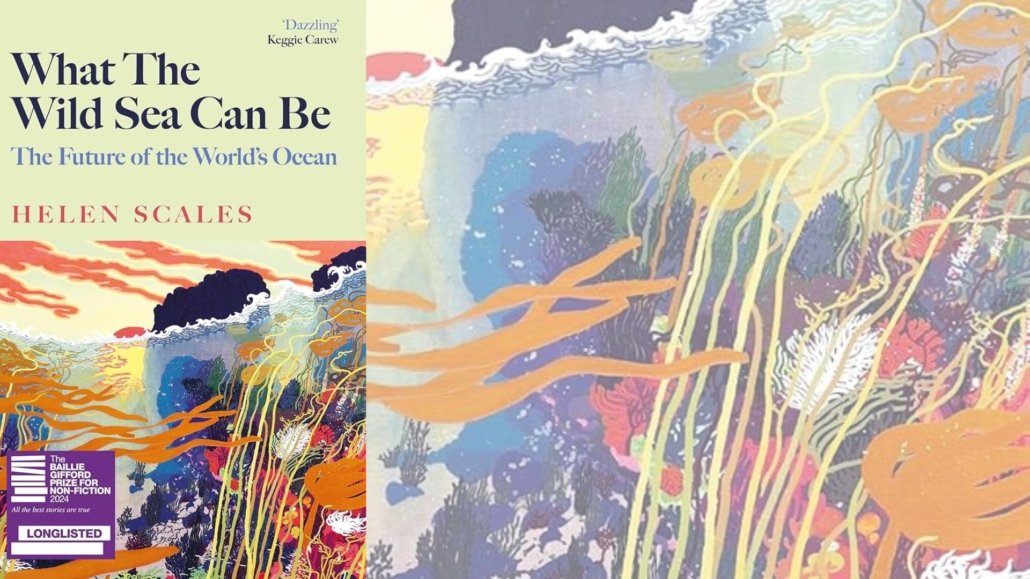
Author: Helen Scales. Grove Press UK, 2024. 266 pages, Rs. 948, ISBN: 978-I-8047I-051-7
The book, What the Wild Sea Can Be, which has been longlisted for the 2024 Baillie Gifford Prize for non-fiction, has been authored by Dr Helen Scales, who is a marine biologist, writer, and broadcaster, and whose books have been adapted for stage and screen and translated into 15 languages. She writes regularly for the Guardian, teaches at Cambridge University and is a storytelling ambassador for the Save Our Seas Foundation. In this latest book, Dr Scales highlights the devastating effects of human actions on the world’s oceans while celebrating the remarkable resilience of marine ecosystems in the face of these challenges. She explores ongoing efforts to safeguard the ocean, including the establishment of highly protected reserves, the restoration of seagrass meadows and giant kelp forests, and initiatives aimed at preserving coral reefs.
Dr Scales paints a beautiful picture of the ocean and the remarkable diversity of life it supports, along with an equally ugly picture of the devastation that humanity has inflicted upon the ocean. She uses the term “anthropocene” (a word that describes the current era in which humans have had a significant impact on the planet) almost as a pejorative but with quite some justification, given that over the past fifty years, the total mass of vertebrate life in the ocean has halved, with the oceans becoming more acidic and hotter than ever.
The book encompasses three themes: Ocean Conversion, Vanishing Glories, and Ocean Revival, explored across ten chapters. The theme of ocean conversion is discussed in the first two chapters, namely, “Ancient Seas” and “Remixing Seas”. Dr Scales avers that the history of the ocean is important because it provides context for what is happening in contemporary times. In a prehuman world, the ocean was both, a “cradle of evolution and an arena for extinction”. The Palaeozoic, Mesozoic, and Cenozoic eras each saw distinct life forms, but even dominant species, such as trilobites, a group of extinct marine arthropods, could not withstand changing conditions. While earlier oceans were shaped by geography, climate, and ecology, human intervention now drives changes, leading to a “remixing” of the seas.
There are numerous examples of humans, driven by economic greed, deliberately introducing invasive aquatic species, which have harmed the local environment. Dr Scales gives the example of lionfish, which were brought into captivity by aquarium keepers in the 20th century, to be bred as pets but were soon released in the Western Atlantic. Native species failed to recognise them as predators, allowing lionfish to thrive while reducing local fish populations by 65 per cent in places like New Providence Island. To control the population of lionfish, “diving derbies” are held where divers try to catch as many lionfish as possible. While lionfish are looked at as evil invaders, it is crucial to remember that these fish are a problem created by human actions.
In part two of the book, Vanishing Glories, the author delves into the coldest continent on Earth, Antarctica. Emperor penguins return there annually to complete a crucial life cycle stage, relying on windproof, waterproof feathers to endure extreme temperatures. However, as temperatures rise, sea ice is breaking during their chick-rearing period, causing many to drown before their feather coats fully develop. Without intervention, Emperor penguins could face extinction by the century’s end. The fate of other krill-dependent species, such as Adelie and Chinstrap penguins, is also precarious. Meanwhile, factory ships from China and Norway harvest krill for salmon farms and pet food, further threatening the Antarctic food chain. Currently, only two marine reserves exist in the Southern Ocean to protect these critical ecosystems.
Chapter 4, Missing Angels, describes the decline of species such as the oceanic whitetip shark, once among the most abundant, large marine animals. By 2019, their population had fallen by 95 per cent, leading the International Union for Conservation of Nature (IUCN) to classify them as “Critically Endangered”. More than one-third of all known sharks, skates, and rays now face extinction. Technological advancements in fishing—such as longline fishing, monofilament lines, and fossil-fuel-powered ships—have increased industrial fishing efficiency but at a devastating cost. In the US pelagic fleet, longlines extend up to 28 miles, with other fleets using even longer ones. These lines, primarily targeting marlin and tuna, also catch and kill sharks. With few fishing vessels having observers, most shark catches go unreported. When observers are present, they document shocking numbers; in 2018, a Spanish longliner near the Cape Verde Islands caught an average of 7.6 oceanic whitetips per line, with some lines catching as many as 54.
Sharks play a crucial role in marine ecosystems and their decline disrupts the marine balance, leading to unchecked populations of rays and smaller sharks. Even native species, such as rays, are increasingly labelled as invasive, leading to misguided culling efforts. Conservation efforts have made some progress. The “Convention on International Trade in Endangered Species” (CITES) regulates species at risk, listing sharks like the basking shark, whale shark, and the Great White shark. Over time, additional species, including manta rays and hammerhead sharks, have been added to its protected list. Dr Scales describes how sharks were historically viewed as dangerous due to films like Jaws but research has revealed their intelligence and their complex behaviour. Over the years, many shark sanctuaries have been established. However, unless longliner deaths are controlled, these sanctuaries offer little protection for highly migratory species.
Pollution is another major issue, particularly affecting marine mammals with high blubber content, such as orcas, seals, and polar bears. The ocean is contaminated with sewage, chemicals, oil spills, pesticides, mercury, and plastic. Lulu, an orca from Britain’s west coast community, died after becoming entangled in fishing lines in 2016. A necropsy revealed that she had high levels of toxic polychlorinated biphenyls (PCBs), chemicals known to impair brain function, immunity, and fertility. The pollutants likely contributed to her inability to reproduce and her eventual entanglement.
The final section, Ocean Revival, focuses on restoration efforts. Dr Scales highlights the successful recovery of species like the Nassau grouper in the Cayman Islands and the northern elephant seal, which rebounded from near-extinction. Marine reserves such as Lamlash Bay in Scotland and areas in Aotearoa, New Zealand, have shown that sea life can thrive when given protection. Ecosystem recovery also boosts resilience to climate change. However, while conservationists fight for no-take zones, deep-sea mining is rapidly expanding. Mining companies are seeking polymetallic nodules from the Clarion-Clipperton Zone (CCZ), an area rich in biodiversity. Despite some areas being designated “no-mining” zones, these were chosen only after mining companies selected their preferred sites, minimising true protection.
In Chapter 10, the author explores potential future developments, such as floating ocean cities. Maldives is planning an ocean city in collaboration with former president Mohamed Nasheed and the Dutch architectural firm, Waterstudio, and this is expected to be operational by 2027. In the Pacific, Dutch entrepreneur Boyan Slat founded the “Ocean Cleanup”, a nonprofit company aiming to remove plastic pollution from the Great Pacific Garbage Patch. However, ocean plastic removal is complex, as many marine animals camouflage with their surroundings, risking accidental removal. The author stresses that grassroots action—limiting plastic production, industrial fishing, and deep-sea mining—is essential for lasting change.
Dr Scales underscores humanity’s dependence on the ocean for clean air, rain, and a habitable environment. She highlights successful conservation campaigns, such as universities divesting from fossil fuel financing and European supermarkets pushing for improved Indian Ocean tuna fisheries. Public pressure has led to policy changes, such as France’s ban on plastic-wrapped produce. A recent success story in India saw a record-breaking mass nesting of 682,000 Olive Ridley turtles at Odisha’s Rushikulya river mouth in February 2025, following conservation efforts.[1]
While the book provides a holistic perspective in terms of ocean conservation, for readers looking for an action-oriented approach, it can sometimes feel less focused than might be desired. Dr Scales revisits themes and ideas multiple times, making parts of the book seem repetitive. While the book provides an in-depth understanding of the ocean’s complexities and is a passionate call to arms, it would have benefited from a tighter structure and as such, might not be an ideal read for those looking for a more sharply-analytical narrative. Also, while this book encompasses all parts of the world, the focus remains primarily on the perspectives of the Global North. In future, Dr Scales would do well to consider incorporating the perspectives of the Global South, so as to offer a more balanced and nuanced view on the subject.
What the Wild Sea Can Be is, therefore, a deeply personal book as the author writes from her own experiences of studying the ocean and witnessing its changes. Through the use of anecdotes, Dr Scales effectively blends personal narrative, environmental insight, and scientific analysis, to paint a vivid picture of the wild, untamed waters that cover much of the face of the Earth. She portrays how deeply interconnected the world is, from sharks to sea stars, orcas, kelp forests and otters, all of which creatures play an indispensable role in maintaining a crucial balance through a complex interplay of natural cycles. What sets this book apart is Scales’s skill in making intricate and sometimes unsettling topics understandable to a lay audience. What the Wild Sea Can Be is a compelling, and informative read that inspires action on ocean conservation. Written by a passionate expert, it is a must-read for those wanting to comprehend the deep significance of the world ocean.
******
About the Author
Ms Kripa Anand is a Research Associate at the National Maritime Foundation (NMF). Her research encompasses maritime security issues, with special focus upon the manner in which India’s own maritime geostrategies are impacted by the maritime geostrategies of the island-States of Oceania in general and Australia and New Zealand in particular. She may be reached at ocn1.nmf@gmail.com.
Endnotes:
[1] Hrusikesh Mohanty, “Olive Ridleys Set New Mass Nesting Record at Rushikulya”, The Times of India, 22 February 2025. https://timesofindia.indiatimes.com/city/bhubaneswar/olive-ridleys-set-new-mass-nesting-record-at-rushikulya/articleshow/118485378.cms


Leave a Reply
Want to join the discussion?Feel free to contribute!