
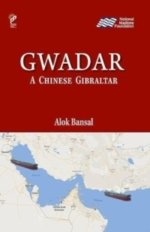
Alok Bansal. New Delhi. Pentagon Press LLP, 2023. 224 Pages, ISBN 978-81-951894-8-9. Rs 995 (Hardcover)
China, in its attempt to secure a foothold in the Indian Ocean region, has taken keen interest in its ‘all-weather friend’, Pakistan, and has significantly aided the development of the much talked about deep-water port in Gwadar on its Makran coast. The book, Gwadar: A Chinese Gibraltar, by former Indian Naval Captain Alok Bansal, seeks to shed light on this “strategically located” port, describing it (somewhat optimistically, in the opinion of this reviewer) as a “gateway for the landlocked countries of Central Asia and Afghanistan”. The book attempts to squarely address the significance of the Gwadar seaport for a variety of stakeholders, especially those located in its geographical proximity.
An established South Asian expert on Pakistan and a well-known defence analyst, Captain Bansal possesses impressive academic and experiential knowledge of multiple facets of South Asian geopolitics. In this, his latest book, he offers the reader a wide range of perspectives relevant to the port of Gwadar. The book begins with a fairly elaborate description of the location of Gwadar port and its convoluted history, which is deeply intertwined with the history of Balochistan — a region that spans three countries, namely, Pakistan, Afghanistan, and Iran. In addition to tracing the region’s history, the author has delved into the geography and topography of the region, facilitating his readers’ understanding of its complexities.
Bansal next discusses the significance of the Gwadar deep-sea port project vis-à-vis its location in the proximity of the Persian Gulf. He scrutinises the vulnerability of the Karachi-Md Bin Qasim port complex and outlines the maritime security aspects of Gwadar in this regard. The author has also provided some details about the berthing facilities, hinterland development, and the concomitant limitations of the Gwadar seaport.
The book goes on to encapsulate the external- and internal security implications of Gwadar upon Pakistan, with particular regard to the maritime dimension. The susceptibility of the ports of Karachi and Muhammad Bin Qasim to being blockaded provides a distinct military dimension to Gwadar. The author asserts that while Gwadar attempts to eliminate Pakistan’s economic vulnerability, it has, along with Pakistan’s other naval bases such as Ormara, Jiwani, and Pasni, transformed the security dynamics in the region. He feels that with the operationalisation of Gwadar, Pakistan needs to improve its external security environment, while simultaneously stabilising and developing the turbulent and impoverished province of Balochistan.
Being a prominent stakeholder in the region, China deservedly receives significant attention in this book. The Belt and Road Initiative (BRI) of China encompasses more than sixty countries and includes over seventy per cent of the global population. The China-Pakistan Economic Corridor (CPEC) — which ought to be called, at least within India, the “China-‘Pakistan-Occupied-Kashmir’ Economic Corridor [CPOKEC] — is one of the more-prominent of the components of the BRI, with Gwadar being projected as the seaward terminal of the project. This, in the opinion of this reviewer, is a highly fanciful projection. This notwithstanding, Captain Bansal points out that for China, the significance of Gwadar also lies in its potential to correct the regional imbalances in Pakistan’s domestic development dynamics, where the country’s western provinces continue to remain far less developed than do their eastern counterparts. The author explains that the core idea of the CPEC [CPOKEC?] is to establish a link between China’s restive Xinjiang province with the Gwadar seaport through a network of infrastructural and energy projects and, in the process, to create an alternative supply channel for China’s energy imports from West Asia and Africa. Quite correctly, the author questions the economic rationale of this — on account of a host of geographic, geomorphological, and geoeconomic factors that add to the political instability of the Baloch region.
The latter part of the book discusses regional security impacts and has separately detailed the implications of Gwadar for India’s own security. While deliberating upon regional security, the author has dwelt upon the Afghanistan-Pakistan relationship and its evolution over the years. Afghanistan’s relations with Pakistan have always been tense. Being a land-locked country, Afghanistan has always sought access to the sea, while Pakistan has consistently denied Kabul this access. In this regard, the author has referenced the Afghanistan-Pakistan Transit Trade Agreement (APTTA) and acknowledges that Gwadar port was recognised as the port of entry for Afghan merchandise. The author also writes that the Taliban’s continuing hold in Afghanistan makes the possibility of Afghanistan’s emergence as a transit point for legitimate trade fairly bleak. Captain Bansal has also dealt with the implications of Gwadar for Iran, West Asia (as a region), and the USA. Iran’s port of Chabahar, in the development of which India has invested huge amounts, could, he feels, become an economic liability should Gwadar emerge as the preferred gateway to Central Asia. The caveat, of course, is that such comparisons might well be odious given that both Chabahar and Gwadar lie in the Baloch dominated territories and have enormous security vulnerabilities. The author observes that the Baloch tribes are major players in the region and it the Baloch leadership that will eventually decide which of the two ports (if either) emerge as gateway to Central Asia. In terms of West Asia, the author opines that the port of Dubai could face an existential threat, since Gwadar, being closer to Eurasian heartland, has certain inherent geographical advantages over Dubai.
Captain Bansal reminds us that the Gwadar seaport project could well give China a permanent presence in the Indian Ocean, and this would, in all probability, erode the maritime edge that India currently enjoys over China in maritime terms. China is the largest importer of crude and second largest importer of Liquefied Natural Gas (LNG) and its energy imports traverse through the Malacca and other straits of West and Southeast Asia, making it vulnerable to interception by the Indian Navy. In what is the arguably the weakest set of arguments in the book, the author asserts that Gwadar will eliminate this vulnerability and resolve China’s ‘Malacca Dilemma’, and further, that its presence at Gwadar would equip Pakistan as well as China with the opportunity to interdict Indian shipping transiting to and from the Persian Gulf. He adds that apart from interdiction, enhanced Chinese military presence in Gwadar, given the extant tensions between China and the US, can cause massive turbulence in the region.
Bansal briefly touches upon the impact of all this upon extra-regional powers such as Russia. Russia, which historically has had good relations with India, and has been promoting the International North-South Transport Corridor (INSTC), jointly with India and Iran. Russia needs access to warm water ports on Iranian coats for its trade with Asia and Africa. It has actively engaged with Pakistan and has sought permission to use Gwadar for its own trade, thereby demonstrating, as the author points out the ‘shifting loyalties’ that are endemic to the region.
While the book is an applaudable source of knowledge, discussing as it does the geopolitical effects of the operationalisation of the Gwadar port, it does not address on the viability of the port itself, or the deeper economics that are entwined therein. The silver lining is, of course, that this opens the door for in depth research on these aspects without the attendant need to repeat geopolitical fundamentals, since the book is heavy-laden with geographical information. One wishes that there had been descriptive and annotated maps, for as Robert Kaplan has famously said, maps matter, since “the right map can stimulate foresight by providing a spatial view of critical trends in world politics”.[1] Thus more numerous and more granular cartographic representations of the locations discussed in the book would have enabled better assimilation by its readers. The book also becomes repetitive in certain parts, generating some degree of avoidable monotony. These few shortcomings notwithstanding, the book has immense value for any scholar or strategic analyst wishing to understand the regional geopolitical and security implications of Gwadar. In this context, the author provides extremely interesting nuggets in respect of a ‘Hormuz Dilemma’ for India that China could create along the Sea Lines of Communications (SLOCs) that might, in conflict, run from the Persian Gulf to the Gulf of Kachchh. The bulk of India’s crude imports originate from ports in the Persian Gulf, which is only 40 nautical miles from Gwadar — a distance that the author points out is so small that even a small gunboat from Gwadar could interdict a large oil tanker. By way of mitigating options for India, Captain Bansal recommends that India engage with Baloch nationalist groups to ensure that Chabahar (and not Gwadar) emerges as the preferred gateway to Central Asia.
The author provides an exhaustive list of literature in the form of notes and bibliography that will be invaluable to serious readers. All in all, Gwadar: A Chinese Gibraltar is an excellent adjunct to the tortuous story of Sino-Pak-India relations.
Endnotes:
[1] Robert D Kaplan, “Center Stage for the Twenty-First Century: Power Plays in the Indian Ocean”, Foreign Affairs 88, No 2 (2009), 16–32, http://www.jstor.org/stable/20699491.


Leave a Reply
Want to join the discussion?Feel free to contribute!