
India has situated its maritime defence partnership with the United States (US) within a broader bilateral and multilateral framework in recent years to manage various traditional and non-traditional challenges in the Indian Ocean Region (IOR). Arguably, the US is now believed to view the IOR through a South Asian and potentially Indian lens.[1] The US has also renamed the erstwhile “Pacific Command” to the “Indo-Pacific Command” to reinforce this fact.[2] Over the years, this strategic shift in US policymaking has indicated an expansion in the US’s strategic swath at a time when growing Chinese maritime presence in the western Pacific Ocean and the IOR has enabled a natural convergence of diplomatic and strategic interests between India and the US.[3] As a result, the US has now increasingly come to view India as a strategic bulwark against a rising China in the IOR.[4]
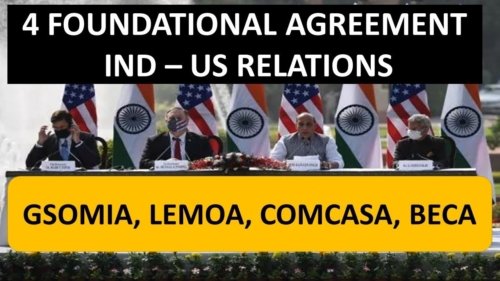
This shift has enabled the advancement of bilateral defence ties between India and the US with the foundational agreements — the “General Security of Military Agreement” (GSOMIA), the “Logistics Exchange Memorandum of Exchange “Agreement (LEMOA), the “Communications Compatibility and Security Agreement” (COMCASA), and the “Basic Exchange and Cooperation Agreement” (BECA) — emerging as ‘catalysts’ or ‘facilitators’ in the process. Consequently, maritime partnership between India and the US has emerged as a natural subset of the defence partnership within the cooperative bilateral framework. In order to substantiate the importance of the ‘maritime’ partnership within the context of the larger bilateral one between India and the US, an Indian scholar has argued that “the maritime domain (has) become the actionable ground for implementing the promise of the (India-US bilateral) partnership”.[5]
This article attempts to assess the impact of these foundational agreements upon the growing maritime partnership between India and the US. In addition, it suggests means to further operationalise the agreements by addressing structural impediments that limit the potential of the relationship.
Foundational Agreements and their Impact
The regular conduct of combined exercises such as those of the MALABAR[6] series, which seek to promote naval diplomacy and enhance interoperability,[7] and the various editions of the tri-Services India US Exercise TIGER TRIUMPH, which enables military-to-military cooperation within the realm of humanitarian assistance and disaster relief (HADR) among other exchanges,[8] have created an enabling environment for the growth of the India-US bilateral defence partnership.[9] This camaraderie between the two partners and the emergence of new geopolitical realities within the IOR, where certain revisionist States are striving to change the existing ‘rules based international order’, has brought about a natural convergence of interests between India and the US. This convergence is strikingly visible within the maritime domain, with the foundational agreements acting as convenors of this partnership.[10]
Moreover, these foundational agreements have also emerged as confidence-building measures (CBMs) that have facilitated the growth of greater trust between India and the US. For instance, formalisation of these agreements has been viewed as a ‘foreign policy statement by India’ and an acceptance of the “extended arm of friendship of the predominant superpower”.[11] Similarly, Indian military practitioners have opined that signing these agreements have amplified strategic options for the parties involved, thereby, “posing a credible deterrence to both State and non-State actors that may potentially conspire to undermine the stability of the beneficiary State”, in this case, either India or the US.[12] Within this context, the contents of these agreements and their impacts are listed below for greater conceptual clarity.
General Security of Military Information Agreement (GSOMIA) and Industrial Security Annex (ISA)
India signed the “General Security of Military Information Agreement” (GSOMIA) in 2002 to protect information shared between the militaries of India and the US.[13] Over time, as the bilateral relationship became more complex, the GSMOIA was augmented by the “Industrial Security Annex” (ISA) — an extension to the GSOMIA that was signed in 2019. This is an important development, since the ISA has enabled the exchange of classified information between the defence industries of India and the US.
Interestingly, before the signing of the ISA, only government departments could share classified military information.[14] The ISA has also pioneered the formation of the “Indo-US Industrial Security Joint Working Group” that has specifically brought the Indian and US industrial collaborators together for the joint creation of cutting-edge technologies.[15] The signing of the ISA also supported Indian efforts to be a part of the global supply chain in the defence sector.[16]
Similarly, the finalisation of the “Defence Trade and Technology Initiative” (DTTI) in 2012, which initiated the co-production and co-development of defence systems, and India’s designation, in 2016, as a ‘Major Defence Partner’ (MDP) by the US, have enabled India to be treated at par with other defence treaty allies of the US, potentially furthering the sale of weapon systems to India.[17] At the same time, the awarding of the US ‘Strategic Trade Authorisation’ (STA-1) status in 2017 has enabled India to acquire license-free access to dual-use technology products from the US, in the civilian and defence sectors.[18]
Logistics Exchange Memorandum of Agreement (LEMOA)
India and the US signed the “Logistics Exchange Memorandum of Agreement” (LEMOA) in 2016 — a bespoke remodelling of the more commonly encountered “Acquisition and Cross-Servicing Agreements” (ACSA), specially tailored to address Indian interests and sensitivities.[19] The India-centric LEMOA came with a wide mandate, wherein it enables, for example, ships of one country to replenish their fuel stocks in the other country during port calls, exercises and training.[20]
In conjunction with the “Helicopter Operations from Ships Other Than Aircraft Carriers” (HOSTAC) protocol that was signed in 2017 and which enables helicopters of the two navies to land and take off from each other’s warships, the LEMOA has enabled the commencement of various activities that are likely to be of especial significance in potential or future contingencies. For instance, the LEMOA allows Replenishment at Sea (RAS) activities between ships of the Indian Navy and the US Navy as also its auxiliary vessels. It can also be used for accounting purposes during training exercises.[21] Most importantly, LEMOA has provided India with enduring access and refuelling facilities within US military facilities in Djibouti, Diego Garcia, Guam, and Subic Bay.[22]
As a corollary, the signing of the Master Ship Repair Agreement (MSRA) by the US Navy and Mazagaon Dock Shipbuilders Limited in August 2023, in addition to the US Navy’s use of the Larsen & Toubro shipyard at Kattupalli for ship repairs,[23] has reinforced India’s position as a hub for maintenance and repair for forward-deployed US Navy assets and auxiliaries in the Indo-Pacific.[24]
Communications Compatibility and Security Agreement (COMCASA)
The signing of the “Communications Compatibility and Security Agreement” (COMCASA) — once again an India-centric customised version of the “Communication Interoperability and Security Memorandum of Agreement” (CISMOA) for India — has enabled the installation of US Combined Enterprise Regional Information Exchange (CENTRIX) System terminals, enabling secure exchange of information between both partners in text and web-based formats.[25] Furthermore, the agreement enabled India to access COMCASA-protected equipment such as advanced “Global Position System” (GPS) and “Identification Friend or Foe” (IFF) systems where the adjective “advanced” indicates additional features to provide protection against jamming and spoofing.[26]
Finally, on the weapons-procurement front, COMCASA has enabled India to acquire the most advanced versions of Unmanned Aerial Vehicles (UAVs) from the US, boosting India’s combat ability.[27] This is significant, as thus far, despite acquiring large military platforms like the C-130J Super Hercules special mission transport aircraft and P-8 (India) long range maritime reconnaissance and anti-submarine aircraft, India did not have access to encryption technologies and other sophisticated software with which the US versions of these platforms were equipped.[28] Thus, signing the COMCASA resulted in greater operational efficiency for the Indian forces, with Indian military units getting access to a secure ‘common tactical picture’ that would enable surveillance aircraft to receive data from the US and other partner countries.[29]
Basic Exchange and Cooperation Agreement (BECA)
The signing, in 2020, of the Basic Exchange and Cooperation Agreement (BECA) for geospatial intelligence has augmented Indian precision-strike capabilities, while increasing India’s access to advanced satellite data, nautical charts and real-time intelligence to improve targeting solutions, when conducting missile strikes.[30] BECA has also facilitated operational information-sharing. Within the maritime domain, BECA has enabled the exchange of critical maritime information and geospatial data pertaining to Chinese submarine transits in the Indian Ocean.[31] BECA has also allowed India access to advanced Electronic Intelligence (ELINT) clusters.[32]
Additional Spinoffs
It is within the context of these foundational agreements that the genesis of the “India-US Defence Acceleration Ecosystem” (INDUS-X) and the “Initiative on Critical and Emerging Technologies” (iCET) lies. These have assisted in creating an ecosystem for startups to collaborate on industrial defence production. Such a collaborative project has increased enduring engagement to newer areas of cooperation such as space and next-generation telecommunications, with coproduction of defence articles becoming possible between stakeholders in India and the US.[33]
Finally, signing these agreements has enabled India to gain access to Missile Technology Control Regime (MTCR) Category -1 Unmanned Aerial Systems (UAS) such as the Sea Guardian UAS manufactured by General Atomics, in addition to the General Electric F-414 jet engines.[34] The latter is considered a ‘crown jewel’ within the realm of technology in the US.[35]
Path Ahead
While the Foundational Agreements have been signed by both India and the US, there is considerable scope to enhance their beneficial impact and to simultaneously minimise potential irritants. Examples in this regard might include the following:
- The US will need to address Indian concerns pertaining to the US Navy and its Freedom of Navigation Operations (FONOPs) in the IOR.[36] In this regard, it is important to note that the US Navy had conducted a Freedom of Navigation Operation (FONOP) approximately 130 nautical miles west of the Lakshadweep Islands, inside India’s Exclusive Economic Zone (EEZ) in April 2021. This FONOP gave rise to the “Goldilocks Dilemma” for India —- “as New Delhi sought the right balance of US naval presence in the Indian Ocean littorals — not too hard, not too soft, but just right.”[37]
- India and the US should regularly engage in more “high-end combined operational activities involving their naval forces” both at the bilateral and multilateral level .[38] Interestingly, a precedent for the same had been set when the Indian Navy had launched Operation SAGITTARIUS, in the aftermath of the 9/11 attacks and performed its constabulary role, duly escorting and protecting US ships passing through the Indian Ocean at the time.[39] In similar vein, the Indian Navy conducted the 24th edition of the Exercise MALABAR with the navies of navies of the other members of the QUAD, namely, the US, Australia and Japan,[40] engaging in advanced surface and anti-submarine exercises (amongst others) at a time when India was managing a standoff with China along the border in Ladakh.[41]
- Bilateral maritime cooperation could be significantly enhanced by addressing the contents of the 1920 US Merchant Marine Law that protects US shipyards from overseas competition and permits only non-combat ships to be repaired in other countries. This legal requirement restricts the full leveraging of LEMOA and the MSRA, and limits India’s potential to be a logistics hub for the US military in the advent of a future conflict.[42]
- Maritime cooperation can be progressed further through a signing of the “Security of Supply Arrangement” (SOSA) and the “Reciprocal Defence Procurement (RDP) Agreement”, to ensure supply-chain sustainability and the priority delivery of defence purchases to meet potential military contingencies.[43] In fact, signing the RDP Agreement is a prerequisite to “promote standardisation, interchangeability, and interoperability of conventional defence equipment” for the US. Only if the RDP is signed can India become a “Defence Federal Acquisition Regulation Supplement” (DFARS) compliant country.[44] As a corollary, a ‘DFARS compliant status’ would enable Indian companies to potentially co-produce military hardware with their US counterparts.
- While the enabling agreements have facilitated defence procurement, India and the US are now shifting their focus on broadening and deepening their maritime partnership to include undersea communication and maritime Intelligence, Surveillance and Reconnaissance (ISR) within its realm.[45] As India attempts to reduce its dependencies on Russian weapon systems and platforms, update its inventory through diversified sources — especially the US — it will need to navigate all the legal mechanisms for the technological transfers to actually come through. [46] In this regard, India will have to negotiate regulatory barriers such as the International Traffic in Arms Regulation (ITAR) export-control regulations that protect US security interests in line with the US “Arms Export Control Act” (AECA) and the “Commitment on Foreign Investment” in the US (CFIUS) if meaningful technology transfers are to occur.
- Finally, Indian agencies will need to understand the complexities attached to the “US Munition List” (USML) that designates several categories of items as ‘sensitive’ — especially those that fall within the bracket of ‘defence articles’, such as surface vessels of war and special naval equipment and have relevance within the naval domain. In addition, it also includes items of export linked to communication, remote sensing, navigation that have both naval and maritime applications.[47] These engagements should take place between concerned representatives of the designated government agencies on a priority basis. Once this Rubicon is crossed, India would find itself in a considerably more advantageous place.[48]
Conclusion
The India-US bilateral maritime partnership, as a subset of the larger defence partnership, is likely to grow in scope and intensity in the years to come. Although the formal signing and operationalisation of the four foundational agreements has taken twenty years, the resultant consensus on the defence partnership has increased prospects for cross-domain interoperability in the years to come.
Strategic convergences are likely to develop further between India and the US as the latter attempts to manage specific revisionist powers in the Indo-Pacific. However, the true test of the partnership will occur when a military contingency emerges in mutual and/or overlapping geographical areas of concern.
While the signing of the foundational agreements has facilitated a transformation in ties, India will still have to navigate the structural impediments in the legal and operational realms that limit the partnership, so as to ensure better bilateral interoperability between the two countries. Such an approach will ensure that the India-US bilateral relationship emerges as an “all weather partnership” in this century.
******
About the Author:
Anuttama Banerji is a policy analyst and Junior Research Associate within the Americas Cluster at the National Maritime Foundation. She graduated with a Master’s degree in International Relations from the London School of Economics and Political Science (LSE) in 2018. Her research dwells on the maritime geostrategies of India and how these are likely to be impacted by those of the Indo Pacific powers of North and South America, especially the US. She has prior published work to her credits across different national and international platforms. She can be reached at usa2.nmf@gmail.com.
Endnotes:
[1] Nilanthi Samaranayake, “Why the US Wants to Step Up Engagement in the Indian Ocean”, US Institute of Peace, 24 May 2021, https://www.usip.org/publications/2023/05/why-us-wants-step-engagement-indian-ocean
[2] US Indo-Pacific Command, “Pacific Command Change Highlights Growing Importance of Indian Ocean Area”, 31 May, 2018, https://www.pacom.mil/Media/News/News-Article-View/Article/1537107/pacific-command-change-highlights-growing-importance-of-indian-ocean-area/
[3] China officially asserted its sovereignty over the South China Sea in 2009 in keeping with the ‘Nine Dash Line’ (jiuduanxian) doctrine, which was first released in 1947. In 2013-14, China began to reclaim land and build infrastructure on the Fiery Cross Reef in the disputed Spratly Islands.
See: Weifeng Zhou, “China’s growing assertiveness in the South China Sea”, Real Instituto Alcano, 05 November 2015, https://www.realinstitutoelcano.org/en/analyses/chinas-growing-assertiveness-in-the-south-china-sea/
[4] Anuttama Banerji, “India in 2023: Year of India-U.S. Bilateral Exchanges and Burgeoning Defence Ties”, South Asian Voices, 28 January 2024, https://southasianvoices.org/geo-f-in-r-india-in-2023-01-28-2024/
[5] Vivek Mishra, “India US Maritime Cooperation: The Next Decade”, Indian Foreign Affairs Journal, Vol. 12 No. 1, Jan-Mar 2017, 60-73.
[6] Vice Admiral Pradeep Chauhan, “After “Malabar 2020”, What? – Next Steps in Consolidating Our Maritime Space”, National Maritime Foundation, 20 November 2020, https://maritimeindia.org/after-malabar-2020-what-next-steps-in-consolidating-our-maritime-space/
[7] Jennifer Parker, “Not Just Another Naval Exercise: Malabar’s Vital Messaging”, Australian Strategic Planning Institute, 10 August 2023, https://www.aspistrategist.org.au/not-just-another-naval-exercise-malabars-vital-messaging/
[8] US Indo-Pacific Command, “US, India Launch First Tiger TRIUMPH Exercise”, 15 November 2019, https://www.pacom.mil/Media/News/News-Article-View/Article/2018116/us-india-launch-first-tiger-triumph-exercise/
[9] Press Information Bureau, “EX TIGER TRIUMPH -24” 19 March 2024, https://pib.gov.in/PressReleaseIframePage.aspx?PRID=2015581
[10] Mishra, “India US Maritime Cooperation: The Next Decade”, 61
[11] Rajesh Soami, “COMCASA- Wind-Vane of Indian Foreign Policy?!”, National Maritime Foundation, 28 June 2018, https://maritimeindia.org/comcasa-wind-vane-of-indian-foreign-policy/
[12] Captain (Dr.) Gurpreet Khurana, “Indo-US Logistics Agreement LEMOA: An Assessment”, National Maritime Foundation, 08 September 2016, https://maritimeindia.org/indo-us-logistics-agreement-lemoa-an-assessment/
[13] US Department of State, “Agreement between US and India”, 17 January 2002, https://www.state.gov/wp-content/uploads/2019/04/02-117-India-Defense-GSOIA-1.17.2002.pdf
[14] Abhinandan Misra, “India-US Military Ties Reach Unprecedented Heights”, The Sunday Guardian, 31 October 2020, https://sundayguardianlive.com/news/india-us-military-ties-reach-unprecedented-heights
[15] Press Information Bureau, “India and US set-up joint working group in defence industrial security”, 01 October 2021, https://pib.gov.in/PressReleasePage.aspx?PRID=1759911
[16] The Economic Times, “Industrial Security Annex to deepen industry collaboration between India, US: Nisha Biswal” 28 December 2019, https://economictimes.indiatimes.com/news/economy/foreign-trade/industrial-security-annex-to-deepen-industry-collaboration-between-india-us-nisha-desai-biswal/articleshow/73004435.cms?from=mdr
[17] U.S. Department of State, “U.S. Security Cooperation with India”, 20 January 2021, https://www.state.gov/u-s-security-cooperation-with-india/
[18] Mark Rosen and Douglas Jackson, “The U.S.-India Defence Relationship: Putting the Foundational Agreements in Perspective”, Centre for Naval Analyses, February 2017,
[19] US Department of State, “US Security Cooperation with India”, 20 January 2021, https://www.state.gov/u-s-security-cooperation-with-india/
[20] Rosen and Jackson, “The U.S.-India Defence Relationship”
[21] Financial Express Online, “LEMOA comes in force, US tanker refuels Indian Navy ship in the Sea of Japan; know what the memorandum is all about”, 11 November 2017, https://www.financialexpress.com/india-news/lemoa-comes-in-force-us-tanker-refuels-indian-navy-ship-in-the-sea-of-japan-know-what-the-memorandum-is-all-about/928773/
[22] Rajeshwari Rajagopalan, “India’s Military Outreach: Military Logistics Agreements”, The Diplomat, 09 September 2021, https://thediplomat.com/2021/09/indias-military-outreach-military-logistics-agreements/
[23] US Embassy in India, “US Navy Ship Salvor Reaches L&T Kattupalli Shipyard for Voyage Repairs, 10 July 2023, https://in.usembassy.gov/united-states-navy-ship-salvor-reaches-lt-kattupalli-shipyard-for-voyage-repairs/
[24] The White House, “Joint Statement from India and the US”, 8 September 2023, https://www.whitehouse.gov/briefing-room/statements-releases/2023/09/08/joint-statement-from-india-and-the-united-states/
[25] Saxena, “COMCASA-The Bigger Picture”, Vivekanand International Foundation, 19 September 2018, https://www.vifindia.org/article/2018/september/19/comcasa-the-biggerpicture
[26] Jeff Smith, “COMCASA: Another Step Forward for the US and India”, The Diplomat, 11 September 2018, https://thediplomat.com/2018/09/comcasa-another-step-forward-for-the-united-states-and-india/
[27] Soami, “COMCASA- Wind-Vane of Indian Foreign Policy?!”, 28 June 2018.
[28] Lt Gen VK Saxena, “COMCASA-The Bigger Picture,”19 September 2018.
[29] Ankit Panda, “What the Recently Concluded US-India COMCASA Means?” The Diplomat, 09 September 2018, https://thediplomat.com/2018/09/what-the-recently-concluded-us-india-comcasa-means/
[30] Ministry of External Affairs, “India-US sign BECA empowering India’s military valour”, 26 October 2020, https://indbiz.gov.in/india-us-sign-beca-empowering-indias-military-valour/
[31] Joshua T. White, “After the Foundational Agreements: An Agenda For US-India Defence and Security Cooperation”, Foreign Policy at Brookings, January 2021, https://www.brookings.edu/wp-content/uploads/2021/01/FP_20210111_us_india_white.pdf
[32] Strategic Vision Institute, “India-US Basic Exchange and Cooperation Agreement (BECA): Implications for the South Asian Region on 11th November 2020”, 16 November 2020, https://thesvi.org/svi-webinar-panel-discussion-india-us-basic-exchange-and-cooperation-agreement-beca-implications-for-the-south-asian-region/
[33] White House, “FACT SHEET: US and India Elevate Strategic Partnership with the initiative on Critical and Emerging Technology (iCET)”, 31 January 2023, https://www.whitehouse.gov/briefing-room/statements-releases/2023/01/31/fact-sheet-united-states-and-india-elevate-strategic-partnership-with-the-initiative-on-critical-and-emerging-technology-icet/
[34] US Department of State, “US Security Cooperation with India” 20 January 2021. https://www.state.gov/u-s-security-cooperation-with-india/
[35] Prashant Jha, “US seals key ‘jet engine deal’ ahead of Modi’s visit”, Hindustan Times, 19 June 2023, https://www.hindustantimes.com/india-news/us-seals-key-jet-engine-deal-ahead-of-modi-s-visit-101687114785567.html
[36] US Seventh Fleet Public Affairs, “7th Fleet Conducts Freedom of Navigation Operation”, 07 April 2021, https://www.c7f.navy.mil/Media/News/Display/Article/2563538/7th-fleet-conducts-freedom-of-navigation-operation/
[37] Abhijit Singh, “The US Navy in the Indian Ocean: India’s ‘Goldilocks’ Dilemma”, War on the Rocks, 11 May 2021, https://warontherocks.com/2021/05/the-u-s-navy-in-the-indian-ocean-indias-goldilocks-dilemma/
[38]Captain Kamlesh K Agnihotri, “India-US Maritime Cooperation: Strengthening Security Arrangement in the Indian Ocean Region for Mutual Benefit”, Chanakya Forum, 21 December 2020, https://chanakyaforum.com/india-us-maritime-cooperation-strengthening-security-arrangement-in-the-indian-ocean-region-for-mutual-benefit/
[39] Harsh V. Pant and Yogesh Joshi, “The “American” Pivot and the Indian Navy: It’s Hedging all the Way”, Naval War College Review, Vol. 68, No. 1, (Winter 2015), 47-70, https://www.jstor.org/stable/26397816?seq=1
[40] Indian Navy,” Exercise MALABAR 2020 Concludes in Arabian Sea”, 2020, https://www.indiannavy.nic.in/content/exercise-malabar-2020-concludes-arabian-sea
[41] Dinakar Peri, “Indian Navy holds passage exercise with ‘USS Nimitz’ carrier group”, The Hindu, 20 July 2020, https://www.thehindu.com/news/national/indian-navy-holds-passage-exercise-with-uss-nimitz-carrier-group/article32140656.ece
[42] “Shipping Under the Jones Act: Legislative and Regulatory Background”, EveryCRSReport.com, May-November 2019, https://www.everycrsreport.com/reports/R45725.html
[43] The Economic Times, “Security of Supply Arrangement, Reciprocal Defence Procurement Arrangements will Bring Indo-US Defence Industries Together: Pentagon”, 21 June 2023, https://economictimes.indiatimes.com/news/defence/security-of-supply-arrangement-reciprocal-defense-procurement-agreements-will-bring-indo-us-defence-industries-together-pentagon/articleshow/101156102.cms?from=mdr
[44] US Government Federal Register, “Negotiation of a Reciprocal Defence Procurement Agreement with the Republic of India”, 10 October 2023, https://www.federalregister.gov/documents/2023/10/10/2023-22429/negotiation-of-a-reciprocal-defense-procurement-agreement-with-the-republic-of-india
[45] US Department of Defence, “INDUS-X Senior Advisory Group Holds Kick-Off Meeting”, 05 September 2023, https://www.defense.gov/News/Releases/Release/Article/3515656/indus-x-senior-advisory-group-holds-kick-off-meeting/
[46] Russian Arms and ammunition constitute 86% of India’s inventory. For more details, see Dr Sameer Lalwani et al, “The Influence of Arms: Explaining the Durability of India-Russia Alignment”, Journal of Indo-Pacific Affairs, 15 January 2021, https://www.airuniversity.af.edu/JIPA/Display/Article/2473328/the-influence-of-arms-explaining-the-durability-of-indiarussia-alignment/
[47] Vivek Mishra and Anuttama Banerji, “Getting to the High Table on Space Affairs”, Deccan Herald, 03 November 2023, https://www.deccanherald.com/opinion/getting-to-the-high-table-on-space-affairs-2754618
[48]Captain Kamlesh K Agnihotri, “India-US Maritime Cooperation: Strengthening Security Arrangement in the Indian Ocean Region for Mutual Benefit”, Chanakya Forum, 21 December 2020, https://chanakyaforum.com/india-us-maritime-cooperation-strengthening-security-arrangement-in-the-indian-ocean-region-for-mutual-benefit/


Leave a Reply
Want to join the discussion?Feel free to contribute!