
 CFR org
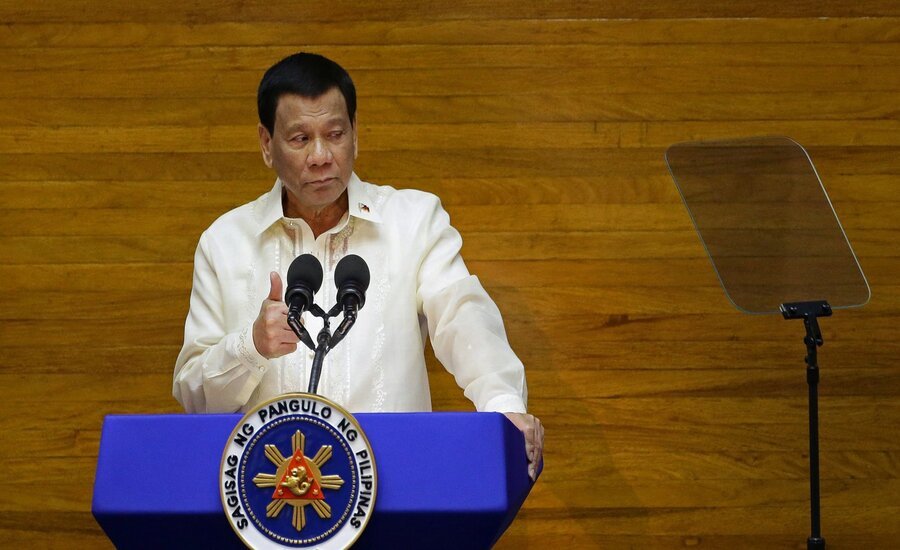
In June 2016 led to a remarkable shift in the foreign policy of the archipelagic state. Unlike the previous administration of Benigno Aquino III, which was somewhat confrontational with China on several fronts, including dragging Beijing to the Permanent Court of Arbitration (PCA) over the maritime disputes in the South China Sea (SCS), Duterte downplayed the friction and adopted a more conciliatory stance towards China. Shortly after his election victory, Duterte announced that his foreign policy “will not be dependent on the United States”.[1] He also embarked on a state visit to China in October 2016 (his first outside the Association of South East Asian Nations countries) where he announced his “separation” from the U.S. in favour of a new association with China and Russia.[2] Incidentally, this policy pivot also comes a year after the arbitral tribunal invalidated China’s claims in the South China Sea and censored it for violating the Philippines’ sovereign rights in the region. This reflects the unpredictable nature of geopolitical shifts in the Indo-Pacific, which has recently witnessed traditional U.S. allies like Thailand and the Philippines moving into closer relationship with China.
In view of the increasing geopolitical competition at play between China and the U.S. over dominance in the Indo-Pacific region especially over the South China Sea, this paper attempts to evaluate how Beijing has been successful in bringing the Philippines to its fold and whether the Philippines under Rodrigo Duterte is ‘bandwagoning’ with China. [3] It also analyses the declining U.S. influence in the Philippines and attempts to examine the implication of Duterte’s strategy for India and the wider Indo-Pacific region.
Conceptual Framework
Several scholars like Amitav Acharya and Peter Katzenstein are inclined to believe that Western theoretical frameworks do not adequately explain the full range of ideas, norms and attributes associated with intra-Asian relationships.[4] A prominent voice among this group is of David Kang, who points out that Eurocentric ideas, concepts and theories have created wrong predictions and conclusions about Asia. He, therefore, highlights the need for new analytical frameworks to study Asia. According to him, Asian states behave differently than the West because of their different historical and cultural traditions and dissimilar geographical and political realities. Kang argues that containment of China does not have a strong appeal in the region as most Asian states generally have a penchant for ‘hierarchy’ as opposed to ‘equality’. He criticizes not just Realism but Western International Relations theory in general for “getting Asia wrong” and argues that instead of balancing against China, they are bandwagoning with it.[5]
Duterte’s Approach to China
Whether Kang’s conceptual framework can fit into Manila’s recent bonhomie towards Beijing can only be gauged from an understanding of Duterte’s broader policy priorities since coming to power. It is noteworthy that even though Duterte assumed office just before the PCA verdict in July 2016, he continued to downplay the disputes in the South China Sea and moved towards rapprochement with Beijing. During his first visit to China, Duterte declared his intention to have an “independent” foreign policy, to reduce U.S. influence over the Philippines. As part of his poll promise, he is also seeking foreign aid and investments in order to drive growth and create more employment opportunities. Furthermore, Duterte is facing pressing domestic challenges including a violent campaign against illicit drug trade, which has already claimed around 3,000-7,000 lives and the ongoing conflict in Marawi City, where the government is currently battling a homegrown pro-Islamic State, Maute group. The ensuing violence has also led to the killing of over 300 people, besides displacing tens of thousands of Marawi residents.[6] Duterte has also been unsuccessful so far in negotiating a peace treaty with another significant armed group, the Moro Islamic Liberation Front (MILF). Simultaneously, his administration is also negotiating for peace with the National Democratic Front-Communist Party of the Philippines-New People’s Army (NDF-CPP-NPA); although, even after repeated setbacks, prospect of a final settlement of the five decade old conflict still looks dim.[7] He has attached more importance to confronting illegal drug trade and militancy in Marawi City on the island of Mindanao, his home island. Duterte has further promised to the progression of infrastructure projects held up under the previous administration, and is also planning to build a large infrastructure system in Mindanao.
Towards these domestic policy priorities, Duterte has been able to receive substantial financial, military and diplomatic support from China. Beijing has consistently supported Duterte’s campaign against drugs and his confrontation against the Islamist militants in the south; for which, it has been willing to provide large-scale assistance in counter terror and domestic security operations.[8] Besides offering the Philippines about US$ 12 million in weapons and ammunitions for counter-terror operations, Beijing has also made available a loan of US$ 500 million for its military to counter its historically close ties with Washington, D.C., and increase China’s own ability to shape the Philippines’ defence and foreign policies.[9] Duterte has also been able to garner investments and financing agreements worth US$ 24 billion (of which US$15 billion comprised investment projects and US$ 9 billion credit facilities) during his first three day visit to China.[10] Moreover, recently, China has also began allowing Filipino fishermen to resume fishing activities around the Scarborough Shoal under a tentative fishing agreement which is now being hailed by Duterte’s administration as “fruits” of his “strategy”.[11] However, the Scarborough Shoal is still under the administrative control of the Chinese Coast Guard, and the Filipino fishermen have only been allowed to operate in the immediate vicinity of the Shoal. They have not been allowed to enter the lagoon within the shoal, which is not only rich in fisheries but also serves as a crucial rest, repair and recuperation spot for fishermen, especially during inclement weather.[12]
Another positive development in the region has been China’s agreement to sign a “Code of Conduct for the South China Sea” with the Association of Southeast Asian Nations (ASEAN). Although not a legally binding agreement, it is still taken as a “positive momentum” for a “steady progress toward a substantive Code of Conduct”.[13] Also, in contrast to its past attempts to diplomatically isolate the Philippines, China is now wooing the Philippines to partner in its Asian Infrastructure Investment Bank (AIIB) and the “Belt and Road” initiative. Hostilities between the two states have also reduced considerably despite China’s unabated island construction activities in the region.[14]
Analyzing Duterte’s Anti-U.S. Stance
In contrast to China’s strong backing of Duterte’s policies, the U.S. has not been able to offer similar support and assistance to the Philippines. On the contrary, the Obama administration was harshly critical of Duterte’s anti-drug campaign over concerns regarding gross human rights violations and extrajudicial killings allegedly committed by the Duterte administration. In light of these concerns, the U.S. State Department halted a planned sale of 26,000 assault rifles to the Philippines national police.[15] Washington had also deferred an aid package to Manila worth up to US$ 434 million in December 2015.[16]
The U.S. was very supportive when the Philippines approached the PCA on the SCS issue against China. Surprisingly, however, it took a comparatively subdued position on the PCA verdict by calling for calm and patience in the region rather than declaring its resolute support to the Philippines, with which it has a “Mutual Defence Treaty” since 1951. [17] This was in contrast to states like Japan and Australia, which despite having no defence obligations to the Philippines, categorically called for compliance by all parties to the dispute over the ruling.[18]
Thus, the repeated Western criticism over human rights in the Philippines, the U.S.’ restrained stance with regard to the arbitration verdict, the increasing need for aid and investments to sustain higher growth and investor confidence in the Philippines as well as Duterte’s own predicament to pursue an independent foreign policy steered him to maintain distance from the U.S., and opt for rapprochement with China. As part of this policy shift, Duterte also reversed from the Filipino leaders’ diplomatic tradition of undertaking their first major foreign trip to Washington. Much to the chagrin of the U.S., he has not only visited China twice in his capacity as the Filipino President but has also become the first President to undertake a state visit to Russia, while deliberately snubbing major Western capitals including Washington, D.C.[19] Even when President Donald Trump invited him to the White House in April 2017, Duterte refused to give any positive response, saying he “cannot make any definite promise”.[20]
Philippines-U.S.: Continued Engagement
Of late, relations between the U.S. and the Philippines have shown signs of improvement. Both of them have been conducting joint patrols, more recently in the Sulu Sea amid rising concerns about Islamist militancy and piracy in the region. The high profile exercise involved the American Littoral Combat Ship USS Coronado and the flagship warship of the Philippines Navy, the Del Pilar Class Frigate BRP Ramon Alcarez.[21] The U.S. have also been providing technical assistance to the Philippines military in the battle against the pro-Islamic militants. However, when asked about the U.S. support to the Philippines, Duterte said he had “never approached America” for assistance and was “not aware of that until they arrived”.[22]
Nevertheless, despite all the rhetoric about “separation” of ties with the U.S., security relations between the U.S. and the Philippines is likely to remain strong since territorial and maritime disputes with China continue to persist especially over growing assertiveness by the Chinese Navy. Duterte is also facing heavy criticisms from several quarters at home. Apart from the military which has been historically close to Washington, D.C. and deeply suspicious of Chinese activities in the region, Duterte’s approach to China has also been criticised as lacking “discernible direction, coherence or vision” by Antonio Carpio, the Philippine Supreme Court Justice who played an advisory role in the arbitration award.[23] Nevertheless, Duterte has shown proclivity to his domestic concerns while downplaying the disputes with China.
Deduction
Although known for his temperamental attitude and use of unparliamentary language, Duterte has been successful in receiving defence assistance from both the U.S. and China. Similarly, through pragmatic diplomatic flexibility, Duterte is also enhancing diplomatic ties with Japan and Russia.[24] Besides, military-to-military contact and coast guard talks with China have also resumed in order to enhance confidence-building and reduce risk of miscalculation.[25] This clearly indicates that rather than bandwagoning with China, Duterte has adopted a multi-vectored approach in dealing with both the U.S. and China in the region. This is also reflected in the fact that Duterte has improved relations with not only China and Russia but also U.S. allies in the region like Japan, which shows his emphasis to have balanced relations with the major powers of the region.
Conclusion
To conclude, Duterte’s policy change towards China can best be described as a tactical maneuver rather than a strategic realignment of foreign and security policies. Therefore, this may not affect India’s immediate interests in the region. However, Delhi should have a long term perspective on the region taking into account the changing facts on the ground marked by the growing presence of the Chinese Navy and the implications that it can have over India’s external relations and trade in the region. India must also remain actively engaged with like-minded regional states like Japan, Vietnam and Australia especially in view of the prevailing uncertainties in the region, particularly after the election of Donald Trump as the U.S. President.
*******************************
* Jyotishman Bhagawati is a Research Associate at the National Maritime Foundation (NMF), New Delhi. The views expressed here are his own, and do not reflect the official policy or position of the NMF. He can be reached at bhagawati.jeevan@gmail.com
Notes and References
[1]Heydarian, Richard. 2017. “Duterte Marked His First Year By Obtaining Dual China, US Defence Aid”. South China Morning Post. http://www.scmp.com/comment/insight-opinion/article/2103351/duterte-put-his-foreign-policy-stamp-his-first-year
[2] Blanchard, B. 2017. “Duterte Aligns Philippines With China, Says U.S. Has Lost”. Reuters.Com. https://www.reuters.com/article/us-china-philippines/duterte-aligns-philippines-with-china-says-u-s-has-lost-idUSKCN12K0AS
[3] Bandwagoning refers to a situation when a weak state aligns itself with a stronger, adversarial state instead of balancing against it.
[4] Acharya, Amitav. 2008. “Theoretical Perspectives On International Relations In Asia”. In International Relations of Asia, 1st ed., 57-58. Lanham: Rowman & Littlefield Publishers.
[5] Kang, David C. 2003. “Getting Asia Wrong: The Need For New Analytical Frameworks”. International Security 27 (4): 57-85.
[6] D. Holmes, Ronald, and Mark R. Thompson. 2017. “Duterte’s Year Of Sound And Fury”. The Diplomat. http://thediplomat.com/2017/06/dutertes-year-of-sound-and-fury/
[7] Ibid.
[8] Heydarian, Richard. 2017. “Duterte Marked His First Year By Obtaining Dual China, US Defence Aid”. South China Morning Post. http://www.scmp.com/comment/insight-opinion/article/2103351/duterte-put-his-foreign-policy-stamp-his-first-year
[9] Ibid.
[10] Bhatt, Pooja. 2017. “Assessing The Impact Of Beijing’s Militarisation In The South China Sea On ASEAN Relations”. Defence And Diplomacy 6 (2): 76-82.
[11] Flores, Helen. 2017. “‘OK Being Soft With China If Sea Dispute Resolved’”. Philstar.Com. http://www.philstar.com/headlines/2017/09/01/1734692/ok-being-soft-china-if-sea-dispute-resolved
[12] Heydarian, Richard Javed. 2017. “Here’s Why The South China Sea Dispute Will Continue To Haunt Philippine-China Relations”. Huffingtonpost. http://www.huffingtonpost.com/entry/south-china-sea-dispute-duterte_us_597603aae4b09e5f6cd0d53b
[13] Zhou, Laura. 2017. “What Is The South China Sea Code Of Conduct, And Why Does It Matter?”. CNBC. https://www.cnbc.com/2017/08/03/what-is-the-south-china-sea-code-of-conduct-and-why-does-it-matter.html
[14] Baviera, Aileen S. P. 2017. “Duterte’S China Policy Shift: Strategy Or Serendipity?”. East Asia Forum. http://www.eastasiaforum.org/2017/08/13/dutertes-china-policy-shift-strategy-or-serendipity/
[15] Stratfor. 2016. “Philippines: Detente With China Remains Solid”. Worldview.Stratfor.Com. https://worldview.stratfor.com/snapshots/philippines-detente-china-remains-solid
[16] Ibid.
[17] Heydarian, Richard Javed. 2017. “Here’s Why The South China Sea Dispute Will Continue To Haunt Philippine-China Relations”. Huffingtonpost. http://www.huffingtonpost.com/entry/south-china-sea-dispute-duterte_us_597603aae4b09e5f6cd0d53b
[18] For official statements of all the three governments, see: U.S. Department of State. 2016. Decision In The Philippines-China Arbitration. https://2009-2017.state.gov/r/pa/prs/ps/2016/07/259587.htm., Minister for Foreign Affairs The Hon Julie Bishop MP. 2016. Australia Supports Peaceful Dispute Resolution In The South China Sea.
https://foreignminister.gov.au/releases/Pages/2016/jb_mr_160712a.aspx., Ministry of Foreign Affairs of Japan. 2016. Arbitration Between The Republic Of The Philippines And The People’S Republic Of China Regarding The South China Sea (Final Award By The Arbitral Tribunal) (Statement By Foreign Minister Fumio Kishida). http://www.mofa.go.jp/press/release/press4e_001204.html.
[19] McKirdy, Euan. 2017. “Philippines’ Duterte Looks To Strengthen Ties With Trip To Moscow”. CNN. http://edition.cnn.com/2017/05/22/asia/duterte-putin-moscow-summit/index.html
[20]Romero, Alexis. 2017. “Rody Can’t Promise To Accept Trump Invite”. Philstar.Com. http://www.philstar.com/headlines/2017/05/02/1695925/rody-cant-promise-accept-trump-invite
[21] Mateo, Janvic. 2017. “Philippines, US Hold Naval Patrols In Sulu Sea”. Philstar.Com. http://www.philstar.com/headlines/2017/07/02/1715562/philippines-us-hold-naval-patrols-sulu-sea
[22] Osborne, Samuel. 2017. “Philippines’ President Rodrigo Duterte ‘Not Aware’ Of US Forces Joining Battle Against Isis In City Of Marawi”. The Independent. http://www.independent.co.uk/news/world/asia/philippines-marawi-rodrigo-duterte-us-forces-joining-battle-besieged-isis-maute-a7784736.html
[23] Esmaquel II, Paterno. 2017. “Justice Carpio Hits Duterte Policy After Hague Ruling”. Rappler. https://www.rappler.com/nation/175403-justice-carpio-duterte-policy-hague-ruling
[24] Stratfor. 2016. “Philippines: Detente With China Remains Solid”. Worldview.Stratfor.Com. https://worldview.stratfor.com/snapshots/philippines-detente-china-remains-solid
[25] Baviera, Aileen S. P. 2017. “Duterte’S China Policy Shift: Strategy Or Serendipity?”. East Asia Forum. http://www.eastasiaforum.org/2017/08/13/dutertes-china-policy-shift-strategy-or-serendipity/
duterte’s foreing policy shift bandwagoning with china
 Image Credits: Council on Foreign Relations
 Mapco Trading
  Image Credit - Japan Maritime Self-Defense Force
  Image Credits: Navy Recognition
  Image Credits: Pinterest
  Vivekananda international foundation
Leave a Reply
Want to join the discussion?Feel free to contribute!