
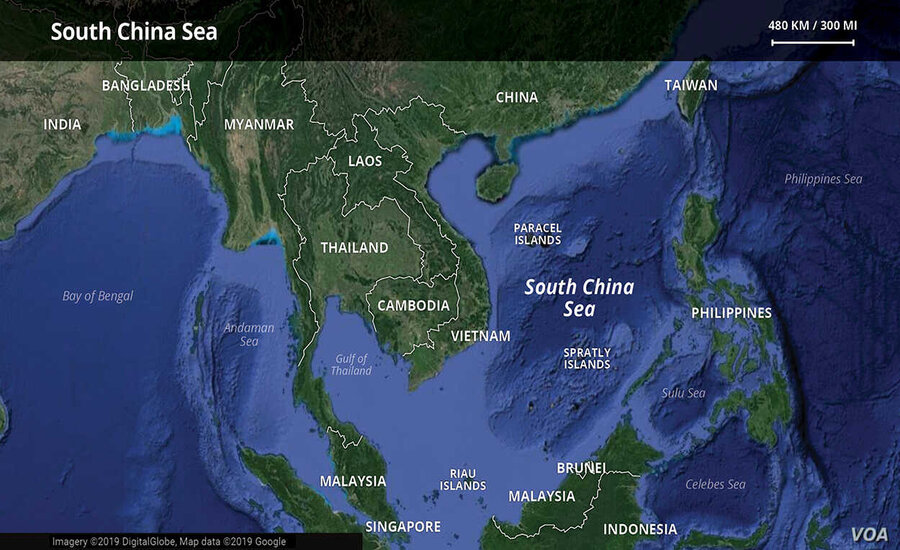
 Voice of america
On 06 August 2017, the foreign ministers from the Association of Southeast Asian Nations (ASEAN) and China met in Manila, The Philippines, and adopted the “Framework of the code of conduct (CoC) in the South China Sea (SCS)”. The framework is meant to lead eventually to the CoC comprising a set of rules outlining certain norms, proper practices and responsibilities of all those involved in maritime activities in the SCS.
The SCS encloses some of the world’s most important international shipping lanes (ISL), and is believed to be rich in mineral and marine resources. This has led to the area being the locus of politico-military jostling – including over competing maritime-territorial claims between China and many ASEAN countries – and varied interpretations on the provisions of international law on ‘freedom of navigation’.
While adopting the framework, the Chinese Foreign Minister Wang Yi stated China’s intent “to begin consultations on the text of the COC sometime within the year”. For long, the ASEAN countries have vied for the CoC as a ‘holy grail’ that could be fruitfully employed by the ASEAN solidarity to moderate China’s assertion of its maritime-territorial claims in the SCS. It is important to note that the CoC framework has come 15 years after the ASEAN and China agreed upon the Declaration of Conduct (DoC) for SCS in 2002 amidst heightened tensions in the disputed waters.
Towards a win-win end-state of a benign environment in the SCS and the consequent stability of the broader Indo-Pacific region, it may be hoped that the CoC fructifies. However, imponderables and uncertainties abound. Notably, China has avoided releasing in the public domain even the details on the CoC framework’s content, stating fears of possible attempts by external powers like the United States to ‘meddle’ in the process. China’s intent remains unclear. Does the framework signify a policy change in Beijing, making it amenable to negotiate its maritime-territorial claims multilaterally? Or is it merely assuaging its maritime neighbourhood to wean away the influence of the United States and ‘bide time’. Will the CoC interpret and extrapolate the legal order stipulated by the UN Convention on the Law of the Sea, 1982 (UNCLOS)? If the CoC is not legally binding, it will lose all its ‘teeth’, barely serving as another meek instrument for confidence-building.
During the Indian Ocean Conference 2017 (IOC-17) held at Colombo on 31 August – 01 September 2017, Sri Lanka proposed that the countries of Indian Ocean Region (IOR) emulate the ‘success’ (albeit partial) of the ASEAN, and develop a similar CoC for the Indian Ocean, which could address the key aspect of freedom of navigation.
It is true that since its first articulation in a 2007 academic paper, the ‘Indo-Pacific’ concept has led to a mental map portraying Pacific-Asia (enclosing the western Pacific, including its contiguous seas) and the IOR as an integrated region. However, such interconnectivity between the two areas is premised on the broader geopolitical and strategic rationale, rather than in terms of maritime security. After all, the inherent security characteristics of the western Pacific and the Indian Ocean are vastly dissimilar. The environment in the former is characterised by traditional military threats, which differs substantively from that in the latter, wherein non-traditional issues are predominant.
In the best case scenario, the conception of a CoC for the Indian Ocean may an ‘overkill’, or at least premature. In the worst case, it may even lead to a deleterious effect on regional stability. Owing to the divergent strategic alignments of the IOR, any multilateral deliberation on a CoC could germinate geopolitical polarisation, which may be accentuated through lobbying by the extra-regional stakeholders. This could stymie cooperation among the member countries of the recently revitalised Indian Ocean Rim Association (IORA) on all fronts. The proposed CoC could also adversely affect the IORA’s nascent agenda of maritime safety and security, which needs to grapple with the exigent issues relating to non-traditional security. It may also impair the IORA’s ‘inclusive’ approach to security that seeks a constructive contribution of the extra-regional powers, which are represented in the IORA as dialogue partners.
The current CoC suggestion of Colombo is reminiscent of Sri Lanka’s erstwhile initiative of declaring ‘Indian Ocean as a Zone of Peace’ (IOZOP), which led to the adoption of the UN General Assembly Resolution 2832 on 16 December 1971. The objective of IOZOP was well-conceived to mitigate the Cold War super-power rivalry in the Indian Ocean, and spirit of living in a benign environment unconstrained by the motives of external powers was endorsed by India’s National Security Advisor (NSA) as lately at in 2016. However, the IOZOP effort collapsed in 2005, when China stepped up its role in the deliberations of the Ad Hoc Committee on the Indian Ocean, established in 1972 to study practical measures to achieve the objectives of IOZOP. Ostensibly, the lack of a sustained endorsement and involvement of India as the key Indian Ocean power took its toll on the otherwise laudable initiative from Sri Lanka.
Hence, while the IOR countries would need to continue conceptualising innovative means to enhance regional security and stability, the proposed replication of the CoC for SCS in the Indian Ocean may not be a good idea, particularly without India being onboard. Rather than the CoC as a political agreement, a functional arrangement to de-conflict unintended encounters among warships of different nationalities may contribute more substantively to maritime security in the Indian Ocean. Such de-confliction is becoming exigent due to the increasing presence of China’s PLA Navy in the Indian Ocean, including through its submarine deployments in the area. In 2014, the Western Pacific Naval Symposium (WPNS) developed such a mechanism called the Code for Unplanned Encounters at Sea (CUES). The Code provides for basic instructions for communicating and manoeuvring when warships and military aircraft of different nationalities meet at sea unexpectedly. In September 2016, China and the ASEAN jointly agreed to abide by the CUES in the SCS. The Indian Ocean Naval Symposium (IONS) is presently discussing the proposal to emulate the CUES, which needs to be taken forward.
**********************************
*Captain (Dr) Gurpreet S Khurana, PhD, Indian Navy, is Executive Director at the National Maritime Foundation (NMF), New Delhi. He represented NMF in IOC-17 at Colombo. The views expressed are his own and do not reflect the official policy or position of the NMF, the Indian Navy, or the Government of India. He can be reached at gurpreet.bulbul@gmail.com
is new code of conduct required for indian ocean south china sea
 The japan times
Leave a Reply
Want to join the discussion?Feel free to contribute!