
Keywords: Compellence, Re-Flagging, Registration, Energy Security, Supply-Chain Security, Legal Statecraft, Legislative Innovation, Statutory Interpretation, Strategic Litigation, Lawfare.
Abstract
In March 2026, the Prime Minister of India addressed the Rajya Sabha on the ongoing conflict in West Asia, and noted that “supplies of essential goods such as petrol, diesel, gas, and fertilizers [have been] disrupted.”[1] For researchers of law and policy, this observation by the PM highlights the role of law and State in addressing the maintenance and stability of essential supplies for citizenry. This analysis accordingly identifies the legal mechanism(s) that may be used/invoked by the Government of India (hereinafter “the GoI”) to control/manage the key maritime actors and carriers associated with India’s essential supplies (like, but not limited to, crude oil) in a difficult period brought about by conflict/other crises. The first few sections of this paper explore how such legal compellence may be exercised through India’s (extensive) statutory provisions, and existing legislation with potential is successively examined. The paper then extends its search for such compellence mechanisms to the Constitution of India. Finally, it sums up some key parts of the discussion and concludes with some recommendations for the GoI.
The Essential Commodities Act, 1955
As explained by its somewhat long title, “The Essential Commodities Act, 1955”[2] (hereinafter “the ECA”) was enacted “to provide, in the interest of the general public, for the control of the production, supply and distribution of, and trade and commerce, in certain commodities.”
Petroleum and petroleum products are essential commodities for the purpose(s) of the ECA.[3] Given that the ECA’s scope covers “trade and commerce” in petroleum and petroleum products, it is not unreasonable to argue that the ECA’s control and compellence measures can be extended to Indian citizens (like shipowners) and companies (like shipping companies based in or operating out of India) involved in the import(s) of petroleum and petroleum products. Furthermore, section 2A(2) also allows the Government of India (GoI) to add a commodity to the ECA’s Schedule, i.e., to the list of essential commodities covered by the ECA.
Section 3 of the ECA provides a wide range of useful powers and compellence mechanism(s) to the GoI in the context of essential commodities. Relevant parts thereof are reproduced below (emphasis added to indicate utility and relevance):
“Powers to control production, supply, distribution, etc., of essential commodities.
(1) If the Central Government is of the opinion that it is necessary or expedient so to do for maintaining or increasing supplies of any essential commodity or for securing their equitable distribution and availability at fair prices, or for securing any essential commodity for the defence of India or the efficient conduct of military operations, it may, by order, provide for regulating or prohibiting the production, supply and distribution thereof and trade and commerce therein.
(2) Without prejudice to the generality of the powers conferred by sub-section (1), an order made thereunder may provide―
…(d) for regulating by licences, permits or otherwise the storage, transport, distribution, disposal, acquisition, use or consumption of, any essential commodity;
(e) for prohibiting the withholding from sale of any essential commodity ordinarily kept for sale;
(f) for requiring any person holding in stock, or engaged in the production, or in the business of buying or selling, of any essential commodity, ―
(a) to sell the whole or a specified part of the quantity held in stock or produced or received by him or,
(b) in the case of any such commodity which is likely to be produced or received by him, to sell the whole or a specified part of such commodity when produced or received by him, to the Central Government or a State Government or to an officer or agent of such Government or to a Corporation owned or controlled by such Government or to such other person or class of persons and in such circumstances as may be specified in the order.”
The powers under section 3 are further enhanced and widened by section 3(2)(j)(i)-(ii), wherein the powers extend to “any incidental and supplementary matters,” including “in particular” entry, search or examination of vessels, and seizure(s) of article(s) and vessel(s).
This potential of the ECA was recently made clear when the GoI invoked it to deal with the crisis brought about by the conflict in the Persian Gulf and with particular reference to the Strait of Hormuz. On 09 March 2026, in exercise of its powers under the ECA Act, the GoI issued the “Natural Gas (Supply Regulation) Order, 2026”.[4] Paragraph 5 of this order is reproduced below (emphasis added):
“Directions to gas producers, marketers and pipeline operators. – All entities involved in production, import, marketing, transportation or supply of natural gas…shall forthwith comply with the directions contained in this order, including revision of supply schedules, diversion of supplies and sector-wise allocation of natural gas as directed by the Central Government in coordination with the GAIL.”
Given the emphasis in its title to “gas producers, marketers and pipeline operators”, it is unclear if this order was used to compel the sea-based importers or transporters of natural gas. Nevertheless, the ECA appears to hold clear potential for exercising legal compellence on the actors, controllers, and carriers associated with India’s essential maritime cargo.
Finally, one clarifies a possible objection that may be raised on the applicability of the ECA beyond the sub-continental mass of India, and into her maritime zones. As per section 1(2) of the ECA, the ECA “extends to the whole of India.” This may lead some to argue that the reach of the ECA, despite the text of its other provisions (discussed above), is confined or restricted to the sub-continental mass of India. However, India’s higher Courts have observed on multiple occasions — including while rejecting a petition filed by the Italian Marine Massimilano Latorre — that “the area of exclusive economic zone/continental shelf…. (which, of course, lies outside territorial waters) is deemed to be a part of the territory of India under the Central Government notifications issued pursuant to the provisions of the Maritime Zones Act, 1976.”[5]
The next section examines if some compellence options may be provided by “The Indian Navy Act, 1957”.
The Indian Navy Act, 1957
There are tow specific segments of the “The Indian Navy Act, 1957” (hereinafter “the Navy Act”) that bear upon the issue under examination.
The first is Chapter III of the Navy Act, which deals with “Special Provisions Relating to Discipline in Certain Cases”. Section 6 of this chapter, which sets-out the provision respecting discipline of persons under engagement to serve Central Government stipulates that:
(1) If any person not otherwise subject to naval law enters into an engagement with the Central Government to serve,—
(a) in a particular ship; or
(b) in such particular ship or in such ships as the Central Government, the Chief of the Naval Staff, or the prescribed officer may, from time to time, determine;
and agrees to become subject to naval law upon entering into the engagement, that person shall, so long as the engagement remains in force and notwithstanding that for the time being he may not be serving in any ship, be subject to naval law.
The second is Chapter XX of the Navy Act, which deals with Regulations. Section 184(1) therein empowers the Central Government to make regulations (inter alia) “for the purpose of carrying into effect the provisions of this Act”. Accordingly, the GoI needs only to develop specific regulations for carrying into effect “section 6 engagements” (under the Navy Act) with the actors and individuals involved in the movement of India’s essential/critical cargo. This is because “every person not otherwise subject to naval law” legally becomes, after entering into an engagement under section 6, “subject to naval law wherever they may be”.[6] This legal effect should allow India’s naval and maritime decision-makers to impose legal compellence, when required, on the persons with whom section 6 engagements are entered into. (It is presently unclear if the “persons” referred to in sections 2(1)(d) and 6 of the Navy Act incorporates “legal persons” such as companies. This issue deserves greater scrutiny, because extending legal compellence to companies, especially Indian companies, involved in the movement of India’s essential supplies is certainly desirable.
The Merchant Shipping Act, 2025
The Merchant Shipping Act, 2025 (hereinafter “the MSA 2025”)[7] also contains some provisions that hold-out the possibility of exercising specific kinds of compellence (during emergencies, etc.) through the regulatory regime under the MSA 2025.
Perhaps the greatest such potential (in the MSA 2025) lies in section 301, which provides wide powers to the Director General Maritime Administration (DGMA) to give directions to “any vessel”, and not just those registered in India. Its text is reproduced below (emphasis added):
“Power of Director-General to give directions. – The Director General may, if he is satisfied in the public interest or in the interest of Indian shipping that it is necessary so to do, give by notice, circular, order or guidelines in writing, such directions as he thinks fit to any vessel or seafarer or tindal or ship owner or his agent or maritime training institute or recruitment placement service provider or port or person or body of persons.”
Also noteworthy is section 304, which provides some powers to the Central Government “with respect to [a] vessel without nationality.” Per section 304(1), the Central Government “may take charge of such vessel and detain the same as a vessel without nationality including its cargo, as may be deemed appropriate, in such manner as may be prescribed.” Section 304 becomes useful during an emergency because section 304(2), significantly, adds that “[a] vessel which sails under the flags of two or more States, using them according to convenience, may be deemed to be a vessel without nationality.”[8]
The succeeding paragraphs examine some specific provisions relating to the legal imposition of “conditions” upon ships/vessels as a part of the regular regulatory function(s) of the GoI and its maritime authorities.
Section 20 of the MSA 2025, which deals with the procedure for registration of Indian vessels, merits consideration in this regard. Under section 20(3) therein, the DGMA is empowered to “specify certain conditions” for an Indian vessel seeking to be registered under the MSA 2025. This provision can be used to insert conditions which stipulate (say) that upon future issuance/receipt of due official orders or directions in an emergency/disruption, the vessel presently being registered must perform one or more specific action(s) — such as, but not limited to, flagging itself to India for a prescribed period. Thus, an undertaking to this effect (from the vessel owner) can be added to the list of required documents contained in Rule 13(a) of “The Draft Merchant Shipping (Registration of Vessels) Rules, 2026”.[9] (Rule 13 deals with the issue of Certificates of Registry to applicants.) Similar conditions can also be prescribed, under section 16, for “Indian chartered foreign vessels” being registered under the MSA 2025.
Another germane aspect is the licenses that were granted under Part XIV of the Merchant Shipping Act, 1958 (hereinafter “MSA 1958”).[10] Section 406(1) of the MSA 1958 stipulates that “[n]o Indian ship and no other ship chartered by a citizen of India or a company or a co-operative Society shall be taken to sea from a port or place within or outside India except under a licence granted by the [DG Shipping]”. Section 406(3) specifies that such a license “shall be in such form and shall be valid for such period as may be prescribed, and shall be subject to such conditions as may be specified by the [DG Shipping].” Section 408 further empowers the DG (Shipping) to “at any time if the circumstances of the case so require, revoke or modify” a license that may have been granted. Given India’s vast market and consumer base, and its location as an important node in global shipping routes, it is reasonable to assume that India is important to global shipping companies (or anybody else seeking an Indian shipping license. Consequently, India’s licensing powers and functions deserve to be fully leveraged for strategic purposes, like (but not limited to) those being discussed in this paper.
Section 15(6) of the MSA 2025 stipulates that “[n]otwithstanding anything contained in this section [i.e. the section relating to the registration of Indian vessels], an Indian vessel may be registered in a State other than India subject to such conditions as may be prescribed.” These conditions, too, can contain clauses requiring flagging to and registering in India when duly ordered to do so during an emergency/disruption.
Finally, the compellence option(s) provided against Indian (citizen) seafarers under section 52 of the MSA 2025, are of significance within the context of this paper. This section is reproduced below (emphasis added):
“Every Indian citizen holding a certificate of competency or certificate of proficiency or certificate recognised under section 50, shall, at any time during which the security of India is threatened or during a proclamation of emergency issued under clause (1) of article 352 of the Constitution, be liable to serve on Indian vessel for such period and on such terms and conditions as the Central Government may, by general or special order, specify in this behalf.”
It may thus be seen that the MSA 2025 and MSA 1958 both contain options for compellence that deserve examination by the GoI. However, it is also worth mentioning here the effect of section 2 of the MSA 2025, which appears to keep “Indian controlled tonnage vessels” mostly out of reach of the MSA 2025. This needs further research, which the NMF is currently undertaking.
The Petroleum Act, 1934
In this section, “The Petroleum Act, 1934” (hereinafter “the TPA”)[11] is considered as yet another source of compellence-options for the GoI.
Clearly, it is important to first establish the applicability of the TPA to the matters under discussion in this paper. The TPA’s long title declares that it seeks “to consolidate and amend the law relating to the import, transport, storage, production, refining and blending of petroleum.” Section 1(2) also makes it clear that it “extends to the whole of India.” It is true that per the TPA, “to import” petroleum means to bring it into India by land, sea or air, otherwise than during the course of transport [unless there is anything repugnant in the subject or context”].[12] This indicates that ships/vessels engaged in the transport of petroleum are outside the purview of the TPA. However, it is also true that under section 2(d), “to transport petroleum” means to move petroleum from one place to another in India and includes moving from one place to another in India across a territory which is not part of India [unless there is anything repugnant in the subject or context].” Thus, section 2(d) indicates that such ships/vessels may be covered by the State’s “Control over Petroleum” (the title of Chapter I) sought to be legally established by the TPA.
Consequently, the Rules for the import, transport and storage of petroleum that the GoI may make (under section 4 of the TPA) become relevant as possible sources of compellence for the actors and carriers associated with petroleum. Additionally, and as is the case with the MSA 2025, compellence can be also be built into the licensing conditions and requirements (for transporters of petroleum) referred to in section 3(2) of the TPA.
The Constitution of India
The Constitution of India (hereinafter “the CoI”) is India’s supreme legal text in the country’s municipal (i.e., domestic) context. Article 123 therein deals with the promulgation of ordinances by the President of India during recess of Parliament. Some may argue that the power to issue ordinances is an executive power, and an ordinance is therefore not ‘law’ properly so-called. However, this ignores the fact that Article 123 appears in Chapter III of the CoI, and is entitled, “Legislative Powers of the President.” Article 123(2) further declares that an ordinance under Article 123 “shall have the same force and effect as an Act of Parliament”.
Consequently, Article 123 offers itself as an important and powerful source of compellence to be exercised upon the actors and carriers associated with India’s essential supplies during war/conflict/emergency/disruption in supplies. However, Article 123(1) also makes it clear that the President must be “satisfied that circumstances exist which render it necessary for him to take immediate action”. Thus, while the language of Article 123 makes it easy to invoke when the Parliament is in recess, it also makes it difficult to justify such invocation/use if Parliament’s session is due to begin soon (because in that case “immediate action” may not arguably be required.)
While it is true that ordinances should not be used to carry out a legislative agenda or otherwise deal with ‘inconvenient legislation’, they remain strong, legitimate, and necessary constitutional tools and options for rectificatory action during times of need/emergency (such as disruptions in essential supplies).[13] The Indian State should not feel coy about promulgating ordinances to deal with emergencies such as those concerning the recent disruption in national energy supplies brought about by the conflict in West Asia and the Strait of Hormuz. Professor Shubhankar Dam (Chair Professor of Public Law and Governance at the University of Portsmouth’s School of Law) noted as follows in his book on the law and practice of ordinances in India:
“Although constitutionally limited to circumstances when it is necessary to take immediate action, ordinances, in practice, have an expansive presence in India’s parliamentary annals. After six decades, they are neither exceptional nor limited. Rather, they are a convenient and – distressingly at times – the preferred legislative method…. Between 1952 and 2009, 615 ordinances have been promulgated at the national level. That comes to about 10.6 ordinances each year for nearly 60 years…. India’s empirical record, it should be noted, offers interesting parallels and contrasts with Latin American and European jurisdictions…. Latin American and European jurisdictions (with the exception of France) have struggled to control the rate of ordinances, and they are far greater than the 615 ordinances India has had so far.”[14]
Finally, this part adds that in addition to Article 123, there remain other possible sources of compellence in India’s constitutional provisions. These are Article 300A (Right to Property), Article 31A(b) relating to “the taking over of the management of any property by the State for a limited period either in the public interest or in order to secure the proper management of the property” and, the Emergency Provisions contained in Part XVIII. These remain the subject-matter of ongoing research at the NMF.
Conclusion and Recommendations
The analysis undertaken in this paper seeks to establish that India is not devoid of options for legal compellence in the face of a disruption/obstruction/cessation in the maintenance and stability of India’s essential supplies.[15] While small legislative changes or adjustments may be considered as a way of establishing explicit statutory applicability and consequent legal compellence based thereupon, the required legislative provisions exist already in (largely) usable form. Consequently, new or separate legislation for compelling the maritime actors and carriers of India’s essential supplies during a national emergency does not appear to be required. Instead, an optimal mix of existing provisions (like those referred to in this paper) may provide a better framework — especially when the sub-components of such a mix are made to refer to and reinforce each other.
A key point about the flagging and registration of vessels must be made here. While it is true that flagging and registration are frequently equated to each other in common usage by laymen, in legal terms they are not identical. This difference/distinction is made clearer by inter alia the following:
- Nigel P Ready (a legal practitioner who wrote what is widely considered an essential resource for maritime lawyers) clarified as follows: “The expressions “registration”, “nationality”, “flag” and “documentation” are often used as if they were conterminous. This is not simply a question of lay misusage. Imprecise employment of these terms in international Conventions can, [as explored in the subsequent parts of his book], lead to considerable confusion in the application and interpretation of the law of the sea….. A vessel may be considered as possessing the nationality of a State even though she is unregistered, possesses no documents evidencing that nationality, nor even flies the flag of that State… Although registration and documentation generally go hand in hand, this is not always the case and the two concepts should not be confused… Registration means the entering of a matter in the public records. We have seen that registration is generally—but not always—not only a precondition for, but also the test of a vessel’s nationality.”[16]
- Herman Meyers (former senior lecturer in international law at the University of Amsterdam) noted as follows in his book exploring the subject of the ‘nationality’ of ships: “In connection with the acquisition, the maintenance, and the loss of allocation, frequent use is made in international texts of words like nationality, registration, documentation, and flag. They are not always handled with precision. This is due especially to the circumstance that in the great majority of cases allocation (nationality), registration, documentation, and the flag occur in combination, the absence of registration, of documentation, or of a flag in an allocated ship being an exception, at least in commercial navigation. In consequence of this, the differences between the terms have sometimes been neglected and a pars pro toto use of the word registration, but in particular of the word flag, is by no means rare in the doctrine or in the sources of international law. Such a practice may cause confusion…. “The act of attributing national character” is the unilateral legal act which is here called immatriculation. In every unilateral legal act two phases may be distinguished, though sometimes not without some difficulty: first the lawful decision to assume the rights and duties in question is taken, and subsequently this decision is disclosed. In several national and international unilateral legal acts this latter phase takes the form of a recording. After this recording has taken place, the rights and duties as a rule have come into existence. Translated into the terminology of the present subject-matter, this means that the immatriculation is composed of two successive phases: the decision to allocate and the disclosure of this decision. This latter phase frequently takes the form of registration, but other modes of disclosure may also be satisfactory.”[17]
- The text of Article 91(1) of UNCLOS 1982 also makes clear the distinction between the grant of a State’s nationality to ships, the registration of ships in a State’s territory, and the right to fly the flag of a State. The text of Article 91 is reproduced below (emphasis added):
“Article 91
Nationality of ships
- Every State shall fix the conditions for the grant of its nationality to ships, for the registration of ships in its territory, and for the right to fly its flag. Ships have the nationality of the State whose flag they are entitled to fly. There must exist a genuine link between the State and the ship.
- Every State shall issue to ships to which it has granted the right to fly its flag documents to that effect.”
- The International Tribunal for the Law of the Sea (ITLOS) has also indicated that flagging and registration do not refer to the same legal concept/phenomenon. In the case of M/V Saiga (No. 2), its 1999 judgment clarified as follows: “The conclusion of the Tribunal is that the purpose of the provisions of the convention on the need for a genuine link between a ship and its flag State is to secure more effective implementation of the duties of the flag State, and not to establish criteria by reference to which the validity of the registration of ships in a flag State may be challenged by other States.”[18]
- The words ‘flag’ or ‘Indian flag’ do not make any appearance in Part III of the Merchant Shipping Act, 2025 (which deals with the registration of vessels). Further, there is also no stipulation in the MSA 2025 (including, significantly, in Part III) that flying the Indian flag is a necessary and mandated consequence of registration under the MSA 2025.
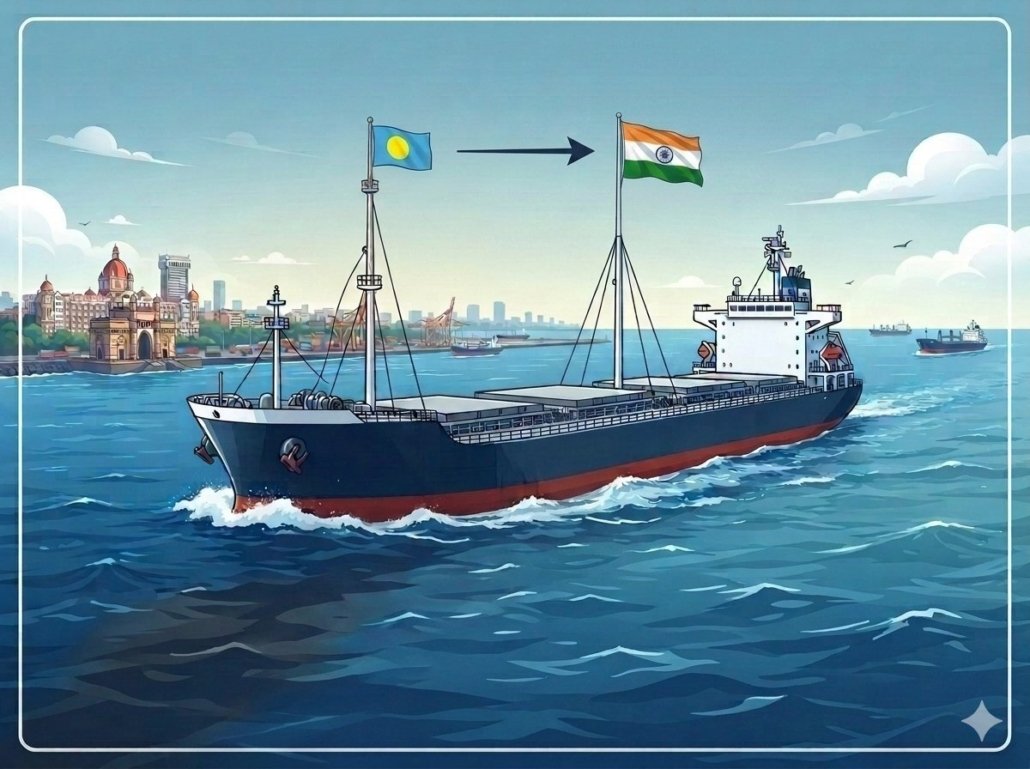
Thus, in times of need/emergency, India will need compellence for flagging to India and registering in India (assuming registration in India is not already a fact for the vessel under consideration/sought to be compelled.) To be legally robust and sound, India should compel not merely flagging in India for the vessel in question, but also that vessel’s registration in India. In addition to the legal distinction between flagging and registration, this is also desirable because registration is generally (but not always) considered as an adequate form of the ‘genuine link’ demanded by UNCLOS.[19]
To further establish and buttress a strong and genuine Indian link, India can also issue to the compelled ships the “documents” referred to in Article 91(2) of UNCLOS. (These documents could be in addition to the regular registration-related documents provided to the ships by India. They could, for instance, provide additional information on how India discharges/is discharging her duties as a Flag State under Article 94 of UNCLOS (titled ‘Duties of the Flag State’). The issuance of such additional documents (in addition to registration) could further bolster the genuine link sought to be established between India and the vessel in question. This is because it would show that – as demanded by Article 94(1) of UNCLOS from all Flag States, India too is “effectively [exercising] its jurisdiction and control in administrative, technical and social matters over ships flying its flag” even as it deals with an ongoing crisis/emergency.[20]
One approach to compellence that is recommended on the basis of this analysis is as follows: While a Presidential Ordinance is legally adequate as a measure for exercising compellence in times of need/emergency, it may be unwise to resort to Presidential Ordinances for every disruption or crisis. In the longer term, India needs to devise a dedicated ‘strategic’ fleet that can be activated in times of need/emergency towards the maintenance of her essential supplies and commodities. This fleet can be composed of pre-identified ships/vessels which are owned or controlled by Indian nationals or business entities but flagged or registered in a ‘Flag of Convenience’ State. In times of need/emergency, or upon issuance of due direction/order, these ships/vessels can be, for instance, requisitioned by the GoI; or, flagged to and registered in India. Of course, such measures would need to be for a defined time-period and with a payment of at least some consideration or compensation, so as to avoid judicial intervention on legal grounds like ‘unfairness’ or ‘unreasonableness.’
An illustrative example in this regard, from which some lessons may be drawn by India, is the USA’s “Effective United States Control” (or EUSC) Fleet model/program. It was developed around 1948 by the USA’s Joint Chiefs of Staff and stood as “long standing policy”[21] for some time, before seemingly being “abandoned in the 1980s during a period of uncontested [U.S.] naval hegemony”[22] and due to some other issues.[23] While not without its problems, some argue that it now “requires reviving” to address logistics requirements in the modern warfare undertaken by the USA.
Three other sets of measures (a-c below) can complement and supplement domestic measure(s) towards such an Indian ‘strategic’ fleet:
Bilateral agreements, arrangements, or understandings with select ‘Flag of Convenience’ States (where the pre-identified vessels of India’s strategic fleet are registered/flagged) can be used to, for instance, effectuate the ‘loss of right’ referred to in the discussion on section 304 of the Merchant Shipping Act 2025. Such bilateral agreements can also be used to provide to the GoI pre-negotiated legal pathways which will allow it to assume control of or otherwise legally command the vessels in India’s strategic fleet during times of need/emergency.
A 2002 study by the Massachusetts Institute of Technology reproduced the views (stated in 1947) of the USA’s Joint Chiefs of Staff. They pointed out the role of such bilateral/diplomatic arrangements or agreements to “resolve the problem of those flag states that would not consent to the use of the vessels in their registries by the United States”. Their submissions indicate that for India, bilateral/diplomatic arrangements with select ‘Flag of Convenience’ States (where India’s pre-identified strategic fleet vessels are presently flagged or registered) are an option worthy of closer examination and subsequent pursuit:
“Except through agreement there are no legal means by which the United States can regain control of a United States merchant vessel the registry of which has been transferred to another country. From a legal standpoint therefore it can be considered that the only time a vessel is under absolute ‘effective United States control’ is when it flies the United States flag. Actually, however, there are certain countries in this hemisphere which through diplomatic or other arrangements will permit the transfer to their registry of United States ships owned by United States citizens or United States corporations and allow these citizens or corporations to retain control of these vessels.”[24]
The signing and negotiation of such bilateral arrangements/agreements with identified ‘Flag of Convenience’ (hereinafter “FoC”) States can be aided — even driven — by highlighting and stressing the legal duties and responsibilities of a Flag State, the failure(s) to discharge such duties and responsibilities, and the detrimental effect(s) of such failure(s) upon India and Indian seafarers.[25] India’s negotiating position in this regard can also be strengthened by hinting (during negotiations) at the possibility of Indian economic/trade measures that can detrimentally affect a FoC State and its economy.[26]
Other additional measures that can aid the activation and operation of such a strategic Indian fleet can be the systematic placement of Indian seafarers on the vessels comprising this fleet, and “ongoing cooperative arrangements” with the ship-owners in this fleet.[27] Some or all such seafarers placed onboard or rotated between identified vessels could be made to enter into an “engagement with the Central Government” under section 6 of The Indian Navy Act, 1957.[28] As explained previously in the section exploring the INA 1957, this is because “every person not otherwise subject to naval law” legally becomes, after entering into an engagement under section 6, “subject to naval law wherever they may be”.[29] This legal effect will allow India’s naval and maritime decision-makers to impose legal compellence, when required, on such seafarers/individuals wherever they may be, effectively giving extra-territorial reach to Indian law. It is reiterated that it remains presently unclear whether the “persons” referred to in sections 2(1)(d) and 6 of The Indian Navy Act, 1957 apply to “legal persons” such as companies. This issue deserves greater scrutiny, because extending legal compellence to the companies, especially Indian companies, involved in the movement of essential supplies is desirable.
A point about extra-territoriality deserves to be made here. The extra-territorial application of Indian law may, somewhat unjustifiably in the author’s view, raise eyebrows in certain legal quarters. However, as far as the legal position under the CoI is concerned, extra-territorial application of law made by India’s Parliament is valid and legitimate. Article 245 of the CoI governs the “extent” of laws made by the Parliament of India, and Article 245(1) is clear that “[n]o law made by Parliament shall be deemed to be invalid on the ground that it would have extra-territorial operation.”
- Another additional measure that India could advantageously consider in this regard is that of partnering/engaging/coordinating with organisations like “The International Transport Workers’ Federation” (ITF), which “campaign globally and locally to advance seafarers’ rights and secure decent and safe working conditions.”[30] Such partnerships have the potential to provide India greater strength and leverage in her negotiations (towards afore-mentioned bilateral arrangements or agreements) with FoC States.
Finally, two other recommendations are also made:
- Not all legal compellence must necessarily be driven in a top-down manner by the GoI. While it is difficult to predict with certainty the decision of a Court of Law, there is considerable scope in India’s legal system for bottom-up strategic litigation by Indian citizens or organisations – seeking compellence based inter alia on the statutory and constitutional provisions outlined in this paper.[31]
Such litigation in Indian Courts can also raise valid and legitimate legal issues (and seek legal remedies therefor) relating to the responsibilities and/or duties of Indian ship-owners who choose to flag in FoC States. This is because legal discussions — and judicial determinations — of a citizen’s duty, the legal onus and burden(s) thereupon, and the presumption(s) of innocence or relevant knowledge — become directly and legally relevant in cases where an Indian ship-owner flags his ship/vessel — for profit-maximisation and regulatory evasion — in an FoC State where any reasonable person would have good reason to know/assume that Flag-State due-diligence is likely to be inadequate.[32]
- It must also be noted that while this paper identifies options provided by explicit provisions in India’s municipal law and legislation, it does not explore the numerous options provided in/by the larger legal universe of principles, doctrines, and concepts that appear across Thus, more research is needed on the compellence options presented by the legal principles and doctrines relating to:
- Corporate layering and corporate veils, and the judicial response to/treatment thereof by Courts of Law.[33]
- The public purpose doctrine and its treatment of private property (particularly in a country like India): in simple terms, this doctrine may be invoked by a State for taking over private property, and thus presents its own compellence-related options for the Indian State.
For instance, in one recent 2024 judgment by the Supreme Court of India (in a case entitled, “Property Owners Association and Ors. v State of Maharashtra and Ors.”), a 8:1 majority judgment of the Supreme Court of India (authored by the Chief Justice) held that “the materiality of a privately owned resource and whether it has a community element cannot be determined in a vacuum and must be identified on a case-by-case basis…. We may, therefore, only outline guiding principles to determine whether a particular privately owned resource falls within the fold of the provision. The following factors may be borne in mind while determining whether the resource constitutes a ‘material resource of the community’ — the nature of the resource and its inherent characteristics, the impact of the resource on the well-being of the community, the scarcity of the resource, and the consequences of such a resource being concentrated in the hands of private owners.”[34]
When one considers the four factors outlined by the Supreme Court of India in this case, a ship/ vessel which is owned by a private entity but is engaged in the maritime import/ transportation of India’s essential supplies and cargo, does appear to be capable of being categorised as a “material resource of the community”, which may be accordingly treated as such by India or Indian Courts. Such categorisation may enable acquisition, requisition, or expropriation of such ships/ vessels by the Indian State; or, at least a reflagging of such a vessel to India for fear of such expropriation, etc. However, more legal research is needed in this area.
**********
About the Author
Mr Mayank Mishra is a litigator and researcher. He has a background in technology and has worked extensively in India’s social sector. Presently, he is a Senior Associate Fellow within the PIML cluster of the NMF. Before re-joining the NMF in January 2026, he was a legal consultant at a Centre of Excellence established by the Research and Information System for Developing Countries (RIS) and the Ministry of Ports, Shipping and Waterways (MoPSW) of the Government of India. He may be reached at law9.nmf@gmail.com
Endnotes:
[1] Government of India, Prime Minister’s Office, “English rendering of PM’s remarks in the Rajya Sabha on the ongoing conflict in West Asia,” 24 March 2026, Press Information Bureau, https://www.pib.gov.in/PressReleasePage.aspx?PRID=2244396®=3&lang=1
[2] The Essential Commodities Act, 1955,” India Code, https://www.indiacode.nic.in/bitstream/123456789/7053/1/essential_commodities_act_1955.pdf
[3] Section 2A read with Item 5 in the Schedule, The Essential Commodities Act, 1955.
[4] Government of India, Ministry of Petroleum and Natural Gas, “Natural Gas (Supply Regulation) Order, 2026,” 09 March 2026, Press Information Bureau, https://static.pib.gov.in/WriteReadData/specificdocs/documents/2026/mar/doc2026310819601.pdf
See also: “Centre invokes Essential Commodities Act to ensure Natural Gas supply for key sectors amid West Asia crisis,” 10 March 2026, News on AIR, https://newsonair.gov.in/govt-invokes-essential-commodities-act-1955-to-regulate-natural-gas-amid-west-asia-tensions/
[5] Judgment of the Kerala High Court, “Massimilano Latorre vs Union of India,” Writ Petition (Civil) No 4542 of 2012, 20 February 2012, Indian Kanoon, paragraph 43, https://indiankanoon.org/doc/191738505/
See also: Judgment of the Supreme Court of India, “Aban Loyd Chiles Offshore Ltd and Anr vs Union of India and Ors,” 11 April 2008, 2008 (11) SCC 439, Indian Kanoon, paragraph 85, https://indiankanoon.org/doc/1530670/
See also: The Supreme Court of India, Judgment by Justice J Chelameswar, “Republic of Italy Thr. Ambassador and Ors vs Union Of India and Ors,” Writ Petition (civil) No 135 of 2012, 04 September, 2012, paragraph 13, Indian Kanoon, https://indiankanoon.org/doc/78409161/
[6] Section 2(1)(d) read with section 6 of The Indian Navy Act, 1957.
[7] “The Merchant Shipping Act, 2025,” India Code, https://www.indiacode.nic.in/bitstream/123456789/22147/1/2025-24.pdf
[8] Section 304 is also useful because it applies “within India” to vessels which have “lost [the] right” to fly the flag of a State. As we see in the recommendations section, such loss of right(s) can be effectuated through bilateral understandings, arrangements or agreements with select ‘Flag of Convenience’ States where Indian ships/vessels are registered/flagged.
[9] Government of India, Ministry of Ports, Shipping, and Waterways (Govt of India), “Draft Merchant Shipping (Registration of Vessels) Rules, 2026,” December 2025, https://shipmin.gov.in/sites/default/files/Draft%20Merchant%20Shipping%20%28Registration%20of%20Vessels%29%20Rules%2C%202026.pdf
[10] The Merchant Shipping Act, 1958 has not been altogether repealed by The Merchant Shipping Act, 2025. Per section 324(1) of the MSA 2025, Part XIV of The Merchant Shipping Act, 1958, remains valid law. Part XIV deals extensively with the control and licensing of Indian ships and ships engaged in coasting trade
[11] ‘The Petroleum Act, 1934,” India Code, https://www.indiacode.nic.in/bitstream/123456789/2401/1/A1934-30.pdf
[12] Section 2(e) of The Petroleum Act, 1934.
[13] See, for instance, the restrictions placed (by section 23(1) of the Merchant Shipping Act 2025) upon the transfer by persons of Indian vessel or shares “at any time during which the security of India or any part of the territory thereof is threatened by sanction, war or external aggression and a proclamation of emergency issued under clause (1) of article 352 of the Constitution is in operation”.
[14] Shubhankar Dam, Presidential Legislation in India: The Law and Practice of Ordinances (Cambridge University Press: 2014), 5, 7, 222-223.
[15] India’s essential supplies may also be understood as India’s critical cargo, which includes (but is not limited to) crude/petroleum/petroleum products. However, given the existing usage of the word “essential” in the existing legislative frameworks for the maintenance of essential Indian supplies and commodities, this paper consciously uses the word “essential.” This usage has legal advantages because it makes it is easier to establish statutory coverage and applicability for the items/services sought to be addressed in this paper.
[16] Nigel P Ready, Ship Registration (Lloyd’s of London Press Ltd: 1991), 3-4, 6, 8.
[17] H Meyers, The Nationality of Ships (Martinus Nijhoff: 1967), 127, 139.
[18] ITLOS, Judgment in M/V Saiga (No 2), 1999, paragraph 83, https://www.itlos.org/fileadmin/itlos/documents/cases/case_no_2/published/C2-J-1_Jul_99.pdf
See also: Doris König, “Flag of Ships,” Max Planck Encyclopedia of Public International Law, paragraphs 1,19, https://opil.ouplaw.com/display/10.1093/law:epil/9780199231690/law-9780199231690-e1166#
[19] Doris König, “The Requirement of a Genuine Link.”
See also: Paweł Krężel, “The meaning and evolution of the ‘genuine link’ concept and its practical implementation 40 years after the adoption of the 1982 UN Convention on the law of the sea,” Prawo Morskie 2023, No XLIV: 75, https://doi.org/10.24425/pm.2023.147840 ; cf. Robin B Churchill and Christopher Hedley, “The meaning of the “genuine link” requirement in relation to the nationality of ships,” Cardiff University, 4-5, https://orca.cardiff.ac.uk/id/eprint/45062/1/ITF-Oct2000.pdf
[20] As far as India is concerned, the content of such additional documents is less important than the fact of their issuance. Accordingly, they can contain relatively uncomplicated information regarding helplines, processes, departments, officers, etc. – most of which is already made freely available by the GoI.
[21] Henry S Marcus et al, “Increasing the Size of the Effective United States Control Fleet,” August 2002, DTIC, 14, https://apps.dtic.mil/sti/citations/ADA409858
[22] Seth Crospey and Barna Peterfi, “No Logistics Tail, No Combat Teeth,” 09 June 2026, Hoover Institution, https://www.hoover.org/research/no-logistics-tail-no-combat-teeth
[23] Christopher J McMahon, “The U.S. Merchant Marine: Back to the Future?,” Naval War College Review 69, No 1 (2016), 18, https://digital-commons.usnwc.edu/nwc-review/vol69/iss1/6
See also: John G Kilgour, “Effective United States Control?,” Journal of Maritime Law and Commerce 8, No 3 (1977): 344-347, https://docs.rwu.edu/law_ma_jmlc/vol8/iss3/3
[24] Henry S Marcus et al, “Increasing the Size of the Effective United States Control Fleet,” 17.
[25] Nivedita M Hosanee, “A Critical Analysis of Flag State Duties as laid down under Article 94 of UNCLOS,” United Nations, https://www.un.org/depts/los/nippon/unnff_programme_home/fellows_pages/fellows_papers/hosanee_0910_mauritius_PPT.pdf
See also: Gurjit Singh, “Flags of ‘inconvenience’: Why are Indian sailors paying the price?,” 22 May 2024, Firstpost, https://www.firstpost.com/opinion/flags-of-inconvenience-why-are-indian-sailors-paying-the-price-13773750.html
See also: Paolo Busco and Alessandro Pizzuti, “Flag State responsibility in international human rights law for individuals on board private vessels,” 01 May 2024, EJIL:Talk!, https://www.ejiltalk.org/flag-state-responsibility-in-international-human-rights-law-for-individuals-on-board-private-vessels/
See also: Food and Agriculture Organisation, “Voluntary Guidelines for Flag State Performance,” 2015, https://openknowledge.fao.org/handle/20.500.14283/i4577t
See also: North Atlantic Fisheries Intelligence Group and INTERPOL, “Chasing Red Herrings: Flags of Convenience and the Impact on Fisheries Crime Law Enforcement,” 2017, https://www.norden.org/en/publication/chasing-red-herrings
See also: Matthew Gianni, “Real and Present Danger: Flag State Failure and Maritime Security and Safety,” 2008, 33, ITF Global, https://www.itfglobal.org/sites/default/files/resources-files/flag_state_performance.pdf
[26] Darren S Calley, Market Denial and International Fisheries Regulation: The Targeted and Effective Use of Trade Measures Against the Flag of Convenience Fishing Industry (Martinus Nijhoff, 2012).
[27] Henry S Marcus et al, “Increasing the Size of the Effective United States Control Fleet,” vii.
[28] “The Indian Navy Act, 1957,” India Code, https://www.indiacode.nic.in/bitstream/123456789/1400/1/AAA1957____62.pdf
[29] Section 2(1)(d) read with section 6 of The Indian Navy Act, 1957.
[30] “Seafarers,” The International Transport Workers’ Federation, https://www.itfglobal.org/en/sector/seafarers
See also: Herbert R Northrop and Richard L Rowan, The International Transport Workers’ Federation and Flag of Convenience Shipping (University of Pennsylvania, 1983).
See also: Herbert R Northrup and Peter B Scrase, “The International Transport Workers’ Federation
Flag of Convenience Shipping Campaign: 1983-1995,” Transportation Law Journal 23, No 3 (1996), https://digitalcommons.du.edu/tlj/vol23/iss3/3/
[31] “Writ Jurisdiction and Private Companies: Understanding the Limitations,” 25 March 2026, Khurana & Khurana, https://www.khuranaandkhurana.com/writ-jurisdiction-and-private-companies-understanding-the-limitations
[32] Vice Admiral Pradeep Chauhan’s remarks in a panel discussion with Barkha Dutt, “Trump Refuses to Apologise For US Strike Killing 3 Indians, What Should Modi Do?,” 13 June 2026, Youtube, 41:38 – 42:32, https://youtu.be/8qSjvXqIprk?si=WiOpggbcRySr4u-j
[33] “Beyond Separate Entities: Understanding the Corporate Veil Doctrine,” 03 February 2025, MMJC, https://mmjc.in/beyond-separate-entities-understanding-the-corporate-veil-doctrine/
See also: Order of the Bombay High Court, “Aurobindo Pharma Limited vs Nyk Theseus (Imo No. 9356701) And 2 Ors on 7 June, 2023,” Indian Kanoon, https://indiankanoon.org/doc/11956671/
See also: Thomas Golson, “Multinational Corporations and Liability according to International Law,” Central College, https://central.edu/writing-anthology/2019/05/31/multinational-corporations-and-liability-according-to-international-law/
[34] DY Chandrachud (Chief Justice of India), Majority Judgment in ‘Property Owners Association and Ors. v State of Maharashtra and Ors.’ (Civil Appeal No 1012 of 2002), 05 November 2024, Supreme Court Observer, paragraph 222, https://www.scobserver.in/wp-content/uploads/2024/11/DY-Chandrachud-majority-Judgement-Property-Owners-Association-Private-Property-Material-Resource-of-community-nine-judge-1-193.pdf
See also: Chinmaya Jain, “Public Purpose or Private Interest? The Supreme Court of India’s Scrutiny of Land Acquisition for a University Project in Tribal Areas,” 15 May 2023, Oxford Human Rights Hub, https://ohrh.law.ox.ac.uk/public-purpose-or-private-interest-the-supreme-court-of-indias-scrutiny-of-land-acquisition-for-a-university-project-in-tribal-areas/


Leave a Reply
Want to join the discussion?Feel free to contribute!