
Keywords: ARMED CONFLICT, MARITIME THREATS, MARINE INSURANCE, P&I CLUBS, MARITIME TRADE, SHIPPING, SUPPLY CHAIN DISRUPTION, INSURANCE LAW, TRANSPORTATION LAW, RISK MANAGEMENT.
Introduction
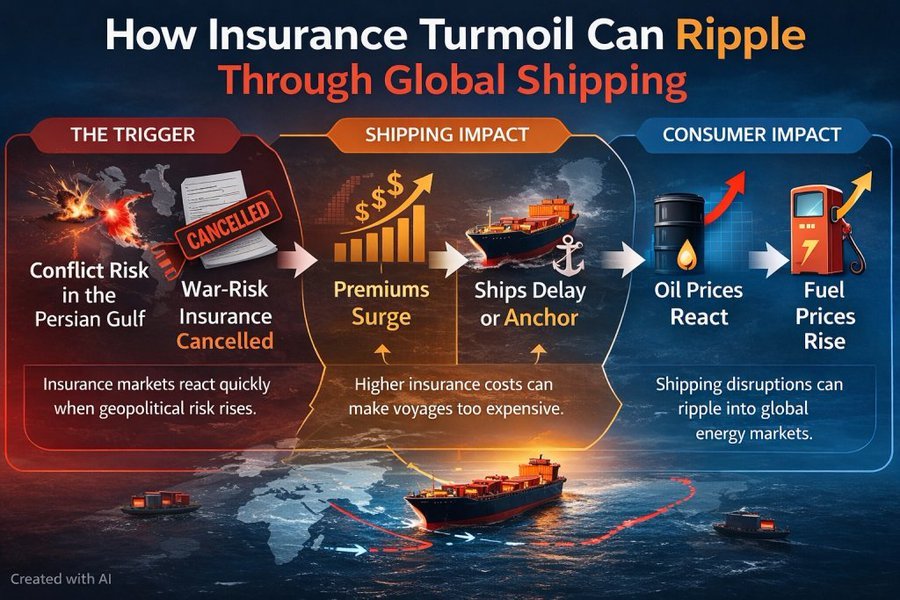
The realities of marine insurance were recently brought home to India by the merchant shipping disruptions in and around the Strait of Hormuz.[1] Amid these disruptions, Rear Admiral Sudhir Pillai highlighted how “modern shipping moves on a stack of financial assurances that make voyages commercially acceptable.”[2] Speaking separately, Vice Admiral Pradeep Chauhan also referred to the “insurance stack” in India’s shipping. He further sought to highlight the role of “P&I Clubs”, and of London-based companies that provide ‘war-risk insurance’.[3]
Such views were not confined to India’s naval veterans alone. Business commentary outside India also noted how “war risk insurance is one of the biggest factors affecting whether ship-owners will trade in a conflict zone,” and — significantly for India — that “high insurance rates are an effective means of deterring vessel traffic.”[4]
Despite such importance, marine insurance and indemnification remains under-explored as a theme in Indian policy research. This lack of knowledge only highlights the (perhaps dangerous) gap between perceived power and actual power in international relations and affairs.
Consequently, this article is written to shed more light on certain aspects of marine insurance and indemnification, and how they affect India (including through the activities of P&I Clubs outside India). It is written as an introduction and seeks to enable further policy-relevant research for India, including into the legal and technical issues outlined herein.
Marine Insurance
First, it must be mentioned that from a business and commercial perspective, marine insurance is one of several “related risk-management strategies” alongside bottomry, sea loan, and general average.[5] Nevertheless, it is important for India, and is examined further in the succeeding paragraphs.
Marine insurance may be the “oldest kind of insurance.”[6] War risk insurance is a “specialised form” of marine insurance, which is written by ‘specialist’ war risk insurers. Most marine insurance policies exclude war risks, and war risk protection typically requires a separate war clause or a standalone war risk policy.[7]
Another common feature of marine insurance policies are the infamous ‘five-powers exclusion’ clauses, which commentators describe as “embedded” and “curious”.[8] The effect of these clauses is that war (whether or not formally declared) between any two of the five permanent members of the UN Security Council causes automatic cessation/termination of war risk coverage, with or without notice.[9] It has been noted how “as early as 1971, the London market also circulated five-powers exclusion clauses for use in the civil aviation context.”[10]
Atmanirbharta in Marine Insurance and Indemnification
India’s maritime vision documents have dealt extensively with the need for Indian capacities in maritime insurance and indemnification. Maritime AmritKaal Vision 2047 (“MAKV 2047”) observed that while the Indian market “has a large capacity to cover most cargo and hull risks, Indian insurers depend on reinsurers for their expertise and capacity [for insuring large vessels, offshore/ energy, port package, and marine liabilities like P&I”.[11] Accordingly it argued for measures to increase India’s insurance and reinsurance capacities for its maritime sector.[12]
Maritime India Vision 2030 (“MIV 2030”) also noted that “[In light of the expected growth of trade and tonnage], it is imperative that India not only has marine insurance [and] reinsurance capacity for its own increasing needs but also be able to provide this service to other countries to gradually become a global leader”.[13] It further highlighted India’s “excessive” reliance on intermediaries, in light of a “nascent” marine insurance market and “insignificant premiums” in India.[14]
Outside a ‘domestic’ context, insurance is also an issue for India’s strategic investments. For instance, P&I insurance and coverage for transit cargo has been identified as a “bottleneck” and a “challenge” for the port of Chabahar.[15]
To its credit, the Government of India is aware of the perils and disadvantages of Indian reliance on ‘foreign’ P&I Clubs such as IGP&I. In 2023, India’s Finance Minister noted:
“[A] need has been felt to have a full-fledged Indian-owned and India-based Protection and Indemnity (P&I) entity in order to: (1) Reduce India’s vulnerability to international sanctions and pressures and to provide greater strategic flexibility in shipping operations. (2) Provide protection of liabilities to the ships operating in coastal waters as well as inland waters during their operation. (3) Provide India a foothold into the specialised segment of Protection and Indemnity (P&I) business, which is currently dominated by very few players internationally, where presently India does not have any presence and (4) Indian Protection and Indemnity (P&I) services can also help in encouraging and increasing Maritime arbitration in India.”[16]
The Ministry of Ports, Shipping and Waterways (MoPSW) has also initiated steps to examine the establishment of a domestic Indian Protection and Indemnity (P&I) Club “to reduce reliance on foreign P&I mutuals and provide Indian-flag and coastal vessels with sovereign, locally administered liability cover.” Evidently, “feasibility studies are underway to assess structural options, regulatory pathways, and financial viability, including mutual or fixed premium models supported by domestic reinsurance. The initiative also involves stakeholder consultations and development of a strategic roadmap covering governance, risk management, and regulatory compliance, with an initial focus on fixed premium P&I cover for Indian vessels.”[17]
Notwithstanding these efforts, India currently relies heavily on foreign actors for marine insurance and indemnification. This dependence and reliance expose Indian shipping to vulnerabilities such as sanctions, limited influence in international insurance governance, and significant outflows of foreign exchange. The proposal to establish a national P&I Club that is domiciled and regulated in India, therefore, represents both an economic and strategic opportunity. However, developing such an institution requires careful thought, planning, regulatory reform, and strong participation by India’s private sector.
The Global P&I Club ‘System’
Protection and Indemnity Clubs (or P&I Clubs) are different from marine insurance companies but are, nevertheless, major players in global maritime risk management.[18] Their history has been described thus:
“[N]umerous coffee houses were gradually established [after 1666] in the City of London for the purpose of underwriting…..The de facto monopoly enjoyed by individual underwriters, centred at the premises of Lloyd’s, was not to the liking of all ship-owners, [who] united and constituted unincorporated associations in order to provide mutual hull insurance. These associations came together to share with each other their hull risks on a mutual basis which is still the basic concept of Protection & Indemnity (P&I) Clubs”.[19]
Global insurance and risk management firm, Marsh, notes that the modern-day success of the P&I Club ‘system’ is “built on three main foundations:
- Mutuality: Risk transfer is provided “at cost” (there is no profit element). P&I clubs foster close relationships with their members and take a long-term view on the performance of individual loss records.
- Limit and scope of cover: Through the pooling agreement, the clubs collectively purchase reinsurance pooling agreements allowing them to provide very high limits of cover at affordable pricing. They have a considerable degree of control over the risks they insure.
- Service: Underwriting is only part of a P&I clubs’ service. They also provide very high-quality claims handling, loss prevention, and technical expertise”.[20]
The next section contextualises these aspects to the P&I Clubs referred to by Indian navy veterans – i.e. the twelve P&I Clubs which comprise the International Group of P&I Clubs (hereinafter “IGP&I”) working out of London.
International Group of P&I Clubs (IGP&I)
While there are many P&I Clubs, IGP&I is comprised of twelve Clubs (Figure 1 refers).[21]
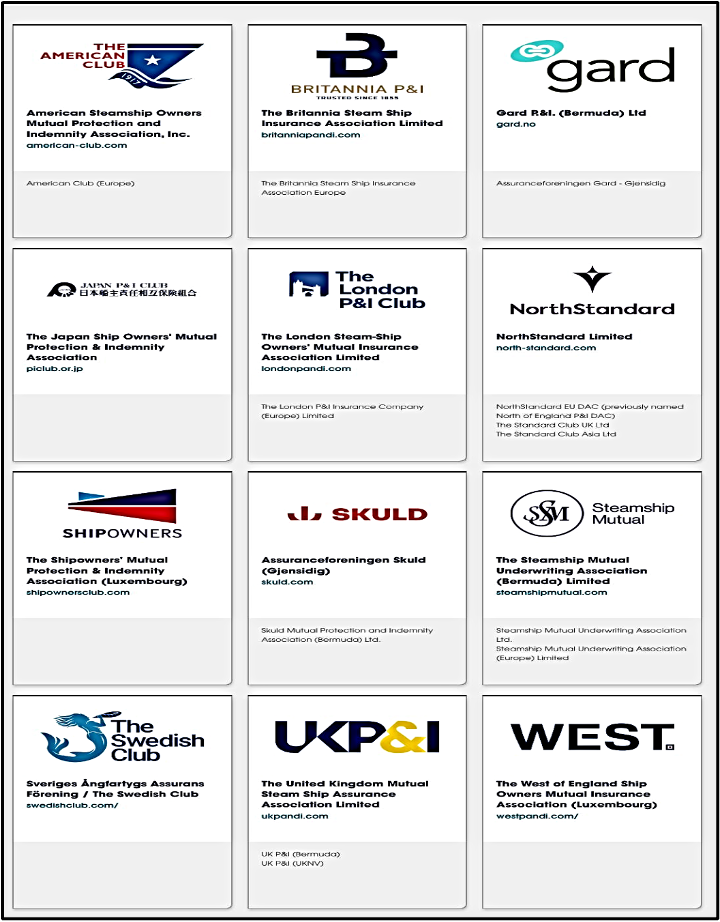
Figure 1. The 12 Group Clubs of IGP&I
Source: MPA Singapore
These 12 Clubs claim that “between them [they] provide marine liability cover (protection and indemnity) for approximately 90 per cent of the world’s ocean-going tonnage.”[22] The website of IGP&I further explains its functioning:
“[IGP&I] is organised as an unincorporated association of the twelve [separate and independent] member Clubs…. [IGP&I] has three “core” functions, firstly the operation of the claims sharing (“pooling”) arrangements and the collective reinsurance of these arrangements, secondly it operates as a forum for collecting and exchanging views between the Clubs and their ship-owner members on matters relating to ship-owners’ liabilities, and insurance of such liabilities, and thirdly it provides a collective industry voice for the purposes of engaging with external stakeholders including intergovernmental maritime organisations, national governments, marine authorities around the world and the shipping and marine insurance/reinsurance industries.”[23]
Against the foregoing backdrop, the next sections explore some policy-relevant aspects of an ‘Indian’ P&I Club.
Defining a ‘National’ P&I Club
In international maritime practice, a P&I Club is considered “national” when it is legally domiciled, headquartered, and regulated in a particular country, even though its membership is often international. For instance, major clubs based in the United Kingdom insure vessels owned by companies across the world.
Similarly, an Indian P&I Club would not necessarily be limited to vessels flying the Indian flag. It could provide coverage to India-owned vessels operating under foreign flags, to regional fleets from Asia or Africa; and, to India’s coastal and inland-shipping operators. This is important because India operates a ‘closed’ ship registry, and foreign ship-owners cannot easily register vessels under the Indian flag. Consequently, the success of a national P&I Club will depend not on the Indian-flagged fleet alone, but on the former’s ability to attract diverse membership through competitive pricing, efficient claims management, and regulatory credibility.[24]
India’s Previous Attempts and Lessons Learned
India has previously attempted to establish domestic P&I arrangements, but these efforts produced limited results. One initiative emerged in 2012, when Indian insurers pooled approximately 50 million US dollars to provide coverage for oil shipments to Iran amid international sanctions. While this demonstrated India’s willingness to develop domestic capacity, the available capital was insufficient to meet the billion-dollar liability coverage required in maritime operations.[25] Another initiative was launched in 2018 when New India Assurance, the Directorate General of Shipping, and the General Insurance Corporation of India introduced a fixed-premium P&I package for coastal vessels with coverage of up to US$ 15 million. Although the scheme was financially viable for minor risks, ship-owners largely avoided it because the coverage levels were significantly lower than those provided by established International Group clubs.[26]
These experiences highlight a critical lesson: without sufficient capital, reinsurance backing, and fleet participation, a domestic or national P&I initiative/Club is unlikely to be competitive enough to succeed.
It is nevertheless true that the establishment of an ‘Indian’ P&I Club would, indeed, generate multiple benefits:
- Strategic autonomy: A domestic P&I institution would reduce India’s vulnerability to external disruptions such as sanctions or insurance restrictions imposed by foreign entities. It would ensure that Indian shipping operations continue uninterrupted during geopolitical crises.
- Economic and financial benefits: Indian ship-owners currently pay significant premiums to foreign insurers. A domestic club could potentially reduce insurance costs by tailoring coverage to the risk profile of Indian shipping operations.
- Development of maritime expertise: The initiative would foster local expertise in underwriting, claims management, maritime law, and risk assessment. This would strengthen India’s broader maritime-services ecosystem.
- Retention of capital: By keeping insurance premiums within the domestic economy, India could reinvest significant financial resources into maritime infrastructure, shipping development, and port modernisation.
- Enhanced Global Influence: A national P&I Club would elevate India’s voice in international marine insurance discussions. Instead of relying solely on representation through individual ship-owners in foreign clubs, India could participate institutionally in global insurance governance frameworks.[27]
Recommendations
Even given that the current Indian dependence and reliance on ‘foreign’ P&I Clubs will remain a serious a concern, for a national P&I Club to succeed, India will require success in three areas:
- Regulatory Reform: The regulatory framework governing marine insurance in India requires adjustments to accommodate the unique structure of P&I mutual associations. The Insurance Regulatory and Development Authority of India (IRDAI) should streamline licensing procedures, establish specialised regulatory provisions for mutual marine insurers, and facilitate easier access to international reinsurance markets. Such reforms would encourage domestic insurers to participate in underwriting maritime risks and create an enabling environment for the growth of a national P&I institution.
- Public-Private Collaboration: Building a viable P&I Club will require collaboration between government agencies, state-owned insurers, private maritime operators, and reinsurers. Institutions such as the General Insurance Corporation of India (GIC Re) could play a central role in providing reinsurance capacity, while shipping companies and port authorities could contribute capital and operational expertise. This cooperative framework would diversify risk pools, enhance financial stability, and strengthen stakeholder confidence.
- International Cooperation: To achieve global credibility, India must also pursue ‘reciprocal insurance recognition arrangements’ with partner nations.[28] Cooperation with maritime economies in Asia, Africa, and Latin America would expand membership and reduce the current dependence on Western-dominated marine insurance networks.[29]
One recommended approach is to implement a national P&I Club in two phases:
- Phase 1 (Foundational Development): The initial stage should focus on launching a fixed-premium P&I model targeting Indian coastal and inland shipping operators. This approach would allow the institution to accumulate claims data, operational expertise, and financial reserves while managing relatively limited risk-exposure. Professional management is essential during this stage. A team with proven expertise in the handling of marine insurance claims, and international maritime regulations should oversee operations. Location, too, matters. Establishing the entity in GIFT City could provide regulatory flexibility, tax advantages, and access to international financial networks.
- Phase 2 (Transition to a Mutual Model): Once operational stability is achieved, the institution should transition into a ship-owners’ mutual association, where members collectively share risk and participate in governance. ‘Mutuality’ is a defining feature of traditional P&I clubs and encourages stronger member-engagement and accountability. Legislative amendments may be required to clarify the treatment of member contributions (“calls”), surplus distribution, and regulatory oversight. Government support would also be crucial for capital infusion, possibly through a consortium of public sector undertakings, private insurers, and maritime stakeholders. Operational readiness should include a ‘24-hour claims-response system’, supported by port correspondents, legal experts, and digital incident management platforms.[30]
Separately, work is also required to strengthen marine insurance capacities overall. For instance, MIV 2030 has already identified four “key intervention areas” for this purpose — risk evaluation, claims status evaluation, implementation of ‘gold’ standards, and port insurance capacity.[31]
Legal Challenges
Legally, marine insurance and indemnification is a complex mix and interplay of insurance law, transportation law, and transnational governance. In this regard, it is essential to examine at least the more important of the several legal aspects that would need clarification and research in the context of an ‘Indian’ P&I Club.
Insurance and indemnification are distinct legal concepts, including under Indian law.[32] While section 124 of The Indian Contract Act, 1872 deals with a contract of indemnity, marine insurance, on the other hand, appears to have dedicated legislation in the form of The Marine Insurance Act, 1963.[33] As such, it is somewhat unclear as to which Indian legal provisions can be invoked as being squarely applicable to the activities of foreign P&I Clubs in India. This lack of clarity also extends to regulatory matters and is made more complex by jurisdictional issues. It will consequently be an impediment to Indian regulatory attempts in this regard.
Prof D Rhidian Thomas, a leading voice on maritime law, has wondered if it is really ‘insurance’ that the P&I Clubs provide, as witness the following remarks made by him:
“To describe a facility as insurance is not necessarily conclusive of its true character but, at the same time, it is not necessarily devoid of any significance. Ultimately the issue is one of substance and not form. There are many commercial agreements that may be regarded as serving a similar function as insurance, in that they are beneficial to the interests of parties exposed to loss, disadvantage or liability, but which are not categorised as insurance agreements…. But if P&I cover is not insurance, to what legal category does it belong…. And if not insurance, what would be the consequences?… It is probable that the question about the status of P&I insurance arises as a consequence of its mutual nature and the significant degree of discretion embodied in the [Club] Rules for determining if claims should be paid. Underpinning the question is the more fundamental issue: what is insurance? This represents the unavoidable starting position, but it is not a hurdle capable of being negotiated with ease.”[34]
Prof Thomas is not alone. Rob Merkin is an Honorary Professor at the University of Auckland and special counsel to the New Zealand solicitors, “Duncan Cotterill”. He teaches insurance law at multiple Universities and observes how “[v]arious standard features of P&I Club rules and their relationship with ordinary insurance principles have vexed the courts over the years, not least the concept that payment of losses is discretionary rather than mandatory.”[35]
Therefore, it is vital that the P&I Clubs (and Indian analysts) acknowledge the importance of pre-contractual duties in insurance law, and the legal obligations of insurance under-writers. The text of section 19 of India’s “Marine Insurance Act 1963” deserves reproduction here: “Insurance is uberrimae fidei — a contract of marine insurance is a contract based upon the utmost good faith, and if the utmost good faith be not observed by either party, the contract may be avoided by the other party.”[36]
Current Developments and Alternative Perspectives
Recent policy discussions have explored the possibility of a mutual insurance model supported by an initial corpus fund, and involving stakeholders such as New India Assurance, General Insurance Corporation of India (GIC Re), and private reinsurers, under the supervision of the Insurance Regulatory and Development Authority of India (IRDAI). The proposed structure could involve layered risk pools, beginning with port-level insurance arrangements and expanding to broader market-retained and reinsured coverage layers.[37] However, a number of experts remain cautious and leaders of Indian industry have argued that establishing a new P&I Club may be unnecessary unless sufficient fleet tonnage exists to support it.[38] These misgivings notwithstanding, comparative data suggests that India’s fleet size is already comparable to that of several countries that host International Group clubs.[39] This debate, therefore, raises a broader strategic question: should India pursue a national P&I Club purely as a commercial venture, or as a strategic maritime policy instrument?
Conclusion and Way Forward
India’s maritime ambitions will require a robust marine insurance and indemnification ecosystem, and establishing a national P&I Club may help with those efforts. However, the business and commercial realities within which such a Club will operate demand that much more research is done on the feasibility (fleet size, tonnage, critical mass, financing, etc.) and implementation of such a Club. The success of such a Club will also depend in large measure on sustained participation (if not support) by India’s private sector — a factor not necessarily under the control of the Government of India.
Nevertheless, the publicly available legal documents associated with the Clubs deserve examination in- and by India (including by Indian academics). From India’s point of view, it is time to examine the legality and legitimacy of the provision(s) contained therein, in general legal terms but also as a matter of India’s municipal (i.e., domestic) law. These documents include the respective Articles of Association and ‘Rules’ of the Clubs themselves, as well as the agreements amongst them.[40] In addition to Indian law, the legal content of rules and documents associated with IGP&I and London’s marine insurance companies should also be assessed under the provisions of England’s Marine Insurance Act, 1906. Illustrative in this regard is the European Commission’s detailed decision on the legal compatibility of such arrangements with EU competition law (specifically, with the competition rules of the EC Treaty and the EEA Agreement).[41] This decision remains in force.
In addition, from an Indian as well as ‘Global South’ perspective, the models and methods used by the P&I Clubs to determine (say) decision(s) related to pricing also demand technical examination. Such technical assessments must, thereafter, inform the legal and evidentiary assessments into correctness, propriety, epistemic accuracy, admissibility, and legal sufficiency.[42]
*******
About the Authors
Mr Mayank Mishra is a litigator and researcher. He has a background in technology and has worked extensively in India’s social sector. Presently, he is a Senior Associate Fellow in the Public International Maritime Law (PIML) cluster of the National Maritime Foundation (NMF). Prior to re-joining the NMF in January 2026, he was a Legal Consultant at a Centre of Excellence established by RIS and the Ministry of Ports, Shipping and Waterways (Government of India). He may be reached at law9.nmf@gmail.com.
Mr John J Vachaparambil is an Associate Fellow at the National Maritime Foundation and meaningfully contributes to the Foundation’s Public International Maritime Law’ (PIML) cluster. His current research focuses on the legal aspects of fishing, including IUU fishing. He may be reached at law5.nmf@gmail.com
Endnotes:
[1] Catherine McBride, “The Price of Uncertainty,” 11 March 2026, Briefings for Britain. https://www.briefingsforbritain.co.uk/hormuz-war-risk-insurance-crisis/
See also: Noor Zainab Hussain and Manya Saini, “Maritime insurance premiums surge as Iran conflict widens,” 06 March 2026, Reuters. https://www.reuters.com/world/middle-east/maritime-insurance-premiums-surge-iran-conflict-widens-2026-03-06/
See also: “Strait of Hormuz Crisis: Insurers Cancel Policies, Raise War Risk Premiums on Ships after Israel Strikes on Iran,” 01 March 2026, LiveMint. https://www.livemint.com/news/world/strait-of-hormuz-crisis-insurers-cancel-policies-raise-war-risk-premiums-on-ships-after-israel-strikes-on-iranreport-11772309959461.html
See also: Shilpy Sinha, “Middle East Tensions: Indian Insurers Review Marine Cargo Insurance, ICICI Lombard Hikes War Risk Premium, 12 March 2026, The Economic Times. https://ecoti.in/MHpUfa
[2] RAdm Sudhir Pillai, “Hormuz and the Financial Spine of Maritime Trade,” 12 March 2026, Substack. https://substack.com/home/post/p-190584679
[3] Chakra, “US-Iran Naval War & lessons for India,” 11 March 2026, Youtube, 26:30 – 30:00. https://youtu.be/g4wU6B-RbTo?si=y6jRqf8tnvflzrgh
[4] “Russian and Ukrainian Strikes are Raising War Risk Insurance Costs,” 15 January 2026, Maritime Executive. https://maritime-executive.com/article/russian-and-ukrainian-strikes-are-raising-war-risk-insurance-costs
[5] Phillip Hellwege and Guido Rossi, “Maritime Risk Management: Marine Insurance, General Average, Sea Loan,” in Phillip Hellwege and Guido Rossi, eds., Maritime Risk Management: Essays on the History of Marine Insurance,
General Average and Sea Loan (Duncker and Humbolt, 2021), 15.
See also: “Bottomry”, Cornell Law School (LII), https://www.law.cornell.edu/wex/bottomry
See also: “What is General Average?,” MunichRE, https://www.munichre.com/specialty/global-markets-uk/en/solutions/cargo-insurance/what-is-general-average.html
See also: Daniel DeMato, “TCH: From Sea Loans to Lloyd’s,” 29 April 2019, LinkedIn, https://www.linkedin.com/pulse/tch-from-sea-loans-lloyds-daniel-dematos
[6] Carmen Vicente, “War Risk Insurance,” 1, 1995, HAL, https://shs.hal.science/halshs-03290863v1
See also: Prashanti Upadhyay, “Development Of Laws Relating To Marine Insurance In India,” Manupatra, https://docs.manupatra.in/newsline/articles/Upload/FBF6E3EA-143D-459F-8AC0-FB70D2F84751.pdf
[7] Gediminas Dauksa, “The Myths of Marine War Insurance,” 06 March 2026, Greco, https://greco.services/the-myths-of-marine-war-insurance/
See also: “Limitations etc. on P&I cover — Rule 58: War risks,” Gard, https://gard.no/rules-statutes-and-guidances/document/limitations-etc-on-p-i-cover-rule-58-war-risks/#footnote-1
See also: “War Risk Insurance in Global Shipping: Updates and Implications for Nigeria,” Bloomfield Law, https://www.bloomfield-law.com/sites/default/files/2025-06/updates_on_war_risk_insurance_and_nigerian_shipping_copy.pdf
[8] Richard L Kilpatrick, “Revisiting the Five-Powers War Risk Exclusion,” International and Comparative Law Quarterly 73, No 3 (July 2024), 551, https://doi.org/10.1017/S0020589324000204
See also: “War Risk Premiums to Surge as Strait of Hormuz Closure Disrupts Global Trade,” 04 March 2026, DredgeWire, https://dredgewire.com/war-risk-premiums-to-surge-as-strait-of-hormuz-closure-disrupts-global-trade/
See also: “What is the Five Powers War Clause?,” 05 June 2023, ECIB, https://insider.ecibglobal.com/blogs/what-is-the-five-powers-war-clause
[9] P Manoj, “Additional War Risk Premium for Ships, Re-Routed Sailings to Hurt India as US-Iran Conflict Roils Trade,” 02 March 2026, ET Infra, https://infra.economictimes.indiatimes.com/news/ports-shipping/war-risk-premiums-surge-as-hormuz-crisis-forces-rerouted-sailings-threatening-indias-trade/128933982
See also: Kilpatrick, “Revisiting the Five-Powers War Risk Exclusion,” 562-564.
See also: Dauksa, “The Myths of Marine War Insurance.”
[10] Kilpatrick, “Revisiting the Five Powers War Risk Exclusion,” 564.
[11] Government of India, Ministry of Ports, Shipping and Waterways, “Maritime Amrit Kaal Vision 2047,” 197, 423, 425, https://shipmin.gov.in/sites/default/files/Maritime%20Amrit%20Kaal%20Vision%202047%20%28MAKV%202047%29_compressed.pdf
[12] Ibid, 199, 421, 424-425.
[13] Ministry of Ports, Shipping and Waterways (Govt. of India), “Maritime India Vision 2030,” 219, https://sagarmala.gov.in/sites/default/files/MIV%202030%20Report.pdf
[14] Ibid, 219, 291.
[15] Ibid, 218.
See also: “Maritime Amrit Kaal Vision 2047”, 273, 457.
[16] “Finance Minister Chairs a Session on ‘Maritime Financing, Insurance and Arbitration’ in the Global Maritime India Summit (GMIS) 2023,” 19 October 2023, Press Information Bureau. https://www.pib.gov.in/PressReleasePage.aspx?PRID=1969106®=3&lang=2
[17] Government of India, Ministry of Ports, Shipping, and Waterways, “Annual Report: 2025-26,” 74, https://shipmin.gov.in/sites/default/files/Annual%20Report%202025-26%20english.pdf
[18] Mohd Taufik Arifin, “What is the Difference between P&I Insurance and Marine Insurance?,” 02 February 2021, Liga Asuransi, https://ligaasuransi.com/en/apa-perbedaan-antara-asuransi-pi-dengan-asuransi-marine/
See also: “Examiner’s Report,” November 2020, Institute of Chartered Shipbrokers, https://www.ics.org.uk/media/635392/mi%20nov%202020.pdf
See also: Di Jin and Hauke L Kite-Powell, “Environmental Liability, Marine Insurance and An Optimal Risk Sharing Strategy for Marine Oil Transport,” Marine Resource Economics 10, No 1 (Spring 1995), https://www.jstor.org/stable/42629096
[19] Kyriaki Noussia, The Principle of Indemnity in Marine Insurance Contracts: A Comparative Approach (Springer, 2007), 5.
[20] “Why insure with a P&I club?,” Marsh, 3, https://share.google/u4ugLZoVo4sEIXAJy
[21] “List of recognised International Group P&I Clubs by MPA for issuance of civil liability convention certificate (CLC) Blue Card,” 20 July 2023, MPA Singapore. https://share.google/ijfzhxD6dwIq5tOMw
See also: “Respectable P&I Clubs,” https://maritime.uab.gov.tr/respectable-p-ve-i-clubs
See also: “Recognised P&I Clubs and Insurance Companies,” 01 September 2025, St Kitts and Nevis International Ship Registry. https://www.skanregistry.com/uploads/download-directory/pdf/98/document.pdf
See also: Capt Rajeev Jassal, “Here is all you wanted to know about P&I Clubs,” 29 May 2017, MySeaTime. https://www.myseatime.com/blog/detail/here-is-all-you-wanted-to-know-about-pi-clubs
[22] “About the International Group of P&I Clubs,” IGP&I. https://www.igpandi.org/article/about/
[23]Ibid.
See also: “Full List of Principal Clubs and Affiliated Associations,” IGP&I. https://www.igpandi.org/group-clubs/
See also: Andrew Bardot, “Overview of the Group and Club system,” November 2011, US Department of the Interior. https://www.doi.gov/sites/doi.gov/files/migrated/restoration/upload/Andrew-Bardot-Overview-of-International-Group-and-Clubs-1.pdf
[24] Hariesh Manaadiar, “Rethinking the sufficient tonnage question and need for an Indian P&I Club”, 01 September 2025, Shipping and Freight Resource. https://www.shippingandfreightresource.com/rethinking-the-sufficient-tonnage-and-need-for-an-indian-pi-club/
[25] “Maritime Knowledge Lecture Series – Role of P&I Clubs in Shipping”, 13 August 2025, RIS, https://ris.org.in/cmec/pdf/event_report/13-August-2025-Maritime-Knowledge-Lecture.pdf
[26] Ibid.
[27] Hariesh Manaadiar, “Rethinking the sufficient tonnage question and need for an Indian P&I Club”.
[28] Julia Kagan, “Reciprocal Insurance Exchange: How it Works, Key Features, Examples”, 14 October 2025, Investopedia. https://www.investopedia.com/terms/r/reciprocal-insurance-exchange.asp#:~:text=Reciprocal%20insurance%20exchanges%20are%20a,to%2Dday%20operations%20and%20management
[29] Ashish Kapur, “Reclaiming Maritime Sovereignty: Why India Needs its Own P&I Club”, 27 Oct 2025, ET Infra. https://infra.economictimes.indiatimes.com/news/ports-shipping/reclaiming-maritime-sovereignty-why-india-needs-its-own-pi-club/124843429
[30] Pankaj Kapoor et al, “P&I Clubs: An Indian Exigency”, 22 September 2025, LEXOLOGY. https://www.lexology.com/library/detail.aspx?g=83a5fc53-0352-4194-89c7-6794ebf62e09#:~:text=Establishing%20a%20domestic%20P&I%20Club%20in%20India,licensing%20and%20facilitate%20access%20to%20global%20reinsurers
[31] “Maritime India Vision 2030,” 220.
[32] Noussia, The Principle of Indemnity in Marine Insurance Contracts: A Comparative Approach.
See also: Manas Shrivastava, “Understanding the Similarities and Difference between Insurance Contracts and Contracts of Indemnity,” Aashayein Judiciary. https://www.alec.co.in/show-blog-page/insurance-contracts-and-contracts-of-indemnity
[33] “The Indian Contract Act, 1872,” IndiaCode. https://www.indiacode.nic.in/bitstream/123456789/2187/2/A187209.pdf
See also: “The Marine Insurance Act, 1963,” IndiaCode. https://www.indiacode.nic.in/bitstream/123456789/1520/5/A1963-11.pdf
[34] D Rhidian Thomas, “Protection and Indemnity Insurance: is it truly Insurance?” in Research Handbook on Marine Insurance Law, Özlem Gürses ed., (Edward Elgar Publishing, 2024), 28.
[35] Rob Merkin, “Protection & Indemnity Clubs and Arbitration Clauses,” in Research Handbook on Marine Insurance Law, Özlem Gürses ed., (Edward Elgar Publishing, 2024), 183.
[36] The Marine Insurance Act, 1963, Indiacode. https://www.indiacode.nic.in/bitstream/123456789/1520/5/A1963-11.pdf
See also: CJI and SB Sinha (Supreme Court of India), “Liverpool & London SP&I Association Ltd vs MV Sea Success I & Anr,” 20 November 2003, Supreme Court of India. https://api.sci.gov.in/jonew/judis/25605.pdf
See also: Dru Corfield, “The Good, the Bad & the Ugly: #18 (The Good). Carter v Boehm (1766),” 31 October 2022, FenchurchLaw. https://fenchurchlaw.com/the-good-the-bad-the-ugly-100-cases-every-policyholder-needs-to-know-18-the-good-carter-v-boehm/
See also: Carter V Boehm (1766) after 250 Years: Insured’s and Insurer’s Pre-contractual duties,” NUS. https://law1a.nus.edu.sg/pdfs/cbfl/events/CartervBoehmAfter250Years.pdf
See also: Pierpaolo Marano and Kyriaki Noussia, eds., Transparency in Insurance Regulation and Supervisory Law: A Comparative Analysis (Switzerland: Springer International Publishing, 2021), 438.
[37] “Maritime Knowledge Lecture Series – Role of P&I Clubs in Shipping.”
[38] Hariesh Manaadiar, “Rethinking the Sufficient Tonnage Question and Need for an Indian P&I Club”.
[39] “Maritime Knowledge Lecture Series – Role of P&I Clubs in Shipping.”
[40] “Maritime Insurance and P&I Clubs,” Law Office of Todd C Passman. https://stluciepersonalinjuryattorney.com/practice/what-is-a-pi-club/
See also: “About the International Group of P&I Clubs,” IGP&I. https://www.igpandi.org/article/about/
See also: “International Group Agreement 2024,” IGP&I. https://static.igpandi.org/igpi_website/media/adminfiles/International_Group_Agreement_2024.pdf
[41] European Commission, “1999/329/EC: Commission Decision of 12 April 1999 relating to a proceeding pursuant to Articles 85 and 86 of the EC Treaty and Articles 53 and 54 of the EEA Agreement (Cases No IV/D-1/30.373 – P & I Clubs, IGA and No IV/D- 1/37.143 – P & I Clubs, Pooling Agreement),” http://data.europa.eu/eli/dec/1999/329(1)/oj
[42] Brian Gedalla et al, “A Practitioner’s Approach to Marine Liability Pricing Using Generalised Linear Models,” 2004, CAS. https://www.casact.org/abstract/practitioners-approach-marine-liability-pricing-using-generalised-linear-models
See also: “Shipping and Biodiversity: Here’s how Marine Insurance can Help,” 22 January 2026, CSN. https://cyprusshippingnews.com/2026/01/22/shipping-and-biodiversity-heres-how-marine-insurance-can-help/
See also: Cameron Meek, “How maritime intelligence is strengthening P&I Club risk management,” 09 March 2026, Kpler. https://www.kpler.com/blog/how-maritime-intelligence-is-strengthening-p-i-club-risk-management


Your blog is a breath of fresh air in the often stagnant world of online content. Your thoughtful analysis and insightful commentary never fail to leave a lasting impression. Thank you for sharing your wisdom with us.