
Rear Admiral Monty Khanna (Retd) – ‘Dabolim Diaries’ Issue No 10 dated 10 Mar 2025
This brief is in follow up to Dabolim Diaries Issue No 9 which dealt with National Deep Sea Center (NDSC), Qingdao, Jiangsu Province. This issue studies the sister organization engaged in similar research i.e. the Institute of Deep-sea Science and Engineering.
Institute of Deep-sea Science and Engineering
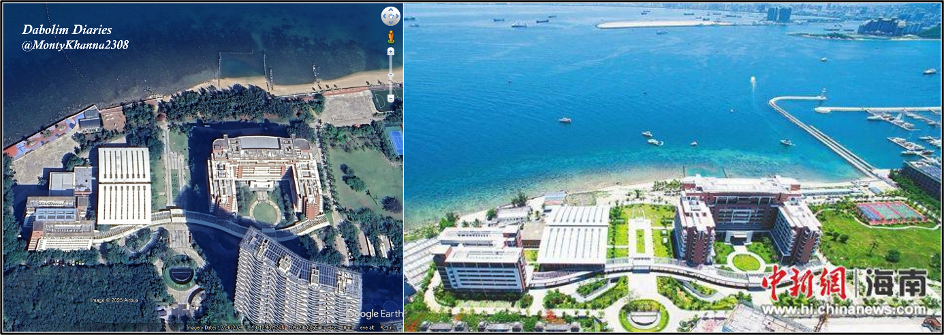
The Institute of Deep-sea Science and Engineering, Chinese Academy of Sciences (IDSSE) is a scientific research institution that functions directly under the Chinese Academy of Sciences (CAS). It is located in the Luhuitou Peninsula, Sanya City, Hainan Province (18o 12’9 N, 109o 28’.3 E). It is a relatively new organization that was jointly approved by the People’s Government of Hainan Province, Sanya City and the Chinese Academy of Sciences in 2011. It commenced functioning in May 2016.
The institute has an area of about 109 acres and a total construction area of 50,183.95 square meters. In addition, it has a living complex about a kilometer away covering an area of about 90 acres and a total construction area of 134,259.60 square meters. This complex includes housing and auxiliary living facilities for institute employees, researchers, and graduate students.
Organization
The IDSSE attempts to bring synergies between marine science and engineering, deep-sea research and development, and offshore operations and tests. To do so, it is organized into three departments, each with several sub-units subordinate to it. These are as follows: –
- Deep Sea Science Research Department. It has eight research units: –
- Deep Sea Biology Laboratory
- Deep Sea Geology and Geochemistry Laboratory
- Deep Sea Geophysics and Resources Laboratory
- Ocean Circulation Observation and Numerical Simulation Laboratory
- Deep Sea Extreme Environment Simulation Research Laboratory
- Extraterrestrial Ocean System Laboratory
- Marine Mammal and Marine Bioacoustics Laboratory
- Analysis and Testing Cente
- Deep Sea Engineering Technology Department. It has seven basic research units: –
- Deep Sea Exploration Technology Laboratory
- Deep Sea Information Technology Laboratory
- Deep Sea Resource Development Laboratory
- Deep Diving Technology Laboratory
- Deep Sea Video Technology Laboratory
- Network Security/Deep Sea Software Evaluation and R&D Laboratory
- Engineering Laboratory.
- Marine Equipment and Operation Management Center. It is the main administrative wing of the IDDSE and is responsible for the management of construction activity and operations of scientific research vessels, piers and deep-sea equipment. It is also responsible for the management and training of crew members and engineering and technical personnel.
Staffing
The IDSSE has a sanction for a formal staff of 300. As of January 31, 2024, there were 260 employees, including 215 professional and technical positions, 42 staff positions, and 3 workers. Among the employees, 89 have doctoral degrees and 118 have master’s degrees. There is also a sanction for a floating staff of 350.
Layout of Facilities
The broad layout of facilities of the IDSSE is as given below: –
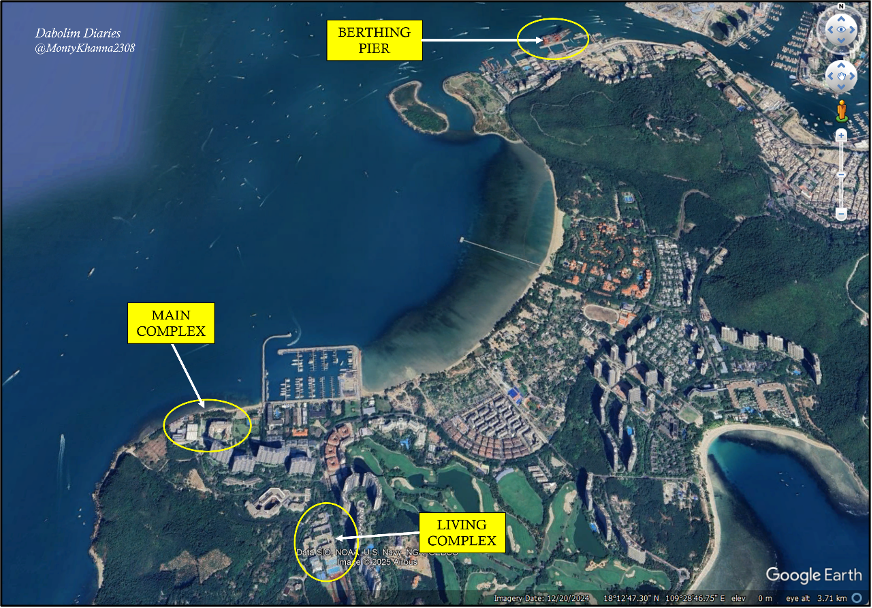
Institute of Deep-sea Science and Engineering, Sanya City
Waterfront Facilities
While the institute does not have a dedicated jetty adjacent to its premises, it uses a pier located 3 kilometers to its North-East for berthing of its vessels. It is possible such activity may shift to the newly constructed Nanshan Port Public Scientific Research Pier in Sanya Yazhou Bay Science and Technology City in future.
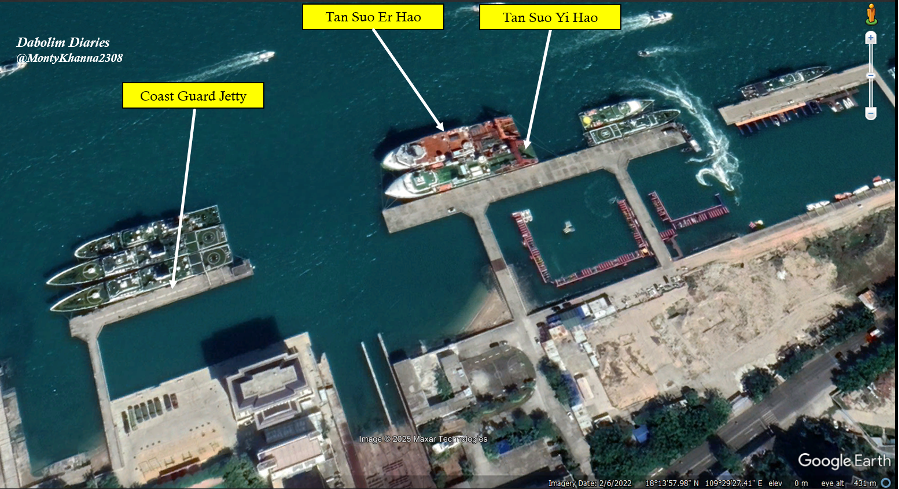
Jetty for Berthing IDSSE Ships
Vessels Operated
The IDSSC is very well resourced in this respect. It operates three large vessels, all of which are designed to embark Deep Sea manned submersibles. These are as follows: –
- Tan Suo Yi Hao (Exploration No 1) – IMO 8315451, MMSI 413523770. She was built as a research vessel in 1984 by Amels Shipyard in Makkum, Holland. She has had several owners since then and has sailed under the names Hai Yang Shi Yo 299, Seaway Explorer, Northern Explorer and Explorer II. In 2016, she was renamed Tan Suo Yi Hao, fitted out for her current role of a mother ship for deep-sea manned submersibles, and handed over to the just created IDSSE. She is 94.45 meters long, has a beam of 17.9 meters, and displaces 6,250 tons. She has four generators each rated at 2205 KW and two motors for propulsion. She has a designed endurance of 60 days covering 10,000 nautical miles. She has a compliment of 60 (25 crew and 35 researchers). She is equipped with eleven laboratories. In addition, the vessel is also equipped with an A-Frame with a deep-sea winch system, sounding system, sediment collection equipment, seismic air compressor system, and auxiliary machinery such as a crane. She has two notable events to her credit, these being the conduct of China’s first 10,000-meter submersible dive in Challenger Deep of the Mariana Trench in 2016 and a subsequent one to a depth of 10909 m in Nov 2020. The submersible Fendouzhe was used for both these expeditions.
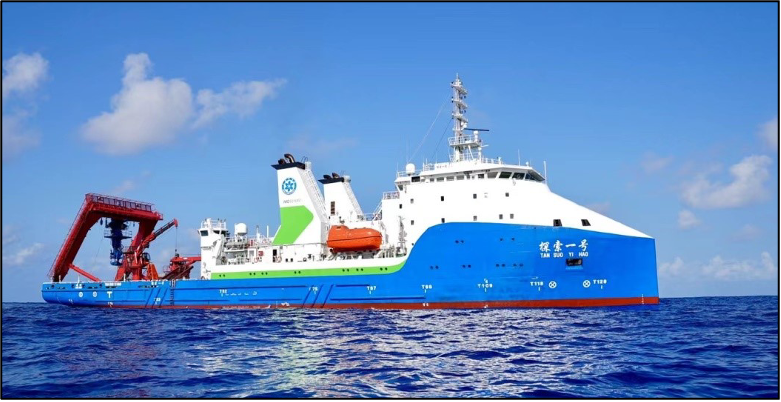
Tan Suo Yi Hao
- Tan Suo Er Hao (Exploration No 2) – IMO 9743071, MMSI 413229620. Built in China, she was delivered to the IDSSE in June 2020. She is 87.25 meters long, has a beam of 18.8 meters and displaces 6,832.6 tons (full load). She has four generators each rated at 1760 KW and two motors for propulsion, each rated at 2000 KW. She has a designed endurance of 60 days covering 15,000 nautical miles. She has a compliment of 60 (25 crew and 35 researchers). She has 13 laboratories an acoustic control room and a data processing centre. She is equipped with a 100-ton stern A-Frame (with a 50-ton guide mechanism) and a 10-ton telescopic jib crane. She has systems for underwater acoustic communication and multi-beam sounding for carrying out manned deep-diving submersible operations, deep-sea comprehensive scientific operations, engineering equipment sea trials and other scientific tasks.
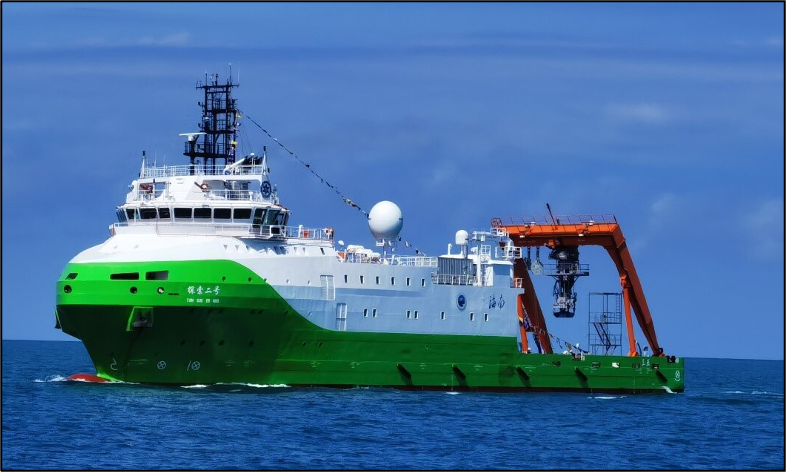 Shen Hai Er Hao
- Tan Suo San Hao (Exploration No 3) – IMO 1024637, MMSI 413595860. The vessel was constructed by Guangzhou Shipyard International (GSI), a subsidiary of the China State Shipbuilding Corporation (CSSC) on an extremely aggressive timeline. Steel cutting reportedly commenced on 25 June 2023. She was subsequently launched in April 2024 in a record time of ten months. She underwent sea trials in October 2024 and delivered to the IDSSE on 29 Dec 2024. The entire build period from commencement of steel cutting to final delivery took 20 months. She is 98.445 meters long, has a beam of 19.7 meters and displaces 9,300 tons (full load). She has four Wartsila 6L32 generators, each rated for 3,300 KW. For propulsion, she is fitted with two DI1400 ABB Azipods (4,500 KW each) and two bow thrusters. She has a designed endurance of 75 days covering 15,000 nautical miles. She has a compliment of 80 (32 crew and 48 researchers). As a PC-4 class icebreaker, she is capable of year-round operations in thick first-year ice which may include old ice inclusions. She is designed to break ice while moving ahead as well as astern. Like her sister ships, she too has a large ‘A frame’ at the stern with four winches, each with a Safe Working Load (SWL) of 50 tons. The max combined SWL for the entire frame is 100 tons.
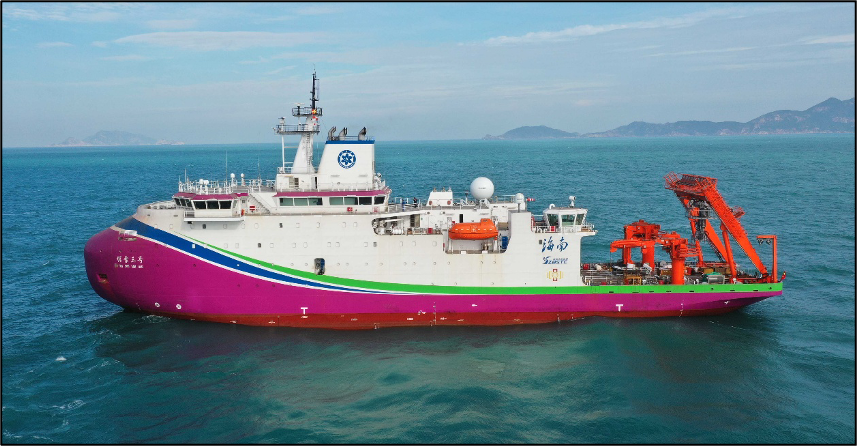 Tan Suo San Hao
Funnel Marking
IDSSE ships carry the symbol of the China Academy of Science on their funnels.
 Symbol of CAS
Submersibles
The IDSSE operates two highly capable manned submersibles, details of which are given below: –
Shenhai Yongshi (Deep Sea Warrior). She is a 4,500-meter class manned submersible. On completion of its sea-trial in October 2017, she was delivered to the Institute of Deep-sea Science and Engineering, Chinese Academy of Sciences for operations. She is reported to have a localisation rate of 95 percent. She has been used extensively and has completed 778 dives as of 13 Dec 2024. As per the website of the NSDC, the submersible is fitted with several features to facilitate deep-sea research. These include:
- A high-precision fixed-point hovering operation capability that allows the vessel to conduct high-temperature hydrothermal sampling and continuous observation in the seabed chimney vents.
- A high-precision target search operation capability enables the accurate positioning, deployment and recovery of seabed abyss scientific instruments.
- A digital hydroacoustic communication system with a transmission accuracy rate of more than 90%.
- A high-resolution bathymetric side-scan sonar to draw large-area three-dimensional bathymetric and side-scan maps of the seabed.
Technical Specifications
- Weight: 20 tons
- Dimensions: Length – 9.3 meters, Beam – 3 meters, Height – 4 m
- Manned Sphere Diameter- 2.1 m
- Science Payload – 220 Kg
- Crew: 3
- Class: 4,500 m submersible
- Max Sea State: Launch – 4, Recovery – 5
- Dive Duration: Routine – 8 to 10 hours, Emergency – 72 Hours
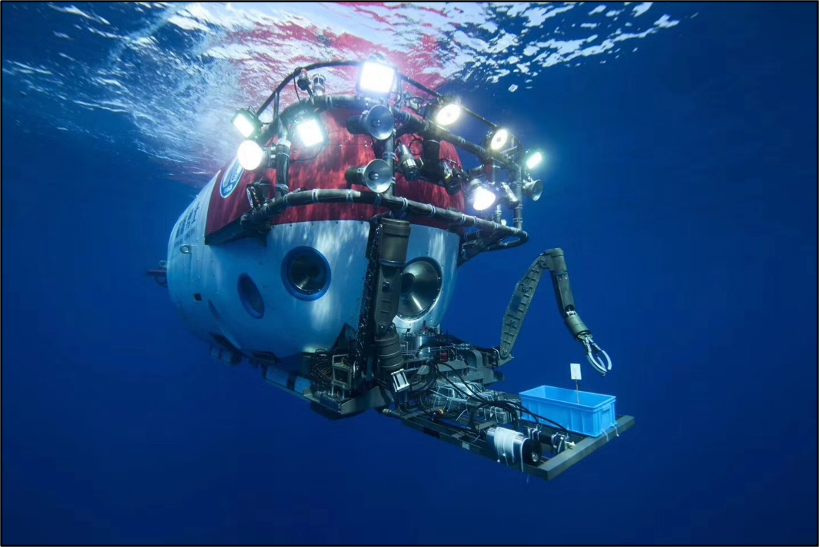 Shenhai Yongshi Submersible
Fendouzhe (Striver). She is a 11,000-meter class submersible that was developed by the China Ship Scientific Research Centre (CSSRC), affiliated to the China Shipbuilding Industry Corporation. She was launched in 2016, and after completing a series of test dives including one to a depth of 10,909 meters on 10 Nov 2020, she was handed over to the IDSSE on 16 Mar 2021. She has completed 336 dives as of 13 Dec 2024 of which 25 have been to a depth of more than 10,000 meters.
Technical Specifications
- Weight: 36 tons
- Dimensions: Length – 10.3 meters, Beam – 3.2 meters, Height – 4.4 m
- Manned Sphere Diameter- 1.8 m
- Science Payload – 220 Kg
- Crew: 3
- Class: 11,000 m submersible
- Max Sea State: Launch – 4, Recovery – 5
- Dive Duration: Routine – 6 to 15 hours, Emergency – 72 Hours
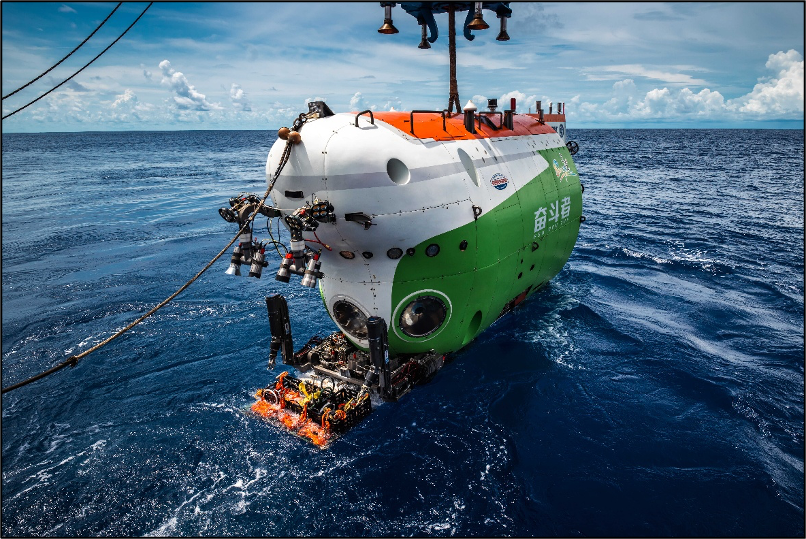 Fendouzhe Submersible
Assessment
China’s three manned submersibles Shenhai Youngshi and Fendouzhe (operated by the IDSSE) and Jiaolong (operated by NDSE) have cumulatively done more than half of world’s deep-dive missions over the past three years. China’s investment in this field continues to grow as exemplified by its announced project to build a deep-sea research centre permanently stationed at a depth of 2,000 meters. Continued research in this field will give China a head start to commercially exploit seabed resources as and when norms to do so get established. The dual-use nature of such submersibles also needs to be kept in mind, particularly in the context of interfering with undersea fibre-optic cables, the incidents of which have witnessed a sharp increase over the last two years.


Leave a Reply
Want to join the discussion?Feel free to contribute!