
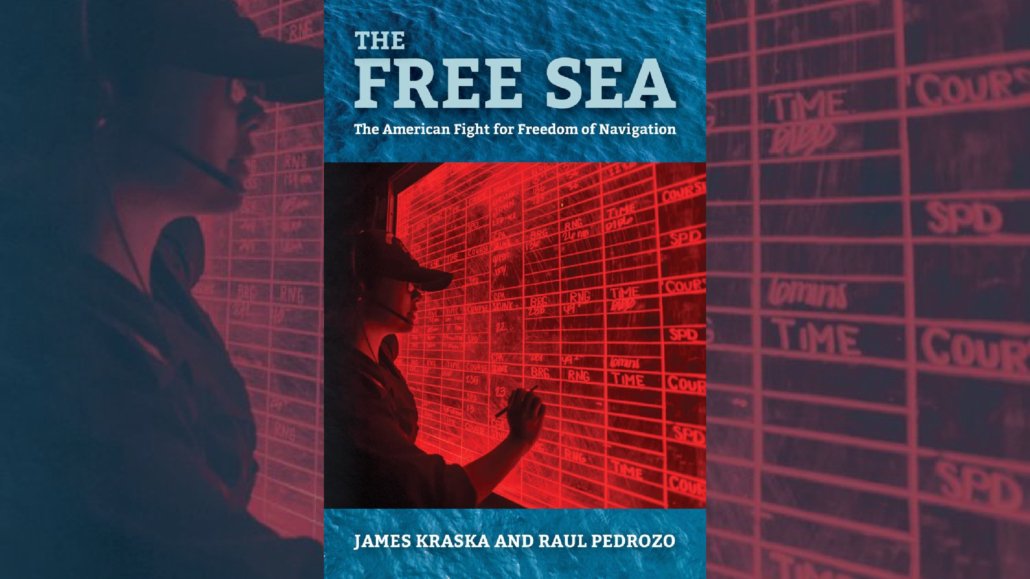
James Kraska and Raul Pedrozo, Annapolis, Maryland: Naval Institute Press, 2018. 395 pages, ISBN 9781682471166, (Hardbound)
The concept of free seas was first formulated by Hugo Grotius in his seminal work of 1609, Mare Liberum (The Free Sea). James Kraska and Raul Pedrozo, in their book The Free Sea build on this legacy. To set the tone, the authors have dedicated this book to John Norton Moore who called freedom of navigation in the oceans the original “common heritage” of all mankind. Their book chronicles the historical events and accompanying legal developments that shaped the freedom of navigation at sea, which the US deems critical to its maritime interests.
It covers more than two centuries of American naval history, starting from the Quasi-War with France in the late 18th century to the contemporary confrontations with Iran, Russia and more recently, China. While tracing these historical events, in some detail, the book highlights how freedom of the seas is “a bedrock principle” of international law and global order, and how the freedom of navigation is central to economic prosperity and strategic security of the US. The book manages to demonstrate how law, diplomacy, and armed force- all have been leveraged to preserve this freedom on different occasions.
The book begins with the French conflict, when the US was still a nascent state. The conflict with the French (Chapter 1) and, later, the Barbary pirates (Chapter 2) brought to the fore the urgency and importance of having a navy. With the loss of previously available safeguards of the British Royal Navy, as a part of the empire, the Americans now had to embark upon a path of building their own naval assets in order to safeguard their trade interests. These events also mark one of the first occasions when the Americans insisted on the freedom of navigation of the neutral state. Robert Harper’s famous statement ‘Millions for defence- not a cent for tribute’ became the rallying cry during this period. And while the naval prowess was beginning to be built, the legal doctrine of ‘free ships make free goods’ was relied upon to use law as a weapon in lieu of naval power. The law of prize and privateering were some of the major concepts delved upon in these chapters.
The third chapter of this book deals with freedom of navigation in the context of the 1812 War when the US still lacked both, a navy and a coherent naval policy to navigate the new seascape. The system of “broken voyages” and “drawbacks” came into play, in order to secure the interests of the Americans and their French allies. The British responded by expounding the doctrine of “continuous voyage”, pointing out the distinction between “trading with the enemy” and “trading for the enemy.” Although the doctrine of broken voyages was dismantled in the Essex case, by the end of the 1812 war, the US commitment to freedom of navigation was evident. Also, became deeply embedded in the American political psyche, the penchant for equal treatment. The gap between 1815 and 1915 did not see any major maritime conflicts but the technological advancements made in this period set the stage for the next century which witnesses the world wars and the cold war, as covered in chapters 4 to 9.
The world war started with the sinking of the RMS Lusitania, marking the beginning of thirty years of struggle with Germany, for the recognition of unfettered freedom of the seas. The idea of the freedom of the seas underwent a major shift from being a wartime right of neutral states to a peacetime right of all states. The Naval Appropriations Act 1916 was passed to address the inability of the navy to protect the nation’s neutral rights. Woodrow Wilson famously remarked that the “paths of the sea must be alike in law and in fact be free”. The fourth chapter further highlights the Point II of Woodrow Wilson’s Fourteen Points which emphasised the ‘freedom of navigation upon the seas, alike in peace and in war, except as the seas may be closed in whole or in part by international action’; Roosevelt’s insistence on the freedom of the seas as the cornerstone of American strategy in peacetime and in war; and the Seventh Principle of the Atlantic Charter that says all nations enjoy the right to transverse the high seas and oceans without hindrance. The inherent aim here is to demonstrates the US commitment to freedom of the seas.
In the ‘Blank Check’, the book describes in some detail, the Gulf of Tokin Incident of 1964 which led to the increased involvement of the US in the Vietnam War. The episode ended in a Resolution that was later criticized for opening the door to a decade of the US combat operations in the Indochina. The incident also coloured the early American view of the conflict as largely a conventional assault by the armed forces of North Vietnam against the South, and the book illustrates how that affected the course of the conflict.
The authors dwell, in chapter 6, upon the USS Pueblo incident of 1968, in which the Banner class environmental research ship was attacked and captured by North Korean vessels. It was the consequence of a “false sense of security” based upon the incorrect belief that other nations of the international community would honour the customary legal norms. This was coupled with the past moderate responses of North Korea in the case of USS Banner. Diplomatic options were resorted to in resolution of this issue. However, the incident shattered the conventional American thinking on freedom of high seas and the inviolability of sovereign immune ships on high seas.
Then, in the SS Mayaguez incident in the Gulf of Thailand, where the Khmer Rouge forces hijacked the American ship, the authors emphasize on how the US responded by firmly ‘drawing a line against illegal actions’, especially when important issues of principle were involved.
In chapter 8 Crossing the “Line of Death”- Gulf of Sidra (1981-89) the authors discuss how the American approach towards Libya’s illegal claims of territorial sea in Gulf of Sidra became firmer as Reagan replaced Carter. Reagan administration significantly increased the scope and frequency of the Freedom of Navigation (FON) operations as he believed that “freedom of navigation is not an empty cliché” of international law.
The issue of the attacks on neutral shipping was once again raised in the chapter on the Tanker Wars. The Tanker Wars were part of the broader Iran-Iraq War wherein a series of military attacks ensued on merchant vessels in the Persian Gulf and the Strait of Hormuz. Both the nations declared exclusion zones in the region. As a result, the US got involved in the war to ensure freedom of navigation in a region critical to energy supplies in various parts of the world, including Western Europe. Operation Earnest Will followed. The war ended in 1988 with no significant gains to account for the great suffering it caused along with the loss of lives and battering of the economies. The authors, here, have illustrated how very little had changed in the US policy since the very first war the nation had fought as an independent country, in 1798-1800, as far as ensuring freedom of navigation is concerned.
In chapter 10, the Black Sea bumping incident exemplifies how the FON program has helped preserve navigational rights and freedoms for all seafaring nations. More than a decade of unsafe incidents initiated by the Soviet Union against the US ships and aircrafts, as the US conducted FON operations, finally led to a uniform interpretation of innocent passage in the light of UNCLOS provisions. Herein, the authors suggest that the bilateral Jackson Hole Agreement of 1989 can be used as a model in South China Sea and East China Sea. The Agreement asserted the unrestricted freedom of innocent passage for warships, encouraged compliance with the navigational regimes set forth in UNCLOS, and affirmed the value of negotiation to resolve maritime disputes. Overall, the INCSEA, the DMA and the Jackson Hole Agreement succeeded in reducing the naval incidents between the United States and the Soviet Union. In this regard, the role of diplomacy is highlighted by the authors.
The final chapter indulges in the analysis of ‘Freedom of Navigation with Chinese Characteristics’. It details the US response to Chinese claims in South China Sea, combined with the Chinese actions which threaten to “undermine the legitimacy of UNLCOS as the constitution for the world’s oceans”. The FON operations in the initial phase were fraught with miscues and inconsistent messaging, during Obama’s administration, but the authors believe that the new regime has done a better job. However, when compared to the earlier conflicts, the South China Sea issue has been considered different, by the authors, because there is no declaration of conflict here.
The authors conclude by emphasising the need for US to join the UNCLOS. They also emphasise the fact that the costs of freedom of navigation should be borne by the international community, not just the US. Freedom of navigation is not a cost free public good. It is a global common that will require, for its preservation, unified action among the world’s major democracies. US struggles to preserve freedom of navigation. The authors warn about the consequences of failure to ensure a free and open global maritime order.
Although the prima facie analysis in The Free Seas is about the freedom of navigation and its evolution during the course of history, the book invariably touches upon the technological evolution in naval warfare, especially in the American context. The book is a must read for practitioners of international maritime law and students of maritime history, alike. The case studies are quite comprehensive and go a long way in enriching a lay person’s knowledge and comprehension of naval warfare and maritime history.
In an attempt to remain true to the theme, the authors have refrained from glorifying US efforts to secure freedom of navigation. They provide accounts of both successes and failures of the United States, the struggles thereof, and the lessons learnt therefrom. The book references the various aspects of armed conflict at sea, without losing track of the focal point which is freedom of navigation. However, the attention to detail in the case studies can make it a cumbersome read for people who are unfamiliar with naval warfare and operations.
Kraska and Pedrozo have been able to bring in the practitioners’ perspective in their works. They have previously co-authored a volume on international maritime security law as well. Kraska himself has authored several volumes on international maritime law, law of naval warfare and piracy, to list a few. The Free Seas makes some reference to the impact of maritime boundary disputes on freedom of navigation, particularly in the case of South China Sea. The theme of maritime boundaries has been dealt with in detail by Kraska in his later work on Peaceful Management of Maritime Disputes. As one dwells upon the freedom of the seas in the current volume, indulging in some of the previous works of the authors would be insightful, especially for a novice. While this book was written in the contemporary context of freedom of navigation in the South China Sea, its broad coverage and attention to detail will ensure its significance in times to come.
******
About the Reviewer:
Ms Eram Mahtab, who holds a master’s degree in Politics: International and Area Studies from MMAJ Academy of International Studies, Jamia Millia Islamia. Ms Mahtab has recently completed a six-month internship at the National Maritime Foundation (NMF). She may be contacted at erammahtab@gmail.com


Leave a Reply
Want to join the discussion?Feel free to contribute!