
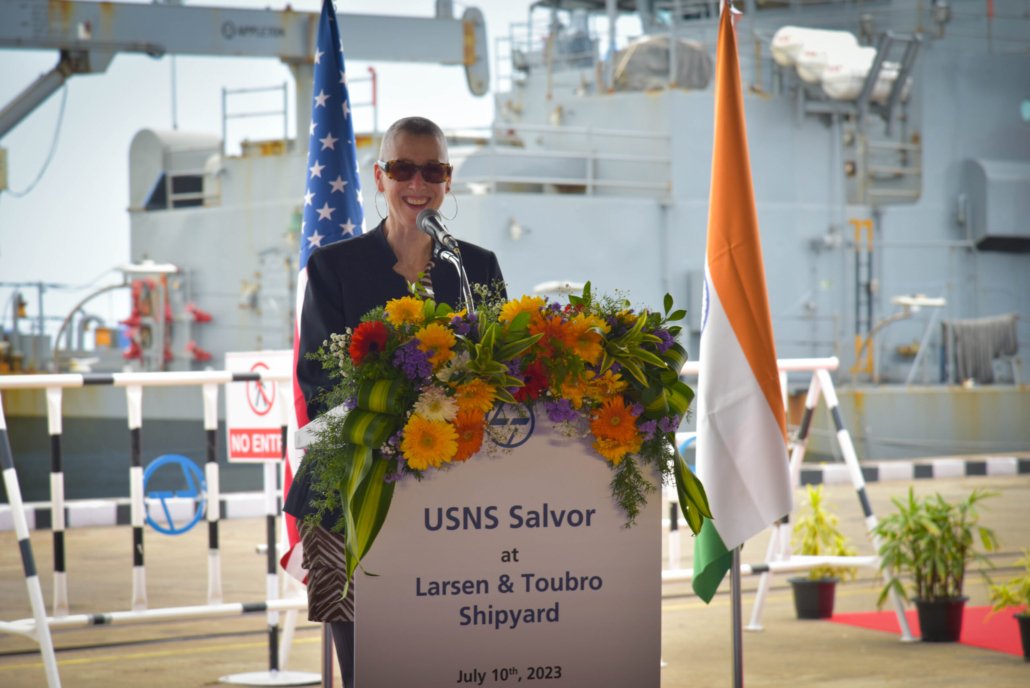
In July of 2023, a “Master Ship Repair Agreement” (MSRA) involving the US Navy was concluded at Kattupalli, Tamil Nadu, for the very first time in India. It is of great consequence to note that it was not a Government of India’s Public Sector Undertaking (PSU) shipyard but rather, a private one, owned by M/s Larsen & Toubro (L&T), which stood at the vanguard of this momentous development.[1] This was followed, in September of 2023, by a second MSRA involving an Indian shipyard, this time the venerable Mazagaon Dock Shipbuilders Limited (MDL), Mumbai.[2] Most recently, in April of 2024, Cochin Shipyard Limited (CSL), another Indian Public Sector Undertaking (PSU), concluded a third MSRA with the US Navy.[3]
This article attempts to provide the reader with an understanding of MSRAs and the potential they hold for India. It also seeks to identify how India could potentially leverage the concept of MSRAs to consolidate her position as an Indo-Pacific hub for ship repairs.
Master Ship Repair Agreements
MSRAs are formal agreements between the US federal government and commercial contractors who are in possession of prior certifications to perform ship repair work on ships of the USA’s Department of Defence — specifically, those operated by the Military Sealift Command (MSC), all of which are non-commissioned US Navy “support vessels” with civilian crews and bear the prefix “USNS” (as opposed to commissioned, combatant warships of the US Navy, which are manned by uniformed US Navy crews and bear the prefix “USS”). This is an important distinction that needs to be borne in mind in managing Indian expectations that the MSRAs will, at a future point in time, enable Indian shipyards to carry out maintenance, repair, and overhaul (MRO) functions for US Navy combatant warships.
To place matters in context it needs to be noted that the MSC is the principal provider of maritime logistics to the US Department of Defence. It forms the naval component of the USA’s “Transportation Command”.[4] As one of an overall number of nine “component commands”[5] of the US Navy, the MSC directly supports the Commanders of the US Navy’s seven active “Numbered Fleets”.[6] Towards this end, the MSC crews, trains, equips, and operates over 130 government and commercially owned as well as chartered vessels for the Department of Defence and other agencies. The MSC fleet includes sealift vessels, tankers, naval auxiliaries, and a variety of special mission and support ships.
MSRAs “allow mid-voyage US Navy ships to undergo service and repair at Indian shipyards, facilitating cost-effective and time-saving sustainment activities for US military operations across multiple theatres.”[7], and play a significant role in enhancing maritime security cooperation between India and the United States,[8] especially following the signing of the four “foundational agreements”.[9]
However, MSRAs do not currently apply to US combatant warships (with the prefix “USS”) and are limited to the support vessels of the MSC. This is because US law, specifically “Title 10 of the US Code — Section 8680”,[10] which addresses the “Overhaul, repair, etc. of vessels in foreign shipyards: restrictions”, states quite clearly that “A naval vessel the homeport of which is in the United States or Guam may not be overhauled, repaired, or maintained in a shipyard outside the United States or Guam.” Section 8680 does provide an exception to US naval vessels “…classified as a Littoral Combat Ship and operating on deployment” in which case, “corrective and preventive maintenance or repair (whether intermediate or depot level) and facilities maintenance may be performed on the vessel (i)in a foreign shipyard; (ii)at a facility outside of a foreign shipyard; or (iii)at any other facility convenient to the vessel”. This why one frequently sees an LCS (but not other ‘types’ of US combatant warships) undergoing repairs in, say, Singapore. That having been recorded, it is technically possible for shipyards outside of the US or Guam to undertake the MRO of US combatant warships, should the Secretary of the Navy — the equivalent of what might, in India, have (hypothetically) been the Union Minister for the Navy — authorise this under Clause 3 of this very same Section, which states:
“(3) Notwithstanding paragraph (1), a naval vessel described in paragraph (1) may be repaired in a shipyard outside the United States or Guam if the repairs are—
(A) voyage repairs[11]; or
(B) necessary to correct damage sustained due to hostile actions or interventions.”
The foregoing is important in that if the Government of India were to support such a proposal in some suitable high-level bilateral forum (the India-US 2+2 springs to mind) it could lead to a significant enhancement in the brand-positioning of India as a hub for warship repairs. Nation-branding is, of course, critical — a subject that has been extensively and excellently dilated-upon by Shantanu Chakrabarti in his recent and eminently readable book, “Nation Branding in Non-Western Societies”[12]
To return, however, to the MSRAs themselves, they basically list out the terms and conditions that enable country-specific contractors to bid for actual repair work projects in a free and fair manner, thereby reducing potential administrative hurdles.[13] They enable the US Navy to receive satisfactory repairs of its ships from private sector entities (and foreign public-sector ones as well) that have successfully made out a commercial proposition to undertake such repairs. MSRAs ensure structural competitiveness of the private / public sector industrial base and enable the repair of US Navy ships at economical rates.[14] In addition, these agreements also include information and clauses associated with issues of mutual concern, such as security, payments, and other potential liabilities.
At the minimum, in order to be awarded a contract under an MSRA, a contractor (indigenous/local or foreign) must have berthing facilities or management control of such facilities.[15] In addition, a request for ship-repair work has to be made from the designated authority/entity for the contractor to undertake the stipulated repairs.[16] Importantly, from the perspective of the contractor, an MSRA contract is deemed to be complete only upon execution of the job order.[17] MSRAs are reviewed every five years but this periodicity may be altered as required.[18]
Potential for India
Within the context of the India-US bilateral partnership, MSRAs need to be viewed — whether through an economic lens or a security one — as important milestones. For one thing, MSRAs have increased India’s overall prestige within the international community of States. ‘Prestige’, as an ideational construct, refers to the perception that other countries have of a nation’s worth or value.[19] As Robert Gilpin stated over four decades ago, “Prestige, rather than power, is the everyday currency of international relations, much as ‘authority’ is the central ordering feature of domestic society… Whereas power refers to the economic, military, and related capacities and capabilities of a State, prestige refers primarily to the perceptions of other States with respect to a State’s capacities and its ability and willingness to exercise its power.” [20] The conclusion of MSRAs has enhanced India’s prestige and positioned her as not only as an important ship recycling hub[21] but also as a major centre of ship repairs across the Indo-Pacific. Thus, Indian shipyards are increasingly being viewed as international players that can provide ship repair facilities of the highest order at competitive rates.
Since the shipping sector has deep linkages with a host of auxiliary industries and can contribute significantly to the creation of a collaborative production ecosystem, the MSRAs that have been concluded have, in addition, provided growth opportunities for Indian vendors within ancillary industries to support US naval requirements.[22] In particular, these MSRAs have benefited small businesses, while strengthening supply chain networks. In addition, spinoff benefits have included the generation of large-scale employment opportunities for workers in remote, coastal, and rural areas.[23] At a broader level, MSRAs have fostered greater knowledge-sharing, giving birth to a variety of technological advancements in the maritime domain.
MSRAs are also beneficial in respect of security, as they build on the existing Logistics Exchange Memorandum of Agreement (LEMOA), a key foundational defence agreement that was signed between India and the United States in 2016. As is well known, the LEMOA has enabled, “ships of one country to replenish their fuel stocks in the other country during port calls, exercises and training” and, by so enabling, has given a significant push to defence and security cooperation between India and the United States.[24] Importantly, these MSRAs enable Indian shipyards, whether in the public sector or the private one, to provide logistic support to the US Navy and ensure supply chain resilience within the Indo-Pacific[25] at a time when a rising Chinese threat continues to be dominant in the region. In this regard, MSRAs, in conjunction with the LEMOA, have expanded logistics coordination between India and the United States within the Indo-Pacific such that the US Navy can complete the requisite repair work on its ships within 90 days, allowing the ships to thereafter return to their established pattern of regional deployment.[26] Since the number of shipyards where US naval ships/vessels can dock for ready maintenance are limited,[27] and given that US shipyards are already stretched in the ongoing US effort construct an enhanced naval fleet to deter armed conflict in the Indo-Pacific,[28] Indian shipyards, with their acknowledged technical skills and their cheap but well-trained work force, can fill the gap in terms of maintenance, repair, and overhaul, and are certainly an attractive proposition. In this sense, “the ship repair deal (is being viewed) as an exercise in reassurance, confirming that warmer relations between India and the United States are here to stay.” [29] It is important to note that India has, thus far, provided maintenance and repair services to Lewis-and-Clark Class dry-cargo vessels such as the USNS Charles Drew, and the USNS Matthew Perry,[30] as well as the rescue and salvage ship, USNS Salvor. [31]
Finally, MSRAs are also significant in that they have been conceptualised at a time when India is attempting to conclude “Security of Supply Agreement” and a “Reciprocal Defence Procurement Agreement” that will expedite the supply of defence goods in the event of potential supply chain disruptions.
Operationalising India-USA MSRAs
The United States Secretary for the Navy, Mr Carlos Del Toro, has made the deepening of US-India relationship a top priority. Towards this end, the US is advancing its cooperation with India in a number of cutting-edge technological initiatives as part of its “new maritime statecraft” policy.[32] It is in clearly in India’s current national interest to leverage its ties with the US across multiple domains, with ship-repair constituting an important element of the bilateral maritime partnership. While the servicing and repair of the US Navy’s auxiliary vessels (which carry the prefix “USNS”) has enabled India to project its state-of-the-art ship repairs facilities, India can consolidate its position as a ship-repair hub in the Indo-Pacific by engaging in the Maintenance, Repair and Overhaul (MRO) of US surface combatants (carrying the prefix “USS”) as well. Apprehensions that this might, in the event of a military conflict between the US and the People’s Republic of China (PRC), cause the latter to regard India as a belligerent because it is providing direct support to the US war effort are unlikely to be realised. Indeed, this might well be a case of first creating ghosts and thereafter becoming terrified of them! For one thing, the PRC is already engaged in a protracted military stand-off with India that has been punctuated by actual armed action leading to military casualties and fatalities and, in that regard, the PRC already perceives India as a belligerent. For another, if the mere act of shipbuilding or ship-repair support were to be viewed by the PRC as specifically belligerent acts, the number of countries that the PRC would need to address militarily would become too large for such an action to be tenable. Hence, the clear and evident advantages for India significantly outweigh any feelings of vague disquiet that might be projected to the country’s politico-military and security establishments.
Consequently, the following steps are recommended:
- The Government of India (MoD, MEA, and MoPSW) need to jointly leverage frameworks such as the “India-US 2+2 Dialogue” to advance Indian PSU and privately owned shipyards to the next step in establishing themselves as regional options-of-choice for MRO activities related to US naval combatant warships, by utilising the legal provisions of Title 10 of the US Code Section 8680.
- Indian shipyards need to be encouraged to conform to US Naval policy and meet prerequisites such as allowing site inspections, the setting-up of specialised MRO departments within the shipyard, and the hiring of technical experts offering MRO solutions, including technology transfers and technical support services.
- The Indian Navy, which aspires to be the “preferred security partner” in the western segment of the Indo-Pacific, namely, the Indian Ocean, is fully aware that ‘strategic sealift’ has emerged as a major naval function along with ‘sea control’, ‘sea denial’, ‘power projection’, and ‘strategic deterrence’. India’s senior naval leadership is acutely conscious that the US Navy owns a large reserve of transport ships under the aegis of the Military Sealift Command, which include fast sealift ships, propositioned stocks, and specialised tanker and container ships.[33] Given that some 50-70 naval ships and submarines are estimated to be forward deployed in the Indo-Pacific,[34] Indian shipyards have a real opportunity of undertaking maintenance, repair, and overhaul (MRO), providing that the restrictions of Section 8680 are waived. Thus, it is the Indian Navy that needs to champion the case for proliferation of MSRAs amongst Indian shipyards within both, the private and the public sectors.
- The MEA and the MoPSW, too, need to weigh-in and work in a closely coordinated manner so as to enable this opportunity to be properly seized, Since India was able to secure a “clean waiver” from the Nuclear Suppliers’ Group (NSG) through US assistance in 2008 (the fact that this was nullified in 2011 notwithstanding) and was able to escape sanctions under the “Countering America’s Adversaries Through Sanctions Act” (CAATSA) in 2017 despite its acquisition of Russian S-400 defence systems,[35] it ought to be possible for India to obtain the good offices of the US Secretary for the Navy for repairs of US Navy combatant warship as well, especially at a time when the India-US defence partnership is on the rise, with the US having declared, in 2016, that India was a “Major Defence Partner” (MDP).
- If one were to push the envelope of the MSRA — as a concept — one could reasonably conclude that it need not be limited to solely an India-US construct. The tantalising question then, is whether the MSRA — as a ‘concept’ rather than simply as a tool in the India-US bilateral toolbox — could be used to have ships of other “distant-water deployers” repaired in Indian shipyards. This might include European navies and could just as easily include the Russian Navy. For instance, India is reportedly keen to sign a LEMOA-like “Reciprocal Exchange of Logistics Agreement” (RELOS) agreement with Russia. Should this be followed up with an MSRA? On the one hand, this might well derail the gains made from the extant India-US MRSAs. On the other, should India desire to assert its strategic autonomy, this might well afford New Delhi a viable pathway.[36] It is recommended that these options be given serious consideration by Indian policymakers as well as policy-shapers.
- It is further recommended that Indian policymakers (the MEA and MoD) and practitioners (basically the Indian Navy) give careful thought to whether MSRAs could be signed for Indian warships to be repaired in ports other than those in India. Given the increasing appreciation of the importance to India of the Pacific (190 billion US dollars-worth of Indian merchandise trade passes through the South China Sea every year — this figure excludes the value of India’s merchandise trade with Indonesia, Malaysia, Thailand, and Singapore — and the robustness of India’s responses to China’s aggressiveness and Beijing’s own fairly ham-handed attempts at bullying New Delhi, it is certain that over the course of the foreseeable future, the Indian Navy’s deployments to the western Pacific will increase in both frequency and duration. Consequently, it would be advantageous for the Indian Navy or the MoD to conclude an Indian variant of an MRA with capable repair-yards in, say, Singapore and/or Vietnam and/or Japan and/or South Korea.
Conclusion
To conclude, India is already establishing herself as a major ship-repair hub and the Master Ship Repair Agreements (MSRAs) signed by the US Navy with various Indian shipyards have served to reinforce this national ‘brand positioning’. These MSRAs also enhance maritime cooperation in the region while providing Indian shipyards with necessary exposure and opportunities to enhance their enduring ship repair capabilities. However, for India to fully operationalise ship repair agreements to accrue commercial benefits from them, India will have to assess and work around relevant US legislation, thereby bringing more business to Indian shipyards. In addition, India would also be well advised to formulate its own version of MSRAs with different regional players within the Indo-Pacific. Finally, India will need to engage in capacity building and capability enhancement to project herself as a lucrative logistics and ship repairs hub in the Indo-Pacific.
******
About the Authors:
Ms Anuttama Banerji is a policy analyst and Junior Research Associate within the “Americas Cluster” of the National Maritime Foundation. She graduated with a master’s degree in international relations from the London School of Economics and Political Science (LSE), in 2018. Her research dwells upon the manner in which the maritime geostrategies of India impacted by those of the Indo-Pacific powers of North and South America, especially the US. She has prior published work to her credit, across different national and international platforms. She may be reached at usa2.nmf@gmail.com.
Vice Admiral Pradeep Chauhan, AVSM & Bar, VSM, IN (Retd), is the Director-General of the National Maritime Foundation (NMF). He is a prolific writer and a globally renowned strategic analyst who specialises in a wide range of maritime affairs and related issues. He may be contacted at directorgeneral.nmfindia@gmail.com.
Endnotes:
[1] US Consulate Chennai, “United States Navy Ship Salvor Reaches L&T Kattupalli Shipyard for Voyage Repairs”, 10 July 2023. https://in.usembassy.gov/united-states-navy-ship-salvor-reaches-lt-kattupalli-shipyard-for-voyage-repairs/#:~:text=United%20States%20Navy%20Ship%20Salvor%20Reaches%20L%26T%20Kattupalli%20Shipyard%20for%20Voyage%20Repairs,-Home%20%7C%20News%20%26%20Events&text=Chennai%2C%20July%2010%3A%20Military%20Sealift,on%20Sunday%2C%20July%209%2C%202023
[2] Amit Mudgill, “Mazagon Dock Shares in News on Signing MSRA with US Government”, Business Today, 08 September 2023. https://www.businesstoday.in/markets/company-stock/story/mazagon-dock-shares-in-news-on-signing-msra-with-us-government-key-details-397395-2023-09-08
[3] Doordarshan News, “Cochin Shipyard Signs Master Ship Repair Agreement with US Navy”, 06 April 2024. https://ddnews.gov.in/en/cochin-shipyard-signs-master-ship-repair-agreement-with-us-navy/
Also see: Cochin Shipyards Limited, “CSL sings Master Ship Repair Agreement with US Navy”, 06 Aril 2024. https://www.bseindia.com/xml-data/corpfiling/AttachLive/27902f27-05fb-4e35-bf57-cf4c09ea7eed.pdf
[4] “Military Units: Navy”, US Department of Defense official website. https://www.defense.gov/Multimedia/Experience/Military-Units/Navy/#894.5937805175781
Note: The “Transportation Command” itself is one of the USA’s eleven “unified combatant commands” (COCOMs) — seven of which are “geographic” commands (viz., Africa Command [AFRICOM], Central Command [CENTCOM], Indo-Pacific Command [INDOPACOM], Europe Command [EUCOM], Northern Command [NORCOM], Southern Command [SOUTHCOM]), while the remaining four are “functional” commands (Space Command, Special Forces Command, Strategic Command, and the Transportation Command)
[5] Ibid.
Note: The nine component commands of the US Navy are: (1) Fleet Forces Command, (2) Military Sealift Command, (3) Naval Forces Central Command, (4) Pacific Fleet, (5) Naval Special Warfare Command, (6) Fleet Cyber Command/10th Fleet, (7) Naval Forces Europe/ Naval Forces Africa, (8) Naval Forces Southern Command/ 4th Fleet, (9) Operational Test and Evaluation Force.
[6] Military Sealift Command Handbook, 2023. https://www.msc.usff.navy.mil/Portals/43/Publications/Handbook/MSCHandbook2023-Final.pdf
Note: The seven numbered fleets of the US, each of which is commanded by a Vice Admiral, are: (1) the 2nd Fleet, which supports the Fleet Forces Command [the naval component of NORCOM); (2) the 3rd Fleet, which supports the Pacific Fleet Component of the INDO-PACOM and concentrates upon the northern, eastern, and southern Pacific as well as the East Coast of the US; (3) the 7th Fleet, which also supports the Pacific Fleet Component of the INDO-PACOM but concentrates upon the western Pacific; (4) the 5th Fleet, which supports the Naval Forces Central Command component of CENTCOM; (5) the 4th Fleet which supports the Naval Forces Southern Command component of SOUTHCOM; (6) the 6th Fleet, which supports the Naval Forces Europe/Africa Component of EUCOM; and the 10th Fleet, which supports the Fleet Cyber Command component of CYBERCOM, which is itself a sub-Unified Command of the US Strategic Command.(STRATCOM).
[7] The White House, “Fact Sheet: Republic of India Official State Visit to the United States”, 22 June 2023. https://www.whitehouse.gov/briefing-room/statements-releases/2023/06/22/fact-sheet-republic-of-india-official-state-visit-to-the-united-states/
[8] US Consulate General Chennai, “Larsen and Toubro (L&T) Master Ship Repair Agreement Ceremony”, 10 July 2023. https://in.usembassy.gov/wp-content/uploads/sites/71/CG-Judith-Ravin-remarks-LT-Master-Ship-Repair-Agreement-Ceremony-final.pdf
[9] Anuttama Banerji, “A Contemporary Assessment of the Maritime Impact of the India-US Foundational Agreements”, National Maritime Foundation, 24 April 2024. https://maritimeindia.org/a-contemporary-assessment-of-the-maritime-impact-of-the-india-us-foundational-agreements/
[10] “US CODE-2022, Title 10, Subtitle C, Part IV, Chapter 863, Section 8680”. https://www.govinfo.gov/content/pkg/USCODE-2022-title10/pdf/USCODE-2022-title10-subtitleC-partIV-chap863-sec8680.pdf
[11] Samuel Nichols, “Overhaul, Repair and Maintenance of MSC Vessels in Foreign Shipyards”. https://silo.tips/queue/subj-overhaul-repair-and-maintenance-of-msc-vessels-in-foreign-shipyards?&queue_id=-1&v=1719222991&u=MTIwLjU3LjcyLjEyMw==.
Note: “Voyage Repairs” include: (1) Corrective maintenance on mission or safety essential items necessary for a ship to deploy, to continue on its deployment, or to comply with regulatory requirements. (2) Scheduled maintenance, only to the extent that said maintenance is absolutely necessary to ensure machinery and equipment operational reliability (e.g., diesel top end overhaul) or to comply with regulatory requirements. (3) Voyage repairs do not include corrective maintenance actions that may be deferred until the next scheduled regular overhaul and drydocking availability in the United States or Guam without degrading operational readiness, the environment, habitability standards or personnel safety, or adversely impacting regulatory compliance.
[12] Shantanu Chakrabarti, “Nation Branding in Non-Western societies: Projecting India as a ‘Civilization State’”, Indian Council for World Affairs (ICWA), Knowledge World Publishers Pvt Ltd, New Delhi, 2024.
[13] Keith Lynn Marchbanks, “Ships Maintenance, Repair and Modernisation Overseas: Requirement Concepts and Funding Issues in Maintaining Material Readiness of Deployed Forces”, Calhoun Institutional Archive of the Naval Postgraduate School, December 1992. https://core.ac.uk/download/pdf/36717217.pdf
[14] US Navy Military Sealift Command, “Industry Day 2023: Navy Supply Systems: Yasuka” 26 July 2023. https://www.msc.usff.navy.mil/Portals/43/Business/IndustryDay2023/MSC%20-%20FLCY%20Industry%20Day_KP%20-%20Eng%20and%20Korean.pdf?ver=sIc1SqNCvDJOAqON-awg0Q%3D%3D
[15] Decision of the Comptroller General of the United States, “B-187062: Fairburn Marine Aviation”, Government Accountability Office (GAO), 22 December 1976. https://www.gao.gov/assets/b-187062.pdf
[16] US Government, “Subpart 217.71: Master Agreement for Repair and Alteration of Vessels”, 2024. https://www.acquisition.gov/dfars/subpart-217.71-master-agreement-repair-and-alteration-vessels
[17] Decision of the Comptroller General of the United States, “B-187062: Fairburn Marine Aviation”, Government Accountability Office (GAO), 22 December 1976. https://www.gao.gov/assets/b-187062.pdf
[18] Press Information Bureau, “Reciprocal Agreement”, Ministry of Defence, 04 August 2023. https://pib.gov.in/PressReleasePage.aspx?PRID=1945713
[19] Bruce Thornton, “Prestige as a Tool of Foreign Policy”, Hoover Institution, 12 June 2017. https://www.hoover.org/research/prestige-tool-foreign-policy
[20] Gilpin, Robert. 1981. War and Change in World Politics. Cambridge: Cambridge University Press, 31.
[21] India stands as the second-largest player in the ship-recycling industry behind Bangladesh. The focal point of India’s ship recycling prowess is the Alang-Sosiya Ship Recycling Yard (ASSRY) in Gujarat, a coastal stretch in Bhavnagar district. For more information, please see Ayushi Srivastava and Commodore Debesh Lahiri, “Sustainable Recycling in India- Social, Technological and Environmental Analysis”, National Maritime Foundation, 20 February 2024. https://maritimeindia.org/sustainable-ship-recycling-in-india-social-technological-and-environmental-analysis/
[22] Dr Vijay Sakhuja, “India: An Emerging Naval-Maritime Maintenance, Repair and Overhaul Destination”, DefStrat, 22 March 2024. https://www.defstrat.com/magazine_articles/india-an-emerging-naval-maritime-maintenance-repair-and-overhaul-destination/
[23] Admiral Karambir Singh and Commander Y Hemanth Kumar, “Combing Shipyards: Strategic Merger of PSU Shipyards for a Stronger Economy”, Vice Admiral Pradeep Chauhan et al eds. Maritime Perspectives 2023 (New Delhi: National Maritime Foundation, 2023)
[24] Banerji, “India-US Foundational Agreements”, April 2024.
[25] CNBC, L&T signs Master Ship Repair Agreement with US Navy, enhancing Indo-US defence relationship”, https://www.cnbctv18.com/business/companies/larsen-and-toubro-signs-master-ship-repair-agreement-with-u-s-navy-17180511.htm
[26]Ashish Dangwal, “US Navy Eyes Indian, Japanese and Korean Shipyards to quickly repair its warships during war with China”, The Eurasian Times, 03 May 2024. https://www.eurasiantimes.com/us-navy-eyes-indian-japanese-korean-shipyards/
[27] USNI News, “Indian to take on Future US Navy Ship Maintenance per Agreement”, 14 September 2023. https://news.usni.org/2023/09/14/india-to-take-on-future-u-s-navy-ship-maintenance-per-agreement
[28] Gill Barnodollar and Matthew C. Mai, “The US Navy Can’t Build Ships”, Foreign Policy, 17 May 2024. https://foreignpolicy.com/2024/05/17/us-navy-ships-shipbuilding-fleet-china-naval-race-pacific/
[29] Damien Cave, “US Pursues Defence Partnership with India to Deter Chinese Aggression”, The New York Times, 17 October 2023. https://www.nytimes.com/2023/10/17/world/asia/india-us-defense.html
[30] US Consulate Chennai, “United States Naval Ship Matthew Perry Returns to Indo-Pacific Waters After Voyage Repair in India”, 28 March 2023. https://in.usembassy.gov/united-states-naval-ship-matthew-perry-returns-to-indo-pacific-waters-after-voyage-repair-in-india/
[31] US Consulate Chennai, United States Navy Ship Salvor Reaches L&T Kattupalli Shipyard For Voyage Repairs”, 10 July 2023. https://in.usembassy.gov/united-states-navy-ship-salvor-reaches-lt-kattupalli-shipyard-for-voyage-repairs/
[32] US Navy, “SECNAV Delivers Remarks at Harvard Kennedy School”, 26 September 2023. https://www.navy.mil/Press-Office/Speeches/display-speeches/Article/3538420/secnav-delivers-remarks-at-harvard-kennedy-school/
Also see, Stimson Center, “Maritime Power for Global Security: A Conversation with US Navy secretary Carlos Del Toro”, 23 April 2024. https://www.stimson.org/event/maritime-power-for-global-security-a-conversation-with-u-s-navy-secretary-carlos-del-toro/
[33] Loyola, “Jones Act” 2020, 16
[34] Commander, US 7th Fleet, “The United States Seventh Fleet”, https://www.c7f.navy.mil/About-Us/Facts-Sheet/
[35] Times Now, “CAATSA waiver for India approved: What is CAATSA and the move is more beneficial for US than India”, Times Now, 15 July 2022. https://www.timesnownews.com/explainer/caatsa-waiver-for-india-approved-what-is-caatsa-and-why-the-move-is-more-beneficial-for-the-us-than-india-article-92897329
[36] Rajeshwari Pillai Rajagopalan, “India’s Military Outreach: Military Logistics Agreements”, The Diplomat, 09 September 2021. https://thediplomat.com/2021/09/indias-military-outreach-military-logistics-agreements/


Leave a Reply
Want to join the discussion?Feel free to contribute!