
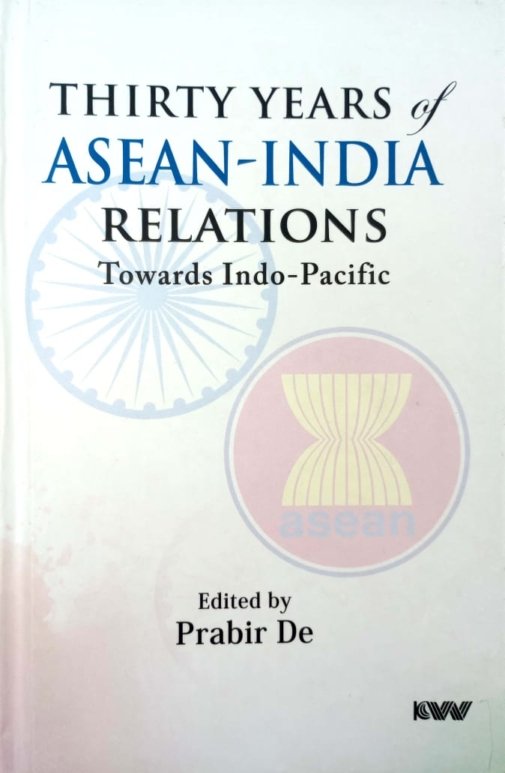
Prabir De, ed., KW Publishers Pvt Ltd, New Delhi 2023
Reviewed by Ms Sushmita Sihwag
In his seminal address at the Shangri-La Dialogue in Singapore in 2018, Prime Minister Narendra Modi made an emphatic appeal for Asian solidarity: “Asia of rivalry will hold us all back. Asia of cooperation will shape this century.” He cited ASEAN as “an example and inspiration” for successful regional integration. Four years later, in 2022, ASEAN and India marked 30 years of dialogue relations and the year was celebrated as the “ASEAN-India Friendship Year”. Aptly titled “Thirty Years of ASEAN-India Relations: Towards Indo-Pacific,” the compilation edited by distinguished economist Professor Prabir De of the New Delhi-based ASEAN-India Centre (AIC)/ Research and Information System for Developing Countries (RIS), is a timely and authoritative work of scholarship commemorating the occasion. A voluminous collection of thirty research papers, the edited volume reviews the accomplishments of ASEAN-India relations in the last three decades, and endeavours to present a roadmap for the forthcoming one.
The book is divided into four major sections and addresses the whole gamut of ASEAN-India relations, from trade and investment to Maritime Domain Awareness (MDA). It begins with a panoramic introduction by the editor, tracing the evolution of ASEAN-India relations, reflecting on contemporary challenges, and identifying opportunities for deepening the partnership in the post-COVID-19 era. Continuing along similar lines, the first part of the book provides a broad overview of diplomatic relations and multidimensional cooperation spanning defence and security, agriculture, energy, technology, trade and investment, tourism, connectivity, and environment. The subsequent parts delve deeper into each of these aspects. Thus, the second part focuses upon traditional areas of cooperation and is subdivided into four sections, namely, trade and investment, production networks, connectivity, and culture. In the third part, the focus shifts to relatively newer areas of cooperation, which include the digital economy, sustainable development, tele-medicine and tele-education, and security issues. The fourth and final part, entitled, “Way Forward”, sheds light on aspects of the partnership that demand greater attention in the next decade, such as MDA, maritime transport, and convergence between the AOIP and IPOI.
In the chapter analysing ASEAN-India trade composition pre- and post-FTA, authors Nida Rahman and Prabir De note the shifting of the bulk of India’s trade with ASEAN between 2010 and 2021, from agricultural raw materials and food to manufactured goods. With regard to the export composition in particular, this shift has been spearheaded by transport equipment, chemicals, and textiles. However, imports of transport equipment from ASEAN have simultaneously increased sharply. Further, imports of high technology products have risen but the country’s exports in this sector continue to consist of low and medium technology products, signalling the need for improving competitiveness in this category. Interestingly, India’s exports-to and imports-from from ASEAN in respect of fuels have witnessed a significant drop. The authors stress that India’s perpetual trade deficit with ASEAN continues to be a cause of concern. In particular, its trade deficit with Indonesia has worsened after the AIFTA implementation, from US$ 5,146.6 million in 2010 to US$ 7,639.5 million in 2020. The same is the case with Thailand and Malaysia. This demands attention from policymakers in New Delhi. Strikingly, India’s trade balance with Singapore, too, has shifted towards a deficit in 2020, from the surplus enjoyed in 2010. The primary cause of these trends continues to be India’s extensive imports of animal or vegetable fats and oils, along with electrical machinery and equipment. On the bright side, meat and edible meat exports to ASEAN formed the largest surplus-generating item, garnering US$ 1.35 billion in 2020. The fact, however, is that while India’s imports from ASEAN are crucial to meet its domestic demand, its exports form only a marginal component of the ASEAN demand. The authors call for urgent remedial action from policymakers within the Government of India if India is serious about achieving a value of US$300 billion in its trade with ASEAN by 2025, without the trade deficit becoming excessively skewed in favour of the latter.
The analysis of agricultural trade data in the subsequent chapter paints a similar picture. India’s agricultural exports and imports to ASEAN have grown in the post-FTA period but its share in ASEAN’s overall agricultural trade remains at a dismal 4 per cent. The authors highlight the need and scope for diversification, given that India and ASEAN have been trading in similar agricultural commodities, such as fish products, cocoa, natural rubber, and cotton. Another reason for the trade imbalance is the frequent imposition of tariff and non-tariff measures (NTMs), which are well known to hinder trade. Likewise, India has not been able to reap the benefits of the “ASEAN-India Trade in Services Agreement” (AITISA), despite it having been ratified by all parties in 2018, due to legal loopholes in the agreement, as well as the lack of implementation of mutual recognition of qualifications, which is further restricted to professional qualifications. When it comes to investment relations, the author spotlights the critical position of Singapore in India’s share of FDI inflows and outflows with ASEAN countries, amounting to 98 per cent and 87 per cent, respectively. He identifies the digital economy, education, healthcare, food processing industry, and start-ups, as potential areas for intensifying investment relations and strengthening regional and global value chains. For this, it is imperative for the trade partners to initiate business facilitation measures, create opportunities for regional investment promotion, skill development, and promote MSMEs. The following chapter calls attention to the importance of enhancing economic freedom, which allowed ASEAN countries to reap the benefits of FDI inflows.
Apart from trade and investment, the compilation also looks into the importance of connectivity for enhancing economic ties. It notes that, in comparison to 2010, the connectivity agenda has now evolved to focus on both, “hard” and multimodal connectivity as well as “soft” connectivity which includes trade facilitation. Further, it emphasises that maritime connectivity is becoming increasingly important against the backdrop of the Indo-Pacific and its rising significance. The focus then shifts to other areas of the relationship, such as culture, and recommends the bolstering of the India-ASEAN ICH (Intangible Cultural Heritage) Network Consortium to deepen the historical cultural links between the two in contemporary times. In the section on new areas of cooperation, the authors call for cooperation in initiating reforms of the global economic order and its various institutions, such as the WTO, IMF, and G20. The chapters on sustainable development highlight the scope for collaboration on low-carbon green growth and achievement of the SDG goals. Further, the book focuses on the need to move beyond the dichotomy of traditional and non-traditional security issues to tackle challenges such as the smuggling of illicit drugs through the “Golden Triangle”, as also piracy and other issues related to maritime security.
In the final section focusing upon a new agenda for the coming decade, the chapter on maritime domain awareness (MDA) underscores three major reasons for India and ASEAN to collaborate and assume joint leadership on MDA, namely, the significance of global maritime trade passing through the region, the problem of piracy in the critical routes within the South China Sea and the Straits of Malacca and Singapore, and finally, inter-State maritime disputes over contested geographical features that plague the region. It recommends the cross-deployment of liaison officers between IFCs/ISCs to build trust, having a single point of contact (SPOC) under a National Maritime Security Coordinator (NMSC) for each member nation, and the conduct of operational exercises between maritime security enforcement agencies.
Overall, “Thirty Years of ASEAN-India Relations” presents an exhaustive coverage of the multidimensional facets of diplomatic relations between ASEAN and India. What makes the edited volume a must-read for any serious scholar of ASEAN-India relations is the deep and incisive first-hand analysis of trade, services, and investment data concerning the two, particularly over the last decade. The data is presented using a variety of graphs and is classified country-wise, commodity-wise, and industry-wise; the analysis also considers the imposition of tariff lines, import penetration of India into ASEAN, as also potential exports to ASEAN in various product categories. The book provides both, a historical overview of the ASEAN-India partnership and a detailed analysis of granular data, which makes it a useful resource for a variety of types of audience, including policymakers, industry analysts, media, and academia.
On the flip side, the attempt to cater to a diverse audience with varying levels of expertise, and the resultant shifting depth of focus across chapters can leave readers confused and make the book hard to follow. Additionally, there is excessive focus on the economic aspect of the partnership, which is something that the Indian policymakers themselves are trying to expand beyond by engaging with the “ASEAN Political-Security Community” (APSC) and the “ASEAN Socio-Cultural Community” (ASCC). Notably, a serious discussion on the deteriorating security situation in Myanmar is starkly absent in the chapters discussing connectivity or security. These infirmities notwithstanding, the compilation presents a comprehensive study of ASEAN-India relations and is a well-referenced book that makes it a valuable scholarly resource.
About the Reviewer
Ms Sushmita Sihwag, who holds a master’s degree in liberal arts from Ashoka University, Sonipat, Haryana, is currently undergoing a six-month internship at the National Maritime Foundation (NMF). She may be contacted at sushmitashwg95@gmail.com.


Leave a Reply
Want to join the discussion?Feel free to contribute!