
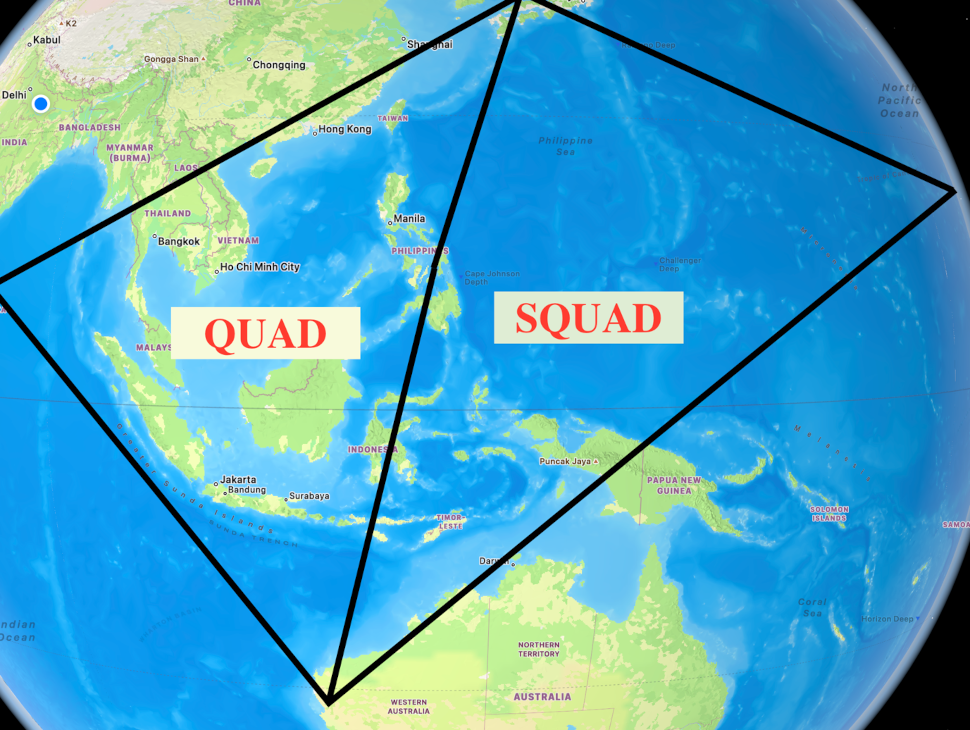
The characteristically dynamic Indo-Pacific region witnessed another seminal geopolitical development on 02 May 2024. At the headquarters of its Indo-Pacific Command (INDO-PACOM) in Hawaii, the United States (US) teamed up with its two regional allies, Australia and Japan, to form a new grouping amongst them, which Pentagon nicknamed (the Indo-Pacific) “SQUAD”.[1] The SQUAD joins the two other minilateral groups raised by the US earlier as part of its Indo-Pacific Strategy, viz., the “Quadrilateral Dialogue” (QUAD) involving Australia, India, Japan and the US; and the AUKUS alliance comprising Australia, the United Kingdom (UK) and the US. It is a well-known fact that these geopolitical groupings are meant to temper China’s increasing politico-military assertiveness in the Indo-Pacific region.
The formation of SQUAD follows a series of confrontations between China and the Philippines in the South China Sea (SCS) that have occurred since August 2023. It began with ships of the China Coast Guard (CCG) — acting in concert with those of the Chinese Maritime Militia and the PLA Navy providing distant-support — using water cannons and floating barriers against small Filipino vessels. The CCG’s aim was to prevent the routine resupply mission to the Filipino military outpost of the BRP Sierra Madre on the Second Thomas Shoal (of the disputed Spratly Islands), which is located within the Philippines’ 200-nautical mile Exclusive Economic Zone (EEZ).[2] Ostensibly, the trigger for the SQUAD was the escalation by China, in March 2024, when the water-cannon of the CCG ships caused damage to the Filipino vessels and even injuries to the personnel on board them.[3] This led to combined military exercises and naval patrols in the SCS, in early-April 2024, amongst the four nations. Reacting to these combined manoeuvres, China’s Global Times cited a Chinese military expert saying,
“The US is clearly trying to rally its allies — Japan and Australia — to support the Philippines, encourage the Philippines to engage in more military provocations in the South China Sea, exacerbate the complexity of the regional situation, and then find excuses to strengthen the military presence of the US, Japan and Australia in the South China Sea”.[4]
The four-nation combined military manoeuvres in the SCS were followed by the Hawaii meeting of their Defence heads on 02 May 2024, as mentioned above, leading to the formation of SQUAD. Reacting to this development, China’s South China Morning Post stated that the SQUAD could lead to “elevating the Philippines’ status beyond that of a ‘junior partner’”.[5] Whereas the validity of such assertion is debatable, the US did declare its intent to upgrade Manila’s military defences by providing a US$ 35 billion investment over next few years. The specific terms of security assistance to the Philippines by the other three SQUAD partners are also being discussed. From Manila’s perspective, therefore, the participation of the Philippines in the SQUAD will provide some much-needed pushback against Beijing’s actions in the SCS, and reinforce the deterrence being attempted by Manala.
The decision of the US and its regional allies to involve the Philippines in this new exclusive grouping (SQUAD) is unlikely to have been taken overnight. It is far more likely to have been based upon profound deliberations over the past few years, not merely in respect of developments in SCS, but beyond these to the risk posed by China to the rules-based order in the broader Indo-Pacific. Whereas the precise origin of the SQUAD is not known, the June 2023 meeting among the four (SQUAD) nations in Singapore on the sidelines of the Shangri La Dialogue was certainly an important ‘waypoint’. It is also known that this meeting was preceded by related discussions in the White House much earlier, albeit involving only the US, Australia, and Japan.[6]
As an advocate of international law and a rules-based order, India is a key geopolitical player in the Indo-Pacific, and an acknowledged partner of Australia, Japan, and the US in the QUAD. Further, India has vital geopolitical — including geoeconomic — stakes, specifically in the SCS, which necessitates a benign and secure environment in this strategically-located waterbody. This policy brief aims to analyse, from an Indian perspective, the deeper rationale that may have driven the US and its three Indo-Pacific allies to form the SQUAD — despite the existence of the QUAD and AUKUS — along with its purpose and likely characteristics. The analysis would also factor India’s own geopolitical interests and identify New Delhi’s concerns emanating from this development.
China’s ‘Lawfare’
The SQUAD flows out of China’s historic maritime claims in the SCS, as represented by its “nine-dash line”. The 2016 verdict of the Permanent Court of Arbitration (PCA) had invalidated this claim in the Philippines-China legal case.[7] This notwithstanding, since the legal proceedings were initiated in 2013, China has intensified its ‘lawfare’ activities to interpret international law in its favour. These activities include China’s land reclamation in the SCS ‘reefs’ to alter their legal status to ‘islands’,[8] its cartographic ‘aggression’ to reinforce its SCS claims,[9] and its ‘grey-zone’ operations involving the CCG and its State-controlled fishing boats (maritime militia) to functionally assert these claims, as has been mentioned earlier.
Notably, China has been using a variety of forms of lawfare against India, too, ranging from promulgating maps showing the India’s provincial state of Arunachal Pradesh as Chinese territory[10]; its ‘salami-slicing’ across the India-China land border, which led to the May 2020 bloody military confrontation in the Galwan Valley (Ladakh);[11] and its military surveys in Indian maritime zones using research ships, underwater gliders, and its maritime militia in the guise of its distant-water fishing fleet.[12]
India’s Stakes in SCS
India’s key interests in the SCS may be broadly summarised as the increasing proportion of its seaborne merchandise trade moving east (about 55 per cent of its total trade[13]) and the safety of Indian seafarers manning the numerous merchant vessels that transit the SCS. India has also been making efforts to diversify the sources of its hydrocarbon imports to the east, as exemplified by India’s stakes in Vietnamese EEZ and the development of the Chennai-Vladivostok maritime trade and energy corridor, which passes through the SCS.[14] China’s objection to India-Vietnam cooperation on oil exploration in 2011,[15] and its disruptive actions in Vietnam’s EEZ since 2014,[16] exemplify the risk to India’s interests in the SCS.
Also, China’s “Maritime Police Law” of April 2021 imposes a variety of restrictions on navigational freedoms within “the sea areas within the jurisdiction of the People’s Republic of China”, presumably within the nine-dash line, and empowers the CCG to enforce this national law.[17] This implies that India’s naval mobility in much of the SCS could well be restricted. Additionally, in the ongoing negotiations over the SCS Code of Conduct between the Association of Southeast Asian Nations (ASEAN) and China, the latter seeks a veto power over the conduct of military exercises and resource-prospecting in SCS by the ASEAN States in cooperation with third-parties such as India.[18] This reinforces the risk to India’s legitimate rights and interests in the SCS — rights that have been bestowed by the United Nations Convention on the Law of the Sea, 1982 (UNCLOS).
In any case, the fructification of China’s SCS claim would have adverse ramifications for India’s national security. It would not only embolden Beijing to push its own territorial claims against India but would also extend China’s naval reach southwards towards the southeast Asian maritime chokepoints and the Indian Ocean.
Is the QUAD or India Insignificant in the Indo-Pacific Strategy of the US?
The QUAD is the oldest minilateral grouping in the Indo-Pacific architecture and it has successfully endured China’s scepticism, derision, objections, and geopolitical stratagems. It was initially formed in 2007 and revived a decade later in response to China’s increased politico-military assertiveness in the SCS,[19] which was even then already spilling over into the Indian Ocean. The QUAD has held out much promise in terms of its ability to temper China’s behaviour, including through programmes such as the “Indo-Pacific Partnership for Maritime Domain Awareness” (IP-MDA),[20] “Supply Chain Resilience Initiative” (SCRI),[21] and six “leader-led” working groups — on health security, climate, critical and emerging technology, space, infrastructure and cyber.[22]
In spatial terms too, the QUAD’s outreach has expanded to encompass not just ASEAN but much beyond SE Asia to incorporate the “Pacific Islands Forum” (PIF) and the “Indian Ocean Rim Association” (IORA).[23] Until recently, there were even speculations that the membership of the QUAD might be expanded to accommodate other willing partners such as South Korea.[24] Therefore, the formation of SQUAD leads to a few valid questions. Why did the US go beyond the QUAD to raise more exclusive forums such as AUKUS and the SQUAD? Why was the QUAD itself not expanded instead? Has the QUAD lost relevance for the US? If so, is the SQUAD an alternative to the QUAD?
Furthermore, amongst QUAD’s constituent States, India is the only one excluded in the SQUAD. It was similarly excluded in the formation of AUKUS. This has led to further speculation. For instance, the title of a Malaysian news-report says, “U.S. replaces India with Philippines, as Quad becomes Squad”.[25] So, has the Philippines displaced India in the US Indo-Pacific strategy? Is this an indication that the US is losing trust in India as a reliable partner? Above all, does India run the risk of being marginalised in the Indo-Pacific construct?
To address these questions, it is essential to examine the timelines of relevant key-developments within the Indo-Pacific. This exercise is necessary to comprehend the strategic motivations and imperatives of the US and India, which led to the shaping of the QUAD’s agenda, and the formation of AUKUS, in the first place.
QUAD: For “Holistic” Security
The QUAD (2.0) was revived in November 2017, concurrently with the “Indo-Pacific” strategy announced by then US President Donald Trump during his Asia tour. Its implicit but nevertheless clear purpose was China’s strategic containment, and its focus was on ‘hard’ military security.[26] From the Indian perspective, this was not conducive for regional stability as it was likely to polarise the Indo-Pacific, making it “another theater of the ‘Thucydides Trap’, in which rising and established powers fight to impose their dominance”.[27] Accordingly, while articulating India’s “Indo-Pacific Vision” at the June 2018 “Shangri la Dialogue”, Prime Minister (PM) Narendra Modi implicitly distanced India from the divisive nature of the US Indo-Pacific Strategy, and attempted to assuage regional anxieties relating to the Indo-Pacific concept. He said that, “Indo-Pacific was not a strategy directed against any country; it is “a positive one (with) many elements (of security)”.[28] What this connotes is that “security” refers to a multitude of issues beyond the military dimension alone, such as human safety and healthcare, logistic connectivity, environmental preservation, climate change, and the management of emerging technologies.
In subsequent years, India also tried to correct the misperception of the QUAD being a quasi-military alliance. For this reason, it was initially reluctant to incorporate Australia into the series of naval exercises that bear the generic name MALABAR, which were expanded in 2015 from the bilateral (India-US) level to the trilateral (India-US-Japan) format.[29] Australia’s inclusion would have reinforced China’s allegation that the QUAD was aspiring to be “an Asian NATO”.[30] However, after the Galwan Valley clash with China in May 2020, India was compelled to accommodate Australia in MALABAR to reinforce its own deterrence against China.[31] Hence, although Exercise MALABAR was not a QUAD event per se, the fact that it incorporated all four constituent States of the QUAD carried an unmistakable message.
This notwithstanding, India continued to push for a more holistic and benign security agenda for the QUAD. The wisdom of this approach was validated by the humanitarian crisis caused by COVID-19 pandemic in 2020-21, when Indian warships transported vaccines and oxygen cylinders to countries across the Indo-Pacific, mainly under the QUAD banner.[32] By mid-2021, therefore, the US eventually relented, and “outlined a softer focus for QUAD”.[33] At the QUAD Leaders’ Summit held in September 2021, the agenda covered benign collaborative themes such as vaccines, digital connectivity, green shipping networks, resilient supply chains, and cyber-security.[34] This did not mean that the QUAD agenda was devoid of military cooperation. For instance, the “QUAD-level” naval Exercise MALABAR continued. Also, in May 2023, the QUAD Chiefs of Defence Staff met in California to discuss military issues.[35] However, military security was not to be the sole objective of the QUAD.
The QUAD was not expanded because in its incorporation of India, diversity was already a ‘given’. India is not a military ally of the US and is the only one among the QUAD partners that shares a land border with China. Expanding the QUAD would have added to its complexity, leading to complications in reaching consensus. India itself was not in favour of its expansion, or even having it institutionalised, and sought to keep the grouping an informal consultative forum.
AUKUS: Military Security beyond QUAD
Whereas India has had its say in shaping the QUAD’s agenda, America’s focus on ‘hard’ military approach against China did not wane. So, in September 2021, it turned to its two anglophone treaty allies, Australia and the UK, to raise the AUKUS grouping.[36] While promoting Australia as a suitable power to operate and build nuclear attack submarines (SSN), AUKUS was also meant to diversify America’s own strategic options into the hard military realm beyond the QUAD’s softer agenda. Australia’s SSN operations in the western Pacific would be a valuable supplement to the US forces seeking to constrain the PLA Navy’s operational freedom.
Notably, when the AUKUS was formed in 2021, and ASEAN States were divided on its merits, India saw it as a valuable tool within the broader Indo-Pacific architecture to supplement the QUAD’s deterrent ability against China. The value of AUKUS also lay in the fact that it would enable the QUAD to focus on “softer” issues of Indo-Pacific collaboration.
In any event, AUKUS could not have involved India. Without a binding alliance commitment, the transfer of US SSNs or associated technology to New Delhi had been virtually inconceivable due to the stringency of US laws — notably the 1976 US Arms Export Control Act (AECA).[37] Even in the case of Australia, the US encountered serious challenges from its lawmakers. These challenges are still in the process of being resolved by “exemption legislation” through a 2023 Bill presented to the US Congress called the TORPEDO Act, which is yet to be enacted into law.[38]
AUKUS could potentially deliver on ‘hard security’ against China, but with a very long ‘gestation period’. Besides, India’s naval power has always been considered to be adequately consequential to counter China in the Indian Ocean. So, the US had to push India again into delivering on ‘hard’ military collaboration. Seeing the scheduled visit of the Indian PM to the US in June 2023 as an opportunity, the US Senate’s “India Caucus” proposed to the Congress that India be incorporated into a “NATO Plus” grouping.[39] The PM’s visit did succeed in enabling expeditious US defence hardware transfers to India, much like those to USA’s defence treaty allies. However, the “NATO Plus” proposal was firmly rejected by India.[40]
SQUAD: Military Security beyond AUKUS
The formation of the SQUAD, driven by America’s compelling (hard) security imperatives, may be seen in the aforementioned context. It is widely speculated that the letter ‘S’ in SQUAD stands for ‘Security”[41] but it is more likely to represent the SCS as the focus of SQUAD. In March of 2024, the US warned China that “Article IV of the 1951 US-Philippines Mutual Defense Treaty (MDT) extends to armed attacks on Philippine armed forces, public vessels, or aircraft – including those of its Coast Guard – anywhere in the South China Sea”.[42] However, through its grey-zone tactics, China has succeeded in keeping the escalation against Philippines below America’s ‘red-line’. This made it essential for the US to demonstrate to China — and to its regional allies and partners — that America’s commitment to the Indo-Pacific region has not waned despite its ongoing strategic compulsions relating to the wars in Ukraine and Palestine.
Unlike the QUAD’s broader scope, both spatially (encompassing the entire Indo-Pacific) and in terms of issues (holistic security), the SQUAD’s focus is likely to be on SCS and legal issues. This group is necessary to prevent China from misinterpreting international law in its favour. It could effectively supplement the US Navy’s Freedom of Navigation Operations (FONOPS) against China’s “excessive maritime claims”.[43] The capability-enhancement and hardware-centric capacity-building of the Filipino military may only be a byproduct of such collaboration, as has been the case of US-India collaboration under the QUAD. With the Philippines being a relatively minor actor in regional affairs vis-à-vis India as a regional power, the prospect of the former displacing India in the US Indo-Pacific strategy — or in the new Indo-Pacific construct — is inconceivable.
India-US: Convergence within Divergence
Nevertheless, the formation of the SQUAD represents a fundamental divergence between America’s ‘hard’ versus India’s ‘soft’ approach to the Indo-Pacific.[44] India’s divergent foreign policy approach, such as is evidenced by its continuing close ties with Russia (amidst the Ukraine War[45]) and Iran (the Chahbahar port long-term deal[46]) may have also contributed to the US diversifying its strategic options away from the QUAD and India, which led to the SQUAD. However, geopolitical and strategic realities would appear to justify the formation of SQUAD, as it did in case of AUKUS.
As was true of AUKUS, the raising of SQUAD needs to be seen in context of the emerging concepts of ‘plurilateralism’ and ‘minilateralism’, which go beyond ‘multilateralism’ relating to large groupings that are often constrained in their ability to reach consensus. These concepts are also rooted in the rationale of international statecraft, which dictates that States diversify their choice of partners to whatever extent possible in order to de-risk their strategic stakes. India itself firmly believes in these concepts. Indeed, it is this belief that has led it to join various multilateral groupings beyond the QUAD such as the ASEAN Regional Forum (ARF), the BRICS (Brazil, Russia, India, China and South Africa) forum, and the RIC (Russia, India and China) forum.[47] In the context of national security, the Russia-Ukraine War validates the value of plurilateralism and minilateralism. Ukraine compromised its security interests by depending merely on the United Nations. This was a lesson learnt by other European States such as Finland and Sweden, which lost no time in applying for membership of the North Atlantic Treaty Organization (NATO), and were admitted into the NATO alliance in 2023 and 2024, respectively.[48] This is not to say, however, that India ought to join the NATO, since each State must be free to choose the kind of partners and relationships that it is comfortable with. This may be seen in context of the statement made by India’s EAM, Dr S Jaishankar, who while speaking at the Raisina Dialogue in 2021, said, “Quad is not ‘Asian NATO’, India never had ‘NATO mentality’”.[49]
The formation of the SQUAD, therefore, ought to be seen in the context of a US attempt at de-risking through the diversification of exclusive groupings. The SQUAD, therefore, is not an alternative to QUAD but complementary to it. This is evident in the view expressed by Ashley Tellis, “Where balancing China is concerned, the QUAD is only one arrow among many in the US quiver.”[50]
To some extent, the formation of the SQUAD may adversely impact India’s increasing geopolitical influence in the western Pacific. Such influence is necessary for India, not only to preserve, protect, and promote its vital interests in the area, but also to further its broader normative aim of regional stability, as articulated in its Indo-Pacific Vision, and more specifically, its Act East Policy. It is, however, noteworthy that India is likely to remain central to the US Indo-Pacific Strategy in the Indian Ocean, while also being in a favourable position to influence events in the critical maritime chokepoints leading to and from the Indian Ocean.
Conclusion
In the foreseeable future, China is likely to remain America’s peer competitor, and therefore, India’s strategic relevance to the US is unlikely to diminish in the now well-established Indo-Pacific construct. On the other hand, India will need to bolster its deterrence against China, not only in conventional terms, but also in strategic ones (not necessarily limited to nuclear deterrence). This translates into a strategic convergence between India and the US, along with the treaty allies of the latter, which could be forged in any form, but is currently best represented by the QUAD. Other minilateral groupings that the US has forged — or is likely to forge in the foreseeable future — will not be detrimental to India’s broader interests in the context of its strategic deterrence against China and the regional balance of power.
The formation of the SQUAD needs to be viewed in India through a pragmatic lens. Akin to the deployment of Australian nuclear attack submarines in the western Pacific via AUKUS, the heightened military activities among the SQUAD partners in the SCS would compel China to focus upon its eastern maritime frontiers, thereby offsetting its strategic attention to the India-China border, and towards the Indian Ocean.
Of course, India’s specific geopolitical interests may not always coincide with those of its QUAD partners. Therefore, New Delhi would need to avoid being sidelined in the affairs of the area east of the Malacca Straits. To achieve this, India is not devoid of alternative options. It has already raised its comprehensive security profile among littorals of the western Pacific such as the constituent States of ASEAN, Japan, South Korea, and Taiwan, particularly through capability enhancement and hardware-centric capacity-building ability of ASEAN maritime forces. The transfer of military hardware such as corvettes and patrol vessels,[51] BrahMos missiles,[52] and air-defence systems to the SCS disputant States of ASEAN, are cases in point. It is noteworthy that whereas both the US and India are committed to “ASEAN centrality”,[53] in their respective ‘hard’ and ‘soft’ conceptualisations of the Indo-Pacific, the “ASEAN Outlook on the Indo-Pacific” (AOIP) is more closely aligned with India’s approach. This confers upon India significant influence in the developments in the eastern part of Indo-Pacific, including in the SCS.
******
About the Author
Captain Gurpreet Khurana is a member of the Adjunct Faculty of the Naval War College, Goa, and a former Executive Director, National Maritime Foundation (NMF), New Delhi. He may be reached at gurpreet.bulbul@gmail.com. Views expressed in this article are those of the author and are not necessarily endorsed by either the Naval War College or the National Maritime Foundation.
Endnotes:
[1] Peter Martin and Ben Westcott, “The U.S. Is Assembling a ‘Squad’ of Allies to Counter China in the Indo-Pacific”, Time, 03 May 2024. https://time.com/6974257/us-australia-japan-philippines-squad-china/
[2] Dzirhan Mahadzir, “China Coast Guard Blast Philippine Military Resupply with Water Cannons”, USNI News, 07 August 2023. https://news.usni.org/2023/08/07/video-china-coast-guard-blast-philippine-military-resupply-with-water-canons
[3] “Philippines says three soldiers hurt by China water cannon”, The Economic Times, 24 March 2024. https://economictimes.indiatimes.com/news/defence/philippines-says-three-soldiers-hurt-by-china-water-cannon/articleshow/108747464.cms?from=mdr
[4] Xu Keyue, “US-led quadrilateral defense talks deemed to target SCS, exacerbating regional risks”, Global Times, 28 April 2024. https://www.globaltimes.cn/page/202404/1311432.shtml
[5] Maria Siow, “New ‘Squad’ bloc could allow Philippines to ‘borrow strength’ of Australia, Japan, US to counter China”, South China Morning Post, 09 May 2024. https://www.scmp.com/week-asia/politics/article/3261905/new-squad-bloc-could-allow-philippines-borrow-strength-australia-japan-us-counter-china
[6] “After Quad, US forms ‘Squad’ to counter China in Indo-Pacific”, Times of India, 07 May 2024. https://timesofindia.indiatimes.com/world/us/after-quad-us-forms-squad-to-counter-china-in-indo-pacific/articleshow/109918889.cms
[7] ‘The South China Sea Arbitration (Philippines versus People’s Republic of China), Press release of the Permanent Court of Arbitration (PCA), 12 July 2016. https://pca-cpa.org/en/news/pca-press-release-the-south-china-sea-arbitration-the-republic-of-the-philippines-v-the-peoples-republic-of-china/
[8] Legally called Low-Tide Elevations (LTE), these reefs are submerged during high tide, and therefore, are not entitled to any maritime zone.
[9] Ma Zhenhuan, ‘2023 edition of national map released’, China Daily, 28 August 2023. https://www.chinadaily.com.cn/a/202308/28/WS64ec91c2a31035260b81ea5b.html,
[10] ‘Philippines, Malaysia, Vietnam and Taiwan join India in rejecting China’s new map’, The Economic Times, 31 August 2023. https://economictimes.indiatimes.com/news/defence/philippines-malaysia-vietnam-and-taiwan-join-india-in-rejecting-chinas-new-map/articleshow/103255646.cms?from=mdr
[11] Jeff M Smith, “The Galwan Killings Are the Nail in the Coffin for China and India’s Relationship”, Foreign Policy, 26 June 2020. https://foreignpolicy.com/2020/06/26/galwan-border-china-india-war-conflict/
[12] Anushka Saxena, “India Has Good Reason to Be Concerned About China’s Maritime Research Vessels”, The Diplomat, 02 February 2024. https://thediplomat.com/2024/02/india-has-good-reason-to-be-concerned-about-chinas-maritime-research-vessels/ and “Chinese Trawlers Jeopardise India’s Maritime Security”, The Daily Pioneer, 07 October 2021. https://channel16.dryadglobal.com/chinese-trawlers-jeopardise-indias-maritime-security
[13] ‘Indian Trade through South China Sea’, Lok Sabha Unstarred Question No. 4832, Press Release, Ministry of External Affairs (MEA), Government of India, 01 April 2022. https://www.mea.gov.in/lok-sabha.htm?dtl/35118/question+no+4832+indian+trade+through+south+china+sea#:~:text=Ministry%20of%20External%20Affairs%20Government%20of%20India&text=(a)%20to%20(e),China%20Sea%20and%20Malacca%20Straits.
[14] Keshav Padmanabhan, “Jaishankar, Lavrov agree to establish Chennai-Vladivostok Maritime Corridor between India & Russia”, The Print, 27 December 2023. https://theprint.in/diplomacy/jaishankar-lavrov-agree-to-establish-chennai-vladivostok-maritime-corridor-between-india-russia/1902456/
[15] Ananth Krishnan, ‘China warns India on South China Sea exploration projects’, The Hindu, 15 September 2011, available at https://www.thehindu.com/news/international/china-warns-india-on-south-china-sea-exploration-projects/article2455647.ece
[16] Nguyen Phuong Linh and Sui-Lee Wee, “Vietnam, China trade barbs after Vietnamese fishing boat sinks”, Reuters, 27 May 2014. https://www.reuters.com/article/us-vietnam-china/vietnam-china-trade-barbs-after-vietnamese-fishing-boat-sinks-idUSKBN0E70CF20140527/ and “The Operation of the HYSY 981 Drilling Rig: Vietnam’s Provocation and China’s Position”, Press release, Embassy of the People’s Republic of China in the Lao People’s Democratic Republic, 09 June 2014. http://la.china-embassy.gov.cn/eng/news/201406/t20140609_1546932.htm
[17]Maritime Traffic Safety Law of the People’s Republic of China, Order No 79 of PRC, 29 April 2021. http://lawinfochina.com/display.aspx?lib=law&id=35408
[18] Carl Thayer, ‘A Closer Look at the ASEAN-China Single Draft South China Sea Code of Conduct’, The Diplomat, 03 August 2018. https://thediplomat.com/2018/08/a-closer-look-at-the-asean-china-single-draft-south-china-sea-code-of-conduct/
[19] “Quadrilateral security dialogue: India, Australia, Japan, US hold talks on Indo-Pacific cooperation”, The Times of India, 12 November 2017. https://timesofindia.indiatimes.com/india/quadrilateral-security-dialogue-india-australia-japan-us-hold-talks-on-indo-pacific-cooperation/articleshow/61616602.cms
[20] “Indo-Pacific Partnership for Maritime Domain Awareness”, Website of the Department of the Prime Minister and Cabinet, Australian Government. https://www.pmc.gov.au/resources/quad-leaders-summit-2023/indo-pacific-partnership-maritime-domain-awareness
[21] The SCRI was initially a trilateral (Australia-India-Japan) initiative, which the US joined later. Felix Kim, “Quad partners push supply chain resilience”, Indo-Pacific Defense Forum, 13 April 2021. https://ipdefenseforum.com/2021/04/quad-partners-push-supply-chain-resilience/ and Somen Jagtap, “Supply Chain Resilience Initiative (SCRI) to Address Chinese Dominance”, SCM Globe, 09 June 2022. https://www.scmglobe.com/supply-chain-resilience-initiative-scri-to-address-chinese-dominance/
[22] “Quad Working Groups: Quad Leaders’ Summit 2023”, Website of the Department of the Prime Minister and Cabinet, Australian Government. https://www.pmc.gov.au/quad-2023/quad-working-groups
[23] Premesha Saha, “The ASEAN, PIF, and IORA drive the agenda of the Quad Leaders’ Meeting in Hiroshima”, Observer Research Foundation, 25 May 2023. https://www.orfonline.org/expert-speak/the-asean-pif-and-iora-drive-the-agenda-of-the-quad-leaders
[24] Dinakar Peri, “South Korea keen on joining Quad, talks on upgrading CEPA underway: envoy”, The Hindu, 12 September 2023. https://www.thehindu.com/news/national/south-korea-keen-on-joining-quad-talks-on-upgrading-cepa-underway-envoy/article67299760.ece
[25] Vijay Prashad, “U.S. replaces India with Philippines, as Quad becomes Squad”, Malaysia Sun, 17 May 2024. https://www.malaysiasun.com/news/274375874/us-replaces-india-with-philippines-as-quad-becomes-squad
[26] “Why Trump keeps saying Indo-Pacific”, BBC News, 9 November 2017. https://www.bbc.com/news/av/world-asia41912990/why-trump-keeps-saying-indo-pacific
[27] Gurpreet S Khurana, “Trump’s new Cold War alliance in Asia is dangerous”, The Washington Post, 14 November 2017. https://www.washingtonpost.com/news/theworldpost/wp/2017/11/14/trump-asia-trip/
[28] Text of Prime Minister’s Keynote Address at Shangri La Dialogue, Press Information Bureau (PIB), Government of India,
Prime Minister’s Office, 01 June 2018. http://pib.nic.in/newsite/PrintRelease.aspx?relid=179711
[29] ‘Australia ready to join Malabar naval exercise’, Business Standard, 13 December 2017. https://www.business-standard.com/article/news-ians/australia-ready-to-join-malabar-naval-exercise117121301562_.html and Rajeswari Pillai Rajagopalan, “Will India now finally invite Australia to the Malabar Exercise?”, Observer Research Foundation, 01 February 2020. https://www.orfonline.org/research/will-india-now-finally-invite-australia-to-the-malabar-exercise-60976
[30] Jagannath Panda, “Beijing’s “Asian NATO” Maxim on Quad is Structural”, Pacific Forum Honolulu, 22 November 2019. https://idsa.in/system/files/news/PacNet-Commentary-Beijing.pdf
[31] “Malabar 2020 Naval Exercise”, Press Release, Ministry of Defence, Government of India, 19 October 2020. https://pib.gov.in/PressReleasePage.aspx?PRID=1665830
[32] Teesta Prakash, “The Quad gives a boost to India’s vaccine diplomacy”, The Interpreter, 16 March 2021. https://www.lowyinstitute.org/the-interpreter/quad-gives-boost-india-s-vaccine-diplomacy
[33] Suhasini Haidar, “U.S. outlines a softer focus for Quad”, The Hindu, 11 October 2021. https://www.thehindu.com/news/national/biden-administration-outlines-a-softer-focus-for-quad/article36930310.ece
[34] “Prime Minister’s participation in the Quad Leaders’ Summit”, Press Release, Ministry of External Affairs (MEA), Government of India, 24 September 2021. https://www.mea.gov.in/press-releases.htm?dtl/34324/Prime_Ministers_participation_in_the_Quad_Leaders_Summit
[35] Shishir Gupta, “Quad steps up to security, top commanders to meet in California”, Hindustan Times, 13 May 2023. https://www.hindustantimes.com/world-news/quad-steps-up-security-top-commanders-to-meet-in-california-101683936115969.html
[36] “US, UK and Australia agree new Indo-Pacific security pact”, Al Jazeera News, 15 September 2021.
[37] Piper Alderman, “The US AUKUS Undersea Act, ITAR & Transfer of US Nuclear Submarines to Australia”, Lexology, 28 June 2023. https://www.lexology.com/library/detail.aspx?g=1930c2f4-975d-431f-987e-d5826c9558f1
[38] Truncating Onerous Regulations for Partners and Enhancing Deterrence Operations (TORPEDO) Act, 2023. Bill S. 1471 dated 04 May 2023 presented to the 118th US Congress (2023-24). https://www.congress.gov/bill/118th-congress/senate-bill/1471/text?s=1&r=96
[39] “Senate India Caucus to introduce bill to add India to NATO Plus bloc”, National Herald, 21 June 2023. https://www.nationalheraldindia.com/international/senate-india-caucus-to-introduce-bill-to-add-india-to-nato-plus-bloc
[40] “US lawmakers get India’s Yes to special benefits, No to NATO Plus”, The Statesman, 28 June 2023. https://www.thestatesman.com/world/us-lawmakers-get-indias-yes-to-special-benefits-no-to-nato-plus-1503194872.html
[41] Oorja Tapan, “The Squad: Adding an ‘S’ for Security”, The Diplomat, 11 May 2024. https://thediplomat.com/2024/05/the-squad-adding-an-s-for-security/
[42] “U.S. Support for the Philippines in the South China Sea”, Press Statement, US Department of State, 23 March 2024. https://www.state.gov/u-s-support-for-the-philippines-in-the-south-china-sea-9/#:~:text=The%20United%20States%20reaffirms%20that,in%20the%20South%20China%20Sea
[43] Annual Freedom of Navigation Report, Fiscal Year 2022, Report to the Congress, US Department of Defense, April 2023. https://policy.defense.gov/Portals/11/Documents/FON%20Program%20Report_FY2022.pdf?ver=8of4c3mCAOnzfa4AfTYIyg%3d%3d
[44] Gurpreet S Khurana, “Where from… Whither to: Trends and Tribulations of the Indo-Pacific Concept”, The Indo-Pacific
Geopolitical Observatory, Institut de Relations Internationales et Strategiques (IRIS), France. October 2023. https://www.iris-france.org/wp-content/uploads/2023/10/ObsIndoPac_note_5.pdf
[45] Vikas Pandey, “2+2 talks: How India and US agreed to differ on Ukraine war”, BBC, 12 April 2022. https://www.bbc.com/news/world-asia-india-61042314
[46] Meryl Sebastian, “Chabahar Port: US says sanctions possible after India-Iran port deal”, BBC, 14 May 2024. https://www.bbc.com/news/world-asia-india-68988190
[47] “The World needs Plurilateralism as Multilateralism has Fallen Short: EAM Jaishankar”, ETV Bharat, 14 April 2021. https://www.etvbharat.com/english/bharat/the-world-needs-plurilateralism-as-multilateralism-has-fallen-short-eam-jaishankar/na20210414233406909
[48] “Finland joins NATO as 31st Ally”, NATO website, 04 April 2023. https://www.nato.int/cps/en/natohq/news_213448.htm and “Sweden officially joins NATO”, NATO website, 07 March 2024. https://www.nato.int/cps/en/natohq/news_223446.htm
[49] “EAM at #Raisina 2021 session on ‘Crimson Tide, Blue Geometries: New Partnerships for Indo-Pacific’”, YouTube video, 48:55, “Ministry of External Affairs India”, 14 April 2021, https://www.youtube.com/watch?v=kiDUKO9liro and Nayanima Basu, “Quad is not ‘Asian NATO’, India never had ‘NATO mentality’, Jaishankar says”, The Print, 14 April 2021. https://theprint.in/diplomacy/quad-is-not-asian-nato-india-never-had-nato-mentality-jaishankar-says/639924/
[50] Ken Moriyasu, “Philippines first, India later, as U.S. prioritizes ‘Squad’ allies”, Nikkei Asia, 08 May 2024. https://asia.nikkei.com/Politics/International-relations/Indo-Pacific/Philippines-first-India-later-as-U.S.-prioritizes-Squad-allies
[51] in June 2022, India handed over twelve new high-speed patrol boats to Vietnam. ‘India hands over 12 high-speed Guard Boats to Vietnam under USD 100 million Defence Line of Credit’, The Economic Times, 09 June 2022. https://government.economictimes.indiatimes.com/news/technology/india-hands-over-12-high-speed-guard-boats-to-vietnam-under-usd-100-million-defence-line-of-credit/92109386
[52] In April 2024, India began delivering BrahMos missiles to the Philippines. has Dinkar Peri, “India delivers first batch of BrahMos to Philippines”, The Hindu, 19 April 2024. https://www.thehindu.com/news/national/india-delivers-first-batch-of-brahmos-to-philippines/article68084161.ece
[53] “Indo-Pacific Strategy of the United States”, The White House (Washington D.C.), February 2022, 9. https://www.whitehouse.gov/wp-content/uploads/2022/02/U.S.-Indo-Pacific-Strategy.pdf and “Prime Minister’s participation in the 20th ASEAN-India Summit and the 18th East Asia Summit”, Prime Minister’s Office, Government of India, 07 September 2023. https://pib.gov.in/PressReleasePage.aspx?PRID=1955355#:~:text=Prime%20Minister%20reaffirmed%20ASEAN%20centrality,in%20a%20time%20bound%20manner


Leave a Reply
Want to join the discussion?Feel free to contribute!