
 Voice of america
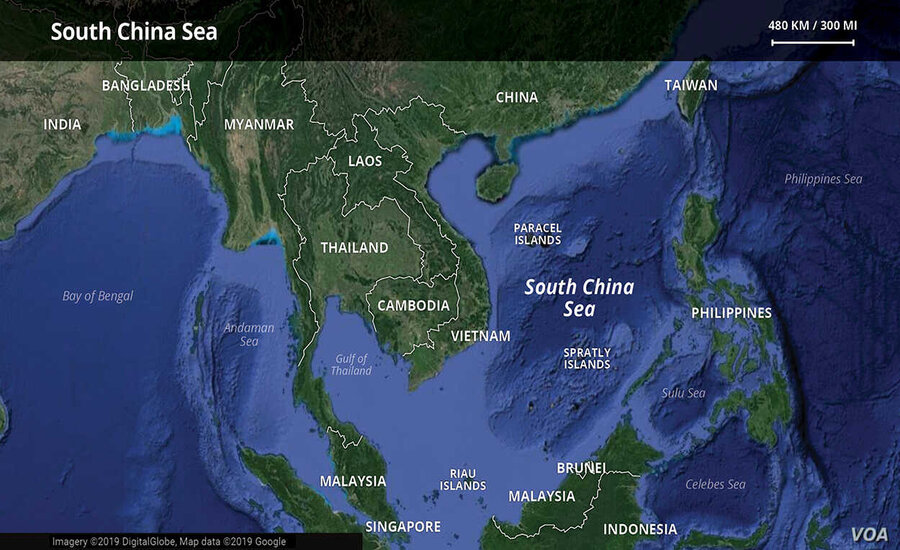
On 16 December 2016, the USNS Bowditch was conducting oceanic survey, 50 nautical miles (NM) northwest of Subic Bay, Philippines. As part of these operations, the vessel had deployed two Underwater Unmanned Vehicles (UUV), which as per the Pentagon, were being used in an unclassified program to collect oceanographic data. While the Bowditch was preparing to recover these underwater drones, a Chinese naval ship, which had been shadowing the US ship, deployed a boat with sailors and picked up one of the drones, even as the US crew looked on. The Pentagon issued a strong statement and demanded the immediate return of the UUV, even as China claimed that it had seized it ‘in order to prevent the device from causing harm to the safety of navigation and personnel of passing vessels’. Four days later, on 20 December 2016, China handed over the drone to the crew of USS Mustin, bringing the episode to a mutually acceptable conclusion. It has, however, raised a number of issues, both from legal and security perspectives, especially in the context of other developments that point to increasing militarization of the South China Sea (SCS) dispute.
From a legal viewpoint, this incident underscores the absence of a uniform interpretation of the Law of the Sea (LoS). The Bowditch was operating in the Philippine Exclusive Economic Zone (EEZ) but outside of its territorial seas. This location was also within 200nm of the disputed Scarborough Shoals, which may lead China to contend that the US ship was within Chinese EEZ. While the US believes it is free to conduct naval activities, including military surveys in the EEZ of other coastal states, China contests that such an exercise can only be conducted with its express consent. However, the recent ruling by the UNCLOS arbitral tribunal has explicitly stated that none of the features in the Scarborough Shoals generates an EEZ. While China may have chosen to reject this award, it raises serious questions on the legitimacy and intent of Chinese actions in seizing the underwater drone. This is particularly relevant, as in this instance, the Chinese naval vessel failed to issue any warning or notice to the Bowditch, indicating a tacit recognition that the act of seizure lay even beyond the line drawn by the Chinese interpretation of the LoS, and in particular, its claims in the SCS.
What would be of greater concern to other littorals in the region, is the progressive militarization of the disputed commons, which may have the potential to escalate future incidents into military skirmishes. When President Xi Jinping visited the US in September 2015, he stated that “China does not intend to pursue militarization” of its outposts in the Spratly islands. It was a surprisingly welcome declaration – but one that the region realizes, may not necessarily be true. While no significant reclamation activities have been reported since the award by the arbitration tribunal in July 2016, a recent report by the Asia Maritime Transparency Initiative (AMTI) at the Center for Strategic and International Studies (CSIS) shows the placement of anti-aircraft guns and Close in Weapon Systems (CIWS) at all of China’s outposts in the Spratly Islands. This is in blatant violation of the public commitment made by the highest political office-bearer of the People’s Republic of China. The installation of weapons on these outposts have been supplemented by Chinese military drills in the SCS, East China Sea and the Taiwan Straits.
It is however not only China which is contributing to the militarization of the SCS. Earlier in the year, in August 2016, Vietnam reportedly moved rocket launchers to its outposts in the SCS, with the ability to target Chinese installations in vicinity. More recently, in November, reports emerged of Hanoi’s construction activities in the Spratly Island, including the extension of runway to accommodate military aircraft. Whilst on a much lower scale than Chinese activities on the disputed features, Vietnam’s efforts to counter them would only lead to an escalatory sequence of events that would cause notable damage to the marine environment, besides raising the ante for an increasingly assertive China.
An aspect that will play a significant part in shaping the immediate future of the SCS dispute, will be the outlook of the new US administration under President-Elect Donald Trump. In fact, one argument attributes recent Chinese belligerence in the region, to the President-Elect’s engagement with the Taiwanese President, and his recent anti-China statements encompassing economic policies and the SCS dispute. For China, both Taiwan and the SCS (the former more than the latter), are among its ‘core interests’, a classification that underpins its rigid and uncompromising stand on these issues, even when it goes against the tenets of international law, both customary and codified. If the increasingly aggressive political posturing on both sides translates into heightened military deployment, it could significantly escalate the situation in the region, much to the detriment of the regional order.
While the seizure and subsequent return of the Bowditch’s underwater drone is the latest in a series of military developments in the SCS, there is solace in the fact that the Chinese naval ship chose not to threaten the Bowditch and its crew directly. This could be indicative of the action being an operational and tactical outcome, as opposed to a strategic political or military directive. For the US and other regional countries however, it may serve as a warning to reinvigorate diplomatic and political efforts, in order to better manage the regional security situation that promises to turn increasingly fragile.
***********************
*Cdr Prakash Gopal is a Research Fellow at the National Maritime Foundation (NMF). The views expressed here are his own and do not reflect the official policy or position of the NMF, the Indian Navy or the Government of India. He can be reached at gprakash.76@gmail.com
SOUTH CHINA SEA DISPUTE MOVING TOWARDS A MILITARY SHOWDOWN
 cambiaso risso group
Leave a Reply
Want to join the discussion?Feel free to contribute!