
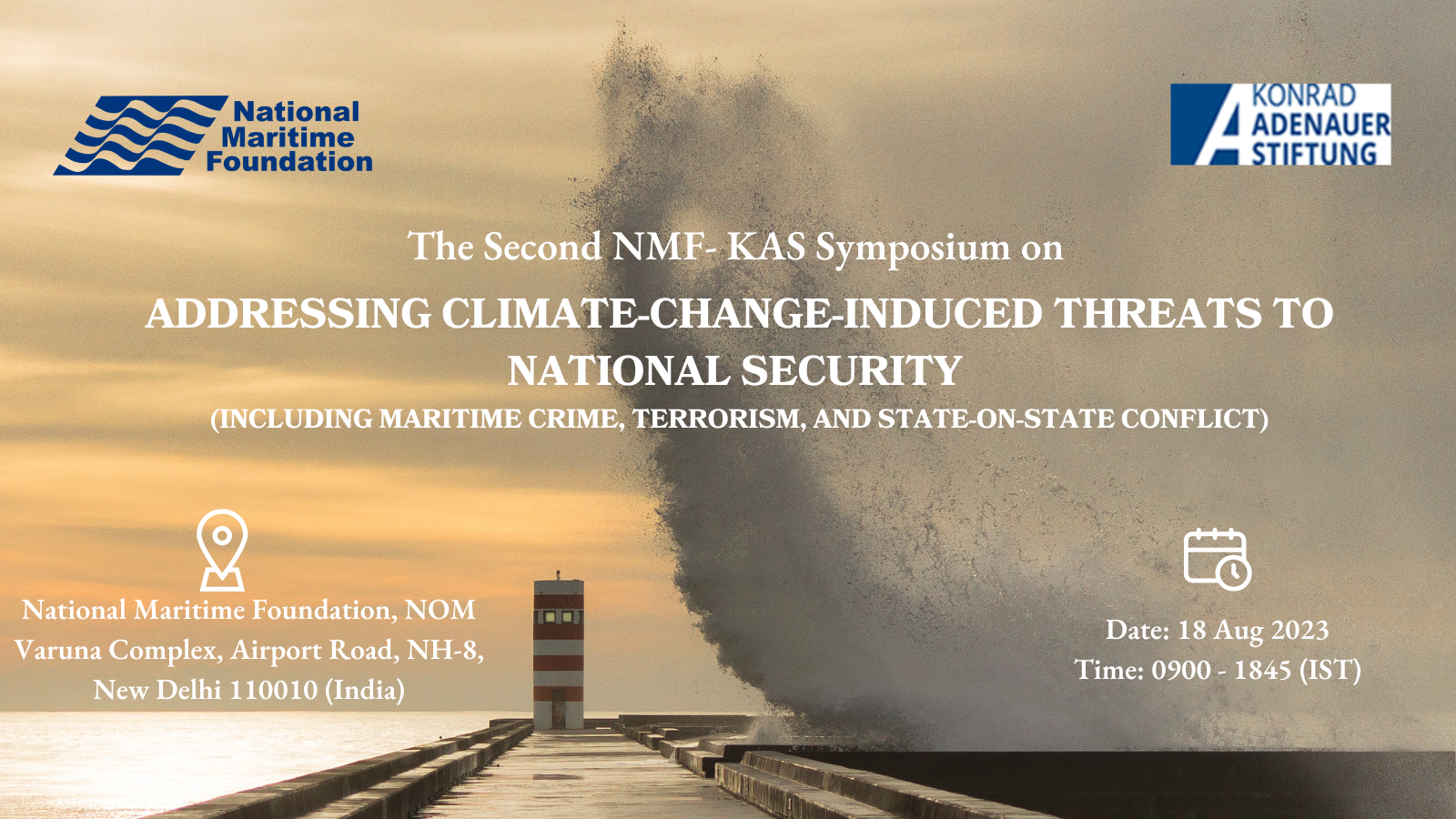
ADDRESSING CLIMATE CHANGE THREATS TO NATIONAL AND REGIONAL HOLISTIC MARITIME SECURITY IN THE INDO PACIFIC
The Second NMF-KAS SYMPOSIUM
ON
ADDRESSING CLIMATE-CHANGE-INDUCED THREATS TO NATIONAL SECURITY (INCLUDING MARITIME CRIME, TERRORISM, AND STATE-ON-STATE CONFLICT)
Jointly organised by
The National Maritime Foundation (NMF), New Delhi, India
and
Konrad-Adenauer-Stiftung (KAS), New Delhi, India
Venue: National Maritime Foundation, NOM Varuna Complex, Airport Road, NH-8, New Delhi, 110010 (India)
Date: 18 Aug 2023
CONCEPT NOTE
In recent decades, climate change has evolved from a distant problem for future generations into a major, imminent, multifaceted threat for nations across the world. Climate-change-induced food and water shortages, combined with sea-level rise and extreme weather shocks, are powerful destabilising forces, not only within the borders of a given State but across international borders as well. The increasing frequency and intensity of extreme weather events driven by climate change, including heatwaves, floods, droughts, and tropical storms, are threatening the socio-economic conditions of billions of people on the planet, with attendant sociopolitical and geopolitical impacts. Climate change often acts as a threat multiplier by amplifying existing stresses and could push already unstable and ill-equipped regions over the edge. Recognising the urgency and seriousness of the risks posed by climate change to holistic maritime security in the Indo-Pacific, the National Maritime Foundation and the India Office of the Konrad-Adenauer Stiftung have embarked on a unique, long-term project, in which Indian and international experts, academics, practitioners, policymakers, and other stakeholders, are brought together to address the national and regional implications of climate change with regard to the different facets of human security, economic security, and hard security, through a series of symposiums, supported and buttressed by research papers, policy briefs, outreach programmes, etc. The inaugural symposium under this project was successfully organised on 04 October 2022, and focused on the theme “Addressing Climate-Change-Induced Security Threats to Critical Maritime Infrastructure: National and Regional Perspectives”. In the second symposium, it is intended to explore the complex dynamics and potential implications of climate change-induced threats on the stability and security of nations (including maritime crime, terrorism, and state-on-state conflict). Even as the world continues to grapple with the several adverse impacts of climate change, the economic dynamism of the Indo-Pacific region — with its voluminous mercantile trade, incredibly busy ports, crowded maritime routes, strategic chokepoints, and abundance of marine resources — is generating a deeply worrying set of challenges in terms of a set of transnational criminal activities that threaten the internationally accepted rules-based order and seriously weaken ocean governance. Amidst the ongoing discussion on the merits of the ‘securitisation of climate change’, as opposed to the ‘climatisation of security’, it is important to recognise the profound impact that climate change has on various aspects of maritime security. While climate change may or may not be a direct cause of armed conflict, it certainly amplifies a variety of problematic social, economic, and environmental issues, thereby increasing the likelihood of intensified political and armed conflicts among coastal littorals and island States of the Indo-Pacific. This amplification is evident in situations where climate-induced factors such as unprecedented crop failures, reduced fisheries production, and protracted scarcity of food and water lead to health emergencies, unemployment, and population displacement. Unsustainable resource exploitation also contributes to widespread poverty and social vulnerability. In regrettable displays of short-sightedness, littoral States often adopt self-centric maritime policies ostensibly to implement poverty-alleviation programmes for their populations. Inevitably, the promised results are not achieved, and vulnerable coastal populations then become susceptible to a range of criminal activities extending from petty theft to far more deleterious practices such as illegal, unreported, and unregulated (IUU) fishing, armed robbery, hijacking, kidnapping, the smuggling of drugs and arms, human trafficking, and trafficking in proscribed species of wildlife, and extending all the way to subversive, extremist, and/or terrorist activities. The strong connection between rising ocean temperatures and maritime crime is well established. In eastern Africa, for instance, rising ocean temperatures have resulted in a significant decrease in fish production and the concomitant loss of traditional economic opportunities. Consequently, there has been a significant increase in piracy and other illegal activities in this area. As States of the east African littoral scramble to provide for the economic wellbeing of their respective populaces, they are easily tempted into significant fiscal borrowings from cash-rich countries such as China to pay for public infrastructure projects such as ports and airports that they believe will bring much needed employment and prosperity. For a brief initial period, this is, indeed, what happens. However, most such projects soon fail to generate revenues sufficient to pay back the loans that have been taken. At this point, the draconian conditions attached to a default in loan-repayment kick-in. These States are now forced to surrender sovereign control over their land and fall into the trap of what is widely referred to as ‘debt trap diplomacy’. The economic conditions that were improving in the initial period of the development of the infrastructure-project suddenly deteriorate sharply. This economic downturn leads to an increase in crime. Where ports and fishing harbours are concerned, the failure of these debt-ridden projects leads to a spike in maritime crime.
Extreme weather events, too, pose significant risks to critical infrastructure such as seaports, leading to delays in cargo-delivery, increased production-costs, and compromised quality of goods. This, in turn, slows down maritime trade and has far-reaching effects on global supply- and value-chains, given that approximately 60% of global maritime trade traverses the international shipping lanes of the Indo-Pacific. The resulting disruptions create favourable conditions for maritime crime, including piracy, smuggling, and illicit trafficking. Likewise, when large-scale human migration caused by extreme weather events spills over national borders, geopolitical tensions rise sharply and may even become the casus belli for inter-State armed conflict. Over the next few decades, sea-level rise will cause considerable changes to the coastlines of littoral States. On the one hand, this leads to a sharp increase in the salinisation of coastal aquifers, causes water stress, and forces human migration. On the other, the issue of whether and how maritime zones and maritime boundaries are to be delimited and delineated is very likely to cause significant tension amongst States. Irrespective of whether baselines are considered to be ambulatory or non- ambulatory as a result of the rise in sea level, there will be challenges in terms of maritime zones, safety zones, traffic separation lines, and marine protected areas, giving rise to new claims and disputes between States. Such impacts are likely to have profound consequences for statehood, national identity, sustainable development, livelihoods, and adherence to a rules-based maritime order, all of which would inevitably hinder the realisation of a free, open, and inclusive Indo-Pacific that promotes political and economic stability. It is against this backdrop, that the theme of the second symposium is “Addressing Climate-change- induced threats on National Security (including Maritime Crime, Terrorism, and State On-State Conflict).” The symposium aims to promote discussions, deliberations, an examination of case studies, and the sharing of best practices innovative approaches to effectively tackle climate change impact on national security. The symposium will address some of the critical questions that need to be explored, such as: Is climate change a national security threat? What is the position of nation-states regarding the securitisation of climate change? How does climate change impact the rules-based maritime order, ocean governance, and maritime security, potentially leading to State failure, and/or State-On-State conflict? How does the ‘securitisation of climate change’ differ from the ‘climatisation of security’? How do either or both these approaches impact policy responses and approaches towards addressing climate-related challenges? With these, the symposium seeks to deepen understanding and foster dialogue on effective strategies. It also seeks to promote sustainable practices, enhance holistic maritime security, and ensure a resilient Indo-Pacific marine environment.
Please find the Details of the Programme: Click Here


Leave a Reply
Want to join the discussion?Feel free to contribute!