
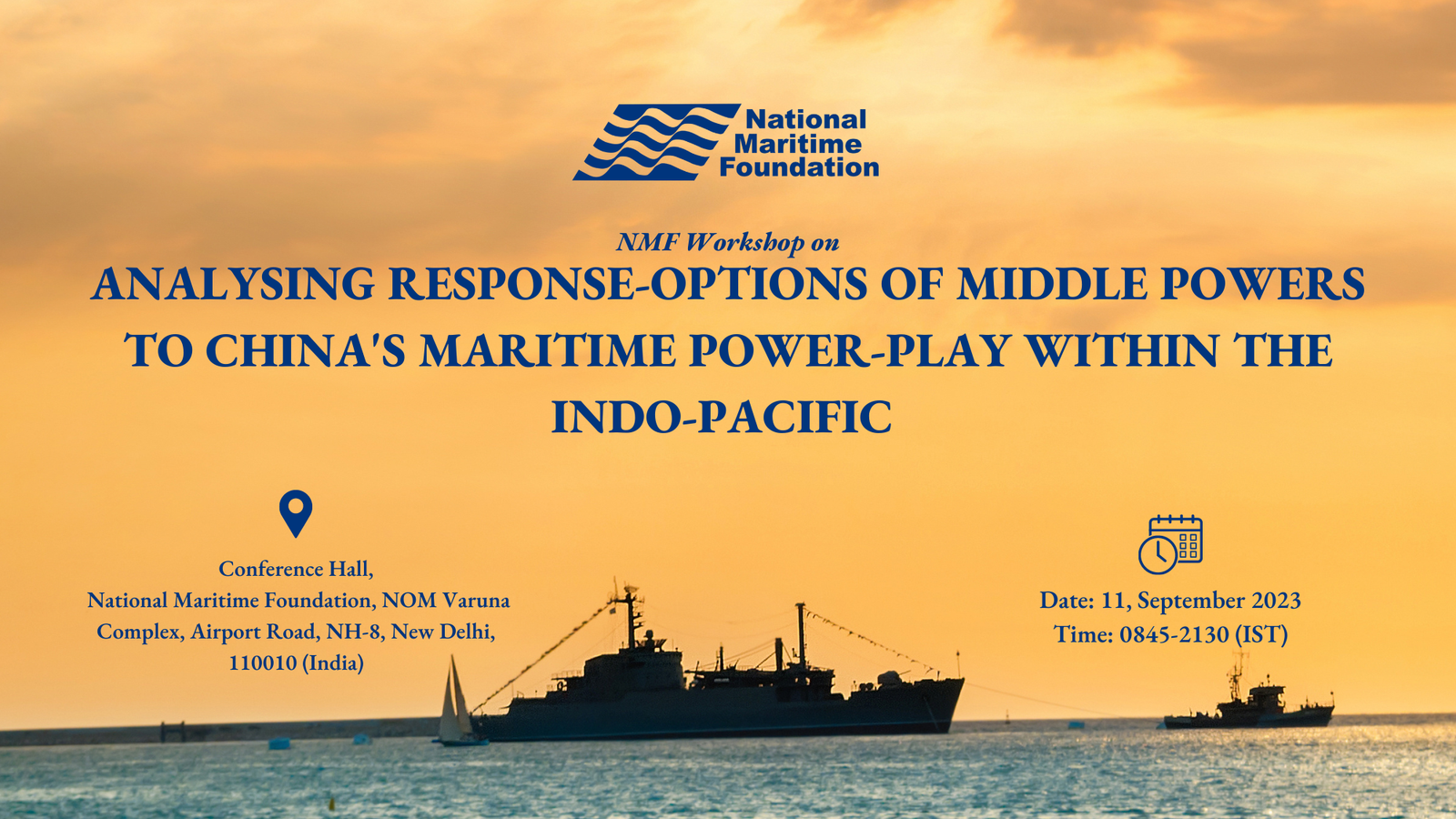
NMF workshop on “Maritime Game-moves of China in the Indo-Pacific — Options for Maritime Middle Powers
NMF WORKSHOP
ON
“ANALYSING RESPONSE-OPTIONS OF MIDDLE POWERS TO
CHINA’S MARITIME POWER-PLAY WITHIN THE INDO-PACIFIC”
NMF Conference Hall,
11 September 2023
CONCEPT NOTE
Thanks largely to the pervasive grip that the USA, as the planet’s sole hyperpower, has over media-driven imagination across the world, the understanding of the “Indo-Pacific” — in far too many cases — tends to be limited to that articulated by the US administration led by erstwhile President, Donald Trump, who conceptualised the “Indo-Pacific” as a “geostrategy” that was designed to contest the aggressive rise of China. In sharp contrast, however, India does not conceptualise or view the “Indo-Pacific” as being in and of itself a geostrategy. India perceives the “Indo-Pacific” as a “strategic geography” within which India formulates and executes a number of “geostrategies” designed to achieve its own set of geoeconomic and non-geoeconomic goals that would promote the economic, material, and societal wellbeing of the people of India. India firmly believes that the Indian economy cannot rise without the simultaneous rise of the economies of our region. In other words, it does not believe that the Indian economy can ride upon the crest of a wave while the economies of its neighbours within the region are wallowing in some trough. This region-wide “desired end-state” — one of sustained and sustainable economic growth within an environment of stability and security — is given expression through the acronym “SAGAR”, which stands for “Security And Growth for All in the Region” and is, consequently, the “maritime policy” of India. The “region” in question is the “Indo-Pacific”. For India, as also for an increasing number of nations, the “Indo-Pacific” is a predominantly (but not exclusively) maritime expanse that encompasses the entire Indian Ocean and the entire Pacific Ocean. It accordingly stretches, as was clearly enunciated by Prime Minister Modi in 2018, from the eastern shores of Africa to the western shores of the Americas. It is within this space that India formulates its several geostrategies, and the Indo-Pacific is, therefore, for India, a single “strategic” space.
Seven contemporary geopolitical trends have contributed to the changing geopolitical context of the Indo-Pacific. The first is the assertiveness and military aggressiveness of the rise of China and the global apprehension that this aggressiveness will not be limited to the South China Sea and the East China Sea alone but will spread across the entire maritime expanse of the Indo-Pacific. The second is the effort of the US, its allies, and its like-minded partners, including India, to balance China and maintain a status quo that is founded upon comity amongst nations — which itself is built upon a respect-for and adherence-to a consensually-derived rules-based order, especially (although not limited to) the maritime domain. On the other hand, China, too, has been trying to muster a grouping of like-minded countries (Russia, North Korea, Pakistan, Turkey, and possibly Iran) that are opposed to the US even if they are not overtly pro-Beijing. The third is the rise of India as a global economy with significant dependence upon maritime merchandise trade. The fourth is the increasing involvement of the European Union as a serious maritime-security stakeholder in the Indo-Pacific. The fifth is the impact of the ongoing Russia-Ukraine armed conflict upon supply chains and value chains throughout the Indo-Pacific. The sixth is the adverse impact of climate change, especially as manifested in extreme-weather events and sea-level rise. The seventh is the impact of pandemics such as COVID-19 — as also its predecessors and, far more worryingly, its successors — and their impacts upon regional economies through restrictions in global trade, maritime connectivity, and regional health.
Of these seven drivers of maritime geopolitics in the Indo-Pacific, the aggressive rise of China as a maritime power is the most pervasive and by far the most dangerous, with serious geoeconomic and geostrategic maritime overtones. Beijing seeks to realise Xi Jin Ping’s “China Dream” of being the predominant world-power by the year 2049 — this is now only 26 years away and Xi is running out of time. This is because history demonstrates that no geopolitical entity has become the predominant world power without first becoming the world’s predominant maritime power. The realisation of the ‘China Dream’ of 2049, therefore, requires China to better the ‘combined’ maritime power of the USA, Japan, India, Australia, France, Vietnam, and a host of other countries that do not subscribe to a future world order whose rules are formulated exclusively in and by Beijing. This seems a tall order. And yet, the Chinese hat is quite firmly in the ring.
It is essential that the challenges that have arisen in the wake of China’s flagrant use of lawfare, its disregard for established legal norms, its disregard for the sovereignty of other nation States, its adoption of grey zone tactics and the securitization of its fishing fleet, all be addressed not only by the US but also by the region’s middle powers such as India, Japan, Taiwan, Vietnam, etc. It seems intuitively desirable for these behavioural trends to be addressed under the rubric of India’s maritime policy, which is encapsulated by the acronym SAGAR (Security and Growth for All in the Region), in execution of which, first-order specificity is provided by the Indo-Pacific Oceans Initiative (IPOI). The desired end state, of course, is as articulated by Japan and others — namely, the maintenance of a free and open Indo-Pacific that is founded upon a consensually-derived international rules-based order, a deep and abiding respect for sovereignty and territorial integrity, and the nurturing of mutual respect (comity) amongst nations.
The central question, therefore, is, “how would current and future maritime game-moves of China play out in the Indo-Pacific and what ought to be the maritime responses of these middle powers?”
This very question forms the theme of the inaugural edition of what is planned to be a series of NMF Workshops on ‘Maritime China’, the first of which is scheduled to held at the NMF on the 11th of September 2023.


Leave a Reply
Want to join the discussion?Feel free to contribute!