
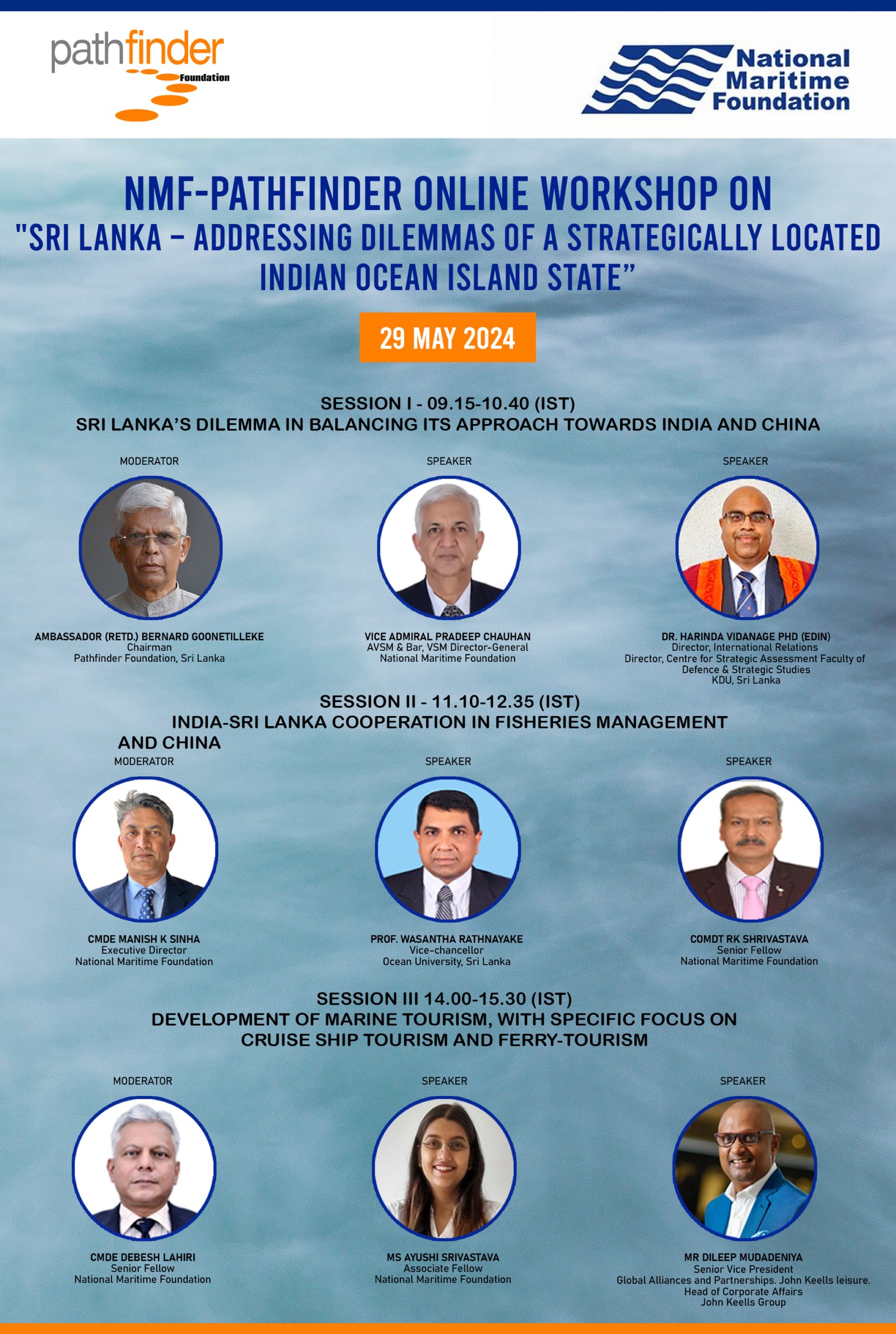
NMF-PATHFINDER ONLINE WORKSHOP ON "SRI LANKA – ADDRESSING DILEMMAS OF A STRATEGICALLY LOCATED INDIAN OCEAN ISLAND STATE"
Concept Note
For nations unto which geography has been favourable, ‘location’ is a great enabler; for those unto which it has not, it is an impediment. Sri Lanka’s central location in the Indian Ocean and its richly endowed natural resources offer several advantages to it, based upon which this ‘Emerald Isle’ has developed a number of mutually reinforcing strategies, several of which seek to leverage the country’s geographic location. A striking manifestation of one of these strategies relates to the various forms of maritime connectivity. Indeed, as an island nation, Sri Lanka’s connection with the rest of the world depends almost entirely upon its ability to use the seas. Sri Lanka’s strategy to leverage its location astride some of the world’s busiest international shipping lanes (ISLs), and to thereby maximise maritime trade connectivity, is typified by the Port of Colombo, which ranks among the top 25 container ports in the world. Another maritime strategy is manifested in the country’s ability and willingness to leverage the natural resources of its Exclusive Economic Zone of 517,000 sq km. Within this vast expanse of the sea, Colombo enjoys sovereign rights for the exploration, exploitation, conservation and management of all living and non-living natural resources of the waters superjacent to the seabed, the seabed, and its subsoil. A second strategy recognises the fact that fish constitute a vital natural resource for Sri Lanka and the fisheries sector contributes 1.5% to the country’s GDP. More than 80% of the country’s fish production comes from marine capture, of which more than 40% comes from deep-sea fisheries. A third strategy concerns marine tourism. The tourism sector in Sri Lanka which, inter alia, seeks to take the fullest advantage of the country’s pristine beaches and scenic coastal areas, contributes about 5% to Sri Lanka’s GDP. This strategy also envisages increasing national earnings through high-end cruise-ship tourism, as also ferry-tourism.
All three strategies (amongst several others) find their mirror images in India which, like Sri Lanka, is favourably positioned in the Indian Ocean. As ‘next door neighbours’, both countries share the advantages afforded by their respective maritime geographies as also a deep and centuries-old ethnic and historical connection. Thus, there is a self-evident case for them to pursue synergistic maritime development. For instance, apart from fisheries management, cruise-ship tourism — as a sub-set of marine tourism — offers ample avenues for cooperation and coordination in terms of the ships themselves, port/terminal infrastructure, the identification, preparation, and maintenance of specific tourism sites and areas, waste management, etc. This would imply cooperation in terms of marine spatial planning (MSP). Another dimension of bilateral cooperation in this area is the promotion of ferry tourism between the two countries, given their geographical proximity.
Militating against this desired degree of synergistic cooperation is the fact that both countries are affected (albeit unequally) by the geopolitical turbulence in the region, which throw up a whole slew of interrelated challenges in respect of maritime security. While the importance of arriving at mutually beneficial approaches to address these challenges is well understood by both Colombo and New Delhi, this has not always resulted in the desired synergy. Thus, the two countries have a few areas of dissonance and discord, sitting uncomfortably amidst the far more numerous areas of convergence and cooperation.
Fisheries management is an area that requires greater engagement and understanding between the two nations than is presently being evidenced. Poor regulation, the unevenness of the stocks of coastal-fish as a consequence of the protracted ban on fishing in the Palk Bay during the long years of Sri Lanka’s civil strife, and persistent over-fishing, especially by mechanised bottom-trawlers, have in aggregate, not only resulted in severe degradation and destruction of the coastal marine habitat (seagrass, coral reefs, etc.), but have also thrown up a host of complex political challenges stemming from actual and alleged poaching and illegal fishing. These challenges are not limited to coastal waters alone but extend equally to illegal, unreported, and unregulated (IUU) fishing in deep-sea areas. Here, the challenges are not merely dyadic, given that the EEZ of both countries are witness to depredations by distant-water fishing (DWF) fleets of other nations as well — some of which are located at great distances from the subcontinent — and not all of which are engaged in fishing alone. Other illicit maritime activities, such as the smuggling of goods, narcotics, arms, and explosives, and human trafficking, significantly exacerbate the maritime challenges of the India-Sri Lanka dyad.
Shortfalls in meaningful collaboration in addressing these dyadic maritime challenges has created an unfortunate patina of mistrust, which has been sought to be leveraged by external powers seeking to execute their own geopolitical strategies in pursuit of their respective geoeconomic and non-geoeconomic goals. This combination — of a bilateral trust-deficit and the propensity of external powers to pursue their own geopolitical agendas in the India-Sri Lanka geographic space — has, in turn, generated a number of bilateral security-sensitivities. These have, unfortunately, been allowed to grow — often driven by fairly localised short-term political considerations in both countries.
New Delhi remains particularly sensitive to the maritime and other overtures to Sri Lanka being made by countries with whom India has a difficult geopolitical relationship. On the other hand, the pulls and pressures of domestic politics drive Sri Lanka to not only ensure that its own sovereign choices remain unfettered but are also perceived as being so. Yet, neither country can free itself from the imperatives of geography and as the comprehensive national power of India rises and is recognised, a delicate balance needs to be struck and thereafter maintained between New Delhi and Colombo. Both nations are mature, and vibrant democracies with experienced State structures in terms of diplomacy, politics, and militaries. Consequently, neither has naïve notions of the manner in which this balance is to be sustained. That having been said, it is nevertheless also true that each seeks to tweak the fulcrum of this balance in favour of its own perceived security interest. Since the geopolitical situation within the broader Indo-Pacific remains highly dynamic and subject to large and sudden shifts, the geographical subsets of the Indo-Pacific also echo these geopolitical vibrations. The India-Sri Lanka maritime space is no exception. The point or points at which balance between India and Sri Lanka is to be maintained are, therefore, continually (if not continuously) shifting. This is where and why continual dialogue based upon constant and unchanging comity (mutual respect) is quite so critical. This range, tone, tenor, and substance of this dialogue sometimes finds itself mired in a hardened amalgam of officially stated positions. It is here that diplomacy can and should be progressed on tracks other than “Track One”.
Remaining mindful of the substantially greater freedoms inherent in engagement and ideation that can be pursued along “Track One-point-Five” and “Track Two”, Sri Lanka’s Pathfinder Foundation, represented by its “Centre for Indo-Sri Lanka Initiatives” (CILI) and India’s “National Maritime Foundation” (NMF) have decided to convene an online workshop, on 29 May 2024, on the theme “Sri Lanka – Addressing the Dilemmas of a Strategically Located Island State’”. The workshop will focus upon three broad themes. The first will examine the dilemma that Sri Lanka faces in balancing its approach towards other States, specifically, in respect of India and China. The second will explore how best fisheries resources could be managed in proximate as well as distant maritime spaces. The third will seek to evolve cooperative measures in order to develop marine tourism, and more specifically, cruise-ship tourism and ferry tourism, in and between the two countries.
It is anticipated that the online workshop will yield meaningful policy-relevant inputs to the “Track-One” establishments of both States, which would impart impetus and endurance to the desired cooperative and collaborative endeavour to address maritime challenges while retaining the primacy of comity between the two neighbours.
For Programme Details: CLICK HERE
To Join Us For the Workshop: CLICK HERE


Leave a Reply
Want to join the discussion?Feel free to contribute!