
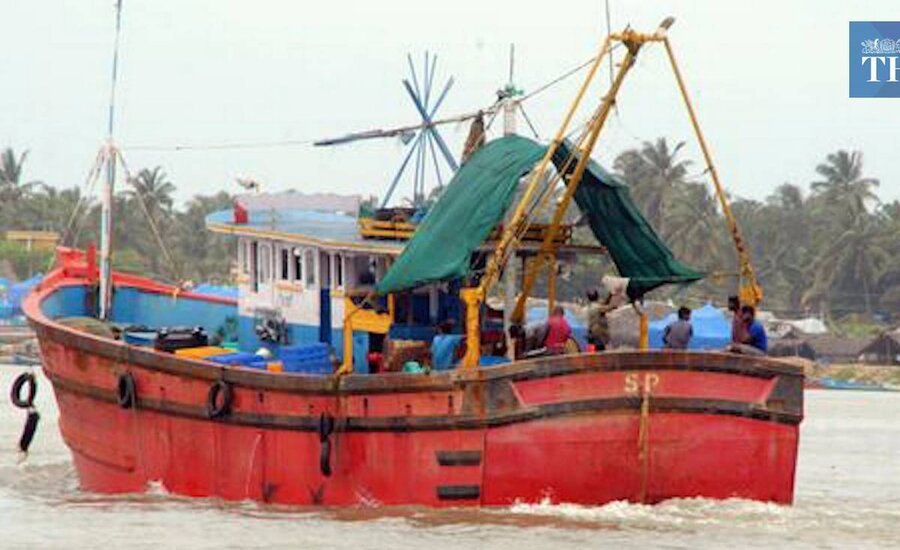
 Image Credit - The Hindu
After being elected for the fourth term as Sri Lanka’s Prime Minister, Ranil Wickremesinghe chose India as his first destination for a foreign visit. He met the Indian Prime Minister Narendra Modi in Delhi on September 2015; and among other issues, they discussed fishing dispute between the two countries.
It is well known that Indian fishermen are often arrested and occasionally shot at by Sri Lankan authorities for straying into Sri Lankan waters. The straying of fisher folk is largely due to ambiguity of boundaries at sea, but more importantly, it indicates a willful transgression by Indian fishermen, leading from the depletion of the marine resource in the Indian side of the Palk Bay and Gulf of Mannar due to over-exploitation. Notably, bottom trawling by Indian fishermen in these relatively shallow waters is a major cause for significant fall in fish potential of these areas.
Towards amicably settling the disputes, PM Modi remarked that this is essentially a humanitarian issue and that fishermen associations from both sides may continue their efforts to find a solution. Furthermore, he encouraged the fishermen to shift their activity from shallower coastal waters to the deep-sea.
Modi’s call to consider the issue as “humanitarian” may have been meant only to mollify the hard stance being taken by the Sri Lankan authorities against the Tamil fishermen; and since it involves the question of livelihood, to push them to consider the straying of Indian fishermen in a more humane light. Further, although his prodding the fishermen associations of India and Sri Lanka could foster greater bonhomie between the two fishing communities, it may not lead to a viable solution to the dispute. Although a common Tamil identity seems binding, the relations of fishermen between the two countries are presently characterized by competition. It is, therefore, unlikely for the two fishing communities to achieve any breakthrough in what seems to be a ‘zero-sum’ scenario, without mediation by the government agencies.
Deep- Sea Fishing: ‘Old Wine’
Essentially based on the concern of sustainability of the marine resources, PM Modi’s third proposal that fishermen be encouraged to undertake deep-sea fishing is along the lines of the recommendations proposed by the Meenakumari Committee (Expert Committee for Comprehensive Review of Deep Sea Fishing in the Exclusive Economic Zone) to address the fast-depleting marine resources. Since non-compliance of regenerative fishing principles adversely affect the livelihood of fishermen, there was a need for provisions to make the industry more sustainable. Modi’s call to usher in ‘Blue Revolution’ in fisheries sector came in the wake of the Meenakumari Report, whose findings were tabled in August 2014. The mandate of the Committee was as follows:-
- Review Comprehensive Marine Fishing Policy (CMFP) of 2004.
- Examine status of compliance of regional and global requirement of management and regulation of fisheries.
- Review the existing guidelines for deep-sea fisheries.
- Suggest exploitation potential in EEZ and international waters.
The Meenakumari Committee noted that waters up to 200 m depth are optimally exploited and there is no scope for expansion of fishing in the 200-500 m stretch. It recommended transforming this stretch into a buffer zone encouraging resource utilization beyond 500 m. However, Indian fishermen currently lack adequate expertise to exploit resources beyond 500 m depth. Therefore, Letter of Permission (LOP) is required to be granted to foreign vessels to fish in these waters, or for Indian vessels to employ foreign crew, encouraging the concept of ‘capitalist deep-sea fishing’.
Tradition versus Technology
The proposed policy of deep-sea fishing has been initiated several times in the past, but its implementation encountered opposition from the fishing community. Even while deep-sea fishing is meant to be an overarching policy for transforming the fisheries sector, it has major voids because it fails to incorporate the vital interests of the prime stakeholder—the fisherman— into its framework.
The Tamil fishermen of Sri Lanka and India are traditional fishermen who engage in near-shore fishing activities. Being a highly capital intensive method necessitating advanced technologies, the domestic capacity of traditional fisher folk has not been expanded to match the capital and technology intensive deep-sea fishing.
Given the inadequate domestic capacity to harvest offshore marine resources by traditional fisher folk, deep-sea fishing would invite foreign fishing vessels and joint venture operations placing traditional fishers and owners of small motorized boats at a direct disadvantage. The advantages of the deep-sea fishing in the form of subsidies and increased resource turnover may not reach them. Additionally, developing domestic infrastructure for industrial fishing is a time consuming process, challenging the livelihood of the traditional fishermen who are in the brink of being transformed as wage earners for ‘capitalist deep-sea fishing’.
Owing to the domestic infrastructural inability to engage in deep-sea fishing, fishermen associations feel that there is little or no applicability of the provisions the Committee as a measure to resolve outstanding disputes between India and Sri Lanka. To them, an immediate solution to the problems lie not in deep-sea fishing as conceived in the Meenakumari Report, but possibly by adapting provisions of deep-sea fishing to fishermen needs in terms of developing their capacity and capability. Augmenting fish production by enabling the traditional fisher folk to effectively imbibe deep-sea fishing techniques and taking steps to hasten capacity building thus becomes essential.
The Way Ahead
Since 1991, efforts have been made on many occasions to undertake deep-sea fishing ventures. However, they have not been effective. The lax nature of policy implementation and lack of adequate technological capacity to engage in deep-sea fishing have been the major impediments.
PM Modi’s suggestion on the lines of Meenakumari Committee recommendation is a step in the right direction. However, it will become an implementable solution only when the capabilities of the fisher folk are developed to harness deep-sea resources rather than resort to ‘capitalist deep-sea fishing’. This can be achieved by adopting a two pronged approach; enhancing their capability in terms of training/expertise and capacity building in terms of technology / hardware. The fishermen—hitherto used to traditional means of fishing— can be brought within the ambit of the suggested way forward by adequate training, technology enhancement, extending loans to procure deep-sea fishing vessels and providing subsidies on fuel.
In sum, amidst reasonable reservations placed on the efficacy of the solutions suggested by Modi, with appropriate adaptation, deep-sea fishing could be a viable proposition to address fishing disputes and mitigate problem of fisheries resource depletion in a more sustainable manner.
About the Author
Ms. Shereen Sheriff is Research Associate at the National Maritime Foundation (NMF), New Delhi.
 Image Credits: The Jakarta Post
 Image Credits: DNA India
  Image Credits: The Quint
  Image Credit- Eunavfo
 Image Credit- GLOBAL YOUNG VOICES
Leave a Reply
Want to join the discussion?Feel free to contribute!