
Rear Admiral Monty Khanna (Retd) – ‘Dabolim Diaries’ Issue No 11 dated 17 Mar 2025
China’s development of long range conventional ballistic missiles, against static terrestrial as well as mobile maritime targets has been ongoing for several years. As part of the development process of such weapons, China has set up a few target ranges. The most robust of these is the Missile Test Range established in the Taklamakan desert in Xinjiang Province.
 Location of Taklamakan Missile Test Range
The range primarily comprises of two clusters of targets which are geographically separated. One focuses on maritime targets, both static and mobile. The other on terrestrial targets.
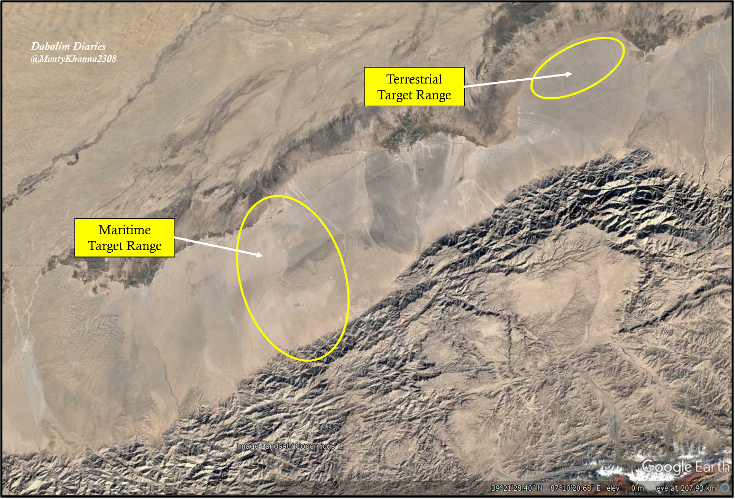 Broad Layout of Maritime and Terrestrial Target Ranges
Maritime Target Range
The range hosts at least three static targets representing ships and a rail system for mobile targets. The broad layout of the range is as given below: –
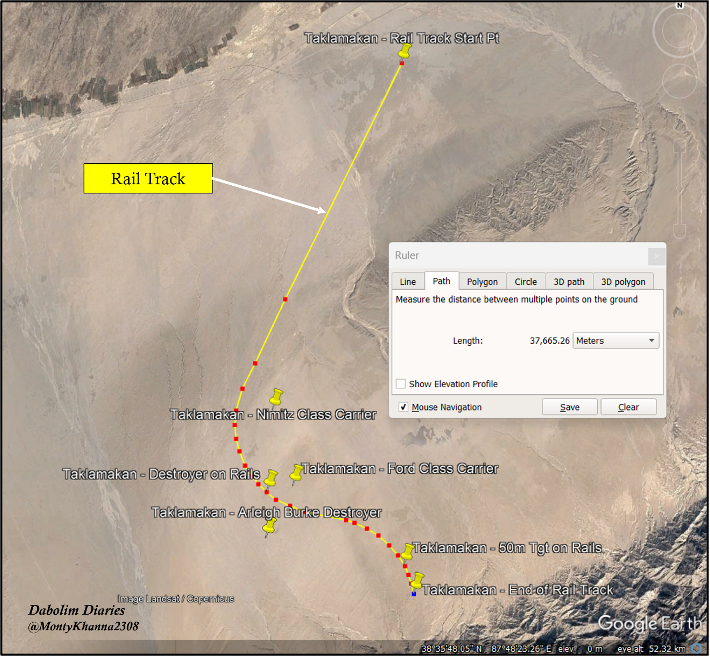 Facilities at Maritime Target Range
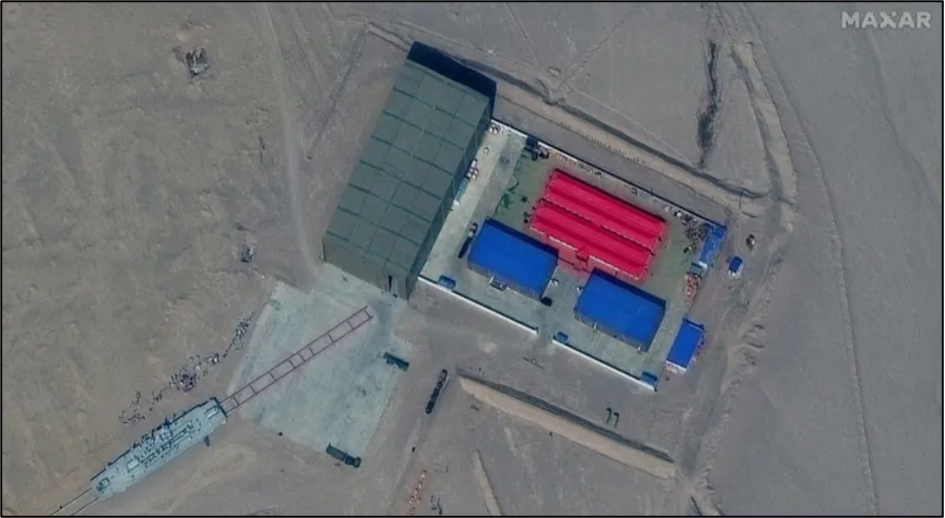
Mobile Target Rail System. This facility was built in the early 2020s. It comprises of a 37.6 km long rail system with a gauge of 12.5 meters. The northern end of the rail system ends in a building complex with a large covered shed which is probably used for fabricating/repairing the mobile targets that traverse on the rails. The southern end terminates without any conspicuous structures, possibly allowing for its extension at a later date.
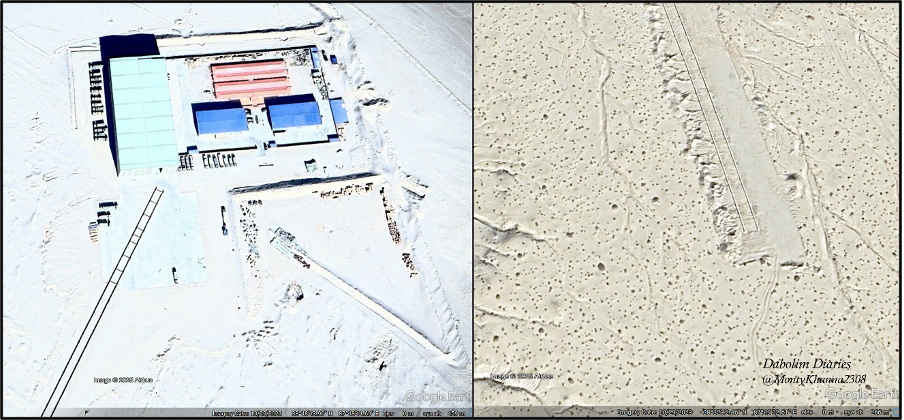 Rail Track Northern End (Left) and Southern End (Right)
A picture showing greater details of the target fabrication and repair facility is below.
Details of Target Fabrication and Repair Facility
Mobile Targets. An examination of the latest imagery on Google Earth Pro (24 May 2024) shows that the rail system currently fields two targets. These are as follows: –
- Large Ship Mobile Target. This target has been in use for over three years. It is 77 meters long and 15 meters wide. From its layout (with a discernable island superstructure on one side), it appears to be a 1:4 scaled down model of an aircraft carrier. The deck contains several poles which probably are used to mount radar reflectors so as to simulate a full-sized aircraft carrier.
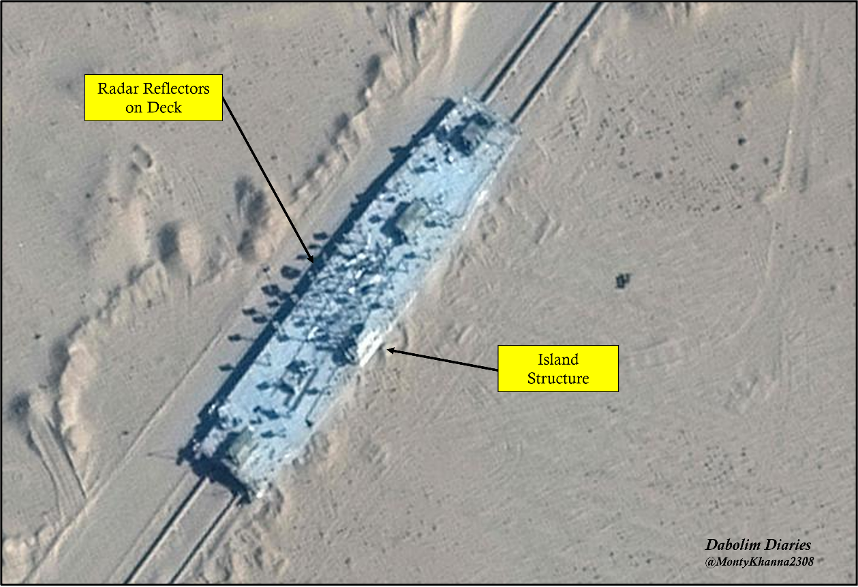 Aircraft Carrier Scale Model on Rails
The latest image shows large distortions to the structure which could be attributed to damage through missile strikes. There are several trucks around the target indicating work in progress.
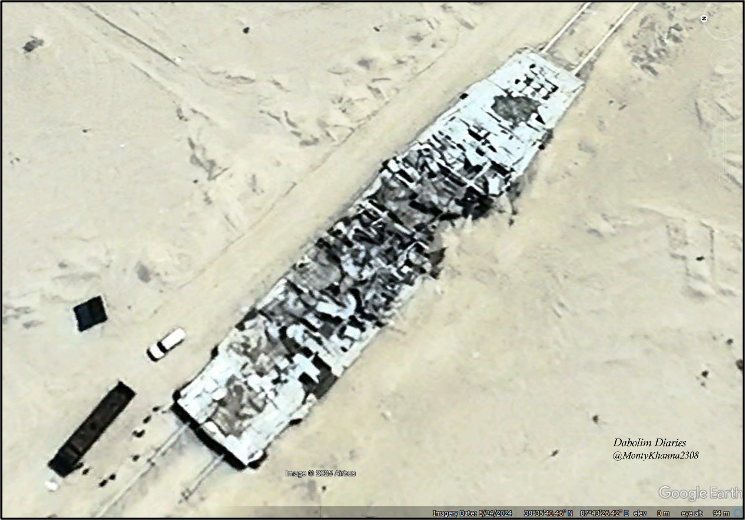 Aircraft Carrier Model with Evidence of Damage
- Small Ship Mobile Target. This target has been set up more recently. It is 50 m long and 16 m wide. It too contains poles with radar reflectors, possibly to simulate a larger target. From the image, it is difficult to discern a specific class of ships that it may represent.
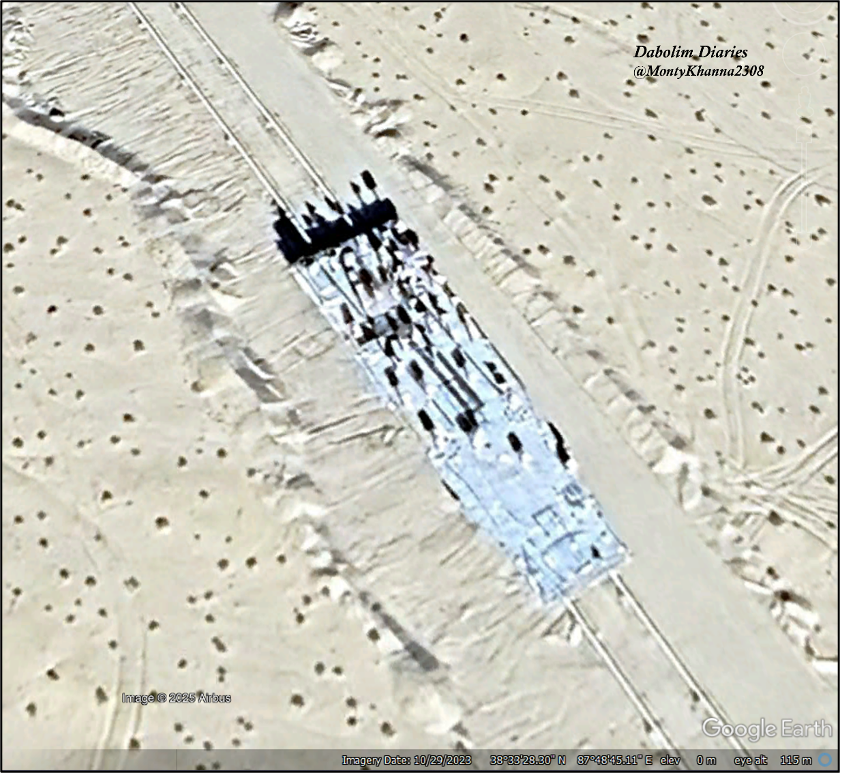 50-meter Target on Rails
Static Targets. The range supports at least three static targets. These are as follows:
- Nimitz Class Aircraft Carrier. This static target is the oldest at the range. With a length of 326 m, it mimics the flight deck of a Nimitz Class aircraft carrier on a near 1:1 scale and is therefore not fitted with reflectors to enhance its radar reflectivity. The Google Image dated 09 Feb 2020 shows a scarcely discernible outline of the target. This could be so either because the target was still under construction at the time or that a deliberate attempt was made to conceal it by covering it with sand.
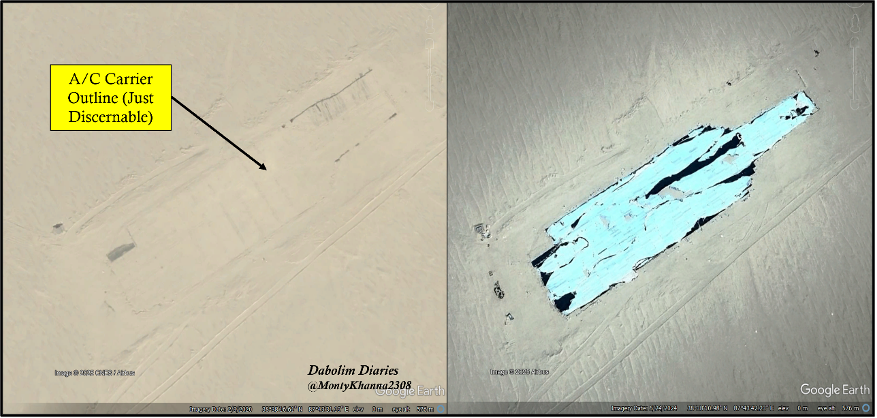 1:1 Model of Nimitz Class Carrier 09 Feb 2020 (Left) 24 May 2024 (Right)
- Arleigh Burke Class Destroyer. This target has a length of 153 m and mimics the layout of an Arleigh Burke Class destroyer in its entirety. Poles with reflectors have been used in places to simulate the radar reflectivity of the superstructure of the vessel. More recently, a grid of (possibly metallic) black squares of dimensions 6 x 6 meters have been installed around the target. This is probably to add a greater degree of realism while carrying out trials by simulating sea clutter or the employment of decoys such as Chaff.
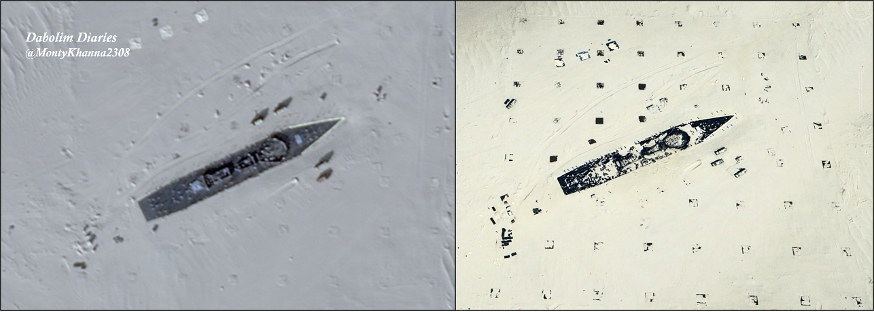 1:1 Model of Arleigh Burke Destroyer 01 Jan 2024 (Left) 24 May 2024 (Right)
- Ford Class Aircraft Carrier. This target replaced models of smaller ships at the same location in 2023. With a length of 337 meters and with the island placed well aft, it is a near replica of the deck of USS Ford. The radar characteristics of the island is simulated by poles with reflectors. The google earth image dated 24 May 22024 shows the model partially covered by sand, possibly due to a sand storm.
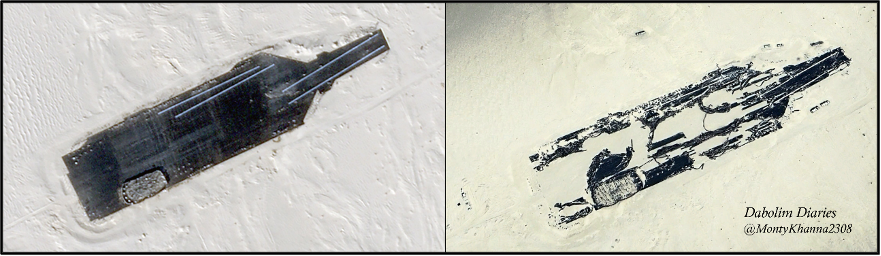 1:1 Model of Ford Class Carrier End 2024 (Left) 24 May 2024 (Right)
Terrestrial Target Range
This dimension of this range is as shown in the figure below. It appears to be enclosed by a wall/fence.
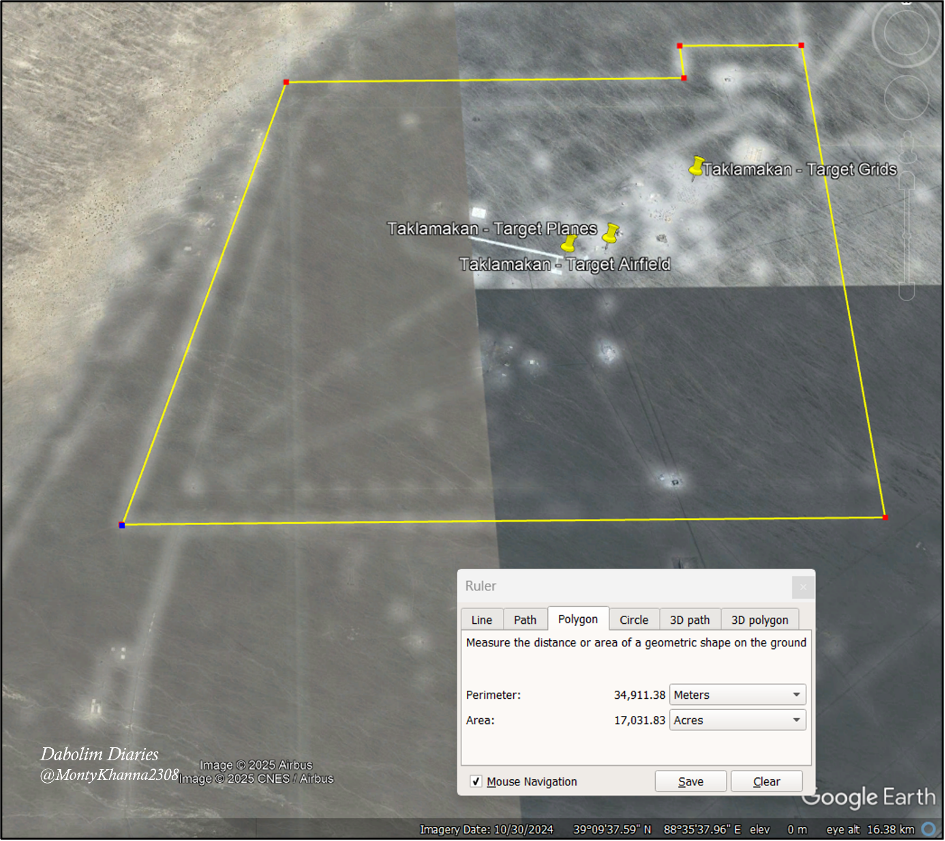 Broad Layout of Terrestrial Target Range
Targets. The main targets in this range are as follows: –
- Runway with Aprons. The center of this range has a runway of length 1.93 kilometers with two aprons.
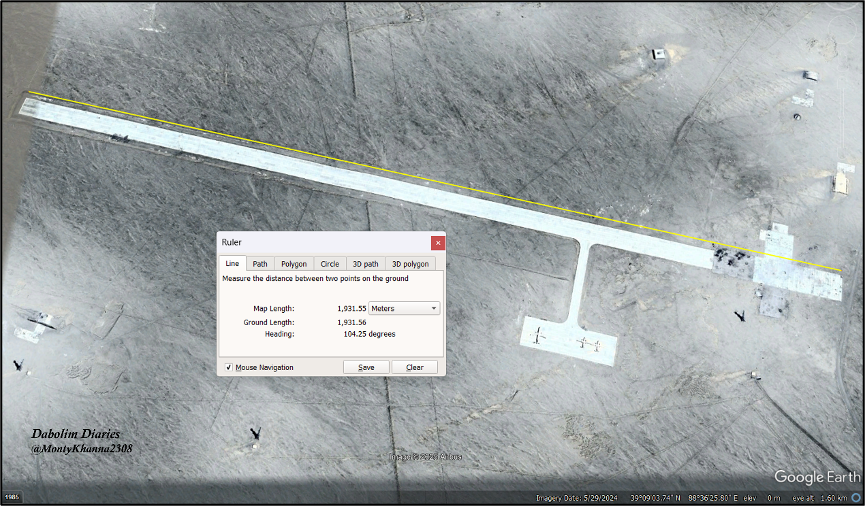 Possible Functional Runway with Target Aprons at Eastern End
The apron to the East along with its intersection with the runway is used as a target area. It is possible that the remaining part of the runway along with the second apron is serviceable for use by aircraft.
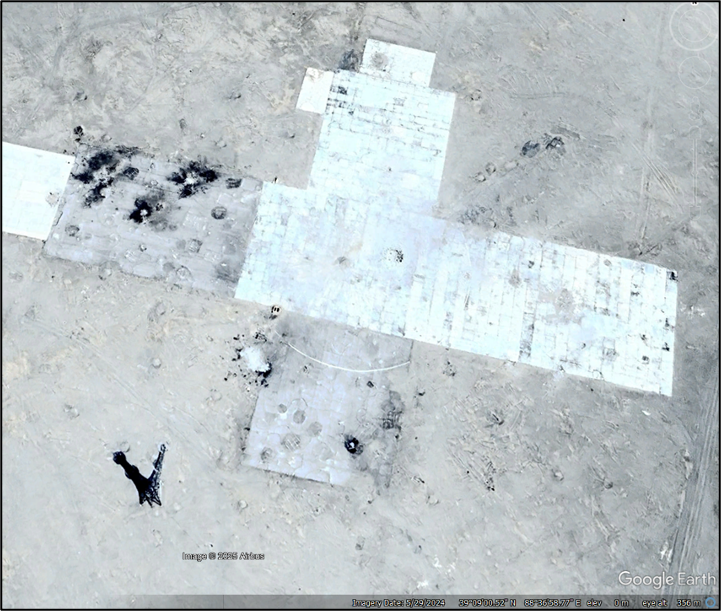
Target Area of Runway with Craters
Just adjacent to the eastern edge of the runway is a hangar with several aircraft models (possibly targets) parked next to it.
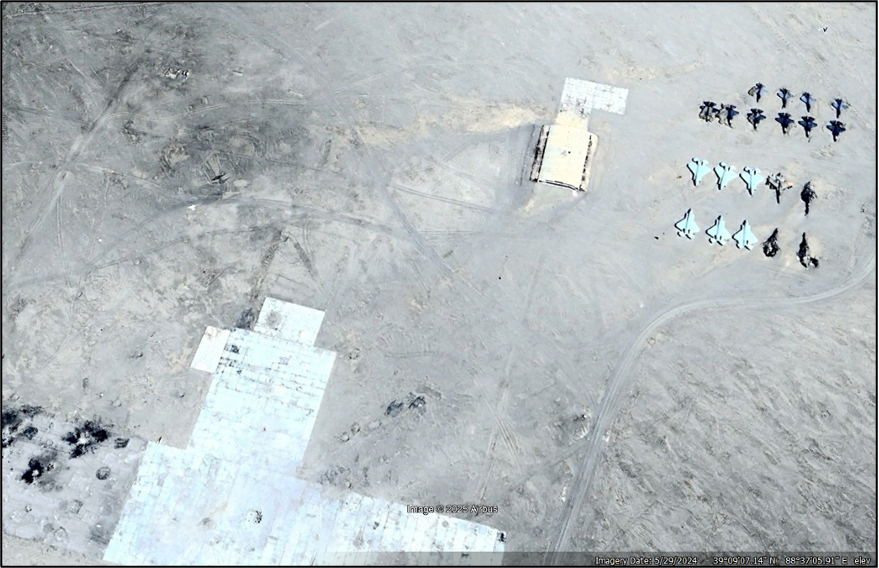
Aircraft Model Hangar with Target Aircrafts
- Large Grid Markings. The site includes three large grids, the circular ones having a diameter of 285 meters and a square with each of its sides having a length of 320 meters.
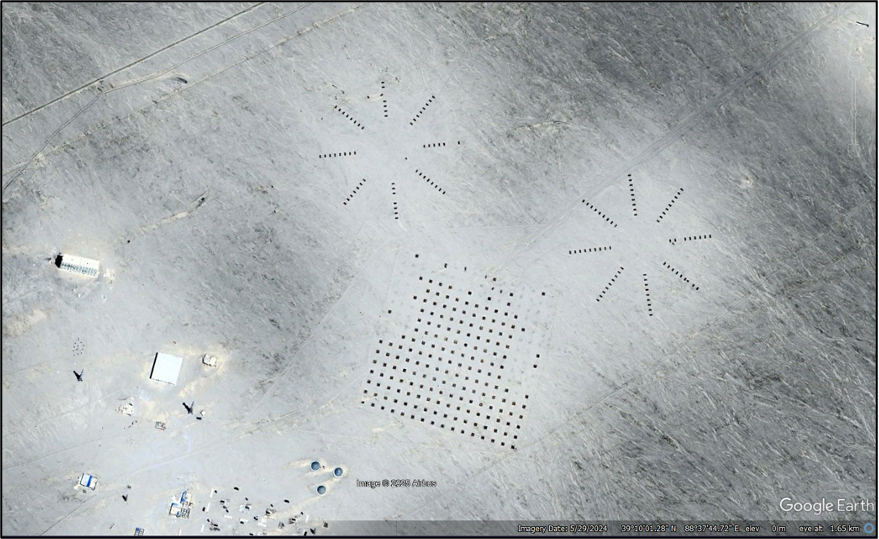 Target Grids at Terrestrial Range
Just to the south is what appears to be another square shaped target in which reflectors appear to be distributed in a random manner. Lattice towers are visible near all the targets most likely for receiving telemetry data.
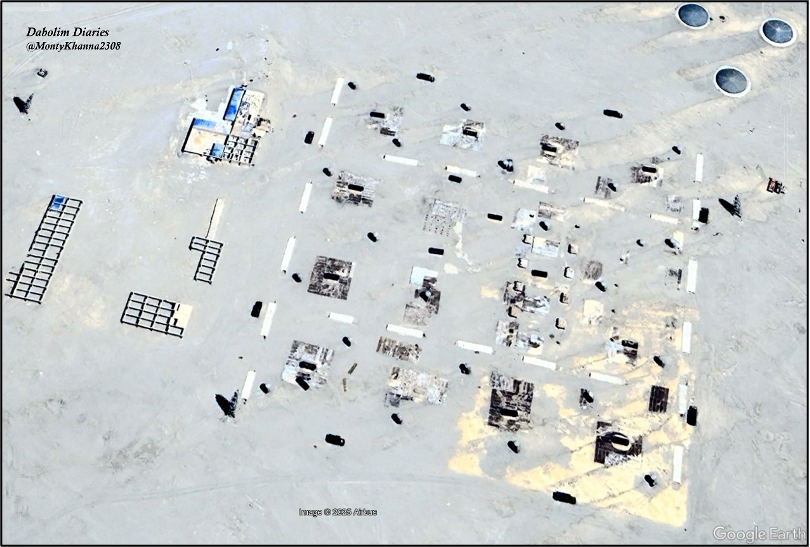 Details of Target Area at Terrestrial Range
- Building Complex with Radar Reflectors. At another location at this site is a 200 x 200-meter square with several lattice structures with reflectors. It is possible that this represents either a hangar complex or a set of fabrication sheds.
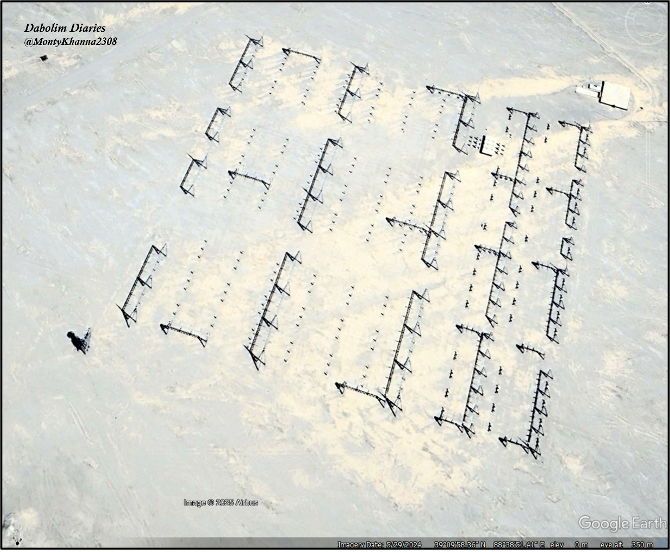 Square Shaped Lattice Target Area
Assessment
It is apparent that China has made a colossal investment in the creation of a missile test range in the Taklamakan desert for testing long range missiles against static and mobile targets. Going by the changing parameters of targets and other facilities, it is clear that systems are being developed to tackle ever evolving contemporary threats. While some of the developments at this range may have an element of Information Warfare (IW) thrown in to keep adversaries guessing on the efficacy of the threat, it would be prudent to assume that a large part of it is to refine weapon systems that will be used in future conflicts.


Leave a Reply
Want to join the discussion?Feel free to contribute!