
Rear Admiral Monty Khanna (Retd) – ‘Dabolim Diaries’ Issue No 13 dated 11 Apr 2025
China’s tryst with the Antarctic was led by Guo Kun, a graduate of the PLA Military Institute of Engineering, Harbin. While working at the State Oceanic Administration (SOA), in the early 1980s, he was appointed as Director of the newly established National Antarctic Investigation Committee. One of the first tasks he was entrusted with was to pave the way for China to become a party to the Antarctic Treaty System (ATS). This happened in 1983 when she was accepted as a ‘Contracting Country; a status that allowed China to attend meetings of the ATS but not to partake in substantive discussions and voting, which was restricted to ‘Consultative Countries’; essentially those which had conducted an expedition and had a permanent presence in the continent. To join the more exclusive group of consultative countries, China decided to send an expedition in 1984 headed by Guo Kun himself. They were tasked to set up its first permanent research station in the continent.
Constrained by resources which precluded the charter of an icebreaker, the newly commissioned non-ice class research vessel ‘Xiang Yang Hong 10’ was chosen for this task. She was accompanied by a Naval salvage vessel ‘J121’, both displacing about 10,000 tons.
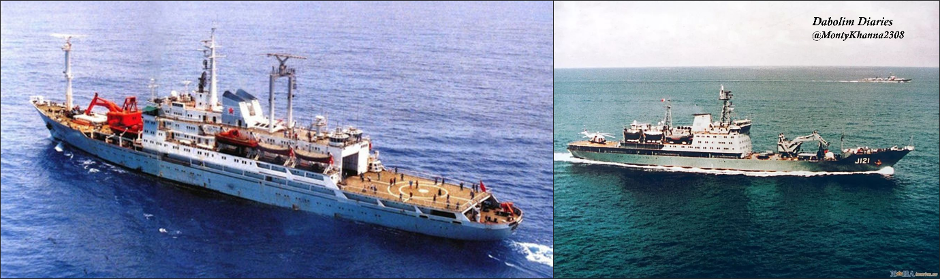
Vessels Used for China’s First Antarctic Expedition Xiang Yang Hong 10 (Left) and J121 (Right)
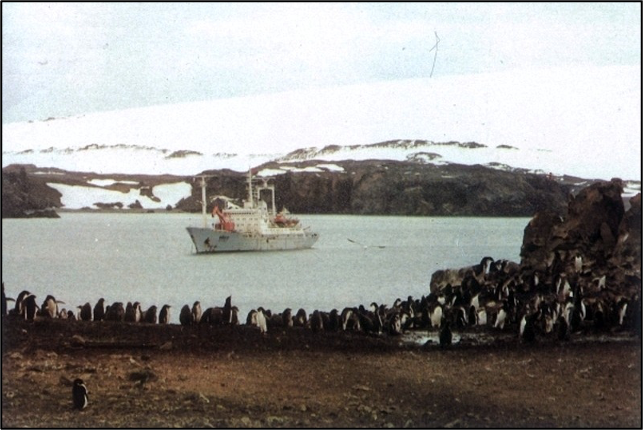
Xiang Yang Hong 10 Entering Maxwell Bay
The expedition comprising of 591 people embarked the two vessels and sailed from Shanghai on 20 Nov 1984. They finally arrived at the Maxwell Bay of King George Island, Antarctica on 30 Dec 1984, when for the first time Chinese nationals set foot on the continent.
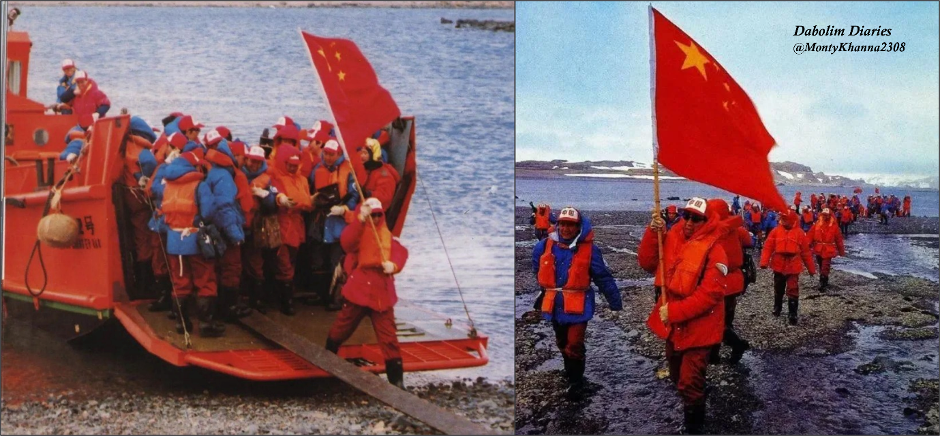
Guo Kun Stepping Ashore (Left) and Leading the Expedition (Right)
Since then, China has significantly increased its presence on the continent. Over the years she has established five stations.
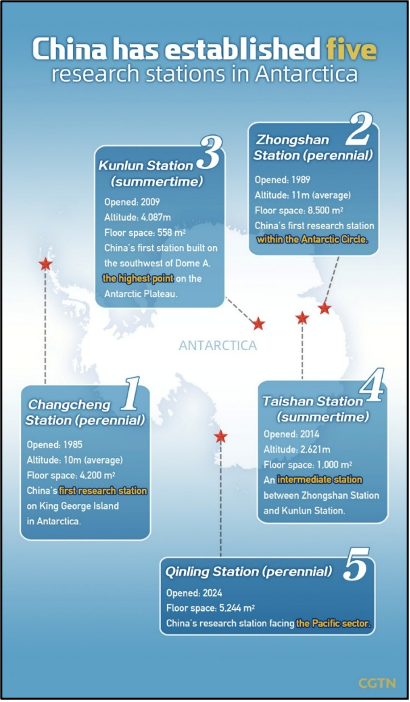 China’s Five Stations in Antarctica
Details of each of these research stations are as described below: –
Chang Cheng (Great Wall) Antarctic Station. This was China’s first research station on the continent. It is located on the Fildes Peninsula in the west of King George Island, southern Shetland Islands of Antarctica (62°12′59″S, 58°57′52″W), and was chosen by Chinese researchers due to its abundant freshwater resources. Work on construction of the the No.1 Building, the first permanent building at the station, commenced on 20 January 1985 (soon after Guo Kun set foot in Antarctica on 30 Dec 1994) and was completed on 20 February 1985.
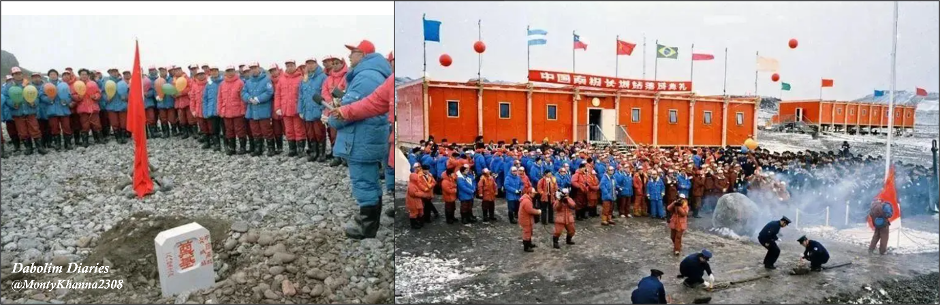 Chang Cheng Station Ground Breaking (Left) and Inauguration (Right)
A formal ceremony for ‘unveiling the nameplate’ of the station was conducted several years later on 04 Feb 1999. This was attended by leaders of Antarctic research stations in the vicinity belonging to Chile, Russia and Uruguay in addition to personnel from the Great Wall station.
The station has grown over the years. It can accommodate 40 people for summer and 25 people for winter. It is well equipped to undertake meteorological and geological observations. It also has extensive communication facilities.
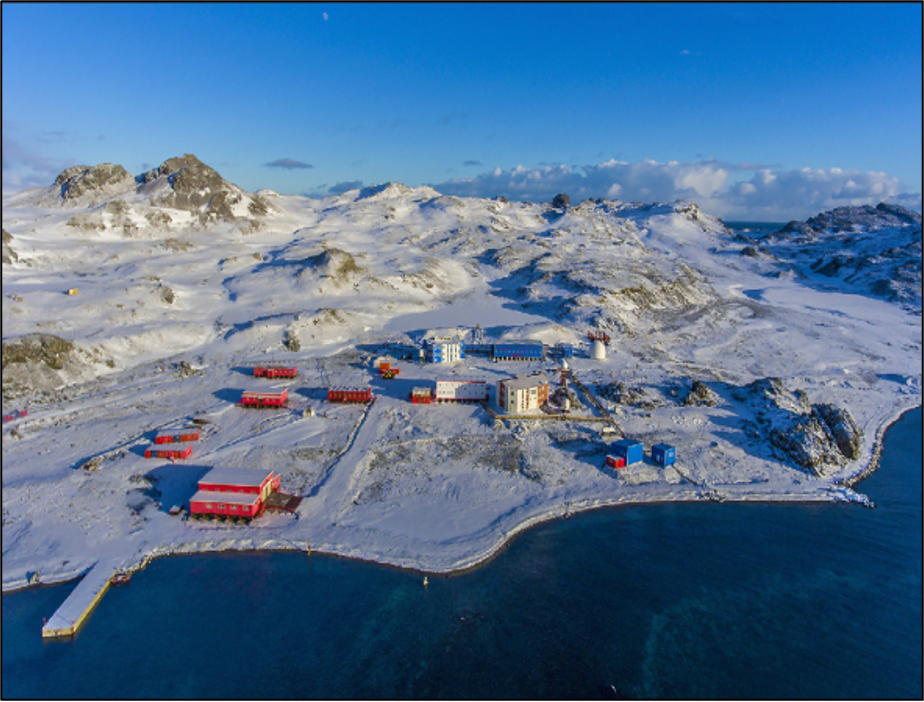 Contemporary Aerial View of Chang Cheng Station
Zhongshan (Sun Yat-sen) Station. This is China’s second Antarctic station. It is located on the Larsemann Hills in Princess Elizabeth Land, East Antarctica (69°22′24″S; 76°22′40″E), near Russia’s Vostok Station. This station too was established by an expedition led by Guo Kun using an Australian ice class vessel Ice Bird (Jidi) on charter. The expedition faced a setback when the vessel was trapped in ice for over seven days in January 1989, and narrowly missed being hit by falling ice. After extricating herself, the team made landfall and completed the construction of the station on 26 Feb 1989.
The station functions throughout the year. When built it was designed to accommodate 60 people in summer and 25 in winter. However, facilities have significantly expanded over the years and it can now accommodate 120 people for summer with the winter team continuing to remain at 25 people. The station primarily carries out scientific observations and research on meteorology, polar high-altitude atmospheric physics, oceanography, geology, geochemistry and environment monitoring. The station also serves as a major transit hub for providing logistical support for China’s inland stations (Kunlun and Taishan) in the continent. She has facilities to support fixed wing and rotary wing aircraft.
 View of Zhongshan Station dated 09 Feb 2019 (Left) and Contemporary Aerial View (Right)
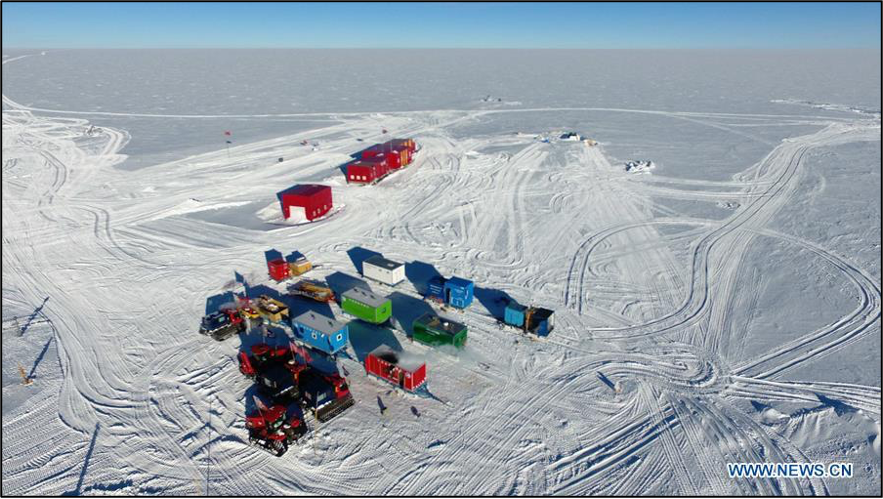
Kunlun Station. This is China’s third Antarctic station and the first one to be built in the interior (away from the coast). It is located on Dome Argus (Dome A) at an altitude of 4,087 meters above sea level (80°25′ 01″ S, 77°06’ 58″ E). For its construction, a 28-member team undertook a 20-day 1,300-kilometer journey from the Zhongshan Station with 11 vehicles, 43 sleds and 625 tonnes of supplies. It was completed on 27 January 2009. The station provides a unique opportunity for meteorological, climate and geological observations with its access to what may be the oldest ice cores to be found on the continent. It is used only in summer and is designed to accommodate 20 people during this period. It is the second closest station to the South Pole, the closest one being the United States Amundsen-Scott station, which is located at the South Pole itself.
Aerial View of Kunlun Station
The station has an airstrip where a landing by China’s first fixed-wing aircraft Xueying (Snow Eagle) 601 was done on 08 Jan 2017.
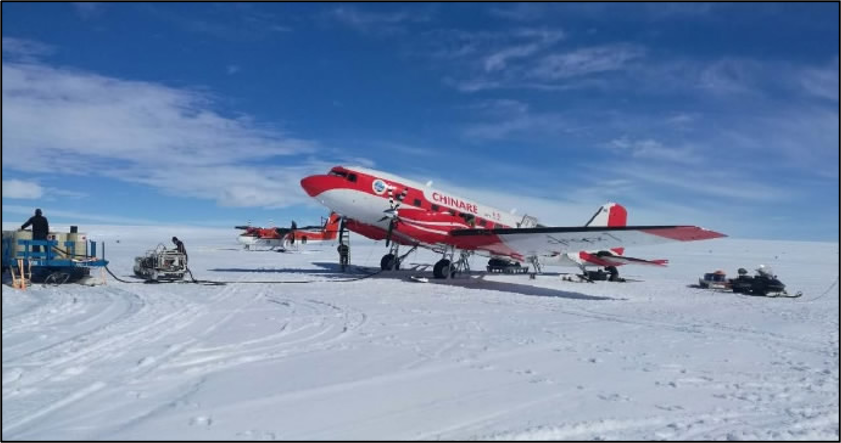 Xueying (Snow Eagle) 601 Aircraft at Kunlun Station
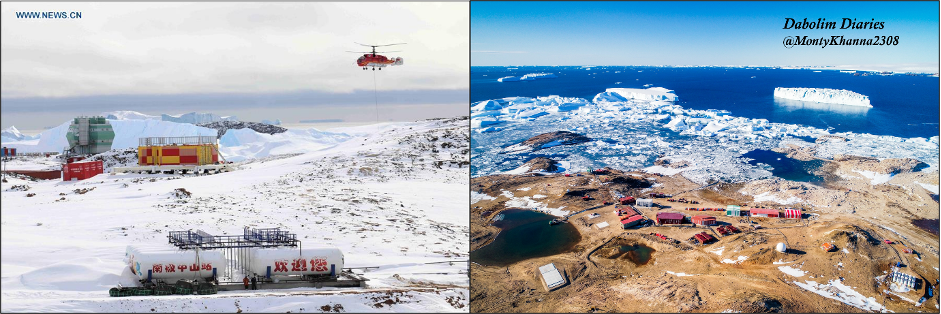
Taishan Station. This is China’s fourth Antarctic Station. Like the Kunlun station, it too is located in the interior of the continent in Princess Elizabeth Land (73°51′50″S, 76°58′27″E), 522 km from and Zhongshan Station 600 km from Kunlun Station. It has an altitude of 2,621 m above sea level. Construction of the station commenced on 26 December 2013 and it was officially opened on 08 February 2014. It was renovated a few years later and equipped with improved support facilities, wind and solar power systems, improved sewage systems and more efficient diesel generators so as to reduce its carbon footprint. The station is used for studying geology, glaciers, and climate change. It has a runway for fixed-wing aircraft. One of its functions is also to serve as a logistics relay point between the Zhongshan and Kunlun stations. The station is manned only in summer and is capable of accommodating 20 people.
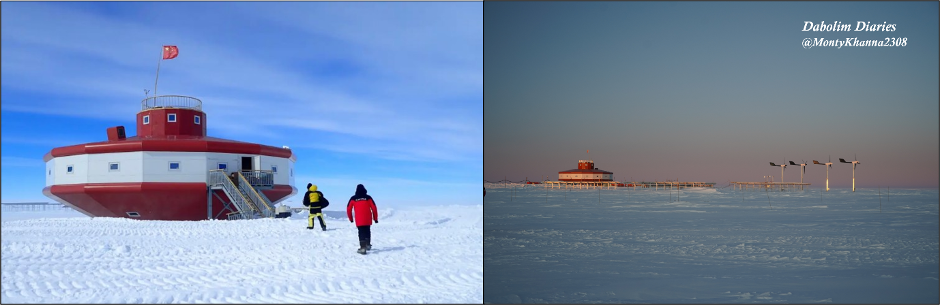 Taishan Station Soon After Construction (Left) and After Augmentation (Right)
Qinling Station. This is China’s fifth and newest station in the Antarctic. It is located on Inexpressible Island in Terra Nova Bay (74°56′04″S, 163°42′55″E). On completion of construction, it was officially named and opened on 07 Feb 2024. It is China’s largest research base in Antarctica and is designed to operate all year, hosting up to 80 people in the summer and 30 during winter. With a covered area of 5,244 square meters, the station is designed in the shape of the Southern Cross constellation. It has a helipad which is located at a distance of one kilometre. The station is built to a state-of-the-art design. Sixty percent of its power requirement is met by renewable sources for which it has a hydrogen power room with a storage tank, 26 solar panels, 10 wind turbines and other associated equipment.
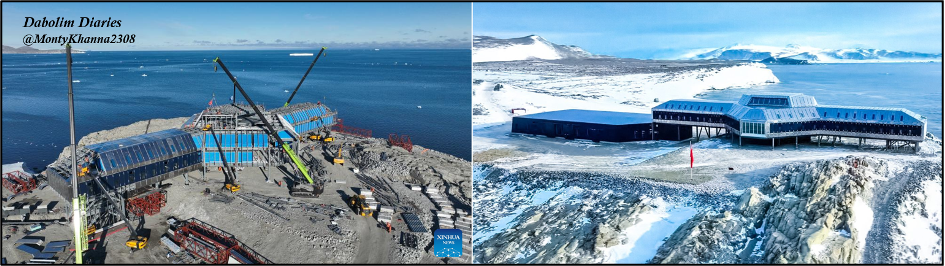 Qinling Station Under Construction (Left) and Completed (Right)
Proposed 6th Station. In early 2025, China forwarded a draft environmental evaluation request to the Secretariat of the Antarctic Treaty for the construction and operation of a new summer research station at Marie Byrd Land, West Antarctica. The matter is scheduled to come up for discussion during the next Antarctic Treaty Consultative Meeting scheduled to be held in Italy in June 2025. The base will have a main building of 900 square meters and a scientific research centre of 500 square meters. It will be capable of accommodating 25 researchers and support staff in summers. It is expected to be operational by 2027.
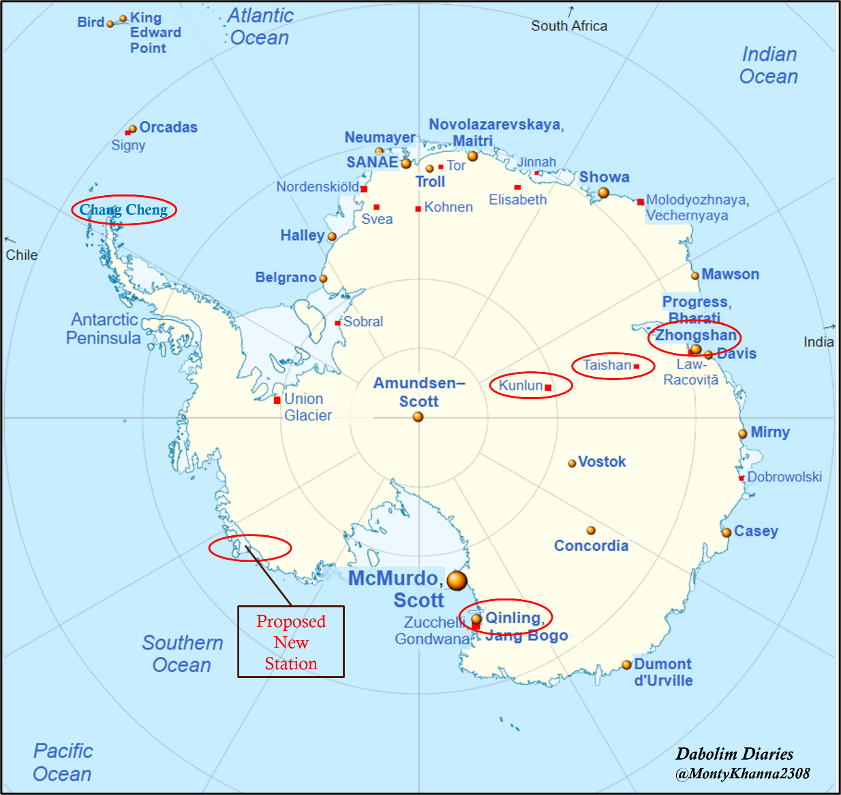 Location of all Chinese Antarctic Stations Encircled in Red
A summary of China’s Antarctic stations is tabulated below.
Summary of China’s Antarctic Stations
| Station | Location | Date Inaugurated | Type | No of Personnel |
| Chang Cheng | 62°12′59″S, 58°57′52″W | 20 Feb 1985 | Perennial
(Coastal) |
Summer – 40
Winter – 25 |
| Zhongshan | 69°22′24″S, 76°22′40″E | 26 Feb 1989 | Perennial
(Coastal) |
Summer – 120
Winter – 25 |
| Kunlun | 80°25’01″S, 77°06’ 58″E | 27 Jan 2009 | Summer Only
(Interior) |
Summer – Nil
Winter – 20 |
| Taishan | 73°51′50″S, 76°58′27″E | 08 Feb 2014 | Summer Only
(Interior) |
Summer – Nil
Winter – 20 |
| Qinling | 74°56′04″S, 163°42′55″E | 07 Feb 2024 | Perennial
(Coastal) |
Summer – 80
Winter – 30 |
| New Station | Exact Coordinates not known | 2027 (Expected) | Summer Only
(Coastal) |
Summer – 25
Winter – Nil |
Assessment
China has been expanding its footprint in the Antarctic at a relentless pace. With the commissioning of the planned sixth station in 2027, it would cement its place amongst nations with the highest number of stations on the continent. In addition to research bases, it has invested substantially in their logistics support by operating a fleet of five icebreakers, two helicopters and one fixed wing aircraft.
Notwithstanding territorial claims put forth by countries, as an outcome of the ATS, the regulatory framework that prevails in the Antarctic is akin to it being a part of the global commons. China knows that the currency that holds maximum heft when it comes to revisiting the prevailing framework in any of the commons is presence.
The principal edifice of the ATS that regulates the extraction of resources from the continent is the ‘Protocol on Environmental Protection’ Article Seven which states that “any activity relating to mineral resources, other than scientific research, shall be prohibited”. Article 25 of the same document, however, provides a future loophole to this stipulation where it states, “If, after the expiration of 50 years, (which is 2048) any of the Antarctic Treaty Consultative Parties so requests, a conference shall be held as soon as practicable to review the operation of this Protocol”. With climate change accelerating almost unchecked, the potential commercial opportunities for extraction of resources that the Antarctic could provide are limitless. China is putting the building blocks in place to ensure that should the revision of the protocol come down to a contestation between the parties involved, its voice will carry adequate weight to ensure that its interests on the continent are protected.


Leave a Reply
Want to join the discussion?Feel free to contribute!