
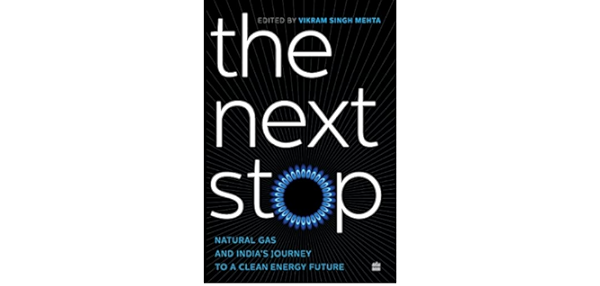
HarperCollins Publishers, 2021. 640 pages, Rs 490 (Hardcover)
The world is yearning for a breath of fresh air — a more sustainable and secure energy future. This burning desire is especially evident in India, a nation grappling with its ever-growing energy needs. Vikram Singh Mehta’s edited volume, “The Next Stop: Natural Gas and India’s Journey to a Clean Energy Future,” makes a timely entry into this conversation and throws open the hood on India’s natural gas sector. The authors collectively propose natural gas as a “bridge fuel”, that is, a temporary solution to help India navigate away from “dirty” coal towards a cleaner energy future. The book delves into the nitty-gritty of India’s natural gas landscape, leaving practically no stone unturned.
The book is helmed by Vikram Singh Mehta, a well-known veteran in the field of India’s energy, who transitioned from the corporate trenches to become a respected analyst. Mehta, formerly the CEO of Shell India, brings his industry expertise to the table as an editor. While international experts lend their voices throughout the book, the section “India – The Current Setting” is firmly grounded in the perspectives of domestic specialists, offering a nuanced view of India’s unique energy landscape.
The book opens with a stark reality check: India’s economy is on a tear, but its continued reliance on fossil fuels, particularly the dirty king coal, is wreaking havoc on the environment. Renewable energy sources are emerging as strong contenders, but they are not yet quite ready to plug the energy gap for the foreseeable future. So, what then, is the plan? The book proposes a strategic pit-stop on the road to clean energy: natural gas, the “cleanest”[1] of the fossil fuels. Mehta and his team advocate for natural gas as a bridge fuel, a temporary solution to wean India off coal and steer it towards a cleaner energy future.
The book casts a spotlight on the roadblocks that threaten to derail India’s natural gas aspirations. One major obstacle is the scarcity of recoverable reserves of natural gas within the country’s sedimentary basins. These reserves often reside in geologically treacherous areas, making extraction a backbreaking and expensive endeavour. Compounding this challenge is the lack of a robust national gas pipeline network. Think of it as a highway system with missing links — it hinders the smooth flow of gas from production sites to hungry consumers. The book further criticises the current policy framework for natural gas, pointing to a labyrinthine pricing structure and complex formulae that leave consumers scratching their heads in bewilderment. To make matters worse, natural gas is currently excluded from the Goods and Services Tax (GST). However, central excise duty, state VAT, and central sales tax, are all levied, leading to inflated costs for end users.
The book takes the reader on a deep dive into the intricate world of natural gas, meticulously dissecting each step in the value chain. From the initial stages of gas production and liquefaction to transportation via specially designed cryogenic ships, the book unpacks the entire natural gas odyssey. It explains how contemporary solutions such as ‘Floating Liquefied Natural Gas’ (FLNG) units — essentially miniature gas-processing plants on ships — and ‘Floating Storage Regasification Units’ (FSRUs) — giant, floating gas-storage tanks — are transforming the industry.
Shifting gears, the book delves into the dynamics of the global natural-gas market, highlighting the growing trend of market-based pricing and flexible contracts. It analyses the emergence of Australia as a major natural gas exporter, contrasting the Australian approach with the long-term, oil-indexed contracts favoured by many Asian countries. This comparison also sheds light upon the evolving power dynamics within the global natural-gas market.
Refreshingly, the book prescribes a slew of recommendations and solutions as well. At the broad level, the authors advocate a major shake-up in the natural-gas import landscape so as to capitalise upon these sorts of advancements. For one, they propose restructuring GAIL (Gas Authority of India Limited) to foster competition within the sector, potentially leading to a more efficient and responsive gas market. They strongly recommend a shift towards market-based pricing — a more dynamic approach that reflects real-time market forces. Additionally, they push for more flexible contracts, allowing India to adapt to changing circumstances. The book also emphasises the need for a policy overhaul that prioritises natural gas. This includes streamlining the inclusion of natural gas within the Goods and Services Tax (GST) to reduce end-user costs.
“The Next Stop” champions a multi-pronged approach to propel India’s natural gas ambitions. First, it calls for a policy shift that prioritises natural gas and streamlines the current labyrinthine pricing structure. Secondly, it proposes including gas under the GST to ease the burden on consumers and advocates for restructuring GAIL to foster competition within the sector.
Recognising that government intervention alone is insufficient, the book emphasises the need for robust collaboration between central and state governments, the private sector, and even consumers. This echoes the importance of a well-oiled machine — all parts working together to overcome roadblocks such as land-acquisition disputes and disagreements over pipeline routes. While acknowledging the environmental concerns surrounding natural gas, the book does not shy away from its potential to displace “dirtier” options in sectors such as transportation and industry, offering a glimpse into a cleaner future.
“The Next Stop” shines brightest in its comprehensive approach and meticulously crafted flow of information. Authored by a team of industry veterans, each chapter delves into a specific aspect of the natural gas value chain or a related policy issue. The book does not avoid complexity, but instead fortifies understanding with detailed charts, graphs, and references. The authors even take a brave dive into the often-opaque world of “Shipping Liquefied Natural Gas,” a topic that strikes a nerve with natural gas carrier owners due to the current lack of profitability. This commitment to transparency is further bolstered by a later chapter that makes a compelling case for India to take control of its natural-gas destiny. The book proposes domestic ownership of natural gas carriers, essentially exhorting India to “get behind the wheel” of its natural gas imports. This bold suggestion foretells a future where India plays a far more proactive role in the global natural gas market.
While ‘The Next Stop’ boasts a wealth of information, its sheer volume can be overwhelming. Writing styles vary across chapters, and key points are repeated like well-worn records, leaving first-time readers, especially those unfamiliar with the energy sector, struggling to absorb the information. Although the book acknowledges the rise of new-natural gas producers, a deeper exploration of the geopolitical chess game surrounding India’s growing dependence on imported gas would have added another layer of intrigue. Perhaps most striking is the fact that the book’s recommendations, published in 2021, remain as relevant today as they were then. And yet, despite the book’s compelling arguments, the government has not implemented any of the suggested changes. This highlights the often-glacial pace of policy implementation, even in the face of pressing challenges.
“The Next Stop” meticulously dissects India’s natural gas sector, but it stops short of delivering a truly impactful punch. While it acknowledges the suffocating grip of air pollution on public health, this critical issue is relegated to the sidelines. A dedicated chapter exploring the potential for natural gas to improve the lives of ordinary Indians would have resonated more deeply amongst readers. Imagine the book quantifying the potential for cleaner air to translate into fewer hospital visits and healthier lungs for millions. It could even propose specific strategies for incorporating natural gas into the energy mix of India’s 14 most polluted cities. This granular approach, focusing on the human cost of air pollution in real places, would have driven home the emotional argument for natural gas far more tellingly. By connecting with the plight of everyday people struggling to breathe, the book could have become a much more persuasive advocate for a cleaner energy future approached across the bridge of by natural gas.
Despite this expressed desire for more, it must be admitted that “The Next Stop” certainly does offer a valuable and meticulously drawn roadmap for India’s journey towards a cleaner energy future. While some portions of the book’s deep dive into the natural gas sector might leave lay readers scrambling for a life raft, its value as a resource for policymakers and energy professionals is undeniable. While advocating for natural gas as a stepping stone on the path to renewable energy, “The Next Stop” offers a clear-eyed view of the hurdles and challenges facing India’s quest for just such a future.
******
About the Author
Ms Harshita Dey is a Junior Research Associate at the National Maritime Foundation. Her areas of interest are Oceania and Maritime History. She can be contacted at ocn1.nmf@gmail.com.
Endnotes:
[1] Natural gas produces 40% less carbon dioxide (CO2) than coal and 30% less than oil, which makes it the cleanest of the fossil fuels.


Leave a Reply
Want to join the discussion?Feel free to contribute!