
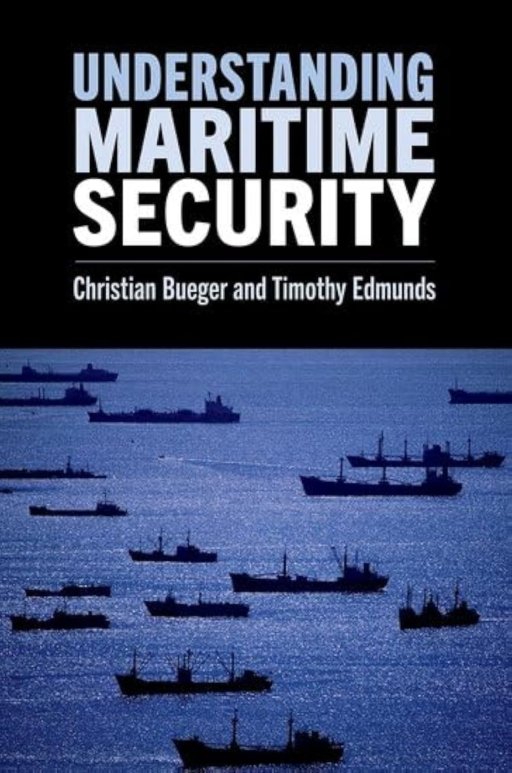
Authors: Christian Bueger and Timothy Edmunds. New York: Oxford University Press, 2024. 217 pages, Rs. 3,366, ISBN: 978-0-19-776715-3
“Understanding Maritime Security”, the recent book by Professors Christian Bueger and Timothy Edmunds, provides a detailed comprehension of the threats and challenges that face the global maritime order in contemporary times. The authors supplement their ideas by the use of rich examples from Europe, the Mediterranean, the Gulf of Guinea, the Western Indian Ocean, and Southeast Asia. Comprising eight chapters, the book provides an excellent insight into the history of maritime security and provides important frameworks to understand the same. The authors suggest relevant tools to deal with the primary concerns of contemporary maritime security and provide an outlook for the future of the maritime security agenda. The book connects the dots between the various issues relevant to maritime security and provides the reader with an understanding that the maritime security agenda, is essentially, an interconnected web.
The authors begin by explaining what maritime security entails and put forth the ‘three dimensions of challenge’ to maritime security. These emerge from three grand ocean visions: the idea of a closed sea, under the sovereign control of States, a free sea, and the sea as a global common, governed by international organisations. These three dimensions comprise inter-State conflicts, maritime terrorism and extremist violence, and blue crime. The expression ‘blue crime’ includes crimes against maritime mobility, criminal flows, and crimes that cause substantial harm to the maritime environment. Bueger and Edmunds attempt to explain the existing threats and struggles that have shaped security at sea.
The idea of closed seas is an ancient one, but its more recent provenance lies in the 1494 Treaty of Tordesillas, in which Spain and Portugal divided the global ocean between them as their sovereign territories. In our contemporary epoch, this same issue has evolved into a question regarding who has control over the ocean’s resources and who should be responsible for environmental protection and marine safety. On the other hand, the idea of a free sea raises questions about the freedom to exploit ocean resources without any restrictions and the freedom of movement of ships for global trade. The debate around the third vision concerns how the wealth from ocean resource exploitation can be distributed equally.
The authors hold that the history of the maritime security agenda has been shaped by four waves of thinking. In the first wave, particularly evident after the terrorist attacks of September 2001 (9/11), the idea of security became a prime focus of concern, following which port and ship security were enhanced. A second wave followed in response to the rise of piracy off the coast of Somalia. The third wave of the maritime security agenda included crimes like smuggling and illicit fishing. The fourth wave has witnessed a broadening of the maritime security agenda through capacity building and an increase in the range of maritime security solutions. Moving forward, a fifth wave of maritime security, focused upon ‘ecosystem thinking’, which incorporates climate change, biodiversity-loss, marine protection, etc., as described by the authors and the need for collective action, is taking shape.
In Chapter 3, Edmunds and Bueger provide different frameworks to analyse maritime security. These frameworks are focused on law, State interest, institutions, meanings, practice, and causes. The framework on law, for instance, looks at ocean governance and the implication of the UN Convention on the Law of the Sea (UNCLOS). State-centric frameworks, which also include institutions, underline that it is the responsibility of States to ensure the requisite degree of security. ‘Practice’ connotes securitisation-analysis or a ‘security as practice’ approach. Frameworks focused on meaning and practice also look at the actions of maritime security actors and how these actions differ in their approach to the determination of solutions. Towards the end of this chapter, the authors introduce a framework of the root causes of maritime insecurity that could help in risk assessment.
The next part of the book focuses on inter-State conflicts, terrorism and grey zones. The authors find that most maritime disputes do not involve military force, unlike the case with conflicts upon the land. They furnish the example of “The Whisky War”, which was a dispute between Canada and Denmark over a small, uninhabited island called Hans. In 2022, the two States agreed to divide the island in half. This, according to the authors, demonstrates that maritime conflicts can be solved through peaceful negotiations. They also give the example of the islands of the Chagos Archipelago to show that international law does, indeed, provide the necessary instruments to peacefully resolve inter-State disputes. At the time the book was published, the UK had refused to return the islands to Mauritius. However, in October this year, after years of negotiations, the UK has agreed to hand over the Chagos Islands to Mauritius[1]. The authors also give the example of the South China Sea to portray how complex inter-State conflicts can be. They explain that the line that segregates types of conflict is often blurred in practice. Grey Zone activities are a good example of this as they are characterised by ambiguity.
With the oceans covering more than seventy per cent of the earth’s surface, they are conducive to illegal maritime activities. Illicit flows are a big part of blue crime and smuggling is a major issue in the maritime security agenda. The authors give examples of the Western African Cocaine route that gained notoriety in the mid-2000s, the methamphetamine trade in Southeast Asia, and the European migration crisis of 2015.
The sixth chapter focuses upon the responsibilities of States in maritime security, which include protecting their own exclusive economic zones (EEZs), meeting obligations under the United Nations Convention on the Law of the Sea (UNCLOS) and other pieces of international law, holding combined security exercises, and so on. The authors delve into the role that international organisations play in conflict resolution and maritime security issues. They also highlight the role of commercial actors in the maritime sector, arguing that their role in maritime security is based on self-interest, rather than tackling issues for the greater good. Non-governmental organisations (NGOs), on the other hand, are underrated actors in the maritime security agenda. NGOs, they feel, play an important role in producing knowledge and maritime domain awareness and have also worked towards tackling the causes of blue crime. The key challenge is for all these organisations to come together for a coordinated response to mitigate maritime security issues.
The book then discusses possible solutions to address maritime threats. These include cooperation between naval forces, such as the US initiative of Combined Maritime Forces (CMF), which coordinates voluntary maritime security operations in the Western Indian Ocean. Another example is that of the Shared Awareness and Deconfliction meeting or SHADE, a platform that was set up in 2008 for informal discussions regarding counterpiracy operations off the Horn of Africa. Other types of cooperation include those between navies and industry, diplomatic fora, and interagency coordination. The authors discuss maritime security operations (MSOs) and show that the growth of the maritime security agenda has seen a rise in their number. Maritime security strategies, including action plans and information-sharing mechanisms also play a vital role to address maritime security, with improving technologies that provide better surveillance. Maritime Domain Awareness (MDA) has also been a ‘key enabling structure’ for building trust between maritime security actors and improving the efficiency of maritime security operations.
In the last chapter, Bueger and Edmunds offer their views on where the maritime security agenda is headed. Threats, including cyber-crime, critical infrastructure protection, the protection of ports, underwater communication cables and maritime energy infrastructure, are highlighted. The authors underline that critical infrastructure such as offshore installations, data cables, and pipelines have, in aggregate, become a major factor in maritime security debates. Here, they give the example of the attack on the Nord Stream pipelines in the Baltic Sea in September 2022. Bueger and Edmunds also draw attention to human-induced climate change and its impact on the marine environment. According to the United Nations Intergovernmental Panel on Climate Change (UN IPCC), sea levels are likely to rise by up to 0.3 metres by 2050 and as much as 1.1 metres by the end of this century, which will result in vast areas of coastal zones and islands becoming uninhabitable. Warmer waters will have an impact on marine life, and in turn, on blue economies. Extreme weather events are also likely to exacerbate marine pollution. While the authors discuss how climate change will force us to take maritime security more seriously and mention the impact of rising sea levels on coastal communities, an issue they could have highlighted in this regard is that of climate change refugees. At a UNSC meeting in February 2023, Secretary-General Antonio Guterres said that the world will witness “a mass exodus of entire populations on a biblical scale”, as sea level rise will lead to a global security crisis.[2]
To conclude the book, the authors offer two clashing ‘master trends’. One trend is inclined towards the rise of ‘planetary thinking’, in which the focus is on environmental challenges the world is facing, and ocean governance. The direction of the other trend is towards growing geopolitical tensions between major States, making cooperation increasingly difficult, while also compounding the militarisation dilemma. The future of maritime security depends on how these two opposing trends take shape over time.
“Understanding Maritime Security” is an excellent reference point for the maritime security community. Overall, the aim of the book is to provide the maritime security analyst and professional, as well as the general reader, ‘what they need to know’ about maritime security, and the book does well to achieve this objective. Bueger and Edmunds succeed in piecing together different ideas, existing literature and theories of the maritime security agenda, providing a clear picture to the reader. Several ideas and theories of maritime security are made coherent with the assistance of tangible frameworks and examples from across the world. The substantial knowledge of the authors on the subject makes “Understanding Maritime Security” an essential read for anyone keen to learn more about this increasingly relevant subject.
******
Endnotes:
[1] Lammy, David. “Foreign Secretary’s statement on the Chagos Islands”. 7, October 2024, https://www.gov.uk/government/speeches/foreign-secretary-oral-statement-on-the-chagos-islands-7-october-2024
[2]United Nations, “Climate Change-induced Sea-Level Rise Direct Threat to Millions around World, Secretary-General Tells Security Council”, 14 February 2023, https://press.un.org/en/2023/sc15199.doc.htm
About the Reviewer
Ms Kripa Anand is a Junior Research Associate at the National Maritime Foundation (NMF). Her research encompasses maritime security issues, with special focus upon the manner in which India’s own maritime geostrategies are impacted by the maritime geostrategies of the island-States of Oceania in general and Australia in particular. She may be reached at rsf4.nmf@gmail.com.


Leave a Reply
Want to join the discussion?Feel free to contribute!