
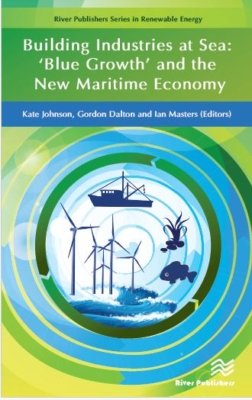
Kate Johnson, Gordon Dalton, and Ian Masters (Editors), River Publishers, 2018, 516 Pages
eISBN: 978-87-93609-25-9
For thousands of years the oceans have been highly prized and have provided us with efficient transport and a plentiful supply of food. Consequently, global society is reluctant to change its set ways and is largely resistant to new ideas. As such, it is often the case that new ideas are not accepted — certainly not as quickly as their advocates would like. These sobering realisations notwithstanding, the editors of this book, Kate Johnson, Gordon Dalton, and Ian Masters hold that traditional uses of the sea can, indeed, coexist with novel technology. The purpose of this book is to undertake a detailed analysis of prospective maritime business sectors that would address both, “Blue Growth” and the “Blue Economy” and to highlight the regimes of maritime governance under which these sectors should operate.
The book is organised into four distinct parts: (1) “The Blue Growth Sectors”, (2) “The Blue Economy Sectors”, (3) “Planning by Sea Basin”, and (4) “Combining Uses”.
Part 1 highlights the promising opportunities for offshore aquaculture in Europe. Recent technological advancements, aimed at alleviating pressure on coastal areas that cannot support any further growth in production, are paving the way for significant fresh investment in this sector. The opening chapter of this part highlights that while offshore aquaculture is still in its early stages, there is significant interest from governments as well as industry to explore its potential. It emphasises the high market value of Atlantic Salmon, which is driving large companies to invest in offshore projects, while also bringing out the fact that shellfish and seaweed cultivation may better suit offshore conditions despite their current market limitations. The next chapter delves into the challenges within the discipline of blue biotechnology, emphasising the need for basic research due to the relatively nascent understanding of marine biodiversity. A primary concern is the sector’s reliance on policy bodies for funding, often neglecting involvement from large companies that possess the necessary resources for successful implementation. Moving to Chapter Three, the discussion shifts to the offshore extraction of metals, wherein geopolitical factors and resource scarcity drive exploration efforts. While some researchers warn of impending shortages, others argue that current land-based reserves are sufficient for at least three decades. This chapter suggests that despite ample existing reserves, market perceptions often undervalue longevity in resource availability, leading to hesitancy in investment. The fourth chapter raises a critical question regarding the slow establishment of wave and tidal energy technologies as viable options for renewable energy. The delay stems from multiple factors, primarily investor scepticism due to the absence of fully operational commercial arrays. Although tidal energy shows promise in terms of its technical viability, wave energy has struggled due to technological uncertainties and the closure of recent projects. The closing chapter of this Part focuses upon the significance of offshore wind energy in the Atlantic and Baltic basins. These regions are expected to remain focal points for future development, although currently subsidised electricity prices may hinder competitiveness. In contrast, the Mediterranean and Caribbean basins face challenges in establishing commercial offshore wind markets due to limited projects and high electricity costs.
In Part Two, the authors shift their focus to more traditional maritime industries. The chapters in this part intricately weave the narrative of transition in the face of challenges such as climate change, overfishing, and regulatory frameworks. The opening chapter of this Part (Chapter 6 of the book) examines the global state of fisheries, noting that nearly all coastlines are fished to some extent and provide significant employment-opportunities for vulnerable communities. In Europe, small-scale fisheries have thrived by shifting their collective focus to species like crustaceans and molluscs, which have seen increases in stock, largely due to reduced finfish predation. The wild fish industry is under pressure, but it remains a resilient one and the cornerstone of the “blue” economy. The next chapter in this part discusses the future of the oil and gas (O&G) industry, projecting a decline in offshore activities as accessible reserves diminish. This shift pushes exploration into remote areas, making operations more expensive and potentially unfeasible. Although the Caribbean and Mediterranean basins hold substantial hydrocarbon deposits, many of them are outside EU waters, raising concerns about supply-limitations as North Sea reserves dwindle. The following two chapters explore the interconnected sectors of shipbuilding, maritime transportation, and coastal tourism. Chapter 8 of the book highlights how European shipbuilding, trying to cope with strong Asian competition, has embraced specialisation to produce high-value vessels, supporting Blue Growth initiatives through technological advancements. Chapter 9 emphasises the significance of coastal and maritime tourism, particularly cruise tourism, which contribute substantially to employment and revenue in Europe. However, this sector faces uncertainties such as fluctuating fuel prices and the adverse impacts of climate change.
Moving forward, the book progresses into more sophisticated realms, with Part Three concentrating upon “Planning by Sea Basin”, while Part IV addresses “Combining Uses”. The discussion on Multi Use Platforms (MUPs) and Multi Use of Space (MUS) is aimed at optimising oceanic resources (Chapters 10 to 13) while minimising conflicts among industries. The narrative promotes synergy across sectors, privileging collaboration (Chapter 14) over competition.
However, the book is not without its limitations. The authors acknowledge the absence of transformative technologies for the blue economy. The data is carefully curated to be relevant to Europe and this makes the reader question its global applicability. That said, it must be acknowledged that even while the focus remains predominantly on European sea basins, the authors have managed to successfully engage the audience in a dialogue about the ocean’s universal importance. Their emphasis on maritime policy paves the way for discussions around ocean governance, although theirs is a narrative fraught with complexities that may deter some who seek answers rather than exploration.
This notwithstanding, this book is a must-read for environmentalists, policymakers, scientists, and, indeed, anyone interested in the exciting potential of the ocean economy. Readers are left inspired to undertake their own exploration of the vast uncharted possibilities that lie beneath the waves.
******
About the Reviewer
Dr Gulshan Sharma is a Junior Research Associate and an environmental scientist at the National Maritime Foundation (NMF). Her research encompasses maritime issues related to the Blue Economy and Climate Change and she specialises in climate change resilience, biodiversity conservation, and marine plastic pollution. With extensive experience in research and academia, she is dedicated to advancing sustainable practices in the marine environment. She may be reached at climatechange3.nmf@gmail.com.


Leave a Reply
Want to join the discussion?Feel free to contribute!