
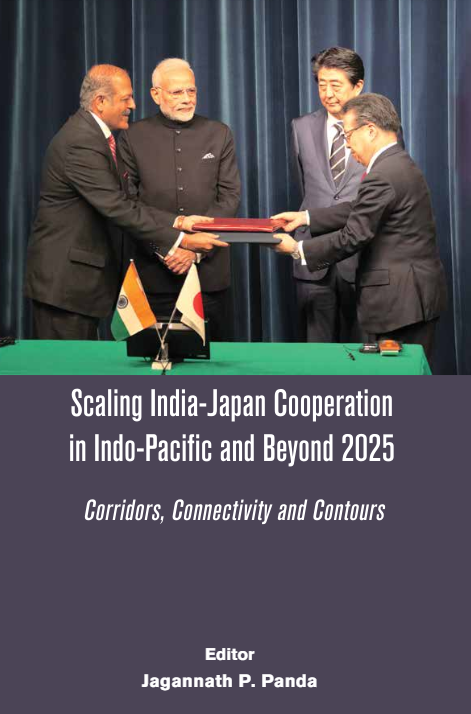
Edited by Dr Jagannath P Panda; KW Publisher Pvt Ltd New Delhi, 2020. 366 pages,
ISBN 978-93-89137-29-3. (Hardcover)
Amongst the most promising bilateral relations of the 21st century is the “India-Japan Special Strategic and Global Partnership”, which is special in many ways and global in its implications. In this regard, “Scaling India-Japan Cooperation in the Indo-Pacific and Beyond 2025: Corridors, Connectivity and Contours”, edited by Dr Jagannath P Panda, is an anthology of articles by a variety of subject-matter experts, each of whom have penned a chapter that explores the many facets of India and Japan’s common interest in building maritime connectivity and quality infrastructure, transparently and inclusively, within the Indo-Pacific. The book fundamentally posits a “win-win” scenario for India and Japan due to the several policy fields in which convergence between the two maritime democracies has steadily been established. The book is segmented into four thematic sections, which address (1) inter-continental connectivity, (2) bilateral perceptions associated with the use of crucial resources and technology, (3) economic imperatives, and (4) maritime cooperation.
Dr Jagannath Panda, who currently heads the Stockholm Centre for South Asian and Indo-Pacific Affairs (SCSA-IPA), is an acknowledged scholar of international renown and was, at the time of publication of this book, a research fellow and Centre Coordinator for East Asia at the Manohar Parrikar Institute for Defence Studies and Analyses (MP-IDSA), New Delhi, India. The book is an offshoot of the India-Japan Symposium, that was held at the MP-IDSA in December 2018 (at which point in time the prefix “MP” had not yet been added to the “IDSA”).
The first section, “Connectivity, Corridors, and Contours: The Inter-Continental Context”, incorporates two chapters. The first, by Jagannath Panda and Mrittika Guha Sarkar, is entitled, “Framing a Eurasia Link in India-Japan Global Ties”, and examines the strategic prospects of aligning Eurasian and Indo-Pacific frameworks to enhance global security and political architecture. The authors feel that a ‘Eurasian’ framework of cooperation is missing in India-Japan mechanisms. Arguing that a ‘global’ partnership can hardly be confined to the Indo-Pacific maritime expanse alone, they advocate the inclusion of Japan in strategic and economic initiatives such as the International North-South Transport Corridor (INSTC), and the Turkmenistan-Afghanistan-Pakistan-India (TAPI) pipeline. The authors also recommend that earlier Japanese policies, such as Hashimoto Ryutaro’s “Eurasian Diplomacy” be revisited and revitalised. The chapter makes for interesting reading but might have stood out better had the authors offered a set of more granular recommendations. The other chapter comprising this section is “Innovation, Value Chain, and Structural Linkages in Asia-Africa Growth Corridor” authored by Srabani Roy Choudhury. She delves into the Asia-Africa Growth Corridor (AAGC), highlighting the collaborative potential between India, Japan, and African nations, in key focus areas such as agriculture, health, and production networks. While India brings to the table its historical presence, manpower, capability, and competence to undertake business and developmental projects, it lacks the necessary capital and high-end technology that Japan brings to bear. The author extensively explores opportunities across a variety of sectors, and this makes for absorbing reading. Although the author presents a fairly comprehensive overview of the analysis of the AAGC, there is once again an absence of adequate detail, making the chapter long in terms of ‘nobility of intent’ but a trifle short in terms of specificity.
The second section, “Bilateral Perceptions and Strategic Significance: Resources and Technology”, delves into the strategic imperatives of the bilateral relationship. KV Kesavan’s “Infrastructure Connectivity and Corridors in Prime Minister Modi’s Japan Policy” expounds upon the manner in which India’s Act East Policy under Prime Minister Modi, driven by the need to counter China’s Belt and Road Initiative (BRI), has led to significant infrastructure and technological projects. Ryohei Kasai’s “Connectivity and Corridors in Shinzo Abe’s Indo-Pacific Foreign Policy: 2025 and Beyond”, on the other hand, highlights Japan’s Free and Open Indo-Pacific (FOIP) strategy and highlights its emphasis on infrastructure to maintain regional stability. The strategic foresight of Prime Minister Modi and the late Prime Minister Abe in leveraging the strengths of their respective countries to foster regional stability and economic growth is given due acknowledgement and praise. The detailed analysis of ongoing and proposed projects demonstrates the potential long-term benefits of India-Japan collaboration for regional development and global economic integration. The next chapter within this section is by AD Gnanagurunathan, who focuses upon “Technology and Resource Imperatives in India-Japan Relations” and examines bilateral technological cooperation aimed at addressing resource challenges. The author strongly espouses the value of India-Japan cooperation in space, exemplified by joint missions such as the Lunar Polar Exploration (LUPEX) mission, which aims to explore the moon’s southern pole and combines ISRO’s own lunar mission expertise with JAXA’s advanced rover-technology. He points out that dyadic cooperation in satellite technology is already enhancing disaster management and environmental monitoring at a global level and apart from positioning both nations as key players in global space technology, is fostering a new era of space diplomacy. This is followed by Shamshad A Khan’s “Role of Forums and Institutional Mechanisms in the India-Japan Partnership of Prosperity”, which evaluates the importance of bilateral and multilateral forums in deepening the strategic partnership. He competently places the bilateral relationship within the broader geopolitical context involving other like-minded nations. Khan explains that maritime exercises such as JIMEX and MALABAR, along with strategic dialogues and frameworks such as the Quad and BIMSTEC, are central to enhancing maritime security and ensuring freedom of navigation and overflight and crucial to counter China’s growing influence in the region. Investments in infrastructure, particularly in the Andaman and Nicobar Islands, and in ports across South Asia, such as Bangladesh’s port of Matarbari — a natural gateway to both South and Southeast Asia — highlight Japan’s commitment to enhancing regional stability and economic integration. This cooperation extends beyond the security realm and includes humanitarian assistance and disaster relief, showcasing a multifaceted approach to regional challenges. The incorporation of other nations into this strategic framework, particularly through the Quad, underscores the importance of collaborative efforts to maintain a free and open Indo-Pacific. Thus, the strategic alignment and complementary strengths of both nations, along with their partnerships with other like-minded countries, are shown to be critical in promoting sustainable development and stability in the region.
The third section, “Financing Projects and Policies: The Economic Imperatives”, focuses upon the economic dynamics of the partnership, emphasising China’s influence as a pivotal economic force in the region. Ravi prasad Narayanan’s chapter, entitled “The Asian Context: Chinese Economy and India-Japan Ties”, examines how China’s “One Belt and Road Initiative” (OBOR), a strategic counter to the US pivot towards Asia, has reshaped regional economic policies, pushing India and Japan closer in trade, defence, and security. Narayanan suggests that China’s focus on development, contrasted with the USA’s emphasis on economic liberalisation, has allowed Beijing to fill the void left by US disengagement from regional multilateralism. This geopolitical shift, he feels, necessitates a robust India-Japan partnership to balance China’s growing influence. The second chapter of this section is by Takashi Terada and is entitled, “Prospects of the Free and Open Indo-Pacific Initiatives and India-Japan Partnership”. It explores the evolving geopolitical dynamics between China, the US, India, and Japan. Terada argues that China’s initiatives such as the “Belt and Road Initiative” (BRI) and the “Regional Comprehensive Economic Partnership” (RCEP) pose significant challenges to regional stability and economic governance and recommends a high degree of sophistication in the strategic responses of India and Japan, involving careful balancing to support a “Free and Open Indo-Pacific” (FOIP). He cautions against a reduced emphasis on multilateralism, explaining that a return to an inward-leaning regional economy would adversely impact the much-needed trilateral cooperation between the US, India, and Japan. Terada’s insights offer a comprehensive understanding of the shifting geopolitical climate within the Indo-Pacific and makes for excellent reading. Another good read is Titli Basu who, in her following chapter on “International Financing, Infrastructure, and Statecraft: Japan’s Role in India’s Modernisation”, argues that Japan’s infrastructure-financing, facilitated through institutions like the Asian Development Bank (ADB) and Japan International Cooperation Agency (JICA), plays a crucial role in India’s modernisation. She highlights that Japan’s strategic investments in Indian infrastructure not only foster economic development but also enhance Japan’s own geopolitical standing in the Indo-Pacific. Basu contends that Japan must leverage its position in multilateral development banks to support India’s integration into regional value chains and industrial networks, thus addressing the “infrastructure imbalance” in Asia, and countering China’s dominance. Both chapters underscore the intricate balance of power and the strategic economic collaborations essential for maintaining stability in the Indo-Pacific region. In the fourth and final chapter of this section, entitled “Infrastructure Investment: EPQI, BRI and the Emerging Asian Contest”, Amrita Jash explores the competitive nature of Japan’s “Expanded Partnership for Quality Infrastructure” (EPQI) and China’s BRI, which reflects the broader geopolitical contest between the two countries. Notably, Jash examines the role of India in this dynamic, particularly in the context of the Asia-Africa Growth Corridor (AAGC), showing how overlapping interests have created a complex landscape of near-simultaneous cooperation and competition. By dissecting the operational aspects and strategic motivations underpinning the EPQI, the BRI, and the AAGC, she adds considerable depth to the understanding of regional dynamics.
The book’s final section explores the convergence of maritime interests between India and Japan. Abhay Kumar Singh, in his chapter, “India-Japan Strategic Partnership: Imperatives for Ensuring ‘Good Order at Sea’ in the Indo-Pacific”, highlights the historical and strategic synergy in maritime Asia, emphasising the importance of maintaining “Good Order at Sea” for both nations to pursue their strategic and economic interests in the Indo-Pacific. Kenta Aoki’s chapter is tantalisingly entitled, “Chabahar: The Fault-line in India-Japan Infrastructure Cooperation”. In it, Aoki examines the strategic complexities of the Chabahar port project and argues that although it serves as a counter to China’s Belt and Road Initiative (BRI) and the China-Pakistan nexus, aligning with India’s “Connect Central Asia” policy, Japan’s own commitment to Chabahar is far less robust. This, the author feels, is partly due to Tokyo’s strategic compulsions vis-à-vis the US, potentially allowing Beijing to expand its influence should Iran seek Chinese assistance for the port’s development. Takuya Shimodaira’s chapter, “China’s Maritime Policy in the Bay of Bengal: How does it Affect India’s and Japan’s Maritime Interests?” analyses China’s expanding naval presence in the Bay of Bengal and its implications for India and Japan. Shimodaira highlights the strategic responses needed to counter China’s “Maritime Silk Road” (MSR) and calls for enhanced connectivity through BIMSTEC and potential cooperation with the Quad. Madhuchanda Ghosh’s brings up the tail of the book, with the chapter “India and Japan in the Bay of Bengal: Strategic Convergence to Maritime Security”. Like Shimodaira before her, she, too highlights the importance of the Bay of Bengal within the context of India-Japan cooperation in their mutual pursuit of their complementary security interests. Where Shimodaira had focused upon mini-lateral and multilateral constructs ranging from the QUAD to the EU and BIMSTEC, Ghosh proceeds along a more bilateral trajectory as evidenced by her dilation upon “the US Factor” in countering China’s naval expansion and ensure regional maritime security. Together, these chapters provide a comprehensive analysis of the strategic maritime dynamics in the Indo-Pacific, emphasising the critical role of India-Japan collaboration in maintaining regional stability and security.
Overall, the book offers its readers a systematic and detailed set of analyses that are enriched by data, graphs, and maps. As such, it is a hugely useful guide for anyone seeking to understanding the complexities of India-Japan collaboration, from uncovering shared challenges to seizing opportunities. The book could certainly have benefited from an exploration of how best India and Japan could leverage ‘soft diplomacy’ and the value that is to be found in the promotion of Japanese and Indian cultural riches, through language education, art (even including ‘anime’), and so forth. ‘Soft diplomacy’ plays a crucial role in the strengthening of bilateral ties and fostering mutual understanding. The Japan Foundation, for instance, is a key player in Japan’s cultural diplomacy efforts in India, offering inexpensive Japanese language courses and organising a variety of cultural events that go a long way in bridging cultural gaps and promoting a deeper appreciation of Japanese culture among Indians. The same is true of the ‘brand positioning’ of India and its culture within Japan, so as to replace negative impressions with positive ones. The book would have been enriched by an exploration of this facet. Even within the structure of the book as it presently obtains, one wishes that there was a greater degree of specificity in the earlier chapters and that they contained less of broad generalities, especially where ‘way-ahead’ recommendations are concerned. That said, the later chapters, especially those that have deliberated on the port of Chabahar are very timely, indeed, given the long-term agreement that has been signed between India and Iran on 14 May 2024. All in all, “Scaling India-Japan Cooperation in the Indo-Pacific and Beyond 2025: Corridors, Connectivity, and Contours” makes for compelling reading, and is a valuable supplement to any researcher’s understanding of regional geopolitics within the Indo-Pacific.
******
About the Author
Ms Aashima Kapoor is a Junior Research Associate at the National Maritime Foundation. Her research focuses on the maritime geostrategies of Japan and their impact on India. In addition to her research expertise, she is proficient in the Japanese language. She can be reached at ea2.nmf@gmail.com


Leave a Reply
Want to join the discussion?Feel free to contribute!