
Rear Admiral Monty Khanna (Retd) – ‘Dabolim Diaries’ Issue No 12 dated 25 Mar 2025
In 2015, Pakistan signed a contract with China Shipbuilding & Offshore International Co. Ltd (CSOC), for eight S-26 Class submarines at an estimated cost of between four to five billion U.S. dollars. Termed as the Hangor Class Submarine Programme, this was the largest defence contract signed by the Pakistani Navy (PN) in its history. As per the terms of the contract, four submarines were to be built by Wuchang Shipbuilding Industry Ltd (WSIL) at their Shuangliu Base in Wuhan and the remaining four by Karachi Shipyard & Engineering Works (KS&EW) in Karachi, Pakistan, under a Transfer of Technology (ToT) agreement. The submarines built by WSIL were to be delivered in 2022-23 and those built by KSEW by 2028. A stated aim of the programme was to transform Pakistan into a submarine building nation.
The S-26 is an export variant of the Type 039 Yuan Class submarine built for the PLA Navy. Like the Yuan, it is equipped with a Stirling engine-based Air Independent Propulsion (AIP) system allowing it to remain submerged for a prolonged duration. The version of the S-26 contracted by Pakistan reportedly has some design modifications. These include a heavier displacement of 2,800 tons (as against the S-26’s 2,550 tons) and a slightly shorter hull of 76 m (as against the S-26’s 77.7 m).
The programme got off to a good start with both China and Pakistan augmenting their shipyards to facilitate construction. The lone Final Assembly Hall (FAH) at the Shuangliu Base of WSIL (which was being used for the Royal Thai Navy S-26 programme) was augmented by a much larger FAH of dimensions 295 x 42 meters built adjacent to it. Work on this FAH commenced in early 2016 and was completed by early 2017. The PN programme is being executed at this hall.
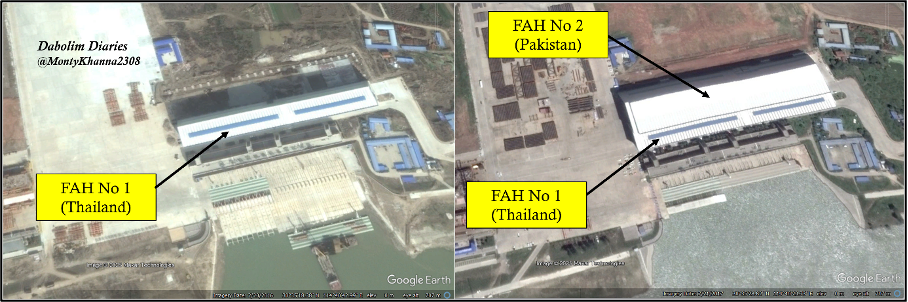 Google Earth Images of Shuangliu Base dated 20 Feb 2016 (Left) and 21 Jul 2017 (Right)
Insofar as KSEW is concerned, a contract was signed in July 2017 with the Norwegian ship design and building firm TTS Group for the construction of a Syncrolift ship-lift system capable of handling ships of up to 7,300 tons. The lift-system was to be connected with a rail-linked system with 30 motorized trollies used for shifting vessels to one of 12 custom-designed workstations on land, including two inside a covered shed of dimensions 135 x 38 meters. Work on this facility commenced in 2018 and it was commissioned on 10 Aug 2021.
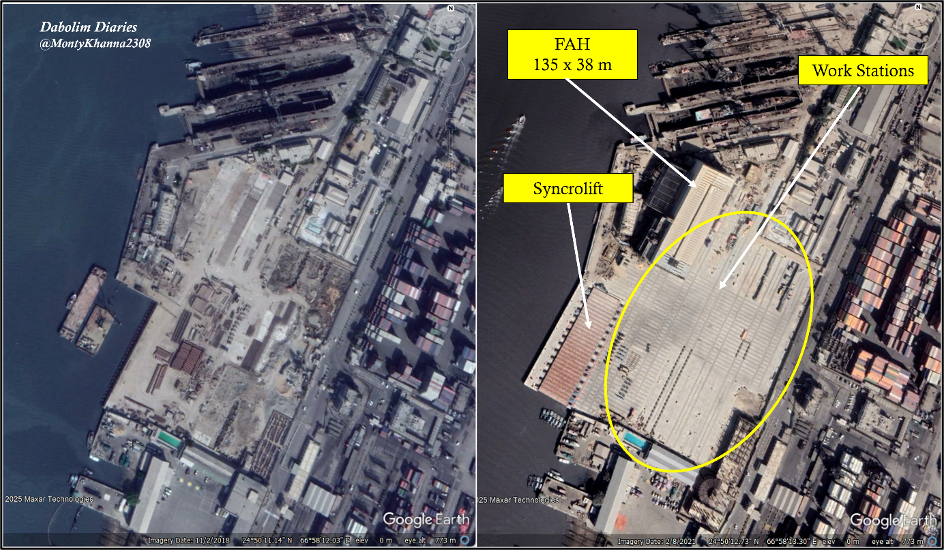
Ship-Lift and Transfer System at KS&EW. Google Earth Images dated 02 Nov 2018 (Left) and 08 Feb 2021 (Right)
The timeline of the programme however got derailed by two major events. The first of these was the outbreak of COVID followed by the lockdown in Wuhan commencing January 2020. The second major issue was Germany’s refusal to give an export license to China for the locally manufactured MTU 396 diesel engines that power the submarine. To address this issue, the PN opted to wait for China to certify its indigenously developed and built CHD-620 diesel engine. It may be presumed that sufficient performance guarantees have been given by China to the PN to address the operational risk associated with the fitment of unproven engines.
The delays to the programme were reportedly used by the PN to persuade China to carry out further modifications to the submarine. The most significant of these is the conversion of the earlier wet snorkel mast to a dry one, which allows the crew to drain the snorkel mast and associated pipes while remaining submerged. This reduces the time required to start generators and commence the charging of batteries after the mast-head breaks surface thereby improving the Indiscretion Rate (IR) of the submarine. Other changes relate to the improvement of habitability and ergonomics.
On 07 Oct 2020, while briefing the press the outgoing CNS Admiral Zafar Mahmoud Abbasi had stated that the PN would obtain a Yuan Class submarine from the PLA Navy (over and above those being constructed as part of the Hangor programme) for training and acclimation purposes on a ‘gratis basis’. This, however, is yet to materialize and given the advanced stage of the programme, appears unlikely at this point of time.
Significant milestones associated with the programme are as mentioned below: –
- Naming of the First Submarine. The PN Chief of the Naval Staff, Admiral Zafar Mahmood Abbasi visited the Shuangliu Base of WSIL on 29 Apr 2019. The naming ceremony of the first submarine under the programme, Hangor, was held during the visit. The dates of steel cutting and keel laying of Hull Nos 1 and 2 are not in the public domain.
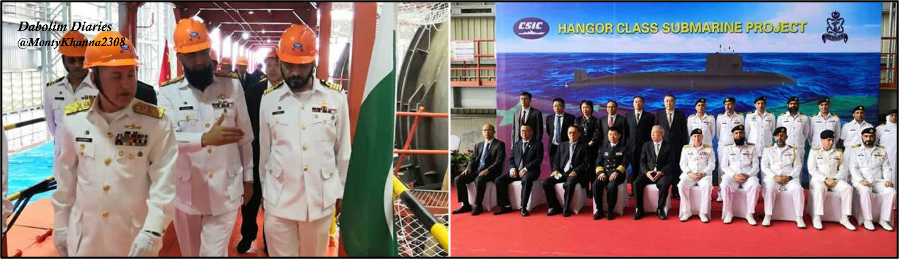 PN CNS Reviewing Construction at Shuangliu (Left), Naming Ceremony (Right)
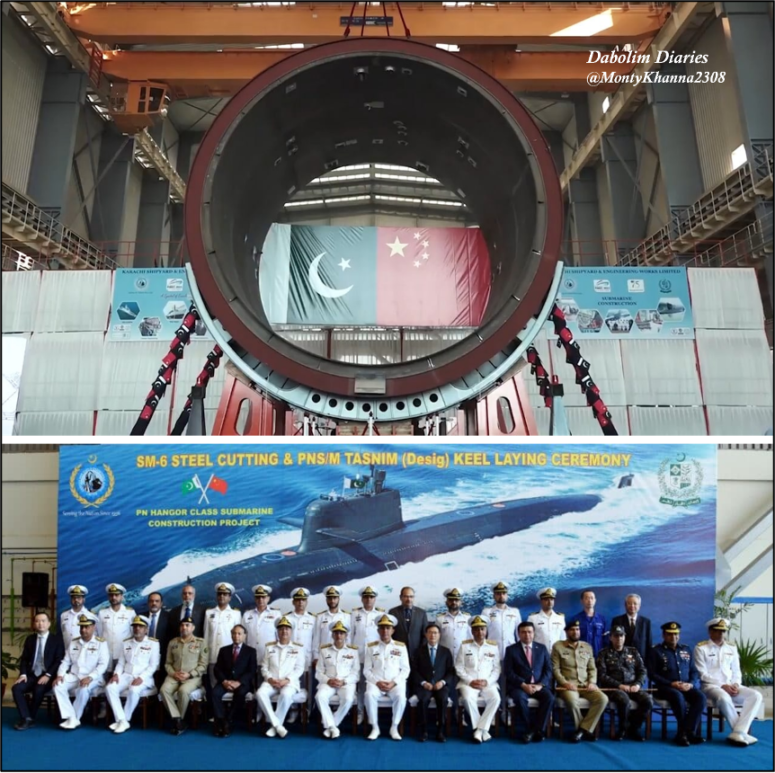
- Steel Cutting of Hull No 5. The steel cutting ceremony of the first Hangor-class submarine to be built at KSEW, originally scheduled for October 2020, was held on 09 Dec 2021. The submarine would be named PNS Tasnim upon commissioning, in honour of the commanding officer of ex-PNS Hangor, Vice Admiral (Retd) Ahmad Tasnim, who was present on the occasion. The event was presided over by Admiral Zafar Mahmood Abbasi, Chief of the Naval Staff of the PN.
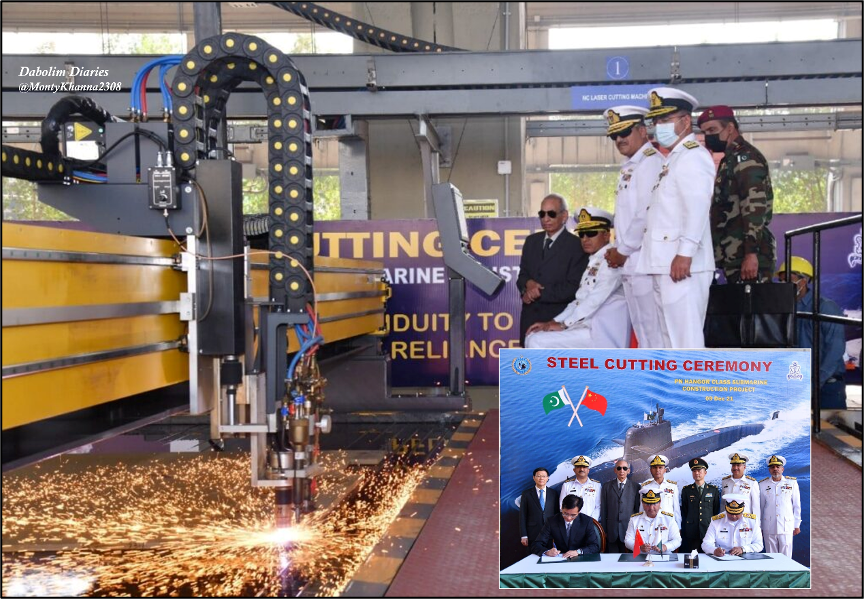 Steel Cutting Ceremony of Hull No 5 at KS&EW
- Keel Laying of Hull No 5 and Steel Cutting of Hull No 6. A ceremony to simultaneously commemorate the keel-laying of Hull No 5 and steel-cutting of Hull No 6 was held at KS&EW, Karachi on 24 Dec 2022. The event was presided over by Admiral Zafar Mahmood Abbasi, Chief of the Naval Staff of the PN.
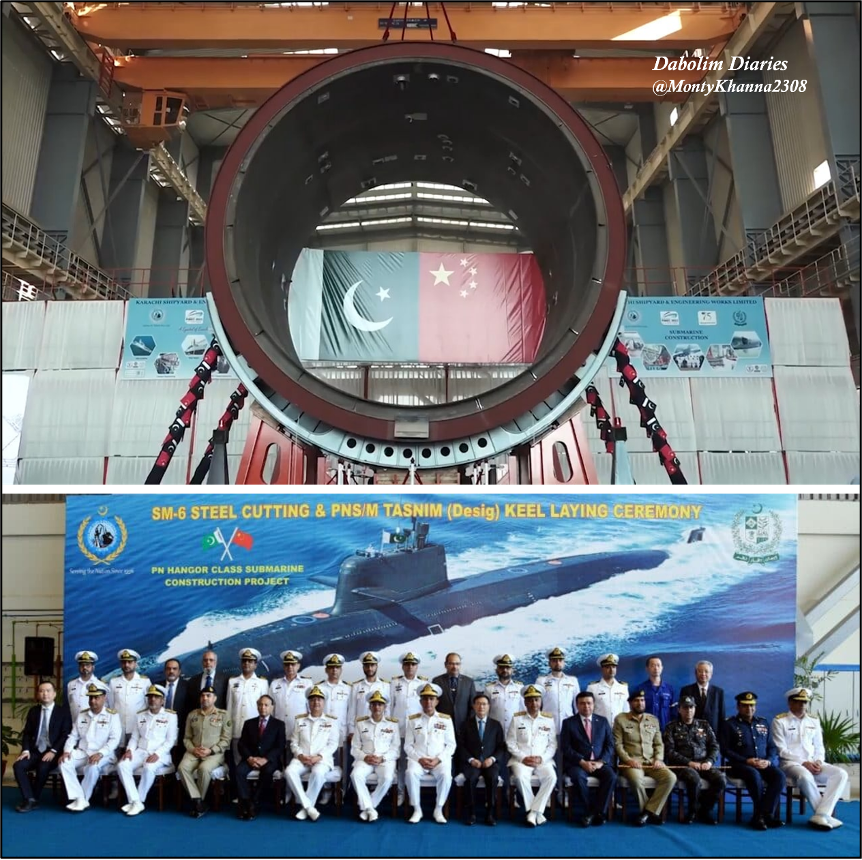 Ceremony Commemorating Keel Laying of Hull No 5 and Steel Cutting of Hull No 6 at KS&EW
- Keel Laying of Hull No 6. The keel-laying of Hull No 6 was held at KS&EW, Karachi on 14 Feb 2024. The event was presided over by Admiral Naveed Ashraf, Chief of the Naval Staff of the PN.
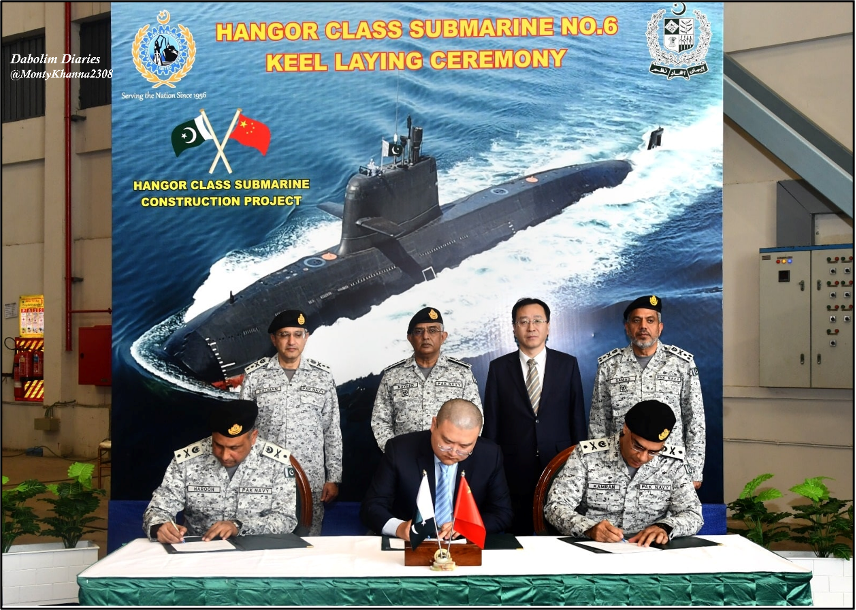 Keel Laying Ceremony of Hull No 6 at KS&EW
- Launch of Hull No 1. The launch ceremony of Hull No 1 (Hangor) was held at the Shuangliu Base of WSIL in Wuhan on 26 Apr 2024. Admiral Naveed Ashraf, CNS of the PN was the Chief Guest at the occasion.
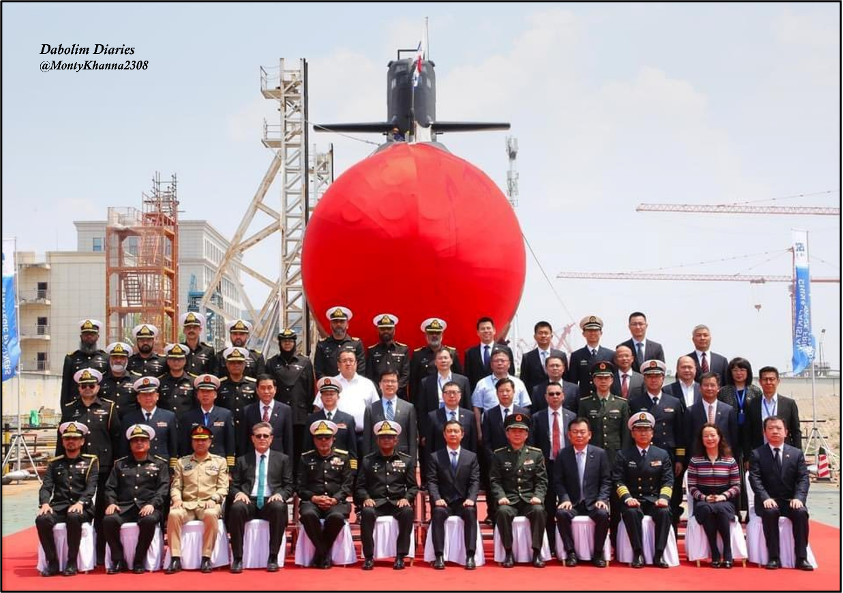 Launch Ceremony of Hull No 1 at Shuangliu Base, Wuhan on 26 Apr 2024
The skewed propellor blades of the submarine are clearly visible while the submarine is being launched into the Yangtse Kiang on the slipway.
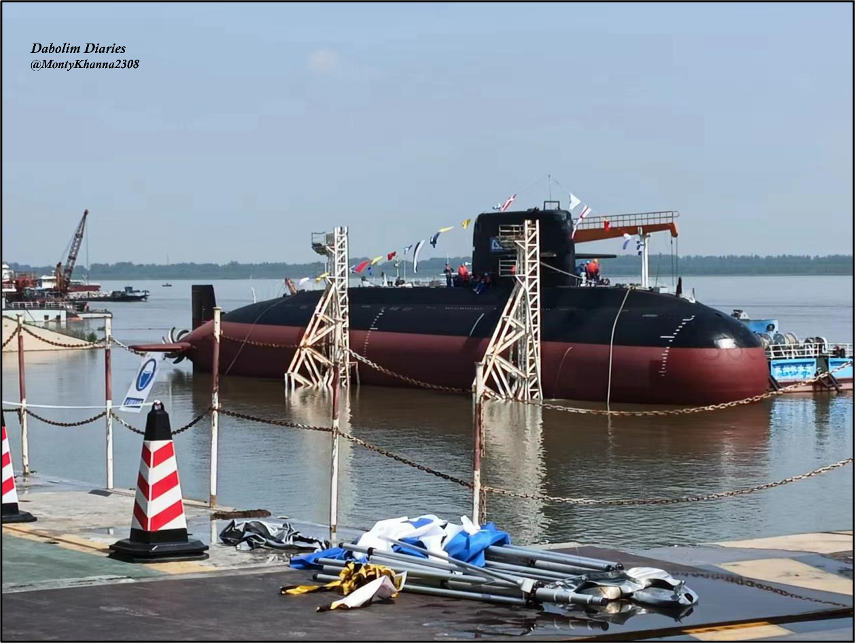 Hull No 1 (Hangor) Being Floated on 26 Apr 2024
Post launch, the submarine has been berthed at one of the floating wharfs of the yard for further outfitting.
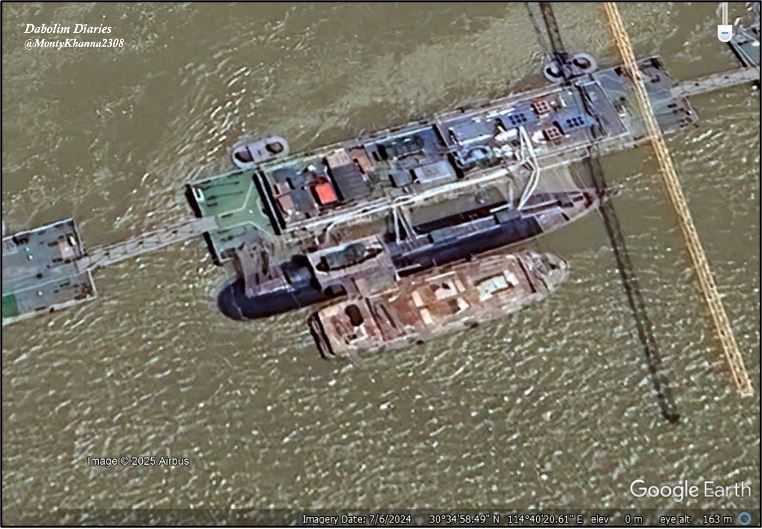 Hangor at Outfitting Berth Post Launch
- Launch of Hull No 2. The launch ceremony of Hull No 2 was held at the Shuangliu Base of WSIL in Wuhan on 13 Mar 2025. Vice Admiral Ovais Ahmed Bilgrami, Vice Chief of the Naval Staff of the PN was the Chief Guest at the occasion.
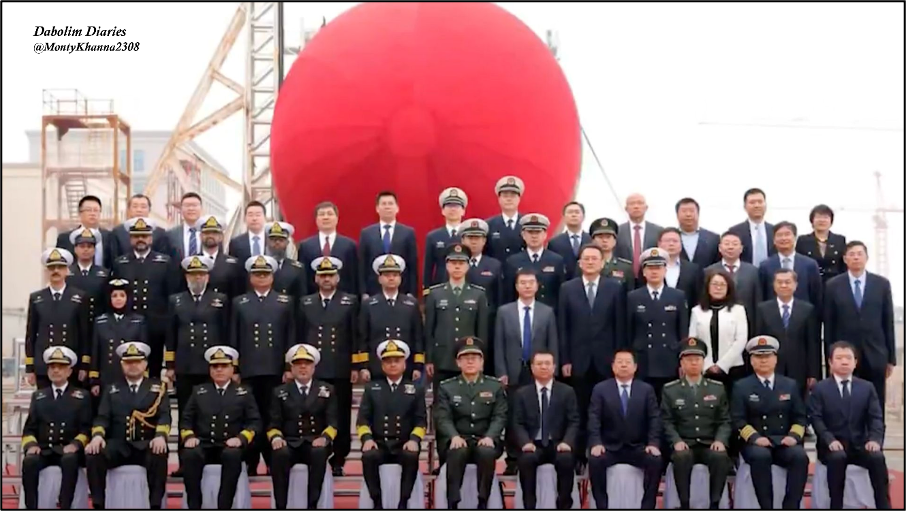 Launch Ceremony of Hull No 2 (Shushuk) at Shuangliu Base, Wuhan on 13 Mar 2025
Tabulation of Cardinal Dates of Submarine Hull Nos 1 & 2 and 5 & 6
|
Boat No |
Yard | Stell Cutting | Keel Laying | Launch | Delivery | Commissioning |
|
1 (Hangor) |
WSIL | Not Known | Not Known | 26 Apr 2024 | Mid 2025 (Est) | End 2025 (Est) |
|
2 (Shushuk) |
WSIL | Not Known | Not Known | 15 Mar 2025 | Early 2026 (Est) |
Mid 2026 (Est) |
| 5 (Tasnim) |
KSEW |
09 Dec 2021 |
24 Dec 2022 | |||
| 6 | KSEW | 24 Dec 2022 | 14 Feb 2024 |
Assessment
Progressive induction of AIP equipped Hangor Class submarines in the PN will give a fillip to their submarine arm and its capabilities. Even though the Agusta 90B submarines in PN inventory are also AIP equipped, the system has been plagued with several technical and contractual issues rendering these plants practically inoperable.
The experience gained by KS&EW in building four of the submarines under this programme will hold them in good stead for conducting major overhauls as well as modernization of these boats as and when they fall due. The yard will also find it easier to transition to the building of newer classes of submarines, particularly if they are of a Chinese design or share several features of the Hangor Class.
As several of these boats are likely to be based at Jinnah Naval Base, Ormara, facilities to support the class will be created there in due course. This will also be immensely beneficial to the PLA Navy which will now have the option of pulling into two ports i.e. Karachi and Ormara (in addition to Djibouti) for supporting their submarines when deployed in the Indian Ocean, should the requirement to do so arise. In doing so, they will however have to confront internal security issues related to a turbulent Sindh and Baluchistan. The long-term solution for them would be to have an exclusive hard-perimeter base at a desolate location on the Makaran coast in which they could minimize their interaction with the local populace.


Leave a Reply
Want to join the discussion?Feel free to contribute!