
Rear Admiral Monty Khanna (Retd) – ‘Dabolim Diaries’ Issue No 9 dated 04 Mar 2025
China’s deep sea exploration capabilities have grown over the years. It is now, arguably the nation with the largest investment in this field. Support for such exploration has come from the apex level with President Xi Jinping, in a speech in end May 2021, encouraging the Chinese scientific community to make strides in four vital frontiers, one of which is ocean research. This is a follow up to an earlier speech made by him in 2013 where he stated, “Care about the ocean, understand the ocean, and strategically manage the ocean”.
China has two large, well-resourced institutions that are engaged in deep sea research. These are the National Deep Sea Center (NDSC), Qingdao, Jiangsu Province that operates under the Ministry of Natural Resources (MNR) and the Institute of Deep-sea Science and Engineering, Sanya City, Hainan Province that functions under the China Academy of Sciences (CAS).
This subject will be covered in two parts. This brief (Part I) focuses on the NDSC.
National Deep-Sea Center
The NDSC is a department-level institution. It used to operate under the State Oceanic Administration (SOA) but with the SOA being subsumed under the MNR at the 19 Mar 2018 reorganization, it now functions directly under the MNR. Located at Qingdao (36o 20’.1 N, 120o 43’.2 E) it has an area of 25.75 hectares with a total construction area of 24,526 square meters. The first phase of its construction, which took place between 2014 and 2015 cost RMB 495 million.
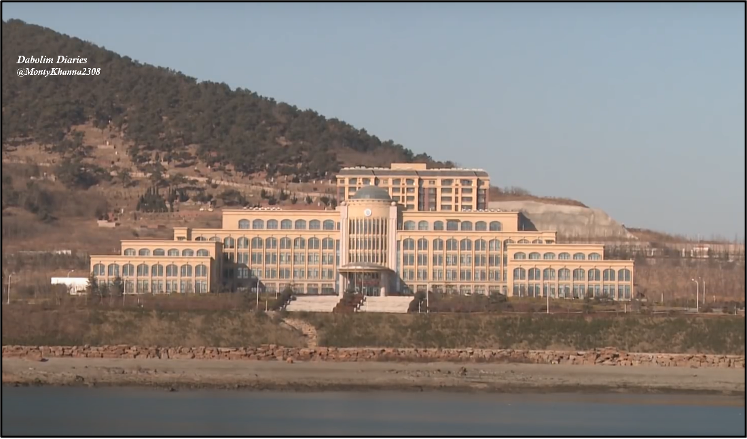 National Deep Sea Base Management Center (Main Building)
Responsibilities
The responsibilities of the NDSC as listed on their website (https://www.ndsc.org.cn/) are as given below: –
(1) To undertake deep-sea resource exploration, scientific investigation, environmental observation and other tasks;
(2) To be responsible for the operation and management of deep-sea base survey ships, major equipment, etc.;
(3) To undertake the purchase and transformation of deep-sea equipment, and to carry out research and development and testing of deep-sea technical equipment;
(4) To be responsible for the selection, training and management of divers and major equipment operators;
(5) To undertake the publicity, education and popularization of deep-sea science and technology;
(6) To carry out industrial transformation and services of deep-sea technological achievements;
(7) To carry out international cooperation and exchanges in deep-sea scientific investigations;
(8) To undertake other matters assigned by the Ministry of Natural Resources.
The organisation of the NDSC is as given below: –
Leadership
The leadership of the organisation is as listed below: –
- Zhang Chunlei – Director and Party Committee Secretary
- Song Chengbing – Deputy Director (Chief Engineer)
Layout of Facilities
The broad layout of facilities at the NDSC is as given below: –
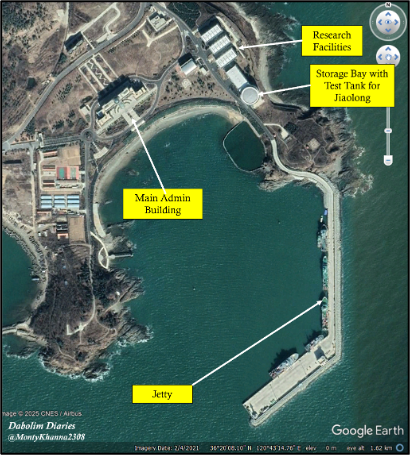 Layout of NDSC Main Base, Qingdao
Jetty
The facility has a jetty that encloses a basin. The jetty comprises of two segments, the first being narrow with the length of 300 m and the second that incorporates a 50 m wide hard and with a length of 280 m.
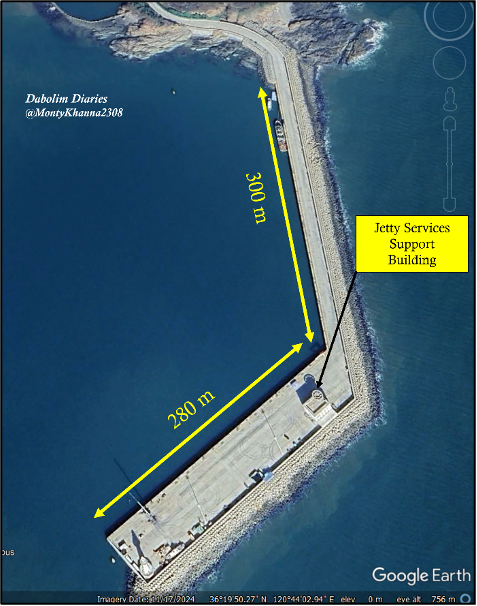 Layout of Jetty
The hard has a jetty services support building at its northern end.
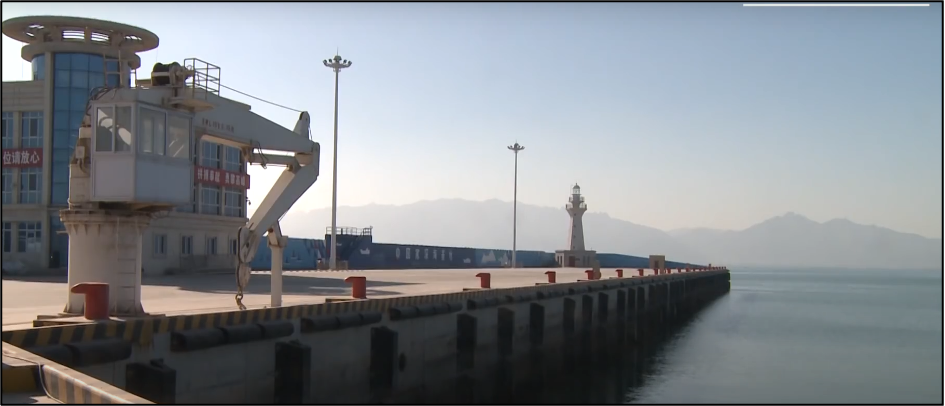 Jetty Services Support Building
Storage Bay for Submersibles
The NDSC Main Base has a large circular building (just North of the jetty) that serves the purpose of a hanger for the storage of submersibles. It also incorporates a test tank for carrying out necessary checks while ashore.
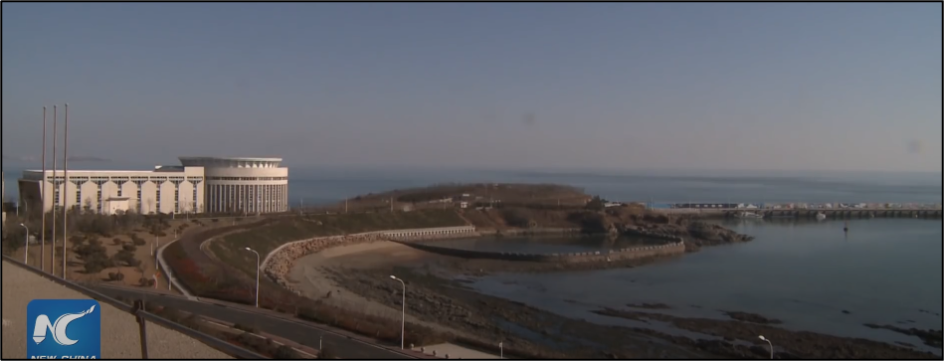 Storage Hanger for Submersibles
Mother Ships for Submersibles
The NDSC operates two ships as carriers for Deep Sea submersibles. These are as follows: –
- Xiang Yang Hong 09 (Facing the Red Sun 09). The Xiang Yang Hong 09 is a 4,500-ton distant-water research vessel built in 1978 by Hudong-Zhonghua Shipbuilding to a design provided by the 708thResearch Institute of the China State Shipbuilding Corporation. In the first 27 years of her life, she took part in several oceanographic experiments and research projects under the ambit of the State Oceanic Administration. In 2006, despite being over 27 years old, she was selected to undergo upgradation to undertake the role of a mothership for China’s deep sea submersible programme. She has been used in this role extensively and made history by being the mothership for the submersible Jiaolong when she did her first dive to a depth of 7,000 m in June 2012.
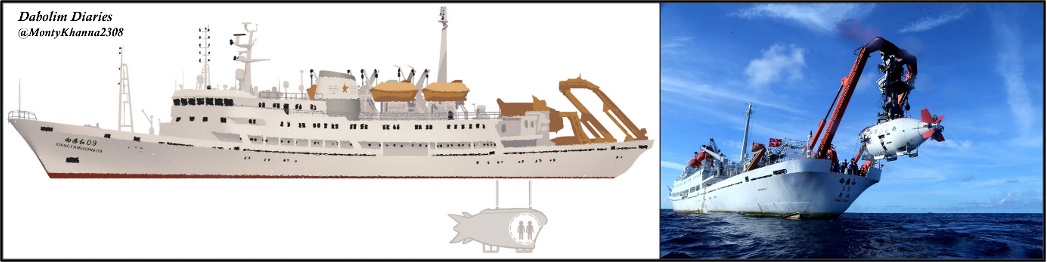 Xiang Yang Hong 09
- Shen Hai Yi Hao (Deep Sea Number 1). The vessel has been built by the Wuchang Shipbuilding Industrial Group at their yard in Wuhan. She was launched on December 8, 2018 and handed over to NDSC in 2019. She has a length of 90.2 metres, beam of 16.8 metres, and a design draught of 5.5 metres. She has a designed endurance of 60 days. She is fitted with a large A-frame at the stern and has been designed as a mother ship for the submersible Jiaolong. She will replace the Xiang Yang Hong 09 in this role in due course.
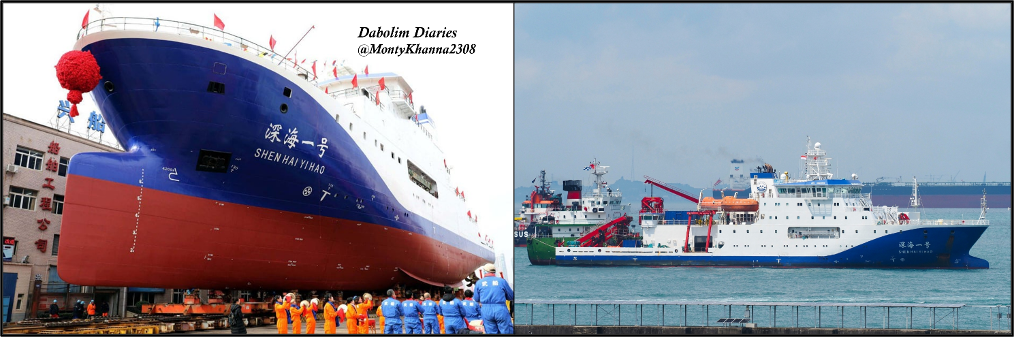 Shen Hai Yi Hao
Funnel Marking
Both the vessels carry the symbol of China Ocean Mineral Resource R&D Association (COMRA) on their funnels. COMRA is the organization responsible for undertaking activities of exploration and exploitation in the seabed, ocean floor and subsoil thereof beyond the limits of national jurisdiction (‘the Area’).
 Symbol of COMRA
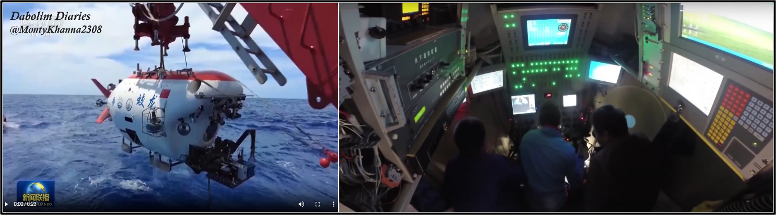
Jialong Submersible
The Jiaolong is the first Chinese manned submersible in the 7,000 meters class.
Jiaolong Submersible – Being Launched (Left), Interior (Right)
The submersible did its first dive in 2009. This was followed by an extensive trial phase during which dives of increasing depth were conducted, finally culminating in a dive to a depth of 7,015 m, just above its maximum designed operating depth of 7,000 m on June 23, 2012 in the Mariana Trench. The event received national acclaim as exemplified by a meeting between Xi Jinping, Li Keqiang and other party and state leaders with representatives of advanced manned deep-sea diving units at Great Hall of the People in May 2013.
Technical Specifications and Exploitation
The brief parameters of the submersible are as follows
- Weight: 22 tons
- Length: 8 meters
- Beam: 3 meters
- Crew: 3
- Class: 7,000 m submersible
The submersible competed her 300th dive on 18 August 2024. As of January 2025, the number of dives completed stood at 317.
As per the website of the NSDC, the submersible is fitted with several features to facilitate deep-sea research. These include:
- A high-precision fixed-point hovering operation capability that allows the vessel to conduct high-temperature hydrothermal sampling and continuous observation in the seabed chimney vents.
- A high-precision target search operation capability enables the accurate positioning, deployment and recovery of seabed abyss scientific instruments.
- A digital hydroacoustic communication system with a transmission accuracy rate of more than 90%.
- A high-resolution bathymetric side-scan sonar to draw large-area three-dimensional bathymetric and side-scan maps of the seabed.
Over the years, the submersible has been used for several deep-sea expeditions in the Western Pacific and Indian Ocean. These include the East Pacific polymetallic nodule exploration area, the West Pacific seamount crust exploration area, the Southwest Indian Ridge polymetallic sulphide exploration area, the Northwest Indian Ridge polymetallic sulphide survey area, the West Pacific Yap Trench area, and the West Pacific Mariana Trench area.


Leave a Reply
Want to join the discussion?Feel free to contribute!