
Rear Admiral Monty Khanna (Retd) – ‘Dabolim Diaries’ Issue No 6 dated 06 Feb 2025
Yuchi Naval Base (35o 43.’4 N, 119o 58’.9 E) in Guzhen Bay is located about 50 km South West of Qingdao. It is the primary base of the Northern Theatre Navy (erstwhile North Sea Fleet) and is amongst the PLA Navy’s largest operating bases. It is home to China’s first aircraft carrier, Liaoning.
This report confines itself to assessing the developments taking place at the base on the waterfront and does not examine the rapid expansion of shore-based training and administrative facilities.
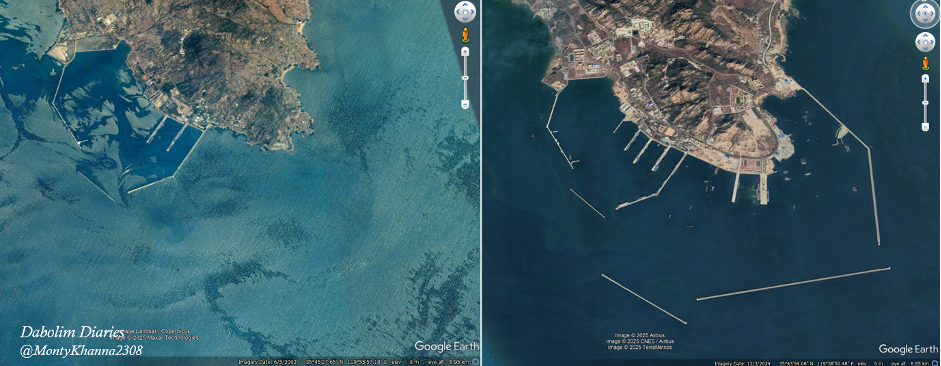
The earliest clear image of Yuchi on Google Earth dates back to June 2003. At this time, Yuchi was a shadow of what it is today.
Fig 1: PLA Yuchi Naval Base 2003 (Left) and 2024 (Right)
At the time, it essentially comprised of three breakwaters of length 1,670 m, 832 m and 1,750 m (Breakwaters A, B & C of Fig 3) enclosing a basin of about 9,000 sq m (1,080 acres).
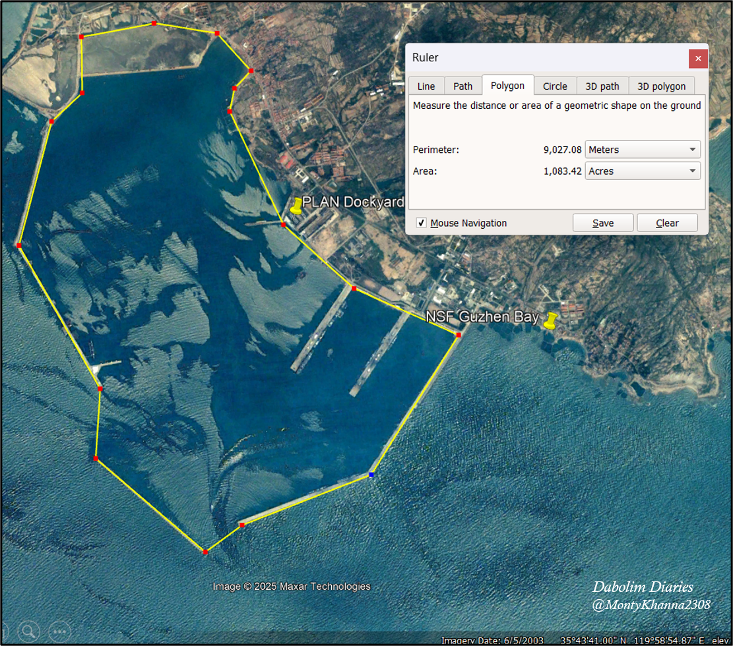 Fig 2: Area of Inner Tidal Basin
Within were two piers, each 600 m long and 40 m wide. In addition, the inner side of the southern breakwater (BW ‘C’) was also available for berthing ships. Altogether, this provided a berthing length of 4,150 meters.
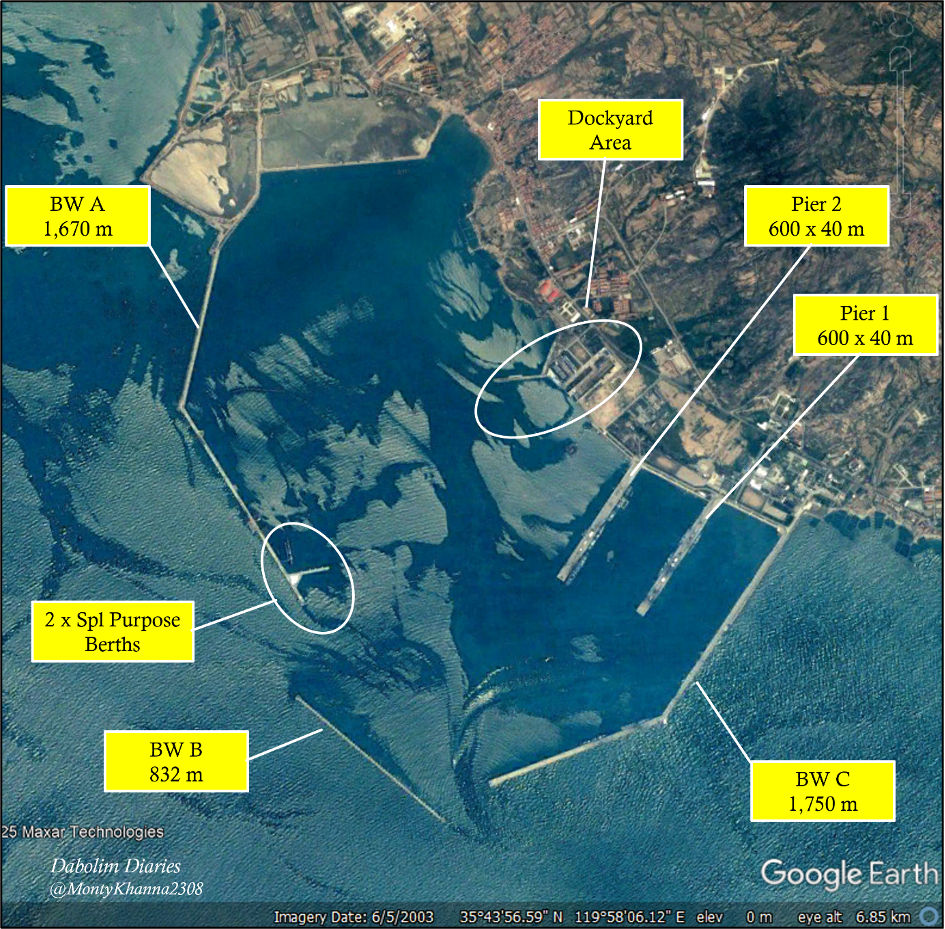 Fig 3: Facilities at Yuchi (Google Earth 05 Jun 2003)
The other notable features of this initial layout are a ramp at the landward end of the southern breakwater (BW ‘C’) to cater for rolling on/off vehicles onto amphibious ships equipped to do so and two relatively small berths at the southern end of the western breakwater. These appear to be for a specialised purpose, the exact nature of which is not known.
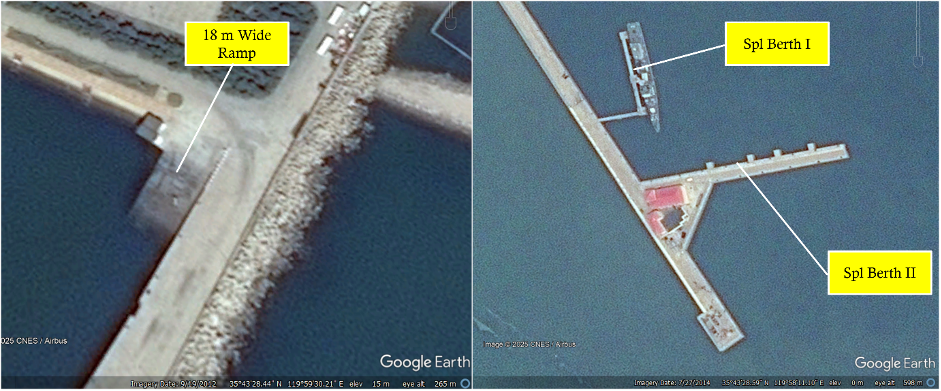 Fig 4: Ramp at Berth No 3 (Left) and Special Purpose Berths (Right)
Insofar as ship repair facilities are concerned, the initial layout included two dry docks, one 220 x 35 m (Drydock 1) and the other, a smaller 150 x 22 m (Drydock 2). The presence of only one crane to service both the drydocks till 2015 and the relatively low utilisation of both the docks (as observed on google maps) is indicative of this being a fairly austere repair facility in its early years.
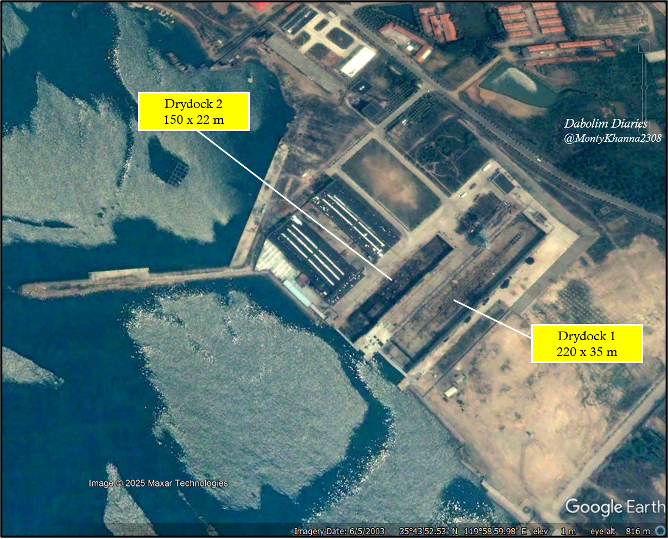 Fig 5: Ship Repair Facility (Google Earth 05 Jun 2003)
In 2009/10, a third pier was added of length 515 m and width 30 m (Pier 3). This is primarily being used to berth frigates and corvettes.
The base witnessed major expansion between 2010 and 2012. Three large breakwaters were built during this period which added an enormous area of about 13,000 sq m to the existing inner tidal basin taking up the area of the enclosed water space (inner and outer tidal basins) to approximately 22,250 sq m (4,090 acres). The breakwater lengths (from West to East) are 1638 m (BW ‘D’), 3385 m (BW ‘E’) and 3494 m (BW ‘F’). In addition, a brand-new jetty, 550 m long and 120 m wide (Pier 5) was completed for berthing aircraft carriers.
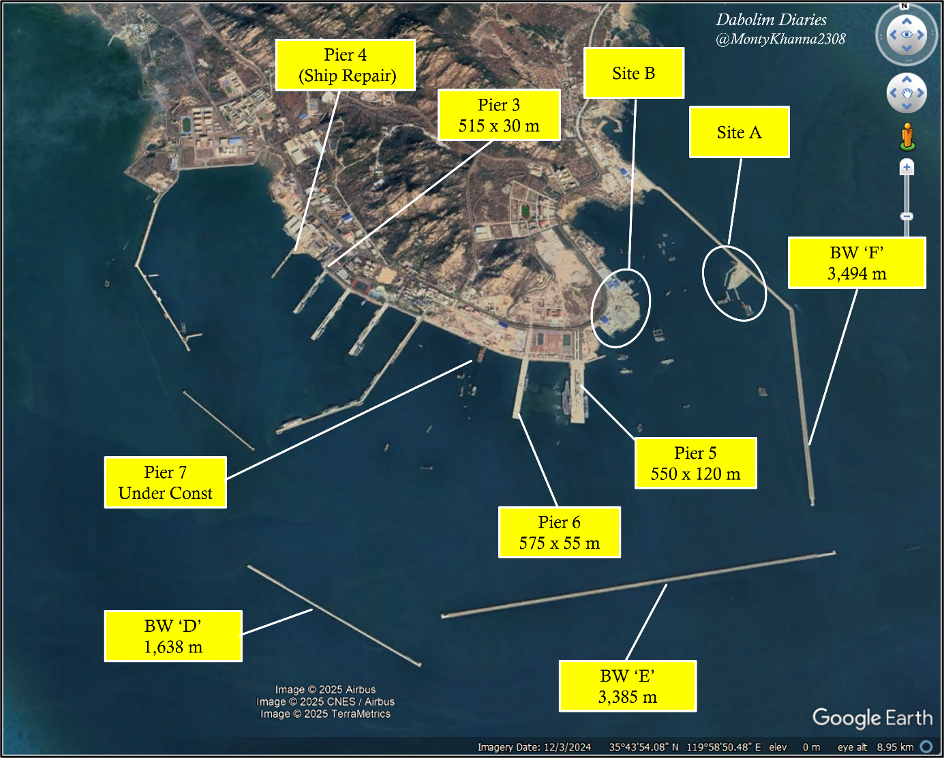 Fig 6: Facilities at Yuchi as of 2004 (Google Earth 03 Dec 2024)
Liaoning, after her commissioning at Dalian on 25 Sep 2012 was relocated to Yuchi and has been based here since. Apart from berthing the carrier, this jetty is also used for major commemorative events such as the commissioning of Nanjing, the first Type 55 Renhai Class destroyer on 12 Jan 2020.
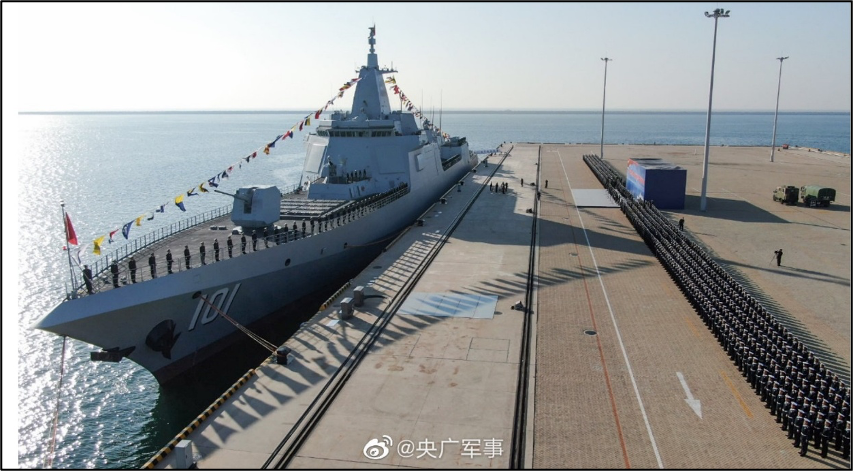 Fig 7: Commissioning of the first Type 55 Renhai Class destroyer Nanjing on 12 Jan 2020
In 2014/15, the naval dockyard in Yuchi received a boost through the addition of an ‘L’ shaped 20 m wide ship repair wharf with a berthing length of 945 m. The inference of this being primarily used for ship repair is based on its proximity to other repair facilities (including the drydocks) as well as the fact that it is provisioned with five cranes. In addition to this berth, other facilities at the dockyard were also augmented simultaneously. These include expansion of the covered area for workshops and an increase in the number of cranes to service the drydocks.
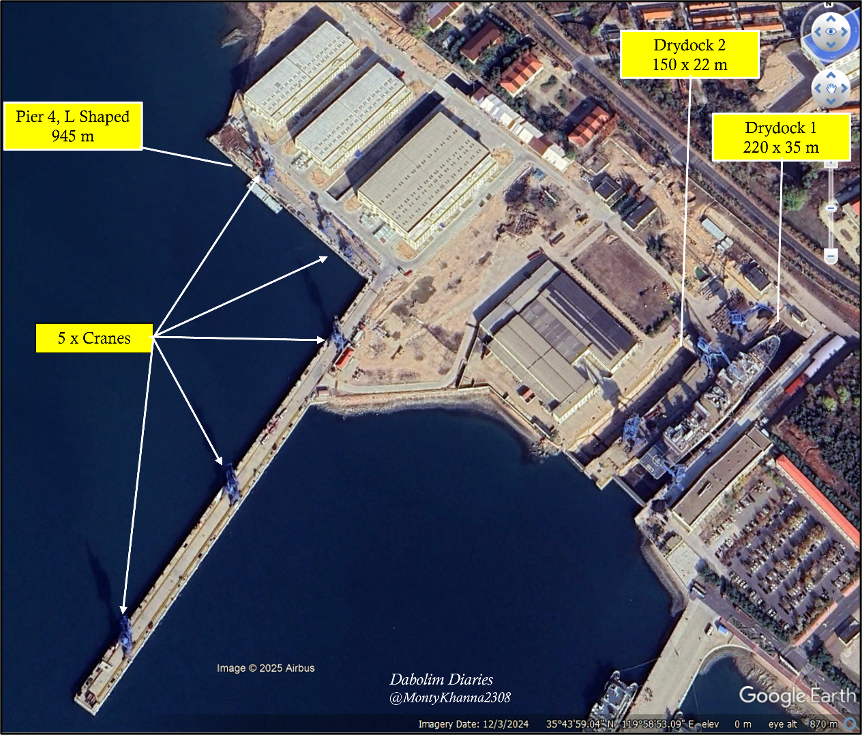 Fig 8: Ship Repair Facility as in 2024 (Google Earth 03 Dec 2024)
A second pier, 575 m in length and 55 m wide (Pier 6) was constructed in 2017/18 in the outer tidal basin. This is being used predominantly for berthing Type 55 destroyers.
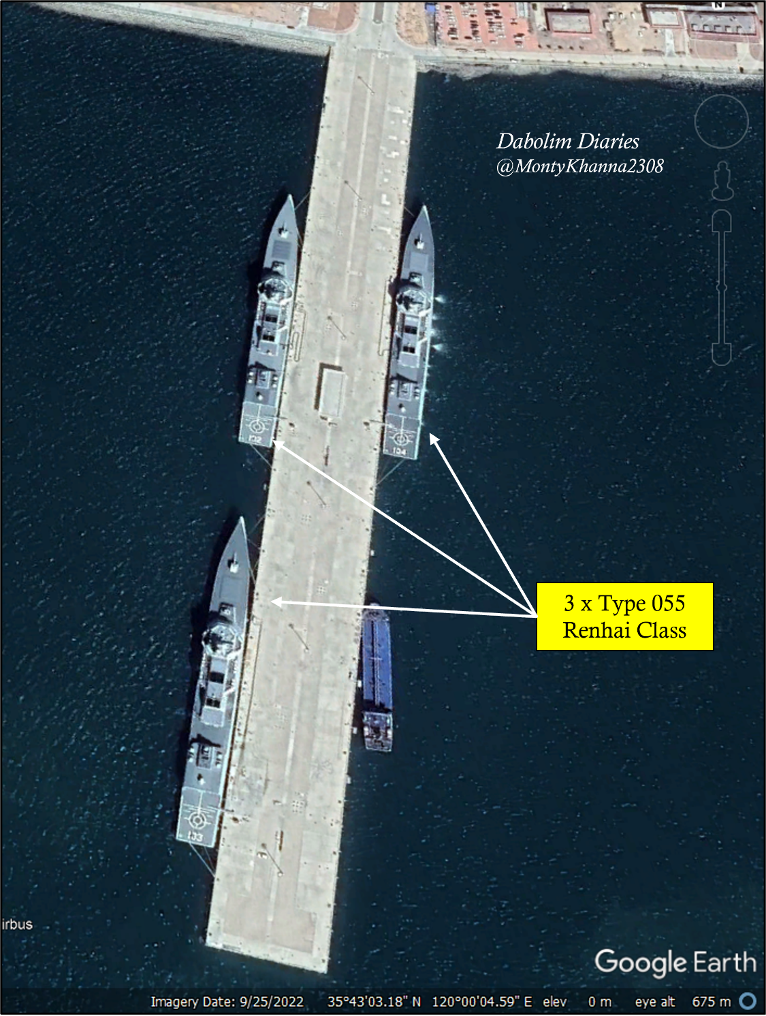 Fig 9: Pier No 6 with three Type 055 Destroyers (Google Earth 25 Sep 2022)
After a few years of relative inactivity, construction work has picked up at Yuchi since 2024. The main projects currently underway are as follows:
New Pier. Construction of a new 40 m wide jetty (Pier 7). This is likely to be of similar length to Pier 6 and will possibly be primarily used to berth the PLA Navy’s growing fleet of Type 52D destroyers.
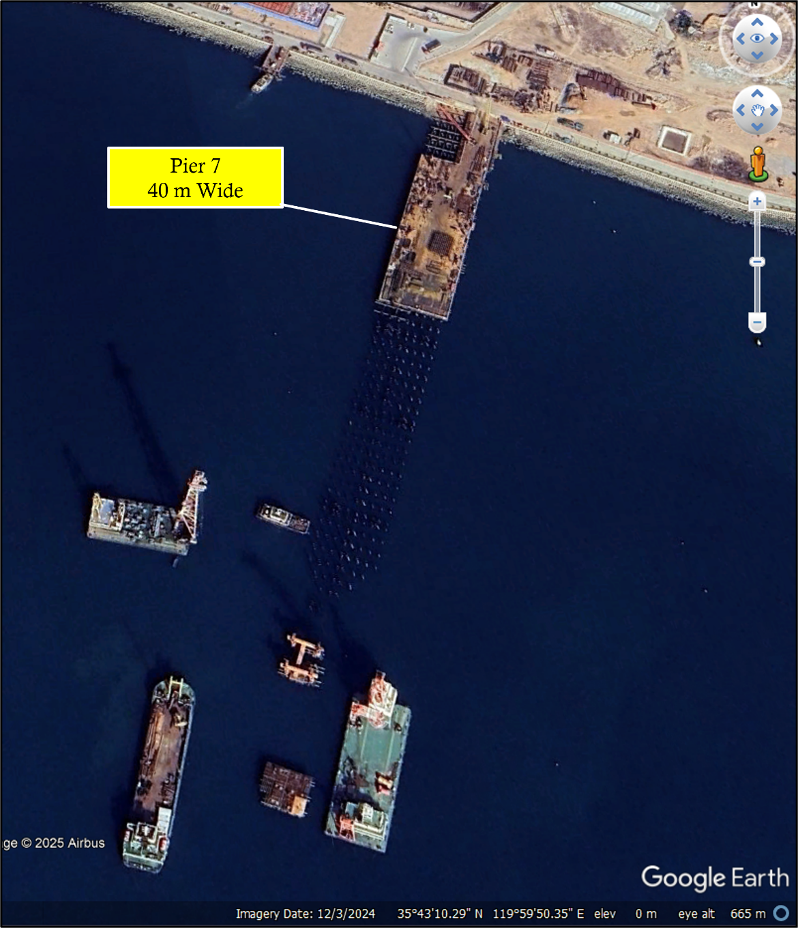 Fig 10: New Jetty (Pier No 7) under construction (Google Earth 03 Dec 2024)
Site A. Consequent to the completion of some reclamation work, construction of what appears to be two parallel piers is currently underway. Each of these is 15 m wide with the current length being 120 m and the final length estimated at approximately 200 m. The size, location and orientation of this construction makes its final purpose unclear. The possibilities are as follows:
- Degaussing Facility. As the NTN lacks its own degaussing facility, these could be the two arms of a brand-new facility to meet this requirement. However, the unusual spacing of 71 m between the arms seems excessive. The corresponding dimensions of degaussing arrangements at Yuling, Hainan (Southern Theatre Navy) and Xiangshan, Zhejiang (Eastern Theatre Navy) are 30 m and 25 m respectively.
- The space between the two arms could be reclaimed, as was done in the case of the aircraft carrier jetty (Pier 5), to create a wide jetty possibly for aircraft carriers or large amphibious assets (Type 075/076). This too, however, seems improbable as the current orientation would make the berth on its eastern flank a little restrictive for use by large assets. Further, if the area in between were to be reclaimed, this process should have commenced by now.
- Conventional Submarine/UUV Base. The two piers currently under construction along with the wharfs surrounding the reclaimed land could be used for berthing smaller assets such as conventional submarines. This seems the most likely option, even though the 71 m spacing between the two piers could be slightly restrictive. Given the PLA Navy’s growing fleet of manned and unmanned underwater assets, additional berthing is a pressing requirement.
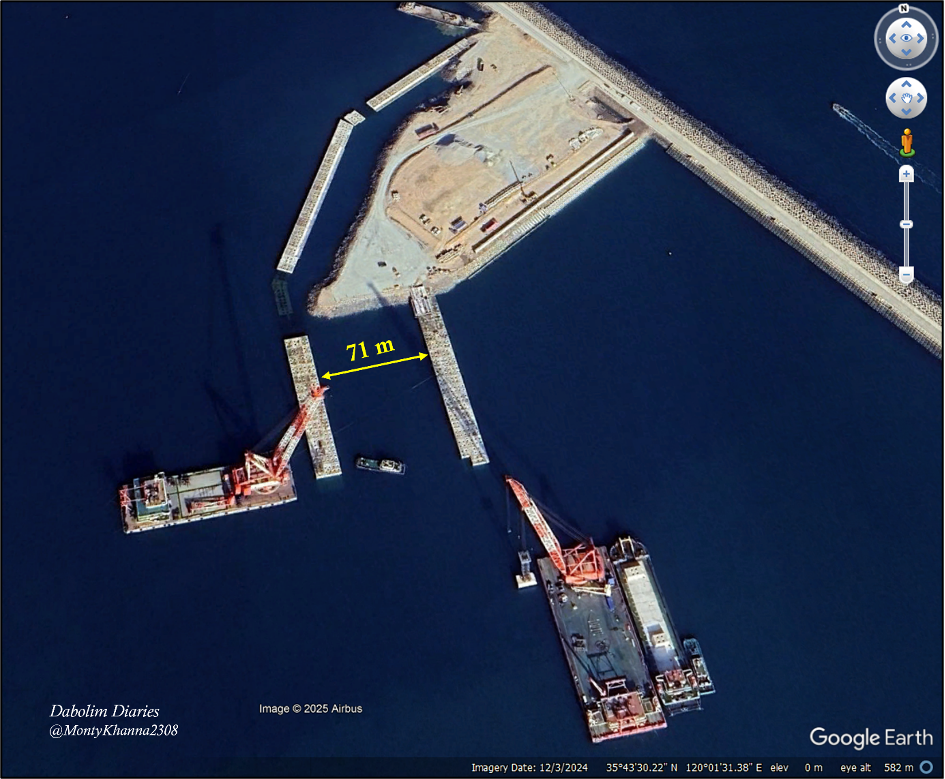 Fig 11: Construction Underway at Site ‘A’ (Google Earth 03 Dec 2024)
Site ‘B’. This is essentially a robust construction site for the manufacture of cement blocks used in the construction of piers as well as tetra-pods for breakwaters. The size and scale of ongoing activity at this site is indicative of the prolonged nature of major construction works currently being undertaken.
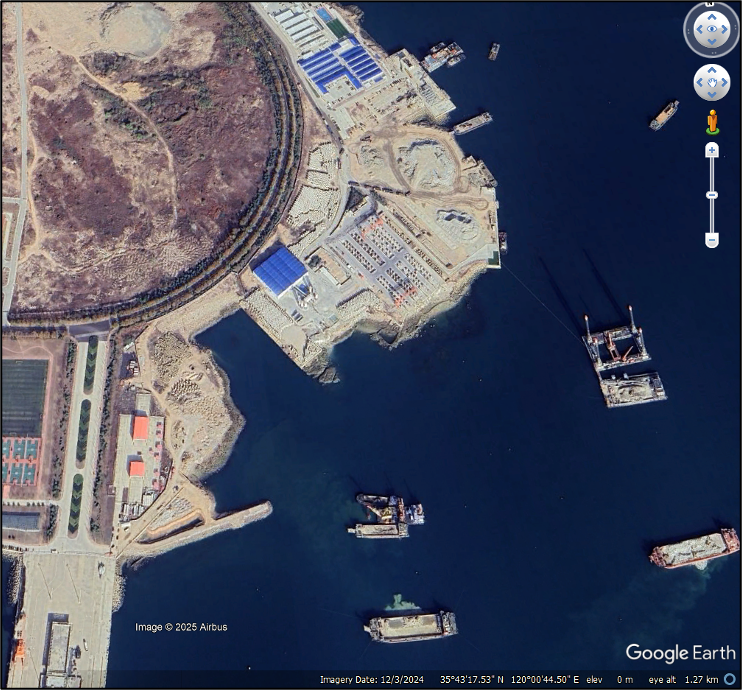 Fig 12: Construction Yard at Site ‘B’ (Google Earth 03 Dec 2024)
Assessment
The overall berthing infrastructure at Yuchi is as tabulated below.
Table 1: Broad Parameters of Berths at Yuchi
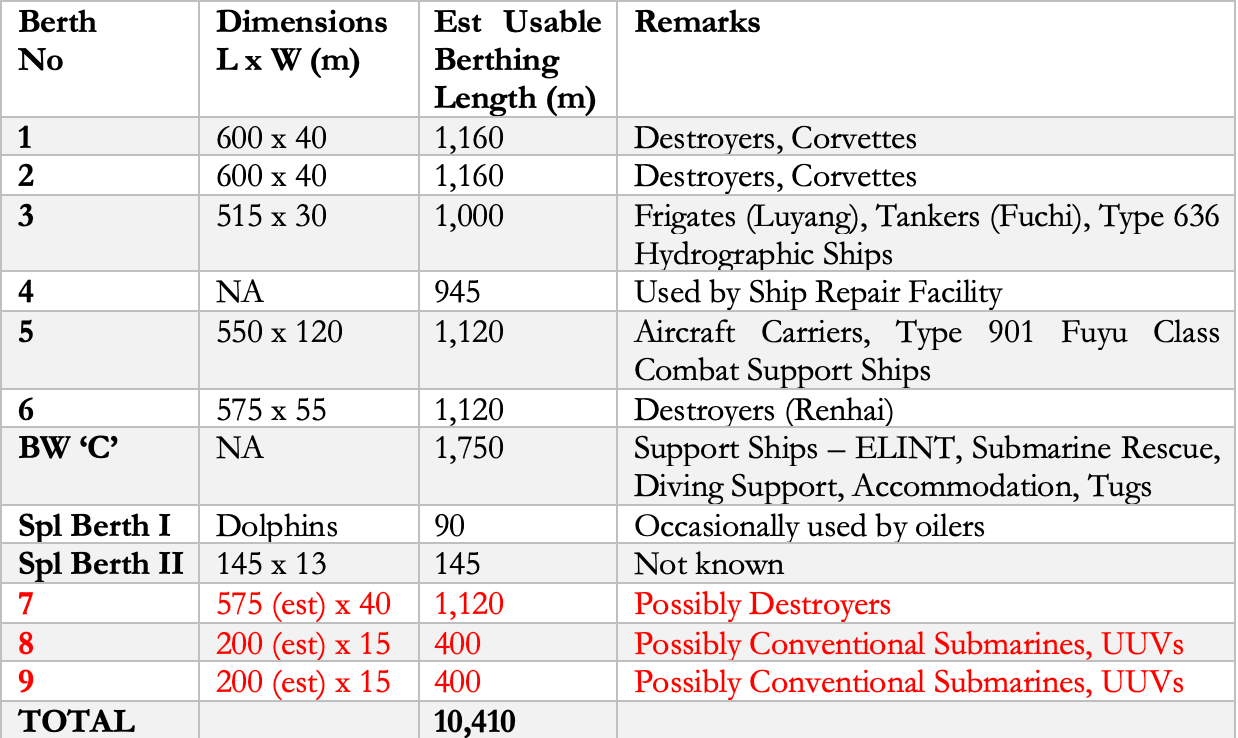 Note: Red indicates still under construction
From the above table, it can be seen that even though the berthing length available at Yuchi remains considerably less than the 18 km of wharfage in the largest US Navy base at Norfolk, Virginia; Yuchi, unlike Norfolk, is still growing rapidly. Further, the tremendous expanse of the tidal basins (both inner and outer) provides considerable opportunities for its continued growth. Given the large construction effort currently underway, this expansion is likely to continue for the next few years.
The eventual purpose of construction activity in progress at Site ‘A’ will soon become evident. Given the spurt in submarine construction, both nuclear and conventional, existing bases may soon become inadequate. It will be interesting to see if a submarine base emerges within the confines of Yuchi.


Leave a Reply
Want to join the discussion?Feel free to contribute!