
The Indo-Pacific encompasses diverse economies, complex security challenges, and critical sea lanes essential for global trade. The region has emerged as a central theatre of geopolitical competition, characterised by strategic rivalries, territorial disputes, and economic coercion.[1] Increasing Chinese assertiveness in the South and East China Seas, alongside grey zone activities such as illegal fishing and maritime militia operations, has heightened regional tensions.[2] These developments have, for some time now, underscored the need for a unified response to safeguard navigational freedoms, uphold international law, and support smaller nations in resisting coercive pressures. The Quad is a significant manifestation of this requirement.[3]
Evolution of the Quad
Initially established as an informal dialogue following the 2004 Indian Ocean tsunami,[4] the Quad was revitalised in 2017, with an enhanced focus on ensuring a “free and open Indo-Pacific.” Over the years, the Quad’s collaborative agenda has expanded significantly,[5] addressing diverse security and resilience concerns — including maritime domain awareness, infrastructure development, disaster response, and economic security — and addressing both immediate and long-term regional challenges. However, the Quad remains a non-military construct, limiting its direct security engagements, and emphasising instead, cooperative measures that reinforce regional sovereignty and stability.
The Wilmington Summit
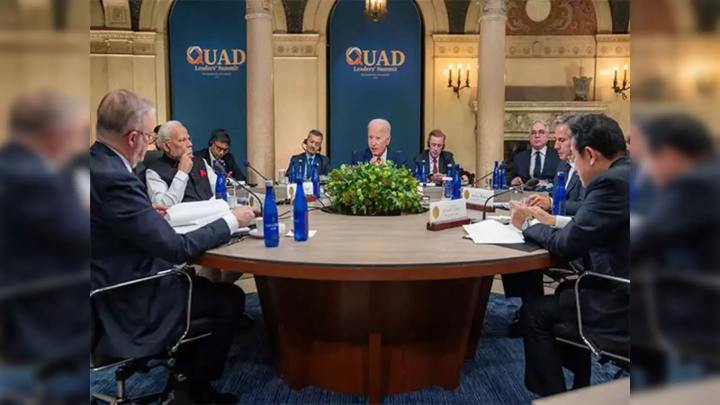
The sixth Quad Leaders’ Summit held in Wilmington, Delaware, on the 21st of September 2024, marked a pivotal moment for collaboration within the grouping. The joint statement released at the end of the summit, now being referred to as the “Wilmington Declaration”,[6] provides a roadmap for the Quad’s unified approach to maritime security, upholding international law, and addressing threats through joint initiatives. Emphasising the principles of peace, stability, and cooperation, the declaration highlights several areas that are critical for sustaining the Indo-Pacific’s security architecture, including support for the 1982 United Nations Convention on the Law of the Sea (UNCLOS), capacity-building for regional maritime partners, and technological investments in surveillance, and infrastructure resilience. Since the Indo-Pacific is primarily (although not exclusively) a maritime geography, it is only natural that the primary focus of the Quad’s varied endeavours remains maritime.
This paper, referencing the Wilmington Declaration, will examine the Quad’s evolving role, and highlight India’s potential contributions, particularly its leadership of the Maritime Initiative for Training in the Indo-Pacific (MAITRI), and its prospective roles within the Indo-Pacific Partnership for Maritime Domain Awareness (IPMDA), underwater infrastructure protection, and climate-resilient infrastructure development. By analysing the Quad’s strategic imperatives and limitations, the paper will propose actionable pathways for advancing a resilient, cooperative, and rules-based Indo-Pacific, through India’s proactive engagement. It would be prudent to take forward this discussion in terms of the four primary themes related to the maritime domain, that were touched upon during the Quad Summit.
Theme 1: Maritime Security
The Wilmington Declaration explicitly brings out that the Quad comprises four leading maritime democracies in the Indo-Pacific each of which emphasise peace and stability across the region as being indispensable for global security and stability.[7] The declaration thus lays preeminent importance upon maritime security, within which it touches upon several ongoing and future initiatives.
Indo-Pacific Partnership for Maritime Domain Awareness (IPMDA)
The Wilmington Declaration details the Quad’s significant effort to bolster maritime domain awareness (MDA) through the IPMDA. MDA is essential for safeguarding maritime territories, especially for monitoring EEZs to detect illegal fishing, unregistered vessels, and other unlawful activities.[8] Since the programme’s inception, the IPMDA has expanded its network across various regional hubs, including the Pacific Islands Forum Fisheries Agency (PIFFA) and the Information Fusion Centre for the Indian Ocean Region (IFC-IOR). This expansion allows over two dozen countries to gain access to critical data on “dark vessels” — ships that deliberately disable their tracking systems to avoid detection.[9] By providing these partners with real-time, integrated information, the Quad enhances their ability to enforce maritime laws within their waters. Prospective collaboration includes the sharing of satellite data, training in data analysis, and integration with local coast guard and naval operations.[10] Further, over the coming year, Quad partners intend to layer modern technology and data into the IPMDA, thereby continuing to deliver cutting-edge capability and information to the region. India can play a defining role in the fruition of the IPMDA to its envisaged levels.
India’s robust space and satellite capabilities, notably through the Indian Space Research Organisation (ISRO), and ongoing Space Based Surveillance (SBS) programmes,[11] would allow New Delhi to contribute advanced monitoring and surveillance data within the IPMDA. Such collaboration would not only strengthen regional security but also position India as a key technology partner and enabler, offering capacity and/ or capability to Indo-Pacific nations that may not have access to cost-effective and high-quality surveillance tools. Further, the IFC-IOR, with its global linkages,[12] is well placed to function as the IPMDA Hub for the Indo-Pacific. Towards this, the Centre would be well advised to increase its focus from just the IOR to the wider Indo-Pacific — by hosting International Liaison Officers (ILOs) from South Pacific Island nations and developing linkages with all the IFCs in the broader region, including the Pacific Fusion Centre[13] Vanuatu and the PIFFA. However, providing capacity would not, by itself, be enough. The success of the IPMDA would also depend upon imparting relevant training and other measures aimed at capability enhancement. These measures would be covered in subsequent sections of the paper.
Maritime Initiative for Training in the Indo-Pacific (MAITRI)
The Maritime Initiative for Training in the Indo-Pacific (MAITRI) represents a proactive training programme that is focused on empowering Indo-Pacific countries to leverage MDA tools, especially those provided by the IPMDA and other Quad initiatives.[14] Such training would include strategies for monitoring maritime spaces, securing maritime territories, and deterring illegal activities.
India is scheduled to host the first MAITRI workshop in 2025.[15] This underscores not only the Quad’s commitment to regional capacity building, where nations gain both practical and technological skills necessary for maritime security enforcement, but also presents India with an opportunity to leverage its substantial capacities and capabilities in this field.
The IFC-IOR would thus become India’s early contribution for MDA-related training and analytics, to speed-up timelines for operationalising MAITRI. At this juncture, it would be prudent to also mention the “Regional Maritime Security Centre of Excellence” (RMSCE)[16] that is being established at New Delhi under the Maritime Security pillar of the Indo-Pacific Oceans Initiative (IPOI).[17] The RMSCE is an India-UK initiative to address common challenges via capability-enhancement. Both constructs would need to synergise their activities towards covering the entire gamut of training that would further the concept of holistic maritime security.
India has long been addressing the requirements of partners on a bilateral basis through Mobile Training Teams (MTTs),[18] that provide in situ training to partner States. Dovetailing this concept with MAITRI, especially for small island nations of the IOR and the Pacific, would yield substantial benefits. This also presents the opportunity to put in place a number of multinational MTTs, comprising members drawn from amongst Quad members. These could, at a later stage, be supplemented by members from other countries of the Indo-Pacific, imparting this concept with a regional and collaborative flavour of inclusivity. This would also result in substantial capability enhancement, as also cultural sensitisation amongst the Quad members themselves.
Quad Maritime Legal Dialogue
The Wilmington Declaration mentions the launch of the Quad Maritime Legal Dialogue to support efforts to uphold the rules-based maritime order in the Indo-Pacific.[19] It may be discerned that this is a direct outcome of the active and widespread use of lawfare by China,[20] especially in (but not limited-to) the South China Sea, where through twisting of historical facts, and interpreting international maritime law as per its convenience, China claims and seeks to exert control over almost 85% of this sea.[21] Another way in which China convolutes maritime law is by the widespread use of “grey zone” activities[22] against its adversaries, a majority of whom are unable to respond because of a large differential in comprehensive national power.
China’s increasing presence in the IOR (warships, research and survey vessels, and fishing boats),[23] and its proclivity for stretching the boundaries of law, is of concern to India, too. India must, therefore, wholeheartedly support this dialogue, lest Chinese actions to shape ‘new normals’ succeed, with adverse impact upon regional maritime security. In addition to publicising all such incidents of transgression immediately, Quad countries could establish a standing legal cell that would provide support and advice to help regional partners uphold their sovereign rights and address maritime disputes legally, in the face of Chinese coercion. It would also be prudent to synergise the activities of the legal dialogue with those of MAITRI, with each supplementing the other.
Quad-at-Sea Ship Observer Mission
The “Quad-at-Sea Ship Observer Mission” planned for 2025, involving coast guards from the US, Japan, Australia, and India, would enhance interoperability and strengthen a coordinated response to maritime security threats.[24] Such missions could include joint training exercises, shared patrol operations, and collaborative responses to piracy, illegal fishing, and other non-traditional maritime security threats.
The proposed “Indian Ocean Ship” programme,[25] wherein India would assign a dedicated warship to conduct EEZ patrols in the small island nations of the Indian Ocean, could be synergised with the Ship Observer Mission, so as to ensure deconfliction and maximise geographical coverage. These endeavours must plough back seamlessly into both IPMDA and MAITRI, towards creation of a self-sustaining, virtuous feedback-and-action loop.
Theme 2: Humanitarian Assistance and Disaster Relief (HADR)
The Quad’s HADR initiative has its roots in the historic collaboration among these nations during the 2004 Indian Ocean earthquake and tsunami response.[26] Building upon that legacy, the Quad’s recent HADR efforts are now more formalised under the “Quad Partnership on Humanitarian Assistance and Disaster Relief in the Indo-Pacific.” This formal partnership is structured to enable rapid coordination among the four nations in the event of natural disasters in the Indo-Pacific, whose frequency is now higher and whose effects are increasingly severe, largely due to climate change and environmental challenges.[27]
In 2022, the Quad countries established operational guidelines for the Quad HADR partnership.[28] These guidelines outline protocols for immediate communication, task allocation, and resource sharing, to maximise the speed and efficiency of response efforts. This protocol enables a faster, more cohesive response, ensuring that essential relief supplies, personnel, and logistics are deployed promptly to areas in need. This foundational coordination reflects the Quad’s commitment to addressing disaster vulnerability and improving resilience across the region.
The Wilmington Declaration, in continuation of the existing structure, lays stress on the “pre-positioning of essential relief supplies.”[29] Strategically pre-positioned relief supplies across Indo-Pacific nations would ensure that response times are minimised. Quad nations could enhance regional capacity by providing logistic support, essential goods, and medical resources, pre-emptively in disaster-prone areas.
Collaborative disaster response is essential to address emergencies, which often overwhelm the capacities of individual countries. In cases such as the landslide in Papua New Guinea and Typhoon Yagi in Vietnam, the Quad demonstrated its capability for joint response.[30] This coordinated approach, whereby combined resources and expertise are brought to bear, is especially relevant to complex emergencies that require sustained relief and recovery support, thereby reducing the burden on any one country and providing a robust, multilateral response to regional needs.
The launch of the “Quad Indo-Pacific Logistics Network” (QIPLN), mentioned in the Wilmington Declaration, is particularly significant in the context of collaborative HADR. Recognising the logistical challenges posed by the vast and dispersed geography of the Indo-Pacific, the QIPLN focuses on enhancing shared airlift capacity among the four nations, allowing them to mobilise resources more effectively and reach disaster-stricken areas faster.[31] This initiative leverages each country’s logistical strengths, offering collective capabilities for a rapid and scalable response during crises. This network aims to leverage shared airlift capacity to support rapid civilian disaster response and quick deployment of aid.
India, due to its strategic position and infrastructure of a high order, is suitably placed to play a pivotal role in terms of acting as a HADR logistic hub, especially for the IOR. Since effective HADR is contingent on quick response, alongside the above two endeavours, customs and regulatory harmonisation, and digital logistics platforms need to be promoted in all earnest for smooth and effective movements of supplies.[32] This also presents the opportunity of exploring synergies with India’s “Gati Shakti”[33] and the “National Logistics Portal (Marine)”[34] for further optimisation. Further, India could examine whether the NLP digital platform could be used as a model for deployment of a similar platform under the aegis of QIPLN. At a later stage, other regional stakeholders could be brought into the QIPLN architecture, ensuring that the logistics network is not just Quad-centred but also has more inclusive regional participation, including for example, the ASEAN member-States.
The time has also come for integrating other countries that have the required capacity and capability, into the Quad HADR framework. In this regard, countries such as South Korea, Singapore, and Indonesia, are particularly relevant.
HADR is a domain that requires specialised training, including cultural sensitisation.[35] Once again, India, because of its location, cultural diversity, and other resident strengths, is optimally placed to take a lead in this activity. The Quad could think of setting up an HADR Centre of Excellence in India, which would undertake training, articulation of standards and SOPs, and predictive analytics in terms of foretelling the occurrence of extreme weather events and natural calamities.
Considering the importance of the subject, and the prospective long-term strategic benefits that could accrue, it is recommended that the Government of India (GoI) set up a multi-domain task group to examine the issues brought out above. This would also align with India’s lead of the IPOI pillar of “Disaster Risk Management”.[36] Conceptual support for this endeavour, under its mandate of furthering holistic maritime security, would be provided by the RMSCE.
Theme 3: Quality Infrastructure
The Wilmington Declaration articulates the Quad’s commitment to improved regional connectivity through the development of infrastructure that is not only of high quality but ranks high on resilience too. As part of this, the declaration highlighted certain key areas that are being progressed.
The Quad Ports of the Future Partnership
The Quad Ports of the Future Partnership represents a significant strategic initiative aimed at enhancing the resilience, sustainability, and security of port infrastructure across the Indo-Pacific region.[37] This initiative aims to leverage the collective expertise and resources of Quad members to foster the development of high-quality, climate-resilient port facilities that are based on the principles of sustainability and designed to withstand both, natural disasters and other disruptions/ threats.[38] The partnership emphasises the importance of regional collaboration, knowledge sharing, and the mobilisation of both public and private sector investments. As part of this broader effort, the Quad, through the Wilmington Declaration, also recognises the integral role of digital infrastructure in supporting modern port operations, with particular attention to cybersecurity and undersea cable connectivity, underscoring the interconnectedness of the region’s physical and digital infrastructure.[39]
It is significant that the Declaration brings out that a “Quad Regional Ports and Transportation Conference” would be hosted by India at Mumbai in 2025.[40] This presents an opportunity for India to showcase its expertise in the development of infrastructure that is customised to the requirements of the region, and more importantly, is affordable. The recently commissioned Vizhinjam Port presents a model for the region in terms of green port initiatives and sustainable practices.[41] This workshop also presents the opportunity to highlight India’s willingness and capability in promoting climate resilient infrastructure in the Indo-Pacific, wherein the following are particularly relevant:
(a) India needs to take a leadership role in the Quad’s efforts to build climate-resilient infrastructure by sharing its own expertise in sustainable development and climate adaptation. This programme could focus on climate-proofing ports, coastal cities, and transportation networks to withstand extreme weather events — a priority for island nations and low-lying coastal areas in the Indo-Pacific.[42]
(b) India’s advances in solar, wind, and hydrogen technologies provide an opportunity to lead renewable energy projects across the Indo-Pacific.[43] By providing affordable, sustainable energy solutions for climate-resilient infrastructure, such as solar-powered backup systems in ports or solar arrays in island nations, India can help these countries mitigate energy disruptions and reduce dependency on traditional energy sources. India could also showcase its use of low temperature thermal desalination[44] technology in the Lakshadweep islands for adoption by small island nations of both the Indian Ocean as also those of the South Pacific.
(c) India must aspire to become a regional leader, and a hub for imparting training on climate-resilient and sustainable infrastructure. This may require the setting-up of a dedicated facility, which could be undertaken in consonance with the other Quad members and institutional linkages with organisations such as the CDRI[45] and the International Solar Alliance. Dovetailing such endeavours with broader programs such as the Blue Dot Network,[46] the Bring Back a Better World initiative, and the EU’s “Global Gateway”[47] programme would help leverage complementary benefits.
Quad Partnership for Cable Connectivity and Resilience
The Wilmington Declaration recognises and reaffirms the criticality of the capacity, durability, and reliability of undersea cable networks to the security and the prosperity of not only the Indo-Pacific, but also the entire world.[48] The Declaration highlights the increasing relevance of the Quad
Partnership for Cable Connectivity and Resilience. In this context, the Declaration brings out the constructive role being played by the Australian Cable Connectivity and Resilience Centre,[49] and the role being played by Quad in enhancing cable connectivity across the Indo-Pacific. The Declaration also makes a mention of the feasibility study commissioned by India to examine the expansion of undersea cable maintenance and repair capabilities in the Indo-Pacific.
The Wilmington Declaration also brings out the inherent vulnerability of undersea cables to cyber threats. Towards this, there is active engagement in taking forward the Quad Action Plan to Protect Commercial Undersea Telecommunications Cables, which has been developed by the Quad Senior Cyber Group.
Recognising the criticality of uninterrupted undersea communications to national security, it is in India’s interest that it develops organic capacity and capability in repairing undersea cables. This would require suitable seagoing platforms, and relevant expertise in terms of trained human resources. Most cable manufacturers and consortiums involved in cable laying operations are of Western origin (mostly from the US).[50] India must leverage its position in the Quad to develop the required human resources. Along with this, it would be prudent to convert at least two Offshore Support Vessels (OSVs) into Cable Repair Ships. While this would depend on commercial considerations, the fact that China is investing heavily in cable repair capacity building[51], makes this even more meaningful. Private players backed by suitable sovereign risk mitigation arrangements could be encouraged to take forward such an endeavour. Further, the backing of the Quad towards recognising such a facility as not only an alternative, but also an addition to existing cable repair arrangements, especially in the Indian Ocean, would reap very substantive and substantial dividends.
India must contribute its expertise to Quad-led initiatives that are focused upon improving the cyber resilience of undersea cables, by providing technical knowledge and sharing best practices. Further, India should aspire to play a defining role in defining cybersecurity standards and protocols for subsea cables. These would help India gain a stake in digital and cyber governance within the region.[52]
India’s participation in the Quad Cable Connectivity and Resilience Partnership offers a multitude of opportunities. By taking an active role in infrastructure development, cybersecurity, research, and regional cooperation, India can help enhance the resilience of global undersea cables while positioning itself as a digital leader in the Indo-Pacific. This initiative would also align well with India’s broader geopolitical and economic objectives, such as improving connectivity, fostering digital inclusion, and strengthening strategic alliances with the Quad, as also with other regional partners.
Theme 4: Working Together to Address Regional and Global Issues
The Wilmington Declaration reaffirmed the Quad’s unwavering support to the concept of ASEAN centrality and its leadership role in the East Asia Summit (EAS).[53] The Declaration was explicit in its support for the ASEAN Outlook on the Indo-Pacific (AOIP). The Declaration also brought out the lead role of the Pacific Islands Forum (PIF), and support for the “2050 Strategy for the Blue Pacific Continent”, which lays great emphasis on climate action, ocean health, resilient infrastructure, maritime security, and financial integrity.[54] The importance of IORA and the role played by India in finalising the IORA Outlook on the Indo-Pacific (IOIP) were also mentioned.[55]
This Quad theme is in complete consonance with India’s own maritime policy of “Security and Growth for All in the Region” (SAGAR),[56] and consequently, the “Indo Pacific Oceans Initiative” (IPOI), which provides first-order specificity to SAGAR. It would thus be prudent for India to identify points of congruence between the IPOI, the AOIP and the IOIP, and prioritise projects that leverage the consensus provided by the three political constructs that have formulated these separate yet similar outlooks for the Indo-Pacific.[57] This would assist in removing the existing confusion, and to an extent, the competition that exists within these endeavours, and help synergise activities on ground. Towards this, India could take the lead in setting up a coordination group comprising members from countries invested in these three initiatives and aimed at identifying complementarities, achieving synergy, and deconflicting projects. This would facilitate a holistic and comprehensive approach to all-round development in the Indo-Pacific and is especially relevant considering that India is set to assume the chair of IORA in 2025.[58]
The Wilmington Declaration also brings out the importance of maintaining a free and open Indo-Pacific and the rules based international order. Without explicitly naming China, it clearly articulates its concerns regarding coercive, intimidating, and aggressive actions in the East- and South China seas, disruption of offshore resource exploitation activities, and the dangerous use of coast guard and maritime militia — all a clear denunciation of Chinese activities. The most pertinent aspect of this theme is that the Quad has unambiguously brought out the indisputable legal validity of the 2016 arbitral award on the South China Sea.[59] This is of considerable significance, since it indicates that India has, perhaps for the first time, clearly articulated its stand on this issue.
Considering China’s propensity for, and extensive use of lawfare, India would be well advised to maintain a proactive stance in bringing transparency to Chinese attempts at obfuscating legal positions to its advantage. This is even more relevant in view of increasing Chinese presence in the IOR, and its geoeconomic interests therein.
The Trump Factor
The re-election of Donald Trump to the US presidency presents a multifaceted yet complex opportunity for the Quad as it navigates the evolving security architecture of the Indo-Pacific. It needs to be appreciated that the first Trump presidency (2017–2021) had a significant and positive impact on the development and strategic cohesion of the Quad. Under President Trump, the United States shifted its foreign policy focus toward countering China’s rising influence,[60] especially in the Indo-Pacific. This priority aligned closely with the goals of the Quad. It was during the Trump presidency that the Quad, which was initially formed in 2007, was revived and institutionalised. While President Trump’s approach invigorated the Quad, certain policies, such as a transactional approach to diplomacy[61] and his scepticism towards multilateralism have led to questions being raised on long-term US engagement in the Quad.
On the other hand, given President Trump’s historical focus on countering China’s influence, it is likely that the second Trump administration would maintain, if not escalate, efforts to align Quad countries in strategic competition with China. His second term could favourably impact the Quad by consolidating efforts against China’s influence, strengthening strategic ties, and broadening the Quad’s scope.
Conclusion
The Wilmington Declaration, especially in the maritime domain, encourages an integrated and complementary approach to holistic maritime security. The protection of undersea infrastructure and maritime domain awareness is one such complementarity. While the IPMDA focuses upon real-time surface-level maritime monitoring, undersea cable protection ensures the integrity of critical underwater infrastructure. Together, they embody a holistic strategy that accounts for both, the security of physical assets (such as data cables) and the ability to monitor and respond to surface-level maritime activities. Similarly, there is a natural synergy between HADR and MDA initiatives. For instance, the IPMDA’s real-time tracking technology could be used not only for monitoring illegal activities but also for tracking weather patterns, storm formations, or emergency situations at sea. In times of crisis, this data can be shared with regional partners, helping to inform decisions regarding evacuation, search and rescue, and relief operations.
In summary, the Wilmington Declaration articulates a clear stance in favour of maintaining stability, legality, and cooperative holistic-security efforts in the Indo-Pacific. The Quad’s initiatives demonstrate a unified approach to counter illegal maritime activities, build regional capacity, and foster adherence to international law. Through collaborative tools, training programmes, and legal frameworks, the Quad seeks to empower Indo-Pacific countries to uphold their maritime rights and enhance collective security, ensuring that the region remains open, secure, and resilient against external pressures.
The Wilmington Declaration has firmly established the Quad’s intent to deepen cooperation across a broad spectrum of issues—ranging from maritime security to resilient supply chains, critical and emerging technologies, and climate adaptation. However, it is highly likely that US foreign policy could face a major recalibration in consonance with President Trump’s views on each of these individual subjects (his recalcitrance on climate adaptation is especially well known) and could alter the Quad’s trajectory, demanding both strategic foresight and pragmatic adaptation from member States.
India, because of its strategic location, the feeling of trust and dependability that it evokes from the Global South, its substantial capacity and capability in practically all the issues being addressed by the Quad, and its unique competitive advantage as a low-cost manufacturing and services hub, is well placed to take advantage of the opportunities presented by the September 2024 Quad Leaders’ Summit. If India aspires to become a part of the select group of countries that formulates norms, sets agendas, and wields discursive power, New Delhi must step forward and go the extra mile in leveraging these advantages and attempt to take a pre-eminent position in each of the lines of effort articulated in the Wilmington Declaration.
About the Author:
Captain KS Vikramaditya is a serving officer of the Indian Navy, currently on appointment to the National Maritime Foundation, where he is a Senior Fellow. His research interests are wide and varied and he supplements his formidable academic credentials with his perspectives as an experienced practitioner. His present research focus is on the manner in which India’s own maritime geostrategies are (or are likely to be) impacted by those formulated and executed by the People’s Republic of China. He may be contacted at: indopac10.nmf@gmail.com
Endnotes:
[1]Robert Beckman, “The UN Convention on the Law of the Sea and the Maritime Disputes in the South China Sea.” American Journal of International Law 107, no. 1 (2013): 142–163. https://doi.org/10.5305/amerjintelaw.107.1.0142
[2] Cameron Smith, “Countering China’s Grey-Zone Diplomacy”, Australian Institute of International Affairs, Australian Outlook, 08 February 2022. https://www.internationalaffairs.org.au/australianoutlook/countering-chinas-grey-zone-diplomacy/.
[3] Sheila A Smith, “The Quad in the Indo-Pacific: What to Know”, Council on Foreign Relations, 27 May 2021. https://www.cfr.org/in-brief/quad-indo-pacific-what-know.
[4] “What’s the 4-nation Quad, and where did it come from?”, The Economic Times ePaper, 24 May 2022.
[5] Garima Mohan, Kristi Govella, “The Future of the Quad and the Emerging Architecture in the Indo-Pacific”, German Marshall Fund of the United States, 21 June 2022, https://www.gmfus.org/news/future-quad-and-emerging-architecture-indo-pacific.
[6] Ministry of External Affairs, Government of India, “The Wilmington Declaration Joint Statement from the Leaders of Australia, India, Japan, and the United States” Media Centre, 21 September 2024. https://www.mea.gov.in/bilateral-documents.htm?dtl/38320/
[7] Op Cit. “The Wilmington Declaration Joint Statement from the Leaders of Australia, India, Japan, and the United States”.
[8] Xidi Chen, Xudong Zhang , Qi Xu, “The implications of the Indo-Pacific Partnership for Maritime Domain Awareness (IPMDA) in the South China Sea: A Chinese perspective”, Marine Policy, Volume 167, September 2024, 106247. https://www.sciencedirect.com/science/article/abs/pii/S0308597X24002458.
[9] Op Cit. “The Wilmington Declaration Joint Statement from the Leaders of Australia, India, Japan, and the United States”.
[10] David Brewster, Simon Bateman, “Maritime Domain Awareness 3.)”, Australian National University, National Security College, Report, September 2024. https://nsc.anu.edu.au/sites/default/files/2024-10/WEB%20UPDATED_NSC_MDA_Report_2024_V2_0.pdf.
[11] Surendra Singh, “CCS Approves Launch of 52 Spy Satellites for Rs 27,000 Crore to Boost Space Surveillance”, The Times of India, 12 October 2024. https://timesofindia.indiatimes.com/india/ccs-approves-launch-of-52-spy-satellites-for-rs-27000-crore-to-boost-space-surveillance/articleshow/114158442.cms.
[12] Commodore Ranjit B Rai, “Guardians Of The Indian Ocean: How India’s IFC-IOR Is Transforming Maritime Security – Analysis”, Eurasia Review, 08 August 2024. https://www.eurasiareview.com/08082024-guardians-of-the-indian-ocean-how-indias-ifc-ior-is-transforming-maritime-security-analysis/.
[13] Pacific Fusion Centre. https://www.pacificfusioncentre.org/.
[14] ANI, “Quad Launches MAITRI Maritime Initiative in Indo-Pacific; India to Host First Training Workshop in 2025”, The Economic Times, 23 September 2024. https://economictimes.indiatimes.com/news/defence/quad-launches-maitri-maritime-initiative-in-indo-pacific-india-to-host-first-training-workshop-in-2025/articleshow/113585927.cms?utm_source=contentofinterest&utm_medium=text&utm_campaign=cppst.
[15] Op Cit. “The Wilmington Declaration Joint Statement from the Leaders of Australia, India, Japan, and the United States”.
[16] The author is a Senior Fellow at the NMF and has been an integral part of the process of establishing the RMSCE.
[17] Vice Admiral Girish Luthra, “As it Completes Five Years, it’s Time to Take the IPOI to the Next Level”, ORF Raisina Debates, 09 September 2024. https://www.orfonline.org/expert-speak/as-it-completes-five-years-it-s-time-to-take-the-ipoi-to-the-next-level.
[18] Shankul Bhandare, “Indian Team Completes Training of Malagasy Special Forces in Madagascar,” DefenceXP, 30 March 2021. https://www.defencexp.com/indian-team-completes-training-of-malagasy-special-forces-in-madagascar/.
[19] Op Cit. “The Wilmington Declaration Joint Statement from the Leaders of Australia, India, Japan, and the United States”.
[20] P Charon and J-B Jeangène Vilmer, “Chinese Influence Operations: A Machiavellian Moment”, Report by the Institute for Strategic Research (IRSEM), Paris, Ministry for the Armed Forces, October 2021. https://www.irsem.fr/report.html.
[21] Study by Office of Ocean and Polar Affairs Bureau of Oceans and International Environmental and Scientific Affairs US Department of State, “Limits in the Seas, No 143, China: Maritime Claims in the South China Sea”, 05 December 2014. http://www.state.gov/e/oes/ocns/opa/c16065.htm.
[22] Bonny Lin, Cristina L Garafola, Bruce McClintock, Jonah Blank, Jeffrey W Hornung, Karen Schwindt, Jennifer DP Moroney, Paul Orner, Dennis Borrman, Sarah W Denton, et al, “A New Framework for Understanding and Countering China’s Gray Zone Tactics”, RAND Research Summary, 30 March 2022. https://www.rand.org/pubs/research_briefs/RBA594-1.html.
[23] Amrita Nayak Dutta, “Uptick in Chinese Vessels’ Presence in Indian Ocean Region: Official”, The Indian Express, 11 December 2024. https://indianexpress.com/article/india/chinese-vessels-presence-in-indian-ocean-region-9237134/.
[24] Op Cit. “The Wilmington Declaration Joint Statement from the Leaders of Australia, India, Japan, and the United States”.
[25] Presentation by Indian Navy during the Goa Naval Symposium on 23 November 2024.
[26] Manjari Chatterjee Miller, “The Quad, AUKUS, and India’s Dilemmas”, Council on Foreign Relations, Asia Program, 13 October 2021. https://www.cfr.org/article/quad-aukus-and-indias-dilemmas.
[27] Christopher Chen, “CO22119: The Quad and HADR Operations: Prospects for Cooperation with Southeast Asia”, RSiS, 21 November 2022. https://www.rsis.edu.sg/rsis-publication/nts/the-quad-and-hadr-operations-prospects-for-cooperation-with-southeast-asia/.
[28] Office of the Spokesperson, “Guidelines for Quad Partnership on Humanitarian Assistance and Disaster Relief (HADR) in the Indo-Pacific”, US Department of State, 23 September 2022. https://www.state.gov/guidelines-for-quad-partnership-on-humanitarian-assistance-and-disaster-relief-hadr-in-the-indo-pacific/.
[29] Op Cit. “The Wilmington Declaration Joint Statement from the Leaders of Australia, India, Japan, and the United States”.
[30] Robert Mizo, “The Quad Shows Concern over Climate Change as Security Threat”, The Japan Times, 09 October 2024. https://www.japantimes.co.jp/commentary/2024/10/09/japan/quad-summit-climate-change-security/.
[31] Op Cit. “The Wilmington Declaration Joint Statement from the Leaders of Australia, India, Japan, and the United States”.
[32] Idris Aida, Saiful Nizam Che Soh, “The Relative Effects of Logistics, Coordination and Human Resource on Humanitarian Aid and Disaster Relief Mission Performance”, The South East Asian Journal of Management 8(2):87-103, October 2014. https://www.researchgate.net/publication/302960060_The_RelaTive_effecTs_of_logisTics_cooRdinaTion_and_human_ResouRce_on_humaniTaRian_aid_and_disasTeR_Relief_mission_PeRfoRmance
[33] Government of India, “About PM Gati Shakti,” Department for Promotion of Industry and Internal Trade. https://ne.pmgatishakti.gov.in/DoNER/about_pmgati.
[34] Ministry of Ports, Shipping and Waterways, “Shri Sarbananda Sonowal Inaugurates National Logistics Portal-Marine, a Single Window Logistics Portal to reduce the Logistics Cost”, Press Information Bureau, 27 January 2023. https://pib.gov.in/PressReleaseIframePage.aspx?PRID=1894117.
[35] NDMA, “Guidelines on International Humanitarian Assistance and Disaster Relief (HADR)”, October 2024. http://www.ndma.gov.in/sites/default/files/PDF/Guidelines/HADR_Guideline_Oct_2024.pdf.
[36] Op Cit. “As it completes five years, it’s time to take the IPOI to the next level”.
[37] Aagya Gupta, “India’s QUAD Strategy”, E-international Relations, 22 October 2024. https://www.e-ir.info/2024/10/22/indias-quad-strategy/.
[38] Harsh V Pant, “The Quad has Defied Critics”, ORF, 26 September 2024. https://www.orfonline.org/english/research/the-quad-has-defied-critics.
[39] Op Cit. “The Wilmington Declaration Joint Statement from the Leaders of Australia, India, Japan, and the United States”.
[40] Op Cit. “The Wilmington Declaration Joint Statement from the Leaders of Australia, India, Japan, and the United States”.
[41] Heena Ojha, “Location, Infrastructure, Economic Impact — What Puts Vizhinjam International Port in Spotlight”, NDTV Profit, 12 July 2024. https://www.ndtvprofit.com/economy-finance/vizhinjam-international-port-in-spotlight-due-to-location-infrastructure-economic-impact.
[42] P Wong, IJ Losada, J-P Gattuso, J Hinkel, A Khattabi, KL McInnes, Y Saito, and A Sallenger, “Coastal Systems and Low-Lying Areas.” Climate Change 2014: Impacts, Adaptation, and Vulnerability. Part A: Global and Sectoral Aspects. Contribution of Working Group II to the Fifth Assessment Report of the Intergovernmental Panel on Climate Change, edited by CB Field, VR Barros, DJ Dokken, KJ Mach, MD Mastrandrea, TE Bilir, M Chatterjee, KL Ebi, YO Estrada, RC Genova, B Girma, ES Kissel, AN Levy, S MacCracken, PR Mastrandrea, and LL White, 361–409. Cambridge: Cambridge University Press, 2014. https://www.ipcc.ch/site/assets/uploads/2018/02/WGIIAR5-Chap5_FINAL.pdf.
[43] Maciej Kolaczkowski, Debmalya Sen, Jeremy Williams, “How India is Emerging as an Advanced Energy Superpower”, World Economic Forum, 27 May 2024. https://www.weforum.org/stories/2024/05/india-emerging-advanced-energy-superpower/.
[44] Ministry of Earth Sciences, Government of India, “Success of Low Temperature Thermal Desalination Technology,” PIB, 29 August 2011. https://pib.gov.in/newsite/PrintRelease.aspx?relid=75249.
[45] United Nations, Department of Economic and Social Affairs, “The Coalition for Disaster Resilient Infrastructure (CDRI)”. https://sdgs.un.org/partnerships/coalition-disaster-resilient-infrastructure-cdri.
[46] US Department of State, “Blue Dot Network. https://www.state.gov/blue-dot-network/.
[47] European Union, “Global gateway Overview.” https://international-partnerships.ec.europa.eu/policies/global-gateway/global-gateway-overview_en.
[48] Op Cit. “The Wilmington Declaration Joint Statement from the Leaders of Australia, India, Japan, and the United States”.
[49] Ministry for Foreign Affairs, Government of Australia, “Launch of the Cable Connectivity and Resilience Centre”, Media Release, 29 July 2024. https://www.foreignminister.gov.au/minister/penny-wong/media-release/launch-cable-connectivity-and-resilience-centre.
[50] Joe Brock, “US and China Wage War Beneath the Waves – Over Internet Cables”, Reuters Special Report, 24 March 2023. https://www.reuters.com/investigates/special-report/us-china-tech-cables/.
[51] Soham Agarwal, “Enhancing Capacity-of and Capabilities-in Repair of Submarine Communication Cables through International Cooperation”, National Maritime Foundation, 14 May 2024. https://maritimeindia.org/enhancing-capacity-of-and-capabilities-in-repair-of-submarine-communication-cables-through-international-cooperation/.
[52] Dr Greta Nabbs-Keller, “Cyber Security Governance in the Indo-Pacific Policy Futures in Australia, Indonesia, and the Pacific”, The University of Queensland, Policy Futures, May 2021. https://policy-futures.centre.uq.edu.au/files/9577/Policy%20Futures_Cyber%20Security%20Indo%20Pacific_May21.pdf.
[53] Rahman Yaacob, “The Translator: ASEAN Centrality”, The Interpreter, Lowy Institute, 04 April 2024. https://www.lowyinstitute.org/the-interpreter/translator-asean-centrality.
[54] Sione Tekiteki, “2050 Strategy for the Blue Pacific Continent & Pacific Roadmap for Sustainable Development”, Pacific Islands Forum Secretariat. https://www.unescap.org/sites/default/d8files/event-documents/Session%202%20-%20Regional%20coherence%20and%20sustainable%20development_%5BPIFS%5D_1.pdf.
[55] Op Cit. “The Wilmington Declaration Joint Statement from the Leaders of Australia, India, Japan, and the United States”.
[56] Commander Subhasish Sarangi, “Unpacking SAGAR (Security and Growth for All in the Region),” USI Occasional-Paper 2-19. https://www.usiofindia.org/images/uploads/2020/02/USI-Occasional-Paper_2_19-Unpacking-SAGAR-Final-print-File-1.pdf.
[57] Pradeep Chauhan, Prabir De, Sarabjeet Singh Parmar, Durairaj Kumarasamy, “Indo-Pacific Cooperation: AOIP and IPOI”, RIS, AIC Working Paper No 3, October 2020. https://aseanindiacentre.org.in/sites/default/files/Publication/AIC%20Working%20Paper%20October%202020_0.pdf
[58] IORA. https://www.iora.int/council-ministers.
[59] Op Cit. “The Wilmington Declaration Joint Statement from the Leaders of Australia, India, Japan, and the United States”.
[60] Council on Foreign Relations, “2017 – 2020: Trump’s Foreign Policy Moments”. https://www.cfr.org/timeline/trumps-foreign-policy-moments.
[61] Joseph S Nye, Jr, “Trump’s transactional myopia”, ASPI, The Strategist, 05 February 2020. https://www.aspistrategist.org.au/trumps-transactional-myopia/


Leave a Reply
Want to join the discussion?Feel free to contribute!